Showing posts with label writing. Show all posts

Monday, December 1, 2025

Reprint: How Writing Builds Resilience

 As a writer, I find this to be doubly true for fiction. Except for the part about writing by hand. I think it's fine to compose stories, especially novels, on a keyboard.


Writing builds resilience by changing your brain, helping you face everyday challenges
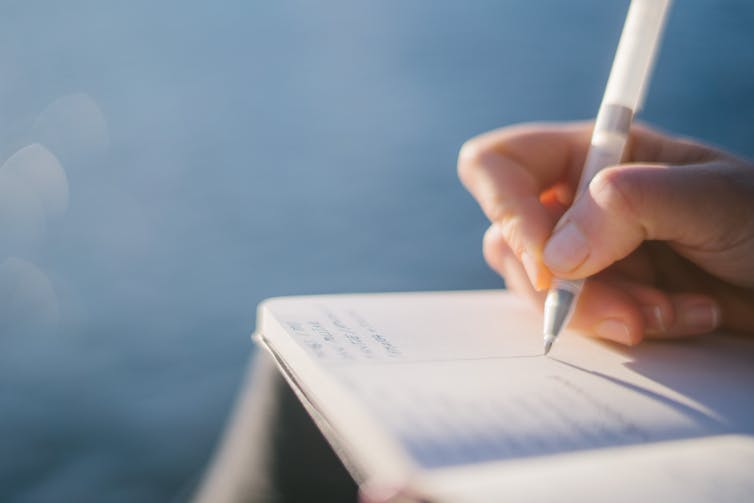
Writing is a way of thinking and doing. AscentXmedia/iStock via Getty Images Plus
Emily Ronay Johnston, University of California, Merced

Ordinary and universal, the act of writing changes the brain. From dashing off a heated text message to composing an op-ed, writing allows you to, at once, name your pain and create distance from it. Writing can shift your mental state from overwhelm and despair to grounded clarity — a shift that reflects resilience.

Psychology, the media and the wellness industry shape public perceptions of resilience: Social scientists study it, journalists celebrate it, and wellness brands sell it.

They all tell a similar story: Resilience is an individual quality that people can strengthen with effort. The American Psychological Association defines resilience as an ongoing process of personal growth through life’s challenges. News headlines routinely praise individuals who refuse to give up or find silver linings in times of hardship. The wellness industry promotes relentless self-improvement as the path to resilience.

In my work as a professor of writing studies, I research how people use writing to navigate trauma and practice resilience. I have witnessed thousands of students turn to the written word to work through emotions and find a sense of belonging. Their writing habits suggest that writing fosters resilience. Insights from psychology and neuroscience can help explain how.

Writing rewires the brain

In the 1980s, psychologist James Pennebaker developed a therapeutic technique called expressive writing to help patients process trauma and psychological challenges. With this technique, continuously journaling about something painful helps create mental distance from the experience and eases its cognitive load.

In other words, externalizing emotional distress through writing fosters safety. Expressive writing turns pain into a metaphorical book on a shelf, ready to be reopened with intention. It signals the brain, “You don’t need to carry this anymore.”
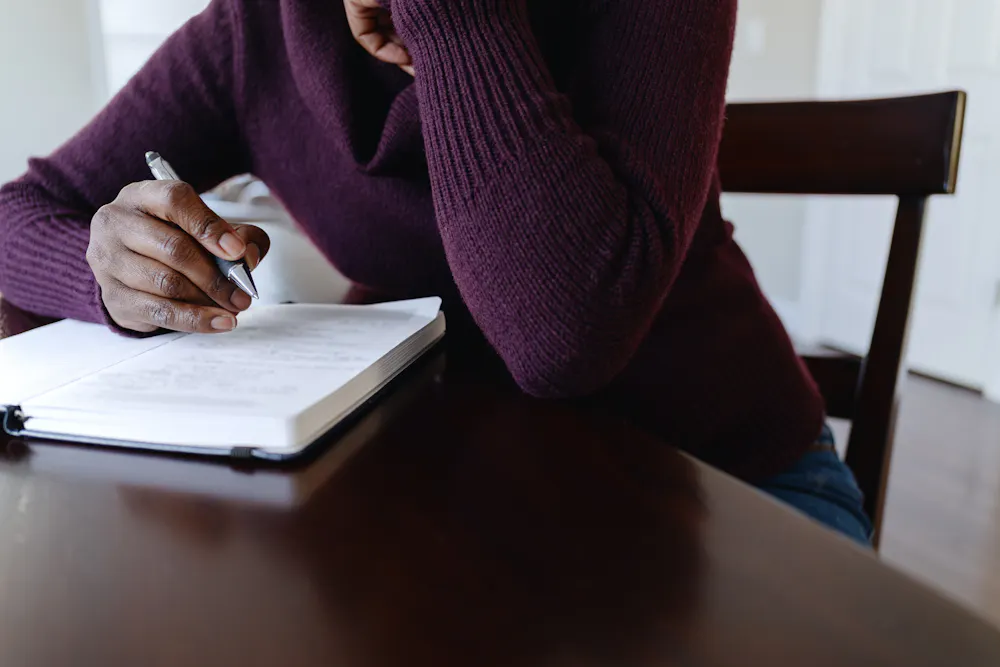
Person sitting at a table writing in a notebook
Sometimes you can write your way through difficult emotions. Grace Cary/Moment via Getty Images

Translating emotions and thoughts into words on paper is a complex mental task. It involves retrieving memories and planning what to do with them, engaging brain areas associated with memory and decision-making. It also involves putting those memories into language, activating the brain’s visual and motor systems.

Writing things down supports memory consolidation — the brain’s conversion of short-term memories into long-term ones. The process of integration makes it possible for people to reframe painful experiences and manage their emotions. In essence, writing can help free the mind to be in the here and now.

Taking action through writing

The state of presence that writing can elicit is not just an abstract feeling; it reflects complex activity in the nervous system.

Brain imaging studies show that putting feelings into words helps regulate emotions. Labeling emotions — whether through expletives and emojis or carefully chosen words — has multiple benefits. It calms the amygdala, a cluster of neurons that detects threat and triggers the fear response: fight, flight, freeze or fawn. It also engages the prefrontal cortex, a part of the brain that supports goal-setting and problem-solving.

In other words, the simple act of naming your emotions can help you shift from reaction to response. Instead of identifying with your feelings and mistaking them for facts, writing can help you simply become aware of what’s arising and prepare for deliberate action.

Even mundane writing tasks like making a to-do list stimulate parts of the brain involved in reasoning and decision-making, helping you regain focus.

Making meaning through writing

Monday, November 4, 2024

NaNoWriMo Thoughts

National Novel Writing Month is upon us. It's an international month-long event in which
folks pound out the first draft of a novel, posting the progress, getting lots of cheers every step of the way, and exchanging writing advice. Lots of friends will be doing it, many of them regular participants.

Alas, or perhaps not alas, not me.

I always have specific reasons. This year, I'm very close to finishing a revision of an on-spec novel that I've been working on for some years now, in the time gaps between contracted projects. I'm on the brink of the climactic scene, which spans 4 or 5 chapters and brings together everything that has gone before with a bang and a few nifty twists. If I nail it, the book works. Needless to say, this book not only haunts my every waking hour but has inveigled itself into my dreams. Not the story, mind you -- the writing and revising of it.

I began this book back in 2013 on a lark, one of those what-if ideas that just takes off on its own. It had been a long time since I'd embarked upon an unoutlined, unplanned, seat-of-the-pants story, especially one of novel length. I had not realized how much my creative spirit needed what I call taking a flying leap off the cliff of reality. Working on my netbook, I continued the draft while taking care of my best friend as she died of cancer. The story, with all its open possibilities -- and it had quite a few surprises for me -- gave me an emotional refuge so that I could return, "batteries recharged," to be present with my friend and her family.

Am I going to set this aside and lose all the momentum I've regained during this revision?

Friday, August 2, 2024

Baycon 2024 Report


Baycon is my local science fiction convention and I’ve been attending it, more or less regularly, since the 1990s. It’s moved from one hotel and city to another over the years and I have followed, “as the tail follows the dog.” My attendance came to a screeching halt in 2020 with the pandemic. The last convention I attended in person was FogCon in February of that year. We knew that a nasty virus was afoot but nobody wore masks. We “elbow-bumped” instead of hugging. If anyone got sick, I never heard. Then came the lockdown, as we called it. Conventions switched to virtual attendance. Althought I’m a somewhat slow adopted or tech, I’d become used to video chatting back in 2013, when I took care of my best friend in a different state while she was dying of cancer. My husband and I stayed in touch (via Skype, if I remember correctly). Then when my younger daughter attended medical school on the other side of the country, we visited by video chat regularly. She moved back to this area for her residency. Her final year was 2020, during which her regular service rotations were replaced by caring for dying Covid patients. Needless to say, I became quite cautious about my exposure. So even when conventions began to move from virtual-only to hybrid to in-person, I reconnected slowly. Even when I was ready to attend a convention in person (2023, which shows you how long it took me), armed with masks, hand sanitizer, and rapid tests, the universe conspired to jinx my plans. It was hard. I missed my friends and all the chance encounters and spontaneous expressions of community. All this is a prelude to my first successful return to in-person conventions.

Baycon programming had asked potential panelists to suggest topics. Two of mine were accepted, including Writing Beyond Trauma. Here’s the description I wrote:

These are perilous times for many of us. As survivors or the loved ones of survivors, how has our experience affected us as writers? How do our stories transcend and heal? Escape? Educate our audience? Are there times when the pain is so great, the words simply will not come--what do we do when we have lost our voice and how do we use writing to regain it? In this panel, we will strive to listen respectfully and to leave time between each speaker to absorb more deeply what they have said.

Monday, May 20, 2024

[link] Art Holcomb on Steps Toward Becoming a Professional Writer

I knew Art Holcomb decades ago -- gosh, have we been around that long? -- and always respected his insight into writing and publishing. He's a guest blogger over at Larry Brooks's "Storyfix" and has some interesting things to say. He doesn't address how to write, but rather the equally important question of what attitudes and habits comprise a professional attitude.

My favorite is Don't Wait For Perfect. Perfect is the enemy of done. And it's also toxic to the creative space so many of us need -- the self-confidence to try new things, but the insecurity to look critically at what we've done. Being a writer (for me, anyway) is a high-wire act, holding that paradox. Perfectionism slams me into paralysis. I have to be willing to be incredibly imperfect in order to take the risks to be great.

Monday, January 29, 2024

When You Can't Write

For a long time, I used to joke that I couldn't afford writer's block. I began writing professionally when my first child was a baby and I learned to use very small amounts of time. This involved "pre-writing," going over the next scene in my mind (while doing stuff like washing the dishes) until I knew exactly how I wanted it to go; when I'd get a few minutes at the typewriter (no home computers yet), I'd write like mad. I always had a backlog of scenes and stories and whole books, screaming at me to be written. The bottleneck was the time in which to work on them.

I kept writing through all sorts of life events, some happy, others really awful and traumatic. Like many other writers, I used my work as escape, as solace, as a way of working through difficult situations and complex feelings. I shrouded myself with a sense of invulnerability: I could write my way through anything life threw at me!

Unfortunately, I was wrong.

I hit an immovable wall during a PTSD meltdown following the first parole hearing of the man who raped and murdered my mother. For weeks at a time, I battled flashbacks and nightmares. I couldn't eat, I couldn't sleep, and I couldn't stop crying. Also, I couldn't write. That creative paralysis added another dimension to the crisis. If I couldn't write, who was I? Where were my secret worlds, my journeys of spirit and heart where people healed and things got better? Gone...and I didn't know if I'd ever get them back.

I was fortunate to have a lot of help, professional and friendly, during those dark weeks and months, some of it from fellow writers. No pep talks, just friendship, constant and true. Eventually, as I recovered, I was able to return to fiction writing as well, although by then, I found myself a single working mom and had a new set of demands on my time.

Writers stop writing for all kinds of reasons. In my case, it was personal and emotional, part of a larger crisis. Other times, however, the well runs dry when the rest of life is going smoothly. Quite a few years ago, I ran into a writer I greatly admired (at an ABA convention), and I'd not seen anything from this writer in quite a few years. I introduced myself and asked when the next book would be coming out. Only when I saw the change in the writer's expression did I realize how difficult the subject was. I was probably the hundredth person that weekend to ask. (Eventually, this writer came out with several new books; I wonder now if the appearance at the ABA wasn't a way of trying to get the head back into writerly-space.)

Sometimes, a writer feels they've said everything they have to say. Or that one book or one series is it; there are no new worlds begging to be explored. They can rest on their laurels with a feeling of satisfaction and closure. For the rest of us, though, not writing is anywhere from excruciating to devastating.

I  think it's not at all helpful to try to "cheer up" a writer in the middle of a dry period. The specific reasons--creative paralysis, personal crisis, discouragement--vary so much. I think it's safe to say that each of us has to find our own way through. For me, it's helped immensely to know I'm not the only one to go through it--and that's the operational term "go through it." Come out the other side. Talk about what happened, in the hopes of being the light in the darkness for someone else.

Monday, January 8, 2024

Writer's Block: Lowering Standards?


Today's thoughts on writing arose from Sandra Tsing Loh's review of Battle Hymn of the Tiger Mother (Amy Chua, Penguin) (about which I may write a completely separate blog post) in the April 2011 Atlantic. Loh wrote:

I follow the old writer's chestnut: "When you face writer's block, just lower your standards and keep going."

Cute, I suppose, and encouraging in its own way, but I'm not sure I agree with the mindset. I had never heard such a thing, and I've been publishing professionally for over 30 years. Maybe it's the difference between mainstream writing (and the expectation of peerless prose?) and genre writing. Or that the mentors I've have and and the pros I hang out with have a more organic approach to writing, an appreciation for story-telling over meticulously "beautiful" language? Or has this writer never been truly blocked, only impatient and self-critical?


Whatever the reason for my not hearing this before, I find its underlying premise destructive: that writing (i.e., composing a first draft) must somehow embody one's highest literary standards. Not to put too fine a point on it, but this is nonsense! If you can just "carry on", what's going on isn't writer's block. It's elitist self-indulgent pifflebunk. If worrying about your "standards" interferes with the flow of your writing, then maybe you're trying to write and to critique yourself at the same time, and it might be better to get out of your own way and just write!

You can always edit and polish to your heart's content, but get the story down first.

For a long time in my early career, I wrote perfectly awful first drafts. I mean really bad in almost every sense -- except the passion I brought to them. Grammar, plot, characterization, prose style, you name it, I butchered it. As a consequence, I learned to revise with a vengeance. I learned that all of these things, these "literary standards" things, are fixable. The only thing that can't be changed is inserting "heart" into a story when it isn't there to begin with. (Or maybe some writers can do that, but I can't.) I'd a thousand times rather write--or read--a story with that core of fiery truth than with the most sophisticated technique in the world.

Monday, July 31, 2023

Writerly Support Goes Both Ways


Some years ago, I struck up a conversation with a young writer at a convention. (I love getting to know other writers, so this is not unusual for me.) One thing led to another, led to lunch, led to getting together on a regular basis, and led to frequently chatting online. I cheered her on as she had her first professional sale and then another, and then a cover story in a prestigious magazine. One of the gifts of such a relationship is not the support I receive from it, but the honor and joy of watching someone else come into her own as an artist, to celebrate her achievements. It's the opposite of Schadenfreude -- it's taking immense pleasure and pride in the success of someone you have come to care about.


I find such friendships invaluable, and even more so when they shift from "pro/newbie" to one of true peers. Although we may not be in the same place in terms of professional publication, we each bring a wealth of life experiences to the conversation. Often, critical skills develop faster than writing craft, so even a novice writer can provide invaluable feedback. Trust arises from recognition of each other's strengths.

This happened recently, when I was wrestling with the opening of a new novel. I typed "Chapter 1" and then stared at the blank screen. Everything I could come up with for a beginning sentence was -- to put it mildly, just awful. I wouldn't want to read a book that began that way. But because my friend and I were DMing and she often shares thoughts about her creative process and struggles with various aspects of storytelling in a very different style than mine, I felt safe with her. She agreed that my idea wasn't very entrancing (she was very nice about it, for she understands that beginnings are vulnerable times and that this is indeed a process, not the final copy on the editor's desk). Her support lightened the burden of "I'm totally useless and now everyone is going to find out; I'll never write another decent sentence in my life and I have no idea how to begin a novel!" which we both knew to be not true, but the sort of self-doubt that regularly assails writers of all skill levels.

Eventually, I calmed down enough to remember one of my tried and true techniques for coming up with titles. I write down every one I can think of, quite quickly so that I get through all the really stupid ones first. I give myself permission to be ridiculous -- and silly -- and quirky -- and by this time, I am usually generating stuff that has some potential. I did the same thing with opening lines, and before long I realized I'd become ensnared by one of my perennial challenges: wrong point of entry. By backing up (in this case) or leaping forward, I can find the place that clicks. 

I went to bed, having written a page or so, and woke up with: "Yes, and this other thing happens and then she gets thrown into jail (on page 2 or 3) and by the time she gets bailed out, her father has been brainwashed..." Okay, this has possibilities!

Thanks, dear friend, for cheering me on through the discouraging part!

Monday, July 24, 2023

Midwifing a Story: Beta Readers and Critiquers


A “story midwife” is someone whose insightful feedback helps the writer to make the story more fully what it is intended to be. A while ago, I wrote about Trusted Readers, the unsung heroes of this process. Sometimes they receive thanks in the Acknowledgements page of a novel, but rarely for a short story. Now let’s talk about more visible helpers: beta readers and critiquers.

Most of the time, there is little functional difference between beta readers and critiquers. Both read a story in draft form and respond with comments and analysis. Unlike a Trusted Reader, a beta reader or critiquer is usually either a writer or someone knowledgeable about the internal workings of fiction, like a professional editor. So the feedback may go more along the lines of technical criticism and less a generalized “this didn’t work for me.” A  beta reader acts like a Trusted Reader-with-expertise, whereas a critiquer focuses on pinpointing weaknesses and often suggesting solutions, many times in a workshop or other group setting. For this blog post, however, I’ll use the terms interchangeably.

Critiques often take place in a structured setting, such as a workshop. My first experiences with exchanging critiques were done through the Science Fiction and Fantasy Workshop, a by-mail-with-newsletter forum run by Kathleen Dalton-Woodbury (back in the 1970-90s or a little beyond, if I remember correctly). I’ve also attended ongoing face-to-face workshops, as well as weekend groups at conventions. All have involved both giving and receiving critiques. Like many writers, I have cultivated a small group of “go-to” beta readers. Although it’s often not stated explicitly, the understanding is that over the course of time, each of us will critique a story from the other. 

Monday, July 17, 2023

Write What You Love

Larry Brooks interviewed best-selling author Philip Margolin on his latest book and a bunch of related writerly topic. This comment from Margolin struck home for me.

Don’t try to figure out what you must write to get published or make the bestseller list; write something that excites you. If you look at most first novels, even ones that aren’t particularly good, they all have a certain energy that comes from a writer getting an idea that excites them.

I think this is right on target. If you look at what's hot now, you're looking into the past. A traditionally published book often takes about a year from its acceptance to its appearance in bookstores. Many times the lead time is longer. The manuscript must be edited and revised, copy-edited, and proofread. Cover art must be commissioned, sketches reviewed and approved, and cover designed. Sales teams need catalogs about six months in advance. That's not counting advance reading copies (ARCs) to review venues like Publisher's Weekly. Finally, the book must be printed and distributed so that it is available at your corner bookstore on or slightly before the release date.

Even with e-publishing, which does not require the long lead times for preparation and distribution of the physical book, there is a gap between the finished product (which hopefully has been through a similarly-rigorous process of editing and proofreading, not to mention cover art and design!) and the initial conception of the author -- the decision to write this particular book. Writers vary in how long it takes to write a novel. This involves not only the speed of creating that first draft but on how much revision the draft needs. And how committed we are to making each book the very best we can, which means both learning our craft and not turning out hastily-written slip-shod work. For most of us, care requires time.

So the ebook or print book you see in the stories may have taken anywhere from 6 months to 6 years in creation. Who wants to be that far behind the times? More to the point, who wants to spend that much of your writing career imitating what someone else was excited about 6 years ago?

Fads will come and go, tastes will change with the seasons. Publishers merge or fold and even more arise. Wonderful books receive lousy promotional support and fizzle. Mediocre ones catch the public's fancy and make pots of money. We as writers have zilch control over any of this. I truly believe that chasing the market is not only futile, but deadly to our creative lives.

The only way to have a satisfying career is to write what you love. It is not enough to guarantee commercial success, but without it, you might as well take a job as an accountant. The paycheck's a whole lot more reliable.


If you've enjoyed this essay on nourishing yourself as a writer, please check out my collection, Ink Dance: Essays on the Writing Life. It's filled with stories, advice, commiseration, and inspiration.

Wednesday, June 14, 2023

[Archives]: Mary Rosenblum on How To Handle Bad Reviews

In light of the recent story about an author who was dropped by her publisher after she engaged in a heated discussion with a reviewer, here are some thoughts from writer and teacher Mary Rosenblum (1952-2018), first published here in 2014 and still relevant.


How To Handle Bad Reviews
by Mary Rosenblum


Paul Klee
What do you do when you get a really nasty review?

You know, we don't teach writers about reviews and reviewers and we should. Everybody thinks of 'good' and 'bad' writing as a standard. If it's 'good' editors and readers will love it! If it's 'bad' nobody will publish the story and readers will hate it. Alas, that mean that many authors who had a really good story felt like failures when they couldn't sell it to a publisher, when it was a matter of simply not suiting the publisher's target audience. The quality of the book was excellent, the publisher felt it wouldn't get the huge numbers of sales they needed in order to show a profit.

Self-publishing has let authors take their stories directly to readers and they vote with their mouse-clicks. You either sell or you don't, but we all know that it's a bit of a slow process at first, that self-publishing is all about the long tail. Meaning your sales are probably not stellar at first, with only one or two books out. So, the feeling of 'success' or 'failure' gets put on hold. Gotta wait to see how many people like it…

Enter the reviewers.

We love Authority. Authorities Know A Lot. Authorities Pass Judgment and They Are Gods. Reviewers Are Authorities And Therefore, They Are Gods.

Really?

You know what? That has never ever ever been the case. Reviewers are people who are willing to read lots and lots of books quite quickly and write down a judgment about the quality of that book to meet a regular deadline. You know what skills are involved? You must be able to read and you must be able to write a relatively coherent commentary and -- most importantly -- do that on a daily, weekly, or monthly basis, reliably.

See anything missing? How about a 'standard of excellence' or some other measuring tool so that you can effectively winnow 'good' from 'bad'? Don't see one, do you? You can become a reviewer. You should become a reviewer. It's a great way to meet new potential fans. One of my clients, from prison, has become a regular reviewer for a large circulation magazine.

Reviewers express their opinions. Their opinions. Remember that lacking 'standard of excellence'? Keep it in mind here. Some reviewers only review books they like, others review books they don't like. And the reasons they don't like them may have nothing to do with lots of other people liking your book. Mr. Reviewer may hate cats and is disposed to pick holes in any story that features a cute cat as a player. So your cozy mystery with the Miss Marple type sleuth who owns a cat gets picked to pieces. Will Mr. Reviewer come out and say 'I hate stories with cats'? No, of course not. How unprofessional! But he got even with you for putting that silly feline in there, didn't he? He called your cozy mystery weak, with an obvious ending.

And it really isn't weak and most readers are surprised by your clever ending.

Should you slit your wrists?

Monday, October 17, 2022

Proofreading The Children of Kings

Here's an image from late 2012. Cleopatra left us the next year at the ripe old age of 20.

Here I am, complete with Cat Muse, working my way through page proofs of The Children of Kings.

Cleopatra is almost 20 years old, and I've had her since she was 8 weeks. She's moving very slowly these days but still loves to curl up with me while I work. She's so thin, I've covered her with the edge of the afghan for extra warmth.


Monday, October 10, 2022

Cat Rambo on Writing Euphoria and Multitasking


Cat Rambo is a wonderful writer and teacher. I reviewed her space opera, You Sexy Thing, here. She runs the Rambo Academy for Wayward Writers, which offers live and on-demand classes. And she's a nifty person. Best of all, I love the way she talks about the writing process. Here, in an article on multitasking from the SFWA blog, she nails the description of the mental state when everything comes together and the world flow like silken fire. Whenever I see a depiction of a blocked writer (last night I watched the "Calliope" episode of the Netflix "The Sandman" series), I cringe. Yes, we go through fallow periods, frustration, and emptiness. But most working writers find strategies to get around, over, or through those blocks because there's nothing like a writer's high.

Here's Cat's description:
You start putting words on the page, and if you’re lucky, you hit the flow, that happy stream of words where you are writing and simultaneously entertaining yourself, discovering what happens next, where the world falls away and all you are doing and thinking about is writing. A state of intense, focused concentration that feels wonderful, because you are simultaneously challenged and exercising competency, constantly rising to that challenge and succeeding. [bold mine]

That’s one of the happiest states for a writer, and one that we chase. And if we want to hit it, we need to get rid of distractions. Multitasking is such a distraction, taking up a little bit of bandwidth in order to keep tabs on that task or other tasks and tracking time. Multitasking is not compatible with things that require concentration and time.

Monday, February 7, 2022

ARCHIVES Northlight: Evolving a Novel


After I submitted Jaydium, which was to become my first published novel, I began work right away on my next project. Or rather, I took a look at all the ideas and characters which were screaming inside my skull to be made into stories and tried to decide which one would cause me the most anguish if I didn't work on it first. High on my list was to rewrite the last novel I'd written before Jaydium. It had received careful attention, not to mention three single-spaced pages of critical feedback, from the editor who would later buy Jaydium.

I felt that if an editor had taken that much time and trouble with the book, there was something of value, something that perhaps I was now a good enough writer to bring out fully.

The book's working title was Weiremaster, and it was based on the world of my very first professional short story, "Imperatrix", which appeared in the debut Sword & Sorceress anthology. Weires are bipedal ape-like creatures, seven-feet tall, fanged, silver-furred, immensely powerful and receptively telepathic. In the world of "Imperatrix," they obey people of imperial blood. For the purposes of that short story, no further explanation was needed.

Now, years later, my world-building had matured. I wanted to know how these creatures had come into a human world, how the control worked, and how the dynastic characteristic had been established. I concocted an adventure which would lead my hero into the world of the Weires and back home again, changed. He would carry me -- and the reader -- along with him, a classical hero-quest. 

Monday, December 6, 2021

I Failed To Save That Chapter: What To Do When You've Lost Your Work

Recently a friend reached out to me when a computer crash resulted in the loss of several weeks'
writing. Here's how I responded.

What a colossal bummer!! There's no getting around how frustrating and just plain maddening it is to lose work. I used to do that with some regularity back in the era when I had to manually save everything to disk/ette. I still have a 5 1/4" floppy that no one can read because of the misalignment of the drive when I saved it -- that I am sure contains brilliant and irreproducible words. And I just did it last year by overwriting a chapter and saving it in the cloud.

So, having been around the block on losing work enough times I know a couple of things.
One, as I began with, is that I'm going to feel wretched and desperate and aggravated no matter what I tell myself.

Two, THIS WILL PASS. Two sub-two, I won't be ready to rewrite until I am ready. Sometimes that's an antidote to Great Flaming Balls of Upset, but more often I need to go away and calm down. Do something else, like making bread by hand or chopping wood or throwing a ball for the dog. And wait for words to start coming again. That could be remembering how I started or a detail I liked. Sometimes I can re-build around that, but more often it's just a starting place.

Sometimes I'll try to recreate what I've written but it's flat, like a xerox of a carbon copy. For some, I suspect, it's better to just start fresh and not try to recreate, but mostly for me I need an entry point (think of me as a sperm cell, frantically trying to find a way into the story ovum) and then at some point I'll clear away the scaffolding.

Telling myself that the rewritten prose will be strong isn't very helpful when I'm still raging. As a matter of fact, it's dubiously helpful except in retrospect when I'm finished. 

Another thing I've learned is that if I can find a way to lighten up, I'll get through the Argh stage sooner. It really is awful, but it's survivable. If you can find a way through it that results in a funny story to share with fellow writers, so much the better.

Monday, November 1, 2021

A Few Thoughts on Technology and Transitions

It’s always amazing and heartening how much inspiration we can draw from the next

generation, whether they are our own children or someone else’s. In my personal life, my younger daughter dragged me, kicking and screaming, into the world of social media, into getting my first stupidphone, and later into video chatting (during her  years of medical school on the other side of the country). Now these technologies are part of my everyday and work life. They've saved my sanity during the pandemic. 

I think it’s good to keep learning new things, to use our minds and bodies in different ways. One of the challenges of these new computer-based technologies is that they require us to use different methods of thought. The transition, for example, from keyboard-based word processing programs (like WordStar for DOS, the one I first used) to graphics-based (Windows) programs entailed a different logic and hand coordination. And both of them are a far cry from the typewriter I used to write my first published stories.

My very first stories (actually, my first umpteen attempts at novels) were written by hand in composition books or on scratch paper. I remember reading an interview with the British mystery writer Dick Francis, in which he described writing in ink in composition books (and that it had never occurred to him that a story, once written, could be revised!) so the method is definitely a time-honored one. Once I learned to type (in high school, on those really heavy manual typewriters) that became my preferred method, although when my children were small, I always carried a spiral-bound notebook on which to work on the Story of the Day in odd moments. Retyping a revision was a major chore, since I had to do it myself. I became expert in the application of white correction fluid. At least carbon copies were no longer necessary, but I had to take my finished manuscript to a copy shop because in those days no one owned a home copier.

I am of several minds about whether the ease of making changes as I go, being able to print out a manuscript at any stage, and so forth, have really changed how I write. I love the saying that the most important word processor is your brain. Perhaps I splat over the page, as it were, more spontaneously when I use a computer just because it’s so easy to tidy up my prose later. 
That can be a good thing as I follow whatever wacky idea pops into my mind. Some of them are truly best expunged but others are quite juicy. In some ways I am more focused now than in 30 or 40 years ago; I know much more about how to put a story together, even if it isn’t one I’ve outlined.

Having multiple writing media available to me is a great thing. I often go back and forth when I’m stuck, especially between dictating and typing or typing and longhand. Dictation using voice recognition software is especially great for dialog or speeches (can you see me acting out the parts of the various characters?) Just as we don’t all write in the same way, I don’t write in the same way all the time. Sometimes words flow and then I want the medium that allows me to best keep up with them. But other times I’m stuck (or sulky, or distracted, or tired) and switching can help get things rolling again.

In the end, though, the only version that matters is the one in the hands of the reader.

Monday, October 18, 2021

Do You Outline Your Novel? Should You?


Photo by Cleo Sanda
It cannot be repeated often enough that there is no single right way to write a novel (or to compose a symphony or design a house). All these artistic endeavors require certain elements (plot, characters, tension rising to a climax, or motif and variations, harmony, contrast, or foundation, walls, plumbing, etc.) They vary in the point in the creative process at which those crucial elements must be in place, of course. Within those parameters, there’s a great deal of flexibility that allows for individual differences. What matters is not when a writer nails down the turning points, but that they are present and in balance with the rest of the book when it ends on the editor’s desk.
Many writers attempt their first novels by the “seat-of-the-pants” method, that is, writing whatever pops into their heads. Sometimes they end up with dead ends (disguised as “writer’s block”) and don’t finish the work. Other times, they do finish, only to discover (either through their own perceptions or feedback from others) that the book has significant problems. So they write another draft and go through the same process until either the story works or they become so frustrated they give up, or they refuse to accept further critiques and self-publish it.

There’s nothing inherently wrong with such a spontaneous approach to the first draft. A good deal of the pleasure of writing is in discovery, in not knowing what will come next as the adventure unfolds. This is how children play. It does require a separate editorial, self-critical phase, at least for most of us. That’s neither good nor bad, it’s just part of the process. If you want to “pants” your first draft, you accept that you’re going to have to revise. Maybe a little, maybe a lot. Some writers loathe revision. I happen to love it.

At some point, it occurs to many of us that if we maybe thought about what was going to happen in our novel and how we were going to portray it, that we might save ourselves a bit of revision time. We might even jot down a few notes, reminding ourselves that this is just a tentative sketch and that nothing is carved in granite. We may and most certainly do change our minds when we discover that the actual story has diverged significantly from our strategy. I’ve been known to rework my notes, negotiating the borderlands between spontaneous writing and ill-thought-out plan.

Monday, August 16, 2021

#Darkover Edits!


I just received editorial comments and a marked-up manuscript of The Laran Gambit from the editor. It's such a joy to work with a professional who "gets it" and offers intelligent, insightful feedback.

Next comes the process of working with the notes to formulate a revision plan. Yes, there is such a thing! Every author approaches revision a bit differently, and in my experience every book requires me to approach it from a slightly different angle. Sometimes the only way to grapple with a structural flaw is to take the whole thing apart, rewrite entire sections, and then put them back together in a different order. Think of it like a Christmas tree, where you're going to keep only half the ornaments but must replace the others as well as the tree itself . That pine tree just won't do—we need a noble fir! 

For other books, the basic structure or armature is sound but all the ornaments and branches are out of balance. There may be problems in pacing, for example, or characters that need to be more fully developed.

The first step is to read through the notes not once but several times, deciding firstly what comments are spot-on, which ones miss the mark—revealing how I failed to convince even a careful reader—which ones I have questions about, and so forth. From there, I make a problem list. By this time, it's usually clear how much rewriting (as opposed to tidying up, minor shifting around, tightening, emphasizing, weaving in themes, etc.) I'll have to do. Since it isn't a good use to time to just dive in, willy-nilly, I also create a priority list or diagram, sometimes a flow chart. Novels can be like spiderwebs, where a tug on one thread affects the whole. Rather than have to go through multiple rounds of revision, I develop a sense of the order of changes. That said, I usually do a round of revisions and then a "jeweler's polish" read-through to spot typos and inconsistencies introduced by the changes.

I love to revise and often fine myself immersed in it for long periods of time. This is a good thing because it involves keeping the entire story in mind—all 100,000-150,000 words (which is my typical novel length) of it.

Stay tuned!

Monday, July 12, 2021

Career Chat: Writing Progress Goals


One of the most common questions I get asked is how I schedule my writing time. Non-writers often think we either write only when the muse strikes (and then, accompanied by quantities of alcohol, swathed in tobacco or other botanical smoke, and living in the most depressing garret imaginable, surrounded by the wreckage of countless relationships) – or we get up at 7, sit down at the computer/typewriter at 9, take a one-hour lunch break at noon, and work steadily  until 5. I am quite sure there are writers who do follow those schedules, but I’m not one of them.

 Some writers need long stretches of time to dig deep into their stories. I’m not one of them, either. I’m a slow-and-steady plodder. There’s nothing right or wrong about either way; each writer discovers what’s right for them. So the following comes from my own experience.

If I’m going to write a novel and a couple of short stories every year (or two novels in 18 months), I need to write consistently, especially when I’m in the early drafting stages. All bets are off when I’m writing proposals, rewriting, or revising to editorial order. Most of the time, I find daily goals helpful, so long as they are achievable. I don’t find it at all supportive to post my progress in terms of words of pages. One writer of my acquaintance used to post not only words written but anti-words; words the writer had deleted. I like that the writer acknowledged that not all progress can be measured by the total number of words.

A better goal for me is to write well.

Monday, May 24, 2021

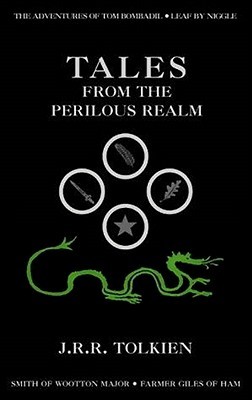
J. R. R. Tolkien on Fantasy

A lovely quote, worth re-reading over time:

Recovery (which includes return and renewal of health) is a re-gaining—regaining of a clear view. I do not say “seeing things as they are” and involve myself with the philosophers, though I might venture to say “seeing things as we are (or were) meant to see them”—as things apart from ourselves. We need, in any case, to clean our windows; so that the things seen clearly may be freed from the drab blur of triteness or familiarity—from possessiveness. Of all faces those of our familiares are the ones both most difficult to play fantastic tricks with, and most difficult really to see with fresh attention, perceiving their likeness and unlikeness: that they are faces, and yet unique faces. This triteness is really the penalty of “appropriation”: the things that are trite, or (in a bad sense) familiar, are the things that we have appropriated, legally or mentally. We say we know them. They have become like the things which once attracted us by their glitter, or their colour, or their shape, and we laid hands on them, and then locked them in our hoard, acquired them, and acquiring ceased to look at them.
[…]
Creative fantasy, because it is mainly trying to do something else (make something new), may open your hoard and let all the locked things fly away like cage-birds.

The whole article is here.

Monday, November 27, 2017

Auntie Deborah Holds Forth on Writing Topics

Q: Can I learn to write novels from movies? If so, which movies?

A: Rather than specific movies, watch those director’s commentaries in which the process of story construction is discussed. For example, in the extended DVD editions of The Lord of the Rings, Peter Jackson and the writers talk about the decisions they made in adapting the books for film; these segments are filled with insights into how stories work (on film) that also apply to prose narrative.

My second suggestion is to read some of the excellent books on screenplay writing, paying particular attention to the 3-act structure and the way tension is created, built, and resolved. With only dialog and action as tools, the script writer has to use both to excellent advantage, something we novelists could learn much from.


Q: Do you write stories longhand or on the computer, and why?

A: I do most of my drafting on computer (used to be typewriter, back in the day) because I want to write quickly. I don’t care if it’s rough, I just want to get the basic elements of the story down. To promote the free flow of ideas, I need to get my internal critic offline. Longhand comes in when I’m stuck or revising and then the slower pace helps me to focus on nuance and detail. Then I want and need all my critical faculties; I’m usually either trouble-shooting, adding layers of resonance and depth, or filling in crucial gaps.

In the past, I wrote extensively in notebooks by hand when I wasn’t at home — waiting for appointments, while my kids were in gym class, at the airport, etc.; this was in the days before laptops/netbooks/tablets. Now it’s just as easy to stick my Chromebook in a bag and go; it’s light enough to carry easily. The increased productivity from keyboard vs paper makes it worthwhile.

Very occasionally I’ll switch to dictation (Google Voice, which usually drives me a bit nuts because it doesn’t learn), especially for dialog, but I find the differences difficult. It’s an added if less desirable tool to help me through those stuck places.


Q: I'm too upset to write. Help!

A: Running away to a world inside our minds has long been a strategy for writers. In fact, daydreaming as children was how many of us got started as storytellers. So one way to look at your question is to just let yourself escape and pay attention to what gives you comfort, hope, and courage. That’s where the passion in your story will be.

Another aspect, one I have struggled with, is how to focus enough to write when in the midst of a crisis. Again, the strategy is to do what you can, even if it’s not the project at hand. Have faith that as you allow the story to lead you through survival and recovery, you will regain the ability to concentrate. You may find, however, that coping with those life problems changes what you want to write. If you have a contract or commitment to produce something that no longer speaks to you, you will have to behave like an adult professional and renegotiate. But if your book is “on spec,” it’s entirely possible that the best story for you to work on is one that emerges from your struggles, not something initially conceived before those problems descended upon you.


Q: What are the essential elements of a fantasy novel?

A: A fantasy universe requires the same essential elements in any good story: vivid world-building, characters that are complex and fascinating, a sympathetic protagonist with a worthy goal who faces both internal and external obstacles, and so forth. The difference between mainstream (or science fiction) is that fantasy as a genre allows you to bend the laws of physics as we know them. Whether that means a well-thought-out system of magic, the existence of elves or unicorns or any other mythical being, or any other element, it must be an integral part not only of the world but of the plot. It doesn’t help to have a dragon as your fantastical element if it never puts in an appearance, or a vampire that exists only in stories.

Sometimes stories get marketed as fantasy when they are in reality perfectly non-magical stories set in an alternate-medieval world. Fantasy does not necessarily mean medieval! Some of the best fantasy literature takes place in modern settings (or future, or Renaissance…). And let’s not forget the wealth of cultures that are not Western European! There’s a whole world of folklore and history, not to mention fascinating characters and traditions, out there.

(My epic fantasy trilogy, The Seven-Petaled Shield, was based on the conflict between the Romans and Scythians, with added cultures derived from the nomadic horse peoples of Central Asia, the Phoenicians, and the ancient kingdom of Judea. Each of these has its own relationship to the land/sea, and its own magic derived from that bond.)


Q: How do you know where to end a chapter?

A: My chapter divisions arise naturally from the story itself. Just as the entire novel has an inciting event rising tension, reversals, climax, etc., so does each scene, although of course the resolution of tension is partial if at all, so that it builds over the course of the entire book. A chapter may contain one or more scenes, but has the same overall “arc” of drama. Some may lend themselves naturally to a twist or cliff-hanger at the end, but this is not a good thing to do consistently (you will aggravate your reader!) The end of the chapter, like the end of the scene, can be a transition, “a lick and a promise” of more adventures to come.

When writing a rough draft, I set up one chapter per file, with a numbering system that indicates also which draft it is. I don’t combine them into one “novel-length” file until I’m ready to sent it out (either to a beta reader or my editor). (Example: 1NOVEL.03}

Occasionally, when revising I will divide chapters as I add and develop material, and even less occasionally I will combine them if I find myself ruthlessly pruning “flab.” I don’t try to make them the same length within a book or from one project to the next. They are the length they need to be.