Showing posts with label writers supporting writers. Show all posts

Monday, August 1, 2022

Auntie Deborah is Still Giving Writing Advice

Dear Auntie Deborah...

I wrote a story using another person's characters, even though they said not to. Can I publish it since their book isn't copyrighted?

If the author has published their story in any form, it’s copyrighted. That, however, is beside the point. It’s just plain unethical to do what you suggest. It’s a great way to make enemies in your genre and create a horrible reputation that will haunt your career, assuming you still have one after such a bonehead move.

Create your own characters. Write your own stories. Treat your colleagues and their work the way you would like to be treated. Pursue your career with integrity and generosity.


Are self-published books inferior to professionally published books?

It all depends.

Not that long ago, self-published or vanity press books were assumed to be of inferior quality, that is to say, unpublishable by “real” (traditional) publishers. There were exceptions, of course, but that was the conventional wisdom.

Today, however, many self-published books go through the same rigorous editing and quality standards as traditionally published books. Some genres, like romance, are especially friendly toward self-pubbed projects.

With modern publishing technology (ebooks, POD printing), there are many reasons why a pro-level author might want to self-publish, including:
  • Niche projects, like memoirs or family histories.
  • Series that were dropped by trad publishers but that have an enthusiastic fan following.
  • Well-written books that don’t fit into the NY “best-seller” model.
  • OP (out-of-print, rights reverted to author) backlist.
  • Great books that straddle genres or otherwise confuse traditional marketing/sales departments.
That said, many self-published books are dreadful. They aren’t good enough to attract the interest of an agent or publisher to begin with, they aren’t professionally edited or proofread, the covers are amateurish, and so on. The challenge for the reader is to sort out those books that are truly a wonderful reading experience.

Does reaching a certain number of reviews increase your indie sales?


The short answer is that nobody knows. Theories abound, usually to line the pockets of the “experts.” “Gaming” the Amazon system is a losing proposition. What might have been true 2 years or 6 months or last week no longer works — because thousands of self-published authors have tried it, thereby flooding the system with meaningless tweaks.

If you want to increase your sales, write a great book. Publicize it. Get stellar reviews on Publishers Weekly and the like. Write an even better book. Rinse and repeat. Even then, there are no guarantees when it comes to sales, but you’ll have the satisfaction of writing really good books.

Monday, December 6, 2021

I Failed To Save That Chapter: What To Do When You've Lost Your Work

Recently a friend reached out to me when a computer crash resulted in the loss of several weeks'
writing. Here's how I responded.

What a colossal bummer!! There's no getting around how frustrating and just plain maddening it is to lose work. I used to do that with some regularity back in the era when I had to manually save everything to disk/ette. I still have a 5 1/4" floppy that no one can read because of the misalignment of the drive when I saved it -- that I am sure contains brilliant and irreproducible words. And I just did it last year by overwriting a chapter and saving it in the cloud.

So, having been around the block on losing work enough times I know a couple of things.
One, as I began with, is that I'm going to feel wretched and desperate and aggravated no matter what I tell myself.

Two, THIS WILL PASS. Two sub-two, I won't be ready to rewrite until I am ready. Sometimes that's an antidote to Great Flaming Balls of Upset, but more often I need to go away and calm down. Do something else, like making bread by hand or chopping wood or throwing a ball for the dog. And wait for words to start coming again. That could be remembering how I started or a detail I liked. Sometimes I can re-build around that, but more often it's just a starting place.

Sometimes I'll try to recreate what I've written but it's flat, like a xerox of a carbon copy. For some, I suspect, it's better to just start fresh and not try to recreate, but mostly for me I need an entry point (think of me as a sperm cell, frantically trying to find a way into the story ovum) and then at some point I'll clear away the scaffolding.

Telling myself that the rewritten prose will be strong isn't very helpful when I'm still raging. As a matter of fact, it's dubiously helpful except in retrospect when I'm finished. 

Another thing I've learned is that if I can find a way to lighten up, I'll get through the Argh stage sooner. It really is awful, but it's survivable. If you can find a way through it that results in a funny story to share with fellow writers, so much the better.

Friday, September 30, 2016

Supporting a New Writer 5: Hope Heals

Barb Caffrey: The main reason I restarted my writing despite a number of life challenges (including
the loss of my husband Michael in 2004) is because I knew I needed to do it. Sometimes, writing can be stress relief; it allows you to step outside of your own head for a while, and do something else other than grieve -- do something else other than concentrate on all the problems you cannot solve.

It allows you to do something positive. Something meaningful. Something that you can point to later, and ask yourself, "I did that?"

Granted, at the time, I didn't realize at all this was why I was trying so hard to write. I looked at it as an expression of creativity (which, of course, it is); I also saw it as my way to strike back against the darkness of entropy, and of course as a way to continue on with what my husband (also a writer) and I had done all our lives.

In short, writing allowed me to feel more like myself, rather than the person I had unwittingly become after my husband died so suddenly. I didn't like feeling like an open wound all the time; I wanted to heal.

Writing helped me heal.

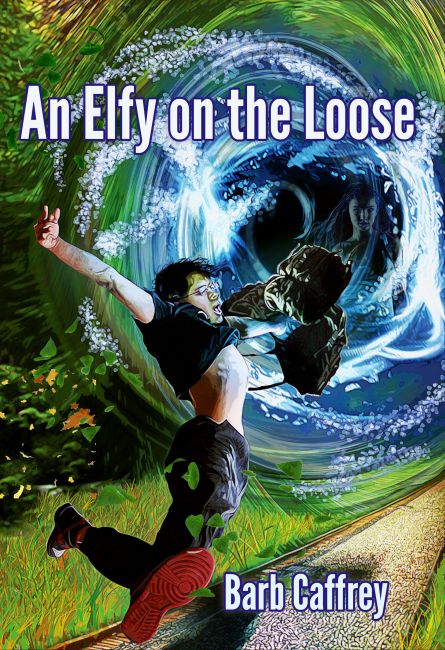
Barb Caffrey has written three novels, An Elfy On The Loose (2014), A Little Elfy in Big Trouble (2015), and Changing Faces (forthcoming), and is the co-writer of the Adventures of Joey Maverick series (with late husband Michael B. Caffrey) Previous stories and poems have appeared in Stars Of Darkover, First Contact Café, How Beer Saved The World, Bearing North, And Bedlam's Edge (with Michael B. Caffrey).


From Wendy, for whom this blog series was created:

Dreams are possible....

Hope lives....

If you take action....

If you reach out with an earnest, heartfelt plea....

Good people will respond.

I do not take this creative journey alone. What a comfort this realization has been to me.  I am encouraged and deeply grateful for the wonderful words of wisdom you have all shared with me.

I am writing again. Perhaps in fits and starts, but still putting words to electronic paper on a daily basis. 

I am starting to believe in myself again, to see myself as a creative spirit with something to say.

My words matter. My words can entertain and enlighten. I have a voice. All of you have helped me find that voice again.

Thank you!


Friday, September 23, 2016

Supporting A New Writer 4: Where We Go from Here

Each of us has a tale to tell about struggling to start or re-start a writing career. Here's the background on this project, and two responses below.

Recently, I received this letter from a fan with whom I’d been corresponding. It spoke deeply to me, and rather than answer it alone, I asked some of my writer friends to join in a series of round table blogs on the issues raised. If you’ve been there, too, I hope you’ll follow along and offer your own wisdom.

I’ve been trying to reconnect with writing friends after a hiatus from the creative life. I’ve spent the past year or so taking care of my mom and working to pay the bills. Mom passed away in October. When your last parent passes away, it changes you in many ways. That foundation you always relied on — even as an adult — is gone for good. Whether you’re ready or not, you are truly on your own in the world and must somehow carry on without their nurturing presence. One of the most difficult aspects of my mother’s final days was the fact that she had so many regrets about life. She once had goals and dreams, but left them behind out of fear and a belief that these dreams were just not possible. I’m 54 years old. More than half of my life is over. Writing has been a dream/goal of mine since childhood. My mom was the only one who believed in me. I don’t want to leave this world regretting the fact that I never pursued this dream to the fullest. To be honest, my writing “career” never took off. I let fear, doubt and the negativity of others keep me from my dreams. I want so much to be brave, to take risks with my creative life. I truly wish for a group of fellow writers who are willing to give me the encouragement and support I need to write with my heart and soul, to grow as a writer and a human being. And I want to be a support for others as well. How do I get back into the writing life after leaving it on the back burner for so long?
Doranna Durgin:  I turned 56 on the very day my mom died just over a month ago.  Meanwhile my writing has floundered for years—damaged by experiences in traditional publishing, never quite reaching fruition in the first place because I was in a financially vulnerable situation where I didn’t dare take risks.  So I played nice.  Too nice.  Too much fear, too much doubt, and way too much negativity from outside sources.  Familiar, right? I was trying to please everyone else before I pleased the muse, knowing it and hoping for some sort of break that would allow me to return to the muse.  But instead of reaching a break, I hit a breaking point, and then…broke.  Now I’m looking at the journey back and not certain how to take it.


So where do we all go from here?

In this case, I hope knowing you’re not alone is of some solace.  Boy, you’re definitely not!  And to some extent, I think we all wish we were bigger, bolder, better when it comes to our writing.  To that same extent, I think having that desire is the critical part of writing.  How do we do anything but stagnate without it?  And just maybe the fact that we do have that ongoing need doesn’t mean we haven’t already been successful in many ways.  Don’t discount those successes!

More practically speaking, I’m finding that I need to give myself space while at the same time setting reachable goals.  For me, that means noodling on development in the background while working on production stuff and writing-related stuff in the foreground.  For you, those first steps might include finding community online and in person, but I have some hesitation about focusing on these as a starting place.  Writing comes from within, not without—and in my experience, outside influence is often about diluting, not enhancing, those pieces from within.

To that point, I’ve found a good book discussion group comprised of savvy readers and other writers to be an excellent place to practice critical thinking and to see how different writing is absorbed by different people…well, differently.  I see it as a way to immerse in the thought process without subjecting the muse to the push and pull of others’ thinking.

I think one key, as we seek growth, is to recognize the successes we have in fact had, and then to keep our specific goals in mind while making decisions about the future—which means taking the time to truly understand our goals in the first place.  So are the support groups and community part of the goal, or a way to reach the goal?  And what other ways can you reach the specific goal?

Either way, good luck—hope to see you there on the other side!


Doranna Durgin is an award-winning (Compton Crook--best first SF/F/H of the year) whose quirky spirit has led to an extensive and eclectic publishing journey across genres, across publishers, and across publishing lines.  Beyond that, she hangs around outside her Southwest mountain home with horse and highly accomplished competition dogs. She doesn't believe in mastering the beast within, but in channeling its power. For good or bad has yet to be decided...


Meg Mac Donald: On Starting Over:
Just write.

I know, I know.  That’s obvious.  I realize that it may be oversimplifying things, but it is true that the only way to begin again is to (simply) start doing it.  Anything.  Write that story idea, or outline—or even that one scene—that has been playing in your mind for years.  You know, the one about That Character when That Thing happened?  Yeah.  That one.  Jot it down.  Follow it as it begins to grow—give yourself permission to change it.  Keep writing.  If you write something, you have something to edit—or rewrite—later.  Worst case scenario?  You line the cat box with it and start something else.  Put aside any notion about it being perfect, or publishable, or even making the remote bit of sense.  It doesn’t have to.  What it has to do is give you something to work with.  Most of writing is rewriting and editing anyway.  Give yourself permission to make a literary mess if that’s what it takes to break the cycle of doubt that is keeping you from writing at all.

Friday, September 9, 2016

Supporting A New Writer 3: We've Been There

Recently, I received this letter from Wendy, a fan with whom I’d been corresponding. It spoke deeply to me, and rather than answer it alone, I asked some of my writer friends to join in a series of round table blogs on the issues raised. If you’ve been there, too, I hope you’ll follow along and offer your own wisdom.


I've been trying to reconnect with writing friends after a hiatus from the creative life. I've spent the past year or so taking care of my mom and working to pay the bills. Mom passed away in October.
When your last parent passes away, it changes you in many ways. That foundation you always relied on -- even as an adult -- is gone for good. Whether you're ready or not, you are truly on your own in the world and must somehow carry on without their nurturing presence. One of the most difficult aspects of my mother's final days was the fact that she had so many regrets about life. She once had goals and dreams, but left them behind out of fear and a belief that these dreams were just not possible.
I'm 54 years old. More than half of my life is over. Writing has been a dream/goal of mine since childhood. My mom was the only one who believed in me. I don't want to leave this world regretting the fact that I never pursued this dream to the fullest. To be honest, my writing "career" never took off. I let fear, doubt and the negativity of others keep me from my dreams. I want so much to be brave, to take risks with my creative life. I truly wish for a group of fellow writers who are willing to give me the encouragement and support I need to write with my heart and soul, to grow as a writer and a human being. And I want to be a support for others as well.

How do I get back into the writing life after leaving it on the back burner for so long?

Cynthia FeliceFilling the Giving Hole

My similar experience was long and arduous; each time I thought I was ready to pick up my writing career I discovered, painfully, I was so not ready. I went through years of bewildering anniversaries and finding ways to establish new normals for everyday life that re-establishing my writing life was always something I'd do tomorrow. It's different for everyone, so don't assume setbacks are failures. Your loss and mine were different, and that alone changes working through the loss. But when writing life did start working again, it was because I made myself find a listserv (actually several, but only one clicked for me) of writers who were working at their craft. Just checking in every day and lurking for a while helped me feel connected again to the familiar problems and worries writers have and need to discuss. Eventually I was "talking" again and involved, sharing my concerns and experience with other writers. No one understands writing life the way other writers do. Besides, what else are you going to do with all that tender care you've been giving to your loved one for years? I needed a place to put mine; maybe you do, too. Don't let not giving daily leave a hole in you.

Similarly, I attended the Pikes Peak Writer's Conference http://www.pikespeakwriters.com/ because it's well known for great organization and attracting the best speakers (heh, heh, and I'd been one of those speakers years earlier) and because it takes place in my back yard! It was a wonderful long weekend spent rubbing shoulders with like-minded folk and learning what had changed in the industry while I was away. There are other fine conferences and also very good writers workshops, but I have personal experience with this one, so am content to recommend it. Research carefully if you're tempted to plunk down the fee; not all are equal. You'll notice that I did not recommend a specific listserv; the one I favored no longer exists, but others are out there, and if the daily passive contact appeals to you, you will find them.

Good luck, Wendy!

Cynthia Felice writes science fiction novels, and occasionally writes short stories and articles. She
was a John W. Campbell Award nominee for her novel, Godsfire. Felice is a workshop enthusiast, including being an early Clarion “grad” and a frequent Milford attendee. Her experience includes managing technical editors, writers, and designing configuration control software, as well as writing and editing technical articles, essays, and documents, one of which received the Award for Outstanding Paper from the Society for Technical Communication. Cynthia Felice grew up in Chicago, and now lives with her husband on a ridge east of Colorado Springs overlooking the Front Range.

Deborah's note: Cynthia critiqued my very, very first attempt at a fantasy novel (1980?) with such kindness and insight that I am still writing!


Meg Mac Donald: Dear Wendy,

Your letter touched my heart in so many ways—and in so many ways, on so many levels, I could relate to what you were saying.  As will always be the case, we each have our own story—that moment, that feeling, that fear, that loss that seemed to take away the dream that we had nurtured from childhood on.  Those hurdles in life that seem insurmountable.  We are of an age, you and I.  No doubt we share many of the same memories about childhood pastimes, favorite books, iconic films, moments where planet Earth stopped turning to look to the moon…  What a glorious, bright future we were promised—especially for girls.  What a “brave new world” where we believed that if we dreamt it, we could achieve it.  No better time to be alive.  No better time to want to write science fiction and fantasy.  No better time.

Maybe every generation has that hope.  There’s something about our generation, though.  Something about promises that weren’t kept.  Something about the future not being what it looked like it should be.  Where did it go?  And we tried to hang onto the dreams and may have even had some luck.  Found those older and wiser to nurture us and lead the charge.  For all those that managed to keep going or never faced serious setbacks, there are probably far more whose lives became overwhelming.   In the midst of trying to plant that creative garden and keep it blooming, we grew up and life happened and the frailty of our own lives was realized in the frailty of our aging parents—or the deaths of friends and kin, or the trauma of war, or financial hardship, or personal trauma wearing a hundred different, dark cloaks.

Friday, September 2, 2016

Supporting A New Writer 2: Following The Dream

Recently, I received this letter from Wendy, a fan with whom I’d been corresponding. It spoke deeply to me, and rather than answer it alone, I asked some of my writer friends to join in a series of round table blogs on the issues raised. If you’ve been there, too, I hope you’ll follow along and offer your own wisdom.


I've been trying to reconnect with writing friends after a hiatus from the creative life. I've spent the past year or so taking care of my mom and working to pay the bills. Mom passed away in October.
When your last parent passes away, it changes you in many ways. That foundation you always relied on -- even as an adult -- is gone for good. Whether you're ready or not, you are truly on your own in the world and must somehow carry on without their nurturing presence. One of the most difficult aspects of my mother's final days was the fact that she had so many regrets about life. She once had goals and dreams, but left them behind out of fear and a belief that these dreams were just not possible.
I'm 54 years old. More than half of my life is over. Writing has been a dream/goal of mine since childhood. My mom was the only one who believed in me. I don't want to leave this world regretting the fact that I never pursued this dream to the fullest. To be honest, my writing "career" never took off. I let fear, doubt and the negativity of others keep me from my dreams. I want so much to be brave, to take risks with my creative life. I truly wish for a group of fellow writers who are willing to give me the encouragement and support I need to write with my heart and soul, to grow as a writer and a human being. And I want to be a support for others as well. How do I get back into the writing life after leaving it on the back burner for so long?
  Katharine Eliska Kimbriel: Do you want to write, or do you want to have written? Is it getting the story down on paper or computer that drives you, or the thought of who will receive the story? Is publishing critical? Are you looking at markets before you even write the tale?

Because these struggles can kill your muse. I wasted a lot of time, once NYC decided that the stories I wanted to tell were not viable, tossing them synopsis after synopsis, trying to get their interest. You don't have to deal with NYC at all, if you don't want to--self-publishing can be done, and done well, if you are willing to pay for good editing and cover art.

The best things I have ever written come when *I do not censor the Writer.* The first draft, you must tell your Editor Voice (and you have several) "There, there, you will get your chance to say something" and keep writing. The first draft of a story, you tell yourself the story. The second pass, you decide what you need to tell this story to other people. There's usually editing--few of us can write a first and second pass in one go.

Beware the Critic Voice. That is the voice of every slighting comment, every undermining statement, every spiteful word ever tossed your way. A strong and smart woman once told me, "The Critic is never you." But the Critic exists, even if no one has ever slammed your dreams of writing because you never whispered that dream aloud. It takes time to smash those slighting words down to dust, to weigh opposites in your hands and mash them together, halving their impact. But you can whittle down The Critic.

Most people I know who adore telling stories can't stop. When they *cannot* tell stories it triggers depression. Right now you are going through that huge transition (it just happened to me, too) where suddenly, at reunions, you are the oldest person in the room. Right there is a huge adjustment. Be gentle with yourself, ask your heart what it wants to write, and give yourself permission to write. That time is NEVER wasted. In my youth I would tell people "I have to work." I didn't say write, because it wasn't how I paid the rent, so they would say "You can do that after the movie, dinner, bike ride"--whatever.

It is for you. Women worldwide are told to put their heart on hold and take care of everyone and everything else. If you don't take something for your own heart, you will have nothing to give others. Take the writing. It may turn out to be something you can offer the world.

Katharine Eliska Kimbriel reinvents herself every decade or so. The one constant she has reached for in life is telling stories. “I’m interested in how people respond to choice. What is the metaphor for power, for choice? In SF it tends to be technology (good, bad and balanced) while in Fantasy the metaphor is magic – who has it, who wants or does not want it, what is done with it, and who/what the person or culture is after the dust has settled. A second metaphor, both grace note and foundation, is the need for and art of healing. Forthcoming stories will talk about new things that I’ve learned, and still hope to learn … with grace notes about betrayal, forgiveness, healing and second chances.” A Campbell Award nominee.


Irene Radford: For as long as I can remember my family told me that writing down my little stories was okay because I would learn to write well, a requirement for succeeding in the business world. Their ambition for me was to run the PTA. However, I mustn’t bother sharing my little stories with anyone because I could never succeed as a writer.

Period. End of conversation.

Except we kept having this conversation every time I got an idea for a new story or book or trilogy…

I’m not certain why my brain suddenly clicked into realizing that I can’t know I’ve failed until I try. It may have had something to do with my 10 year old son entering every mail-in contest the postman delivered. One of those contests was for Harlequin Romances. I won 4 free books every month for 3 months. Then of course I was expected be hooked and start paying for my book fix. But one of the option books I could order was “How to Write Romances for Love and Money.”

I tried it. Over the period of a couple of months I followed the guidelines and deconstructed several of my favorite romances. And then I wrote one. When I thought I was ready to submit I asked a friend of a friend about proper manuscript format. That person put me in touch with another friend of a friend who was active in Romance Writers of America.

I attended one workshop and went home to re-plot the book. The local chapter of RWA led me to a critique group. I re-wrote the book again and again until I submitted. And accumulated rejection after rejection.

At some point in this depressing process I discovered that not only did I need to try before I admitted failure: I had not failed until I gave up trying.

RWA and my critique group led me to an agent, and though we never sold that first romance, I found my voice in fantasy. And I succeeded. October 13, 1993 at 1:33 PM I received THE phone call, that DAW Books wanted to buy, not only the first book I had written for the fantasy market, but also 2 sequels.

Thirty-five books later I still haven’t found a reason to give up trying.

My few words of wisdom for those starting a writing career or re-starting one, is keep on trying. Apply butt to chair and hands to keyboard and keep writing. Five minutes a day, four pages a day, whatever works for your schedule. And keep on until there is nothing left inside you that demands to be written.

Then give it a rest for a bit until the words start bubbling out of you and write some more.


Irene Radford …aka P.R. Frost, aka C.F. Bentley, has been writing stories ever since she figured out
what a pencil was for. A member of an endangered species, a native Oregonian who lives in Oregon,
she and her husband make their home in Welches, Oregon, where deer, bears, coyotes, hawks, owls, and woodpeckers feed regularly on their back deck.

A museum trained historian, Phyllis Irene has spent many hours prowling pioneer cemeteries deepening her connections to the past. Raised in a military family, she grew up all over the US and learned early on that books are friends that don’t get left behind with a move. Her interests and reading range from ancient history, to spiritual meditations, to space stations, and a whole lot in between.

Friday, August 12, 2016

Supporting a New Writer 1: Introduction

Recently, I received this letter from Wendy, a fan with whom I’d been corresponding. It spoke deeply to me, and rather than answer it alone, I asked some of my writer friends to join in a series of round table blogs on the issues raised. If you’ve been there, too, I hope you’ll follow along and offer your own wisdom.

I've been trying to reconnect with writing friends after a hiatus from the creative life.  I've spent the past year or so taking care of my mom and working to pay the bills.  Mom passed away in October. 
When your last parent passes away, it changes you in many ways.  That foundation you always relied on -- even as an adult -- is gone for good.  Whether you're ready or not, you are truly on your own in the world and must somehow carry on without their nurturing presence.  One of the most difficult aspects of my mother's final days was the fact that she had so many regrets about life.  She once had goals and dreams, but left them behind out of fear and a belief that these dreams were just not possible.  
I'm 54 years old.  More than half of my life is over.  Writing has been a dream/goal of mine since childhood.  My mom was the only one who believed in me. I don't want to leave this world regretting the fact that I never pursued this dream to the fullest. To be honest, my writing "career" never took off.  I let fear, doubt and the negativity of others keep me from my dreams.  I want so much to be brave, to take risks with my creative life. I truly wish for a group of fellow writers who are willing to give me the encouragement and support I need to write with my heart and soul, to grow as a writer and a human being. And I want to be a support for others as well.  
How do I get back into the writing life after leaving it on the back burner for so long? 


Effie Seiberg: I hear you. Writing is such an inherently lonely business, spending that much time in your own head, that a good support group is critical. When I first started writing I went though wild mood swings ranging from "OMG this is the most hilarious thing ever" to "Why did I ever think I could English? This is total crap," and I began to fear that I wasn't emotionally stable enough to write. It was only after I found a community of supportive writers that I understood that this is just how writing works, and the only thing that improves is your ability to enjoy the highs and survive the lows. A good support group bolsters you through both.

Effie Seiberg is a fantasy and science fiction writer. Her stories can be found in the "Women Destroy
Science Fiction!" special edition of Lightspeed Magazine (winner of the 2015 British Fantasy Award for Best Anthology), Galaxy's Edge, Analog, Fireside Fiction, and PodCastle, amongst others. She is a graduate of Taos Toolbox 2013, a member of SFWA and Codex, and a reader at Tor.com. She lives in San Francisco, recently and upcoming (but not presently) near a giant sculpture of a pink bunny head with a skull in its mouth. She likes to make sculpted cakes and bad puns. You can follow her on twitter at @effies, or read more of her work at www.effieseiberg.com.


Barb Caffrey: For now, though...I can say this much to Wendy. It's never too late to do what you feel you must, as a creative artist. I have often felt like it's too late for me due to how my husband passed away suddenly; I'm now trying to carry on his work, and mine, and sometimes this seems like an overly heavy weight.

The important thing is that I'm doing it. No matter how long it takes, no matter what is up against me -- bad health or family health issues or foreclosures or anything -- I keep on working. Some days, all I can do is look at my works-in-progress and say, "Hmmm," and do a little fiddling but add nothing tangible. The next day, or maybe the day after that, the dam bursts and I have more new words again.

The most important thing you can do -- and it unfortunately is also the hardest -- is to believe in yourself, and that what you are doing is valuable. No matter what anyone else says, no matter what anyone else does, you are going to do what you feel you must.


I wish I had a better answer, but persistence has mostly worked for me.

Barb Caffrey has written three novels, An Elfy On The Loose (2014), A Little Elfy in Big Trouble (2015), and Changing Faces (forthcoming), and is the co-writer of the Adventures of Joey Maverick series (with late husband Michael B. Caffrey) Previous stories and poems have appeared in Stars Of Darkover, First Contact Café, How Beer Saved The World, Bearing North, and Bedlam's Edge (with Michael B. Caffrey).


Alma Alexander: I'm roughly of an age with you, Wendy, and I think ours is now the generation which has to grapple with some of life's truths.  I’m technically only "half" an orphan at this point - my dad left us three years ago, my mother is still around, in her eighties now, frailer and more fragile than she's ever been before, both physically and psychologically, and it's something that it's up to me to deal with, I am in full defend and protect mode with her, often, and it takes up a huge swathe of mental and physical resources. But there will come a time when she too is gone and at this point it will be as you say - the foundation is gone. Until that moment you can always "go home". Afterwards, that first home, the foundation home, is gone, forever, and it takes a shift of thinking to adjust to it. So before anything else is said... there's that. There's the acknoledgment, and the understanding. We've been here, or we're coming up on that milestone, and we can look into that shadow and know exactly where you're coming from.