Showing posts with label YA fantasy. Show all posts

Friday, June 12, 2026

Book Review: A YA Stumbles


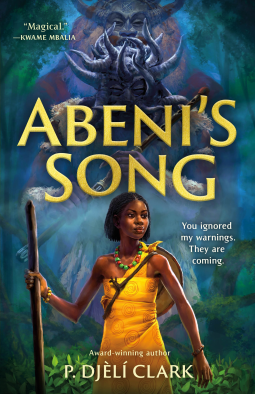
 Abeni's Song, by P. Djèlí Clark (Tor)

I requested an ARC of this book from NetGalley because I loved the author’s previous work. RING SHOUT and THE WAR OF THE DJINN engaged my imagination with compelling characters and gripping, freshly inventive stories. Alas, in my reading experience ABENI’S SONG fell far on all counts. It’s a YA fantasy set in a mythical African village and steeped in African folklore and customs. The first time I tried to read it, it was so tedious and slow-paced and its characters so stilted and bland that it regularly put me to sleep. Then I decided to give it another chance. I made it halfway through before I realized I was using one excuse after another to not read any further. All my previous problems were still there, plus more. I gave up halfway, at a point when I should have been eager to return to the story. Here’s a roundup of what didn’t work for me:

1.        First and foremost, the kids lack agency and competence. At twelve, most children—especially those in traditional societies—already have a wide range of skills. They contribute to their communities at adult or near-adult levels. Here, they have few responsibilities, they consistently behave in ways that are disrespectful and irresponsible, and they are utterly helpless in the face of a threat to their village. One of the joys of contemporary YA novels for both young and adult readers is the resourcefulness of the young characters.

2.       Abeni and some of her friends are annoying to the point that I lost all sympathy for them. Abeni, the viewpoint character, seems completely unaware, for example, of her mother’s fighting skill, something her mother would have practiced regularly to maintain. She’s a self-centered brat, and no one except the witch calls her on it.

3.       Despite bursts of action, the pacing is excruciatingly slow. Material is repeated, adding to the already excessive length for a YA novel. There’s little sense of dramatic shape, and the tension dissipates in the long gaps between action scenes. I perked up during the attack on the village and its aftermath, only to have all the dramatic momentum evaporate.

4.       The evil characters are two-dimensional, as if they woke up in the morning and went, “Evil! Evil! Rah-rah-rah!” This is in stark contrast to the nuanced complexity of the antagonists in Clark’s adult novels.

I am left wondering if this was either a trunk (early, unsuccessful) novel or an attempt at YA by someone who never reads it. The prose, annoyingly peppered with exclamation marks and juvenile (in the worst sense) worldview, is what one might expect if unfamiliar with the genre. All that said, I liked Clark’s adult novels enough to give future work a try and hope there will be more of them.


Friday, December 19, 2025

Short Book Review: Baking as a Magical Art

 The Wizard’s Guide to Defensive Baking, by T. Kingfisher

 I don’t know how I missed this delightful fantasy when it first came out, winning the Hugo and Locus Awards in 2021. It combines some of my favorite story elements: an intrepid young heroine, weird forms of magic, and baking. Yep, baking. Fourteen-year-old Mona’s magical talent is, by any standards, quite modest. She can’t summon lightning, resurrect a cavalry troop of dead horses, or control a flood. As an apprentice in her aunt’s bakery, she uses her magic to encourage bread to rise and, upon occasion to delight the customers, she makes gingerbread men dance. Her life of quiet joys takes a drastic turn when she discovers a dead body on the floor of the bakery. Before she knows it, she’s on the run, either suspected of being the murderer or convinced she is the next target. Worse yet, by the time the dastardly plot is revealed, the super-wizard who is the city’s primary defense has been lured away and Mona has only herself and a ragtag bunch of friends to keep everyone safe.

I loved Mona, her friends, the unusual twists on magic, and most of all, the voice of the author shining through these adventures. I think my favorite part was Mona’s gigantic bread “golem” defending the city gates against the ravening horde. And the zombie horses, who manage to retain both their personality and their loyalty, like true horses across time and imagination.

Recommended.

Friday, March 21, 2025

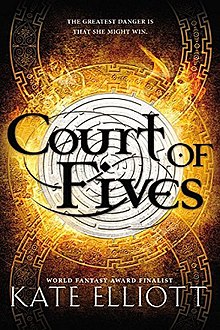
Audiobook Reviews: Kate Elliott's Court of Fives


Court of Fives trilogy (Court of Fives, The Poisoned Blade, The Buried Heart) by Kate Elliott (audiobook)

I’ve been a fan of Kate Elliott for a long time, admiring her thoughtfulness and nuanced presentation of relatable characters wrestling with complex social issues. Plus great action sequences and world-building. I found this trilogy in audiobook format through my public library (hooray for libraries!). It had been around for awhile, the first volume (Court of Fives) having been published in 2015.

After the patriarchal kingdom of Saro invades and conquers the land of Efea, a colonial-style caste system perpetuates the resulting conquerer/conquered elite/slave dichotomies. The fact that the aristocratic Saroese are light-skinned and have straight hair and the Efeans are dark with “coiled” hair evokes echoes of British imperialism in Africa or the post-Civil War America. Here, as in Elliott’s ficticious realm, people from different castes will inevitably meet, fall in love, and have children. Jessamy and her sisters have grown up in such a family; their father is a common, untitled Saroese who has risen to military prominence due to his extraordinary skill. His wife in all but name is a perceptive, generous Efean who excels at caring for everyone in her orbit.

Jessamy has a secret: she has been training to compete in the Court of Fives, a sort of Olympic trial combinng strength, agility, quick-thinking, and speed—and she does so anonymously, against her father’s wishes. He does his best to protect his mixed-race girl in the larger world of Saroese dominance. Jessamy’s secret rebellion and a chance encounter with Kalliarkos, (a Saroese prince in line for the throne) ignite vicious political infighting, simmering Efean rebellion, betrayals within her own family, and a discovery that will transform forever the relationship between the two peoples.

The result is a coming of age story fueled by Jessamy’s burgeoning insight, courage, and maturity, and the her (and the reader’s) step-by-step discovery of the history of this world, the power of rebellion, and the emergence of the leadership this world needs so desperately to survive. The resulting tale is neither a quick nor superficial, but rich, detailed, and ultimately satisfying.

Highly recommended.


Friday, September 13, 2024

Short Book Reviews: A Librarian and Her Spider Plant Assistant


 The Spellshop
by Sarah Beth Durst

I’ve been a fan of Sarah Beth Durst for years now, so I was happy to see the attention her latest novel is receiving. Of course, I eagerly grabbed a copy and devoured it. It’s an understatement to say that The Spellshop is wildly inventive, sweet, enchanting, and impossible to put down.

Fleeing the violent revolution in the capital city, librarian Kiela packs a few crates of precious books of spells (which are illegal for non-approved sorcerers to cast, by the way) and escapes with her friendly assistant, a talking spider plant named Caz, who has more common sense than most humans. She lands on the island of her birth, where she thinks to hide in her parents’ abandoned house until—she does not know, she can’t plan that far ahead. Nor can she cope with the sudden appearance of her neighbor and childhood friend, merhorse herder Loran, who shows up on her doorstep with a welcoming gift of cinnamon buns. Soon Kiela and Caz are drawn into the community of humans and magical beings, ever fearful to keep their stash of forbidden hidden. Before long, however, Kiela ends up creating spells (for reasons that seem good at the time) that she calls folk “remedies,” sometimes with hilarious results (like the apple-tree bird or the sentient cactus that Caz falls in love with).

The world building and cast of characters are fresh, original, and charming, but for me the best part of The Spell Shop was the skill and sensitivity with which Durst portrays how those characters change and grow. In particular, she captures Kiela’s voice as the reclusive librarian slowly emerges from her isolation with evolving insight into the motives and emotions of others…and herself. No wonder Book Riot called Durst “a hidden gem of the fantasy world.”

File this tale under: Perennial Comfort Reading. And buy a second copy to lend to special friends.

Friday, September 2, 2022

Short Book Reviews: A YA Regency Comedy, With Dragons


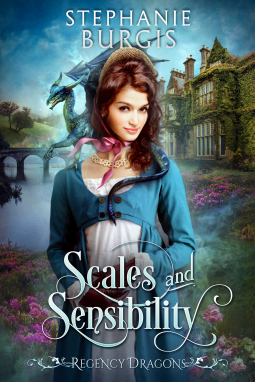
Scales and Sensibility
(Regency Dragons Book 1), by Stephanie Burgis (Five Fathoms Press)

About 15 years ago, Jane Austen mashups were the hot new thing. Pride and Prejudice and Zombies by Seth Grahame-Smith came out in 2009, followed by a glut of similar parodies and even a film or two. The fad didn’t last, especially as the stories got more derivative and less creative. Stephanie Burgis’s Scales and Sensibility opens with an homage to Austen: “It is a truth universally acknowledged…” Other than an occasional textual reference to Austen’s prose, it has nothing in common with the earlier, vapid parodies. Instead, it takes off in its own whimsical and engaging direction. The protagonist is named Elinor, like the heroine of Austen’s Sense and Sensibility and she is indeed sensible, but there the resemblance ends. She is an orphaned cousin, not the eldest daughter, and her counterpart is not her romantic, good-hearted sister but her wealthy, narcissistic cousin, Penelope. When witnessing Penelope’s abuse of her fashionable miniature dragon becomes intolerable, Elinor kidnaps the tiny creature and runs away. Little does she know the dragon’s secret or guess the adventures the two will embark upon.

This novel rests comfortably in the intersection between Young Adult fantasy, Regency romance, and romantic comedy. It’s an engaging, quick read with enough schemes and mistaken identities to satisfy the reader.

Friday, October 29, 2021

Book Reviews: Magical London, Three Views

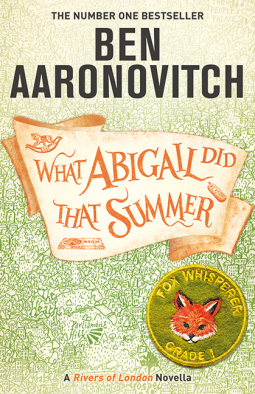
What Abigail Did That Summer, by Ben Aaronovitch (Subterranean)

Lies Sleeping, Ben Aaronovitch (DAW)

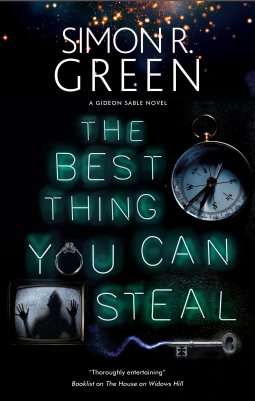
Best Thing You Can Steal, by Simon R. Green (Severn House)


I very much suspect that one night, Simon R. Green, Charles Stross, and Ben Aaronovitch met in a pub, got drunk together, and started telling tall tales about creepy things happening in London. Stross’s “Laundry Files” novels center on a secret agency tasked with keeping Lovecraftian Elder Gods in check. In Aaronovitch’s “Rivers of London,” waterways ancient and modern possess spirits, foxes have their own security forces, and a not-so-secret agency investigates supernatural crimes. Elsewhere I’ve reviewed some of the “Laundry Files” novels (they’re terrific fun, so check them out if you haven’t already).


My introduction to Aaronovitch’s enchanted London was reading Lies Sleeping and What Abigail Did That Summer simultaneously. It wasn’t intentional, but it turned out brilliantly. In the former, police constable and apprentice wizard Peter Grant investigates an ongoing mystery from the agency’s headquarters, “The Folly.” This is actually well into the series, which I didn’t realize, and there’s a massive amount of backstory, but I found that just hanging out with Peter was vastly entertaining. Really, a summer evening picnic, trying to get the spirit of Old Father Thames to remember where King Arthur left his sword? Delicious fun! Abigail of What Abigail Did That Summer is Peter’s cousin, and her own adventure took place back in 2018. Missing kids, a seriously psychotic haunted house, and a security detail provided by talking foxes were just a few of the marvels. Then Abigail appears in Lies Sleeping as an extraordinarily perceptive student, which makes sense given what she went through years ago. It’s no wonder the magical bosses insisted she receive proper training!


And then there’s Green’s Best Thing You Can Steal, which features a thief and con man extraordinaire, going under an assumed name. He specializes in stealing things like a ghost's clothes or a photo from a country that never existed. Now he’s after a television set that shows the future and that most delicious of prizes, revenge against “the worst man in the world.” He’s put together a team that includes a ghost who remembers being human, a man wearing the armor of the angels he’s slaughtered, the possibly human embodiment of random luck, and his ex-girlfriend, who can make technology fall in love with her. Armed with a ballpoint pen that can stop time and a skeleton key that can open any lock, not to mention their special talents and wits, he and his team go up against poltergeist attack dogs, golem guards, shaped curses, and a villain who can foresee their every move.


Each of these books is fast-paced, chock-full of inventive imagination and quirky characters. They also share a blend of off-beat bad guys, love for London and the English language, and humor that strikes me, as an American, as quintessentially British. Which is not to say they share a setting, magical systems, or histories, because each is as individual as the thoroughly skillful author who created it, only that if you enjoyed one you’ll likely find delight in the others.

Friday, December 18, 2020

Book Reviews: Surviving Trauma in a Magical Plague


 The Electric Heir (Feverwake, Book 2), by Victoria Lee (Skyscape)

This is a sequel to Fever King, which I reviewed here. Although I loved the premise of magic being carried by a highly contagious, near-fatal virus, and the virus having been unleashed on a fractured United States by a single power-mad man, I expressed reservations about the depiction of the moral consequences of actions, specifically politically motivated murder. Yet the world and its principle characters were powerful enough to linger in my memory, so I decided to give this next volume a try. And in it I found everything I missed in the first book. To be sure, this isn’t an easy, light-hearted read. It’s a brutally honest delve into the abuse of power. And as such, I found the story powerful and emotionally fearless. Lee doesn’t shy away from difficult or distressing aspects of the deep trauma suffered by the victims or the pernicious nature of the way their thinking and reactions become warped as the result of repeated abuse. In all the essentials, The Electric Heir completes and redeems The Fever King.

Calix Lehrer rose to power by first creating magically gifted “witchings” (the few survivors of the plague he himself unleashed) and then defending them against neighboring nations. Now over a century old, he chooses apprentices from the elite Level IV school – but these teens are not merely students, they are the targets of his seduction, manipulation, and abuse. In the first volume, refugee Noam is first overwhelmed by the privilege of Level IV, filled with hero worship for Lehrer, and first repelled and then fascinated by his fellow student, the charismatically beautiful telepath, Dara. In the course of that story, Noam falls in love with Dara even as he comes under Lehrer’s influence, to the point of becoming Lehrer’s assassin. It becomes clear that not only is Dara’s sexual relationship with Lehrer non-consensual because of the disparity in age and power and the impossibility of refusal, but it involves repeated brutal physical abuse, masked over by Lehrer’s healing magic. The book closed with Dara’s escape and likely death.

Now Lehrer has lured Noam into Dara’s place, forcing him through psychological manipulation and increasingly violent physical abuse into a model of himself: ruthless, exploitive, and devious. In short, to become Lehrer’s carbon-copy heir. Noam, like Dara before him, craves Lehrer’s approval at first, although it is unclear how much of this stems from Noam’s youthful vulnerability and how much is Lehrer making himself charming and magically persuasive. As it turns out, Dara is not dead, although he no longer possesses magic; he has returned with an underground cabal with one purpose: to end Lehrer and his international reign of terror. Lehrer has planted a spy in their midst, perhaps more than one. Noam, after an uncomfortable, divisive reunion, insists on remaining with Lehrer as part of the plot – even though it puts his sanity and his very life at risk. Meanwhile, Lehrer launches a pre-emptive strike against the neighboring nation of Texas, using weaponized magic. As Noam and Dara separately and together come to terms with both the overt and the subtle effects of abuse, it’s a race against time to stop Lehrer. 

It’s a high-wire act to portray slow, intense, personal change and fast-paced action at the same time. Lee deserves immense credit for not abbreviating or minimizing the painful process by which Lehrer’s victims peel back the layers of guilt and shame, discarding the excuses born of what their abuser has led them to believe about themselves. This second volume fully addresses my concerns about the first with courage and compassion. It’s definitely not the place to start the story, but neither is the first book the place to stop. I’m glad I gave The Electric Heir a chance to take me with Noam and Dara in their journey into darkness and the emergence of hope.


Friday, September 4, 2020

Very Short Book Reviews: The Magical Girl Gang and Other Joys


When We Were Magic, by Sarah Gailey (Simon and Schuster)


They’re classic girl buddies, pinky-sworn to support one another. One is the nurturer, another the innovator, yet another the nature lover. One (the narrator) has a secret crush on another girl. But they’re also magic, each with her own gift, and all determined to keep what they can do secret. So when Alexis, in order to make her secret crush jealous, allows herself to be seduced by the high school golden boy on prom night, her dishonesty with herself ignites her magic with disastrous – and lethal -- results. What to do with the body? Call her friends, of course! An ill-conceived plan to chop up his body and get rid of the separate pieces leads to ever more dire complications. Only by unveiling secrets and working together can Team Magic put the world right again.

Wonderful authorial voice, a freshly imagined system of magic, awesome girl friendships, and plot twists galore create a fast and absorbing reading experience.


Jack, by Connie Willis (Subterranean)

I think of this novella, set in London during the World War II blitz, as a companion piece to Connie Willis’s duology, Blackout and All Clear, and her “Fire Watch.” Whereas the two novels were time-travel science fiction, Jack falls into fantasy. Or rather, topples headlong into a seemingly ordinary world replete with Victorian gothic references. A few are obvious, like the character Renfrew, others more subtle. One of the joys of an ereader is the ability to look up names and references <g> When you think about it, it stands to reason that a chaotic, violent time like the London blitz might attract predators, now freer to hunt than in more sedate times – but to what end? To feed on death and pain, or to in small way atone for the evil they’ve done?

As usual, Willis is in fine style, weaving in hints through everyday happenings, in this case, an air raid rescue team spotting fires, digging out survivors, and so forth.

This novella was first published in 1991. I’m glad to see it and others, new and old, find audiences. Not so long ago, it was very difficult to sell a novella, but changing markets and technologies have reintroduced readers to the gifts of this length.


Stormsong, by C. L. Polk (Tor.com)

I loved C. L. Polk’s Witchmark, to which this is a direct sequel, and I heartily advise readers to read that book first. In this world, both politics and the magic upon which the society depends are in an unprecedented and precarious imbalance. At the end of the first book, a series of shattering events have left the realm of Aeland in an even more desperate situation. The supernatural dangerous-elf-like Amaranthines are basically investigating their crimes to decide whether to exterminate them, and the weather workers are in disarray just as the equivalent of the storm of the century bears down on them. This time, the viewpoint character is Dame Grace Hensley, the privileged, magically gifted sister of Miles, our hero from Witchmark. She has much to atone for in her role in enslaving her brother’s will in order to steal his magic, but she’s had her eyes opened to the brutality of her own society. Which, when you come to think about it, is as interesting a place to begin a story as any. Grace’s awakening is not complete, of course. As an unreliable narrator, she still has blind spots aplenty. She has yet to discern the depth of her aristocratic privilege or the lengths to which her enemies will go to keep their grip on power. There’s a sweet lesbian love story, intricate political scheming, and genuine character growth.

Sequels are always tough, especially when the first volume is as good as WitchmarkStormsong, while standing on its own less well, deepens the story. The shift in POV from what was previously essentially an adversary – and who now has a great deal to atone for – gives depth not only to the principal characters but to the world itself.


Creeping Jenny (A Nyquist Mystery), by Jeff Noon (Angry Robot)

I was introduced to the work of Jeff Noon through his previous “Nyquist Mystery,” Man of Shadows, which takes place in Dayzone, a city under perpetual illumination. It goes without saying that without an imposed circadian rhythm and with the ability to sleep and wake on an individual schedule, the culture and psychology warp in bizarre and unexpected ways. I found the effect within the novel downright hallucinatory.

Creeping Jenny is no less weird, although it’s set in a small English village. John Nyquist has received a set of photographs, including one of his father, believed to be deceased. The story begins with his arrival in the village of Hoxley, in search of the truth – could his father be still alive, after all these years? Although the village is superficially quaint and quiet, it is no less weird than the city of Dayzone. For 300 days a year, the saint of that day rules over Hoxley, and a stranger set of saints I could not imagine. One day everyone stays indoors until dusk, another day everyone wears a mask and insists they are Edward or Alice, and on yet another, nothing ever gets completed – sentences, work, trying to get from one place to another. One villager names trees (and people), hanging tags on them, and gives Nyquist a mysterious name, Written in Blood. Two apparent suicides send Nyquist on the hunt for an explanation – were they in truth murders?

Noon has an almost supernatural ability to start off with an apparently mundane, real life situation and warp it in such unexpected directions that by the time you realize you are not in Kansas anymore, you’re not even on the same planet.


Shorefall, by Robert Jackson Bennett (Del Rey)

This sequel to Foundryside is just as engrossing and dramatic. I loved the “industrial magic” of this world, as well as its central characters: scrappy Sancia with her ability to “speak” to scrived objects (enchanted by written spells); Gregor who hides both from his wealthy ruling family and his tormented past; Berenice with her extraordinary talents as a scriver and her love for Sancia; Orso who left a successful professional career working for a ruling family to help create a “people’s foundry;” and new ones as well. The very first scrivers, called hierophants, were able to remake time and space, and reality itself, and the original and most formidable of those, Crasedes Magnus, is bent on returning and re-making the world. His cause: bringing an end humankind’s propensity for turning every invention into a weapon by obliterating free will.

When is the price of peace too much? Can people ever learn to channel creativity and innovation into beneficial uses, or are they doomed always to turn to war and oppression? How do you counter an adversary capable of making you want to believe him?

Friday, July 31, 2020

Short Book Reviews: A Reincarnated Chimera

Race the Sands, by Sarah Beth Durst (Harper Voyager)

I loved this world, in which Becar, a precarious desert kingdom, politics are based on karmic “readings” by Muses of a person’s past lives. The stressed, disenfranchised populace is distracted by races involving vicious, mindlessly destructive chimeric monsters called kehoks, the reincarnated souls of those so evil and depraved as to be beyond hope. When the King dies at a youthful age and quite unexpectedly, his brother cannot take the throne until the King’s spirit is identified, presumably in a traditionally noble beast. The search intensifies as neighboring kingdoms scent weakness and prepare for an invasion. Unstable conditions like this form the perfect settings for taut, dynamic stories, don’t they?

Enter a failed Muse student who finds a new life as an apprentice jockey, a woman who trains racing monsters to pay her daughter’s tuition at Muse academy, her patroness, a socialite with a flair for politics, a Muse agent charged with locating the King’s spirit, and assorted other characters. What links them together with the Prince is the black-iron lion, a kehok even more volatile and dangerous – and intelligent -- than others of his kind. With him, the trainer and her new apprentice jockey have a chance to win the grand championship, and with it, financial security and independence. With war brewing and the search for the King’s spirit intensifying, with their rivals resorting to ever more desperate sabotage, it’s a race against time as well.

An added delight was the effortless skill with which Durst moved from inner to outer action, her subtle handling of tension, her compassionate portrayal of her characters and their situations, and her imaginative magic. Recommended for adult as well as YA readers.

Friday, January 31, 2020

Short Book Reviews: A Plague of Magic


The Fever King, by Victoria Lee (Skyscape)

I loved the premise of this Young Adult fantasy thriller: a plague has swept the former United States, in the form of a magic-carrying virus. Most who are stricken die, but those few survivors now possess magic. Refugees seeking virus-free zones add to the social upheaval. One man, Calix Lehrer, an immensely powerful magic wielder, has survived from the beginning, and now rules the nation of Carolinia from behind the throne. 

The story follows refugee Noam Álvaro through his infection with the virus, his recovery, his new magical powers, and his recruitment into a elite corps of young magicians. As such, he is lifted from the refugee slums into a life of luxury, attending private high school and one-on-one tutoring with the great Calix Lehrer.

This part of the story, with echoes of Harry Potter but also Noam’s loyalty to the memory of his father and the refugees who were once his own people, drew me into the world. Slowly Noam makes friends, including the charismatically brilliant, beautiful boy, Dana, for whom Noam develops a passionate crush. The burgeoning attraction between the two was handled with sensitivity and forthrightness, as was Dana’s anguish about the secrets he is forced to keep.

As the story progressed, however, it seemed to lose the moral compass that was so much a part of the earlier part. Often fictional characters may seem to be either good or bad and then turn out to be the opposite or a complex blend. That’s true in this book as well. However, certain actions remain in one category or the other, especially for younger readers. Among them are a protagonist committing deliberate murder and the sexual exploitation of a young person by an older, far more powerful person. I don’t mean that these things cannot appear in YA literature, but that they must have appropriate context and consequences. They are not, and must not be, morally neutral. Perhaps other readers will feel differently about how these issues were depicted, but I found myself with the equivalent of an ethical hangover after finishing what was otherwise an engrossing tale.

Friday, September 27, 2019

Short Book Reviews: Not Your Grandmother's Ugly Stepsister


Stepsister, by Jennifer Donnelly (Scholastic)

Stepsister is the latest “fractured fairytale” I’ve read, and there have been many over the years – some pedestrian, some relying only on a single concept, but some brilliant and insightful. Donnelly’s contribution falls squarely in the latter category. It’s based on “Cinderella,” and it takes place after the happy ending, from the viewpoint of one of the Ugly Stepsisters. Ella has gone off to live with her prince in the castle (and they have since become King and Queen of France), and the stepsisters and their mother live in a decaying mansion (Maison Douleur, “House of Pain”) with no money and certainly no social prospects, as they are widely reviled as the ones who heaped so much misery upon sweet, lovely Ella.

Of course, there’s more to the story. That’s only the set-up. Although Maman is very much the scheming match-maker of the popular tale, Octavia and Isabelle (the viewpoint character) are anything but the self-absorbed, selfish creatures we have come to despise. Neither particularly wanted to get married, let alone to a prince. Tavi lived for science and mathematics, while Isabelle was devoted to heroic adventure, military strategy, and her favorite horse (at least, before Maman embarked upon her marriage schemes). Even after Ella goes off to her happy ending, Isabelle’s fate is not their own. Literally, because the incarnations of Chance and Fate have a wager as to whether she can overcome the harshness of her present circumstances, or whether she and her family will fall prey to the invading armies of the evil General Volkmar. In the end, it’s up to Isabelle, with her keen wit and her capacity for growth (and remorse) to thwart the bloodbath and save Queen Ella’s throne.

The characters are wonderful, the details whimsical and grim, the emotional arc pitch-perfect, and luscious prose like this:
“The pieces of your heart are restored. The boy is love – constant and true. The horse, courage – wild and untamed. Your stepsister is your conscience – kind and compassionate. Know that you are a warrior, Isabelle, and that a true warrior carries love, courage, and her conscience into battle, as surely as she carries her sword.”
I’ll be re-reading this one. Highly recommended.


Friday, March 24, 2017

Short Fantasy Book Reviews: Near Misses, But No Banana

The Bone Witch by Rin Chupeco.
I really wanted to like this YA described by the publisher as “Memoirs of a Geisha meets The Name of the Wind.” It opened with great promise, and it has many things going for it. I loved the idea of an evolving relationship between the heroine, Tea, and her brother, Fox, after she inadvertently brings him back from the dead. The author gets kudos for a non-Western setting. There are lots of details about the city, the school, the monstrous and occasionally draconic daeva, and so forth. I loved the idea of heartsglass that changes color and reveals much of who you are, although I was perpetually confused about how it worked (also the geisha “asha” and why sometimes a bone witch – necromancer is one and sometimes not). There are a number of wonderful characters like Mistress Parmina (a most un-Japanese name) and Likh, who longs do dance but who is male and so is destined to become cannon fodder for the Deathseekers) and a sense of history and tradition. Unfortunately, the development of intriguing ideas fell short. The relationship with the brother happened slowly, almost as an afterthought or something pinned on. At first I thought how cool it was to have a Japanese Hogwarts, but the culture did not ring true. Attitudes and speech patterns felt Western, and the seemingly random inclusion of elements (like cuisine) from other areas of the world created a slap-dash patchwork instead of a seamless whole. The major problem though, was that there was no clear goal or threat that built to a climax. The result was a story that felt flat and episodic. The hazing from other students had as much emotional weight as the threat of the Faceless (a generic, all-purpose enemy who seem to be evil for its own sake). The utter absence of sex, even sexual feelings, was a jarring omission. These young women are being trained as hostesses and entertainers; it is impossible that the issue of intimate favors for their patrons never comes up. Even if the younger ones are protected from forming liaisons, surely the questions must come up for the more mature asha. It’s ridiculous to thing that a YA novel must exclude all references to sex when it is so important to teens in real life. Discerning older readers may well give this one a pass.

Toward a Secret Sky by Heather Maclean  is a YA novel of the “Twilight with Angels and Demons”
sort. Our teen orphan heroine finds herself shipped off to grandparents in Scotland where she explores scenery, makes friends, and encounters the devastatingly gorgeous angel assigned the guard her. Even though she is told in no uncertain terms of the dire consequences of human-angel love affairs, she plunges into one obsessive daydream after another, refuses to heed his warnings to leave him alone, and in general behaves like an infatuated adolescent incapable of making rational decisions. To be sure, she has personality and strengths, not the least of which are keen mental abilities and a generous heart, and the story moves along nicely, with enough twists to keep the reader engaged. Logic bobbles (like why would a handsome, rich incubus need a date-rape drug when looks and money alone would get him as much sex as he wants?) flawed an otherwise enjoyable flow of prose, and the “the war [with demons] is just beginning” epilog felt tacked-on. These shortcomings may pale in comparison to the overall enjoyability of the story, particularly for a young adult reader but a more critical reader may find them annoying.

Friday, March 17, 2017

Short Book Reviews: Thoughtful, Inspiring YA/MG For Everyone

Born Confused by Tanuja Desai Hidier.

Dimple Lala is an American Indian (as in East Indian, not Native American) caught between the traditional world of her parents and the life of a normal American teenager. Her best friend, willowy blonde ultra-cool Gwyn, thinks Indian culture is exotic and cool. Dimple’s one passion is her photography, and the world as she sees it through her camera lens is described in luminescent detail. Only here can she be herself, instead of awkward and alienated. At school, she can never compete with Gwyn; at home, wishes her meddling parents would stay out of her hair. When they arrange an introduction to a “suitable boy” (suitable for an arranged marriage, that is), Dimple goes on a blind date that Gwyn had set up, with predictably disastrous consequences. As the story unfolds, spilling out into the Indian music club scene, Dimple comes into her own, fusing the best of both worlds. An array of vivid secondary character and gorgeous sensory detail mark this as a book to be savored and shared.

We Are the Goldens by 

This book is deceptively simple in tone yet rich in nuance and courageous in its approach to complex, painful issues. This book chronicles the parallel journeys of two teenaged sisters, using an interesting twist on the usual YA first-person narrative in that one sister is addressing the other: their relationship forms the core of the story as they grow from intertwined to antagonistic to individuated. The story opens with the narrator and younger sister, Nell, beginning high school and discovering that the previously close relationship with adored, perfect Layla has now developed fracture lines. While Nell develops an unrequited crush on a glamorous older boy, Layla begins acting mysteriously. She, too, has a secret – one that Nell discovers and that has the power to tear them and their whole family apart. Highly recommended for both adult and teen readers for its clear and excellent handling of relationships and sexuality.


The Cartographer's Daughter, by Kiran Millwood Hargrave.

This lovely middle grade story offers a wonderful twist to the usual fantasy tale featuring adolescent heroes. The protagonist’s strength is not magic or physical prowess but her understanding of how our knowledge of the landscape gives us power. The techniques of map-making are woven into the story in beautiful, evocative ways. The plot itself involves a group of friends, a journey to forbidden lands, monsters and creatures, villains and allies. Much has a familiar feel, but the use of cartography makes this book stand out. It would make a great book for a family to read together and discuss the principles of geography and their relationship to the plot.

Wednesday, October 26, 2016

Short Book Reviews: Steampunk Victorian Revolution

Rebel Mechanics, by Shanna Swendson (Macmillan Children's Publishing Group) Steampunk and 
alternate American history, spies and skullduggery and steam engines, oh my!

From the beginning, I was captivated by this tale of an 1888 America that never freed itself from Britain, a world ruled by aristocratic “magister” magic-users, Masked Bandits and airships, and an intrepid heroine. With the focus on plot and character, perfect for young adult audiences, the world-building is handled with subtlety. Verity Newton arrives in New York City to take up a position as a governess, only to become entangled with the Rebel Mechanics, a fellowship of engineers committed to freeing themselves from the tyranny of the magisters through the creation of steam engine powered devices that anyone can operate, regardless of magical talent. (A particular charming twist was the role of the novel Jane Eyre, and its reflections on the role of governesses!) I hope this will be the beginning of a series of Verity’s adventures and the eventual liberation of the American colonies. Fans of Gail Carriger will particularly enjoy this book.


Monday, October 17, 2016

Short Book Review: Twilight with Angels and Demons

Toward a Secret Sky by Heather Maclean (Blink, April 2017) is a YA novel of the “Twilight with Angels and Demons” sort. Our teen orphan heroine finds herself shipped off to grandparents in Scotland where she explores scenery, makes friends, and encounters the devastatingly gorgeous angel assigned the guard her.

Even though she is told in no uncertain terms of the dire consequences of human-angel love affairs, she plunges into one obsessive daydream after another about him, refuses to heed his warnings to leave him alone, and in general behaves like an infatuated adolescent incapable of making rational decisions. To be sure, she has personality and strengths, not the least of which are keen mental abilities and a generous heart, and the story moves along nicely, with enough twists to keep the reader engaged. Logic bobbles (like why would a handsome, rich incubus need a date-rape drug when looks and money alone would get him as much sex as he wants?) flawed an otherwise enjoyable flow of prose, and the “the war [with demons] is just beginning” epilog felt tacked-on. 

These shortcomings may pale in comparison to the overall enjoyability of the story, particularly for a young adult reader but a more critical reader may find them annoying.

Friday, September 2, 2016

Supporting A New Writer 2: Following The Dream

Recently, I received this letter from Wendy, a fan with whom I’d been corresponding. It spoke deeply to me, and rather than answer it alone, I asked some of my writer friends to join in a series of round table blogs on the issues raised. If you’ve been there, too, I hope you’ll follow along and offer your own wisdom.


I've been trying to reconnect with writing friends after a hiatus from the creative life. I've spent the past year or so taking care of my mom and working to pay the bills. Mom passed away in October.
When your last parent passes away, it changes you in many ways. That foundation you always relied on -- even as an adult -- is gone for good. Whether you're ready or not, you are truly on your own in the world and must somehow carry on without their nurturing presence. One of the most difficult aspects of my mother's final days was the fact that she had so many regrets about life. She once had goals and dreams, but left them behind out of fear and a belief that these dreams were just not possible.
I'm 54 years old. More than half of my life is over. Writing has been a dream/goal of mine since childhood. My mom was the only one who believed in me. I don't want to leave this world regretting the fact that I never pursued this dream to the fullest. To be honest, my writing "career" never took off. I let fear, doubt and the negativity of others keep me from my dreams. I want so much to be brave, to take risks with my creative life. I truly wish for a group of fellow writers who are willing to give me the encouragement and support I need to write with my heart and soul, to grow as a writer and a human being. And I want to be a support for others as well. How do I get back into the writing life after leaving it on the back burner for so long?
  Katharine Eliska Kimbriel: Do you want to write, or do you want to have written? Is it getting the story down on paper or computer that drives you, or the thought of who will receive the story? Is publishing critical? Are you looking at markets before you even write the tale?

Because these struggles can kill your muse. I wasted a lot of time, once NYC decided that the stories I wanted to tell were not viable, tossing them synopsis after synopsis, trying to get their interest. You don't have to deal with NYC at all, if you don't want to--self-publishing can be done, and done well, if you are willing to pay for good editing and cover art.

The best things I have ever written come when *I do not censor the Writer.* The first draft, you must tell your Editor Voice (and you have several) "There, there, you will get your chance to say something" and keep writing. The first draft of a story, you tell yourself the story. The second pass, you decide what you need to tell this story to other people. There's usually editing--few of us can write a first and second pass in one go.

Beware the Critic Voice. That is the voice of every slighting comment, every undermining statement, every spiteful word ever tossed your way. A strong and smart woman once told me, "The Critic is never you." But the Critic exists, even if no one has ever slammed your dreams of writing because you never whispered that dream aloud. It takes time to smash those slighting words down to dust, to weigh opposites in your hands and mash them together, halving their impact. But you can whittle down The Critic.

Most people I know who adore telling stories can't stop. When they *cannot* tell stories it triggers depression. Right now you are going through that huge transition (it just happened to me, too) where suddenly, at reunions, you are the oldest person in the room. Right there is a huge adjustment. Be gentle with yourself, ask your heart what it wants to write, and give yourself permission to write. That time is NEVER wasted. In my youth I would tell people "I have to work." I didn't say write, because it wasn't how I paid the rent, so they would say "You can do that after the movie, dinner, bike ride"--whatever.

It is for you. Women worldwide are told to put their heart on hold and take care of everyone and everything else. If you don't take something for your own heart, you will have nothing to give others. Take the writing. It may turn out to be something you can offer the world.

Katharine Eliska Kimbriel reinvents herself every decade or so. The one constant she has reached for in life is telling stories. “I’m interested in how people respond to choice. What is the metaphor for power, for choice? In SF it tends to be technology (good, bad and balanced) while in Fantasy the metaphor is magic – who has it, who wants or does not want it, what is done with it, and who/what the person or culture is after the dust has settled. A second metaphor, both grace note and foundation, is the need for and art of healing. Forthcoming stories will talk about new things that I’ve learned, and still hope to learn … with grace notes about betrayal, forgiveness, healing and second chances.” A Campbell Award nominee.


Irene Radford: For as long as I can remember my family told me that writing down my little stories was okay because I would learn to write well, a requirement for succeeding in the business world. Their ambition for me was to run the PTA. However, I mustn’t bother sharing my little stories with anyone because I could never succeed as a writer.

Period. End of conversation.

Except we kept having this conversation every time I got an idea for a new story or book or trilogy…

I’m not certain why my brain suddenly clicked into realizing that I can’t know I’ve failed until I try. It may have had something to do with my 10 year old son entering every mail-in contest the postman delivered. One of those contests was for Harlequin Romances. I won 4 free books every month for 3 months. Then of course I was expected be hooked and start paying for my book fix. But one of the option books I could order was “How to Write Romances for Love and Money.”

I tried it. Over the period of a couple of months I followed the guidelines and deconstructed several of my favorite romances. And then I wrote one. When I thought I was ready to submit I asked a friend of a friend about proper manuscript format. That person put me in touch with another friend of a friend who was active in Romance Writers of America.

I attended one workshop and went home to re-plot the book. The local chapter of RWA led me to a critique group. I re-wrote the book again and again until I submitted. And accumulated rejection after rejection.

At some point in this depressing process I discovered that not only did I need to try before I admitted failure: I had not failed until I gave up trying.

RWA and my critique group led me to an agent, and though we never sold that first romance, I found my voice in fantasy. And I succeeded. October 13, 1993 at 1:33 PM I received THE phone call, that DAW Books wanted to buy, not only the first book I had written for the fantasy market, but also 2 sequels.

Thirty-five books later I still haven’t found a reason to give up trying.

My few words of wisdom for those starting a writing career or re-starting one, is keep on trying. Apply butt to chair and hands to keyboard and keep writing. Five minutes a day, four pages a day, whatever works for your schedule. And keep on until there is nothing left inside you that demands to be written.

Then give it a rest for a bit until the words start bubbling out of you and write some more.


Irene Radford …aka P.R. Frost, aka C.F. Bentley, has been writing stories ever since she figured out
what a pencil was for. A member of an endangered species, a native Oregonian who lives in Oregon,
she and her husband make their home in Welches, Oregon, where deer, bears, coyotes, hawks, owls, and woodpeckers feed regularly on their back deck.

A museum trained historian, Phyllis Irene has spent many hours prowling pioneer cemeteries deepening her connections to the past. Raised in a military family, she grew up all over the US and learned early on that books are friends that don’t get left behind with a move. Her interests and reading range from ancient history, to spiritual meditations, to space stations, and a whole lot in between.

Thursday, January 8, 2015

Winter Reading, part 3


The Spiral Path: A Tale of Ritual Magic, by Katharine Eliska Kimbriel (Book View Café, 2015). In this third book of “Night Calls,” the adventures of Alfreda Sorensson, Katharine Eliska Kimbriel has brought originality and insightfulness to the series. Set in an alternate, magical Colonial America, these are no ordinary Young Adult fantasies, and Allie is no ordinary heroine. In Allie’s confident and inimitable voice, Kimbriel weaves together the necessary survival skills of living in the forested Michigan frontier. One of the things I like best about her is how amazingly competent she is - even when she’s in over her head. Instead of creating an independent heroine by separating her from her family and community, Kimbriel weaves together the lives of Allie, her lively and affectionate family, and the people in their small town. Once Allie’s magical abilities have manifested, she also acquires a “teacher in the Wise Arts,” an older kinswoman. As part of her studies, Allie studies midwifery, never guessing that she will be called to use her wild, untutored magic to deliver the foal of a unicorn.  The birth of the unicorn forces Allie to leave her family and home because she is now the target of supernatural forces she has not yet acquired the power and training to defend against. To protect her and to speed up the process of learning, she travels to New York to study at a school of ritual magic. I jokingly call this “Allie at Hogwarts,” but The Spiral Path is anything but an imitation of the Harry Potter novels. Allie may not yet be adept in ritual magic, but she is competent in a host of other areas, able to think on her feet, draw upon her strengths, and act with courage and compassion. She is in the process of becoming an extraordinary and powerful “practitioner,” not because of inborn talent (although she has that in spades) but through knowledge, hard-won experience, and keen intelligence. I wish these novels had been around when I was a young teenager, but I’m glad I can read them now, nodding, “Yes, yes!” as Allie handles and grows from every twist and turn of the story. I can think of no better role model for Young Adults, boys as well as girls. Highly recommended.

Longbourne, by Jo Baker (Vintage, 2014). This is one of the most delightful riffs on Pride and
Prejudice I’ve come across. It’s not a mash-up, strictly speaking. No monsters or supernatural beings of any sort parade through the hallways of the Bennett family home. Instead, Baker takes us Downstairs (as in Upstairs, Downstairs) to flesh out the lives of the servants, both those mentioned in the Austen novel and others that are entirely her own invention but just as appropriate and real. She does it so well that this novel can be read and enjoyed by those without any familiarity with the source. However, it is not Austenian through-and-through. Baker has her own writing style, one I found delicious and almost poetic in its rhythm, and she does not restrict her focus to the social and marital concerns of the Bennett daughters. She begins there, but expands to the larger world and the brutal realities of the poor in a nation at war. One chapter we’re in Longbourne, comfortable and civilized, and the next we’re in the middle of a Bernard Cornwell “Sharpe” novel, slogging through the frozen mud of Spain with Napoleon’s army at our heels, quite a rude shock, I should imagine, if you were expecting everything to be tea and crumpets (did they have crumpets in Austen’s time?) Even so, this is a story of love and loyalty, lost and regained. I loved it, completely apart from the Austen inspiration, and will look for her other work.

Good Man Friday, by Barbara Hambly (Severn, 2014). I have adored the Benjamin Friday books ever since Free Man of Color came out in 1998, and am thrilled that Severn House is continuing their publication. Each one is a gem, an engaging story that brings to life a not-very-well explored chapter in American History (1830s New Orleans), with all the layers of social and political issues vividly portrayed through the experiences of the characters. Benjamin January is a “free man of color,” his skin as dark as his African father, and his mind as keen as any detective’s. Trained as a surgeon in France, he finds himself unable to practice medicine, so he earns his living playing piano at various evening entertainments in the homes of white folk, and also occasionally solves a mystery. Here he is enlisted by his sister’s white protector to find a friend who has gone missing in what will become Washington D.C. Washington is nothing like the city of today; it’s hot, bug-ridden, and swampy, but the politics are just as dirty as ever. Edgar Allan Poe makes a guest appearance, helping January solve a most excellent mystery (and in the process deciding to forgo a job as a postmaster in favor of his own writing!)

Thursday, April 7, 2011

A Handful of Easy Reading Fantasies

I've been having way too much fun with these,

Enchanted Glass by Diana Wynne Jones. Any new book by Jones is a delicious treat, a reason to put down whatever else I'm doing and curl up with a cup of tea. This one, however, came with special poignancy because I received it just after I learned of her death. So I opened the pages with a kind of sadness, not wanting to admit that in many ways, this was farewell. (If there is another book to be published posthumously, I don't know of it.)

And found magic. Within a few paragraphs, her clear prose and unaffectedly direct storytelling had drawn me into a world in which magicians bequeath not only fine old houses but fields-of-care as well. Only in this case, the old magician left it "rather too late," meaning without personal instruction as to exactly what a field-of-care is and how one cares for it. A few pages later, Andrew Hope is struggling not only with his magical inheritance but with the two classically-Jones abrasive and recalcitrant retainers, Mr. Stock (who expresses his disapproval in the form of boxes of gigantic and inedible vegetables) and Mrs. Stock (no relation to Mr. Stock, who expresses hers by waging war as to the positioning of the piano in the living room). By the time young Aidan (the boy on the rainbow-hued cover) arrived, I had become part of the household as well.