Showing posts with label urban fantasy. Show all posts

Friday, September 22, 2023

Book Review: A New Shapeshifter Novel from Samaire Wynne

 Awakening Fae: A Fated Mates ~ Wolf Shifter Magical Adventure (The Meridian Pack Book 1) by Samaire Wynne (Black Raven Books)

“It’s good to read outside one’s familiarity zone” is oft-quoted advice. Usually, it means to try something darker, grimmer, and grittier than usual. But when I’d had my fill of dark/grim/gritty/depressing tales about sociopaths I really didn’t care about, I happily agreed to take a look at Samaire Wynne’s new wolf shifter novel. I dove into it without preconceptions and soon found it to be not only romantic in the best sense but also delicately layered.

Cameron, a foster kid about to age out of the system, is thrown into the world beyond the mundane when a puppy falls from the sky. I know what I’d do—everything I could to save it! In Cameron’s case, although it takes her a while to realize how she’s done it, this involves reaching out with a magical talent she had no previous idea she possessed.

Despite being forced to grow up too quickly when faced with an uncertain future, Cameron is still half a child. She has some, but by no means all, of the skills she’ll need to survive in the outer world. She’s got the grades but not the money for college; her foster parents do their loving best but cannot afford to keep her once she passes the age cutoff. The author perfectly captured Cameron’s loneliness and insecurity about the future and transforms it into loving protectiveness. In bonding with the puppy, Cameron places the welfare of another before her own, an essential step in growing up.

As Cameron encounters the puppy’s wolf shifter pack and her first terrifying encounter with the Nightmare Fae that are now stalking her, she embarks upon a journey into a new world of reincarnating wolf shape-shifters and magic. Much of what she learns comes from the wolf shifter pack. She struggles to define and understand her place among them. Often, their unqualified acceptance of her is puzzling, as are the gaps in their explanations. Later, it’s revealed that the shifter pack recognizes Cameron as a rare, immensely powerful Moon Fae, which is why they treat her with reverence and take on the responsibility of her education. Like a reader faced with too much exposition, Cameron is handicapped in her ability to understand it all at once, but even more so to put together the new relationships with her changing abilities—and her rapidly evolving identity. Being a normal human teenager is difficult enough, not knowing who you’ll be or what you’ll feel from one day to the next (thank you, hormones!). Added to that, Cameron as a Moon Fae is changing—awakening, as the title indicates. As the story progresses, Cameron matures in her understanding of her new world and herself.

Underlying the supernatural elements and slow-burn romance is a beautifully rendered portrait of a family-of-the-heart, and I think this is what gives this story its emotional depth. As Cameron herself puts it:

Me, who had fleeting connections to a dozen foster parents; me, who had never had a real family; me, who had just two black trash bags to hold every last bit of my life and belongings when I moved from foster family to foster family. I had finally found a family that cared about me. And the monsters had risen up, camouflaged in the most devious, deceptive way, and had descended on us and ravaged them.

The world of the Meridian Pack is an interesting blend of wolf shifters, fae, reincarnation, fated mates, teenage sexuality, nightmare menaces, action, and rational discussion. The author draws a distinction between wolf shifters, shapeshifters who transform into the form of a large wolf, as opposed to werewolves (as in the Underworld movies) and which appear in Book 2 of The Meridian Pack series. One of the more fascinating aspects of wolf shifter lore is the rate of aging; handsome Asher appears to be in his 20s, a little older than Cameron, but is in fact only much younger, with predictable and sometimes humorous consequences.

Although there’s plenty of dramatic (and romantic) tension, Awakening Fae: A Fated Mates often has an almost cozy quality. There was plenty to keep me turning pages but not enough to compel me to stay up all night. As I was puzzling this over, I attended a webinar about what keeps readers engaged. One thing that stood out for me was the importance of how the author makes you feel. That is based in the consistency and reliability of the reading experience, conveyed through the implied contract between author and reader. The author says, in effect, “In exchange for your time (and your trust), I promise this kind of story.” Part of this offer is conveyed through authorial voice, but pacing, character development, and more subtle aspects of story-telling are just as important. In order to repay the reader’s trust, the author had better come through. Wynne’s strong, sure command of these elements means the reader can relax into the story journey, knowing that whatever the ups and downs of dramatic tension and plot twists, the reading experience will unfold as promised, consistent and true.

Fans of Wynne’s other urban fantasies will love this one. It’s also a great place to start, especially if wolf shifters, fae, and coming-of-age stories are your jam. It's available now here and on Kindle Unlimited.


Samaire Wynne is a Puerto Rican author of over 20 novels in various genres, including horror and urban fantasy. She is Editor in Chief of Black Raven Books. She has been writing professionally for over 11 years.

A longtime Californian, you can find her skulking about in southern Virginia. If you were to visit her at twilight, she might serve you flower tea or butter whiskey on her back deck. If she excused herself and strolled into the forest, you might be tempted to wander after her. Past a stream, you’d see a stone well at the edge of her property, and you might hear voices coming from deep inside.

If you were to trip and tumble down the embankment, you might be stolen away by faeries keen to offer you a cookie or a bit of mead in a flower cup.

And if you were to drink it, you’d awake to find that a hundred years had passed...


Next Monday, I'll be interviewing Samaire here on my blog. Don't miss it!


Friday, March 24, 2023

Short Book Reviews: Tracking Down a Husband Across Dimensions

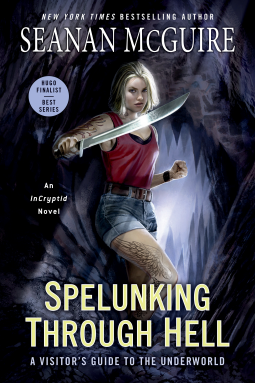
 Spelunking Through Hell, (A Visitor's Guide to the Underworld), by Seanan McGuire (DAW)


I have enjoyed Seanan McGuire’s “Incryptid” series since I discovered it. Earlier volumes felt like related, spin-off stand-alones set in the same world with characters who were loosely related to one another. I was particularly delighted to discover that Rose Marshall, from The Girl in the Green Silk Gown, a series I loved, is a distant, although usually off-scene character. The last couple of volumes were a bit of a disappointment, but on the strength of the earlier ones, I decided to give Spelunking Through Hell a try. It was richly worth it.

The crossroads—as in the place you go to make deals with the devil that never, ever turn out well for you—are sentient entities who make an appearance from time to time in McGuire’s related novels. To say they are nasty is an understatement. One of those bargains involved the magician, Thomas Price. He’s been confined to the premises of his (haunted, see Rose, above, and Mary Dunlevy, a ghost who occasionally doubles as a babysitter) house, but it’s part of the price he pays (to the crossroads, see above) for getting to be with his adored wife, Alice Healy. But when the crossroads eventually come to collect their debt, not even Mary can forestall them. Then he vanishes in the middle of the night and everyone is convinced he’s dead…except Alice, who waits only long enough to give birth to their second child and then embarks upon a five decades-long cross-dimensional search for her husband.

Along the way, she acquires friends and allies, including Ithacan satyrs, Helen and Phoebe, and Naga, the giant snake-man who is a professor of extra-dimensional studies. She also survives dimensions that are dying because their world-souls have been stripped, world inhabited by maniacal cannibals, and worse yet. Her kids won’t talk to the mom who abandoned them. Yet she refuses to give up.

This book is about her happy ending and what it cost her. It’s a brilliant, touching page-turner.


Friday, December 16, 2022

Short Book Reviews: Gideon Sable Returns!


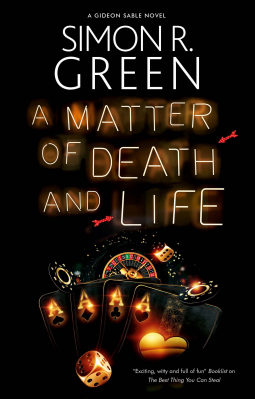
A Matter of Death and Life
, by Simon R. Green (Severn House)

Master thief, rogue, and con artist extraordinaire Gideon Sable is back for another supernatural heist, this time stealing an artifact rumored to grant immortality from a Las Vegas casino. In the process, he’ll pay off a very big favor and piss off his enemies. To do this, he pulls together his old crew, including his now-girlfriend, Annie Anybody, the woman who changes her persona as easily as her clothes and who can make electronics fall in love with her; The Damned, who wears invincible armor made of the halos of angels; and Johnny the Wild Card, who has walked the edge of madness so closely he’s on nodding terms with reality at the best of times. Joining them is predictably unreliable Switch It Sally, whose special talent is exchanging objects from a distance, instantaneously and invisibly. But the casino’s owners are definitely Bad Guys, it’s guarded by supernatural goons, and in this universe, nothing is ever as it seems.

I first encountered Gideon and his crew in The Best Thing You Can Steal, and this book is a worthy sequel. Green handles character, tension, and gorgeous if dark imagery so beautifully, his work is a joy to read. Here’s a taste:

“I finally came to a quiet cul-de-sac where the street lamps were remainders of a bygone age. All black iron and ornate stylings their light was so hazy that shadows formed dark pools between the lamps, like sinkholes in the world. The buildings were just dark shapes, with no lights at any of the windows, slumped together like drowsing animals, waiting for their prey to come within reach. Ample warning that this was not an area to be entered lightly, because the phrase ‘urban jungle’ isn’t always a metaphor.

“One photo showed a city where every building had been carved from a single piece of bone, and insects the size of people, or perhaps people who moved like insects, crawled up the outsides of the buildings. Another photo showed a flock of white whales, flying over an endless desert like living dirigibles. In a New York where all the skyscrapers were wrapped in ivy, lizards in smart city suits walked briskly through the financial district. Pterodactyls flapped around a broken Eiffel Tower…”


Friday, November 25, 2022

Short Book Reviews: A Cat in London Tower


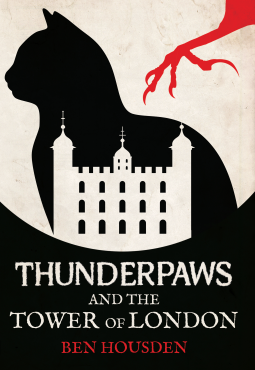
Thunderpaws and the Tower of London
(Nature's Claw Series, Book 1), by Ben Housden (High Gate Press)

When Teufel the cat (who hates his nickname, “Thunderpaws”) moves into the Tower of London with his chaplain owner, he is less than thrilled. The trip itself, including being sedated and transported, was bad enough, but now he finds the new rules insufferable: no doing his business on the lawn, no wandering at all hours, and no chasing the sacred ravens. Teufel is a Cat of Attitude, snark being primary among them, and he is not about to play nicely or restrain his innate Cat Nature. In his attempts to exercise his feline right to kill small prey and anything with wings, he encounters a mystical mouse, a couple of ghostly cats, and the deceased spirits of humans who have died in the Tower. Queen Anne, Lady Jane Grey, and Sir Walter Raleigh are bad enough, with Anne planning to destroy the internet. But when King Richard III and Guy Fawkes hatch a plot to take over London (and the world), Teufel is drawn in to a maze of dark schemes and darker magic. As it turns out, he’s not nearly as savvy as he thinks he is.

Among the many delights of the book are Teufel’s sarcastic voice, details about the ghosts, and the army of lady rats led by a giant rat named Elvis. I wish there had been more exploration of how Teufel changes with his misadventures, especially those that were his own fault. It was a good thing I read the book on my Kindle, because quite a number of references that would have been obvious to Londoners escaped this Californian at first.

My only real issue, however, was the extended epilogue. It’s one thing to set up a sequel, but to go on at length detracts from the satisfaction of defeating the agents of evil and then taking a break. Sequels, as opposed to books in a single multi-volume story arc, run the risk of being episodic, especially when the beginning of the next is inserted into the end of the first, thereby making it not a true end at all.

Despite my quibble about the epilog, this book should have special appeal to cat fanciers (and perhaps Londoners). The illustrations are particularly wonderful.


Friday, January 28, 2022

Short Book Reviews: A Dynamite Conclusion to the "Ghost Roads" Trilogy

 Angel of the Overpass, by Seanan McGuire (DAW)


I’m an enthusiastic fan of Seanan McGuire’s “Ghost Roads” series. I love the inventiveness of the world, the plot twists, and the ghostly-but-eminently-human narrator, Rose Marshall. A half-century ago, Rose was on her way to her high school prom when she was run down and killed. The driver was teenage heart-throb movie star, Bobby Cross, desperate to ensure his immortality through a crossroads bargain that requires him to keep driving a car that runs on the fuel of human souls. Bobby’s been on Rose’s trail ever since, determined to feed her soul to his car. Meanwhile, Rose’s prom date, having lived a long life regretting her loss, has become a ghostly car that communicates with her through his choice of tunes on his radio. Got all that? Now the crossroads themselves have been destroyed, and the realms of the ghosts have become increasingly unstable. And Bobby’s getting closer.

Rose may be dead, a “hitch-hiking ghost,” but she still retains her compassion and her gift for deep friendships. She’s capable of both growth and self-sacrifice, and her personality shines through the pages.

Absorbing and highly satisfying, Angel of the Overpass lifted my own spirits. I’ll come back to this series again and again.


Friday, January 21, 2022

Short Book Reviews: The Dark World of Mexican Vampires

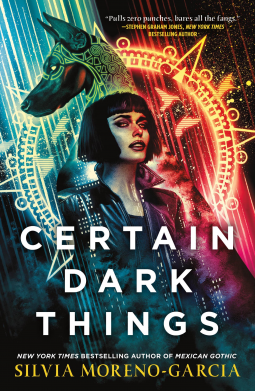
 Certain Dark Things, by Silvia Moreno-Garcia (Tor)


Silvia Moreno-Garcia continues to knock my socks off, literarily speaking. Her Gods of Jade and Shadow was nothing short of breath-taking. Now she turns her wild and dark imagination to a vampire tale set in Mexico City. In this world, there are not one but many kinds of vampires, each with its own history, weaknesses, and predilection for bloodshed. Certain Dark Things tells the story of the perilous friendship between street-kid Domingo and Atl of the Aztec line of vampires whose family has been wiped out by the viciously violent narco-vampire clan. Atl is young and inexperienced in vampire terms and has led a carefree life, never having to make hard choices. Now she’s on the run for her immortal life. She’s the most beautiful woman Domingo has ever seen, and he can hardly believe his luck when she accepts his help. Atl’s only hope for a way to safety lies in fleeing Mexico, but to do that she needs documents available only through a secret and highly elusive vampire underground. Unfortunately, she soon attracts the attention of both crime bosses and a cop dedicated to exterminating her kind.

I’d classify this book as dark urban fantasy rather than horror, but it should appeal to readers of both genres. If you’ve never read Moreno-Garcia, you’re in for a treat.


Friday, January 14, 2022

Short Book Reviews: A Zimbabwean Ghost-Talker in Scotland


The Library of the Dead
, by T. L. Huchu (Tor)

This book is just marvelous. It’s got a near-future dystopic setting, with all the creative and dysfunctional ways people adapt to crumbling civilization and a devastated ecology. A world in which ghosts hang around, pleading to speak with their loved ones and a secret academy trains wizards in the depths of Edinburgh. Best of all, though, is teen narrator, Ropa, a “ghost talker” who blends her Zimbabwean heritage with snappy Scottish slang, a gift for compassion, and intellectual curiosity.

Life is hard enough for Ropa. Along with her grandmother and smart-talking younger sister, she lives in a decaying RV and is always behind on paying rent for their spot. She’s had to drop out of school, her ghost-talking work is unpredictable, and the future doesn’t offer much. To make matters worse, children have been disappearing…and when they’re found, they suffer from extreme premature aging. In a seemingly unrelated incident, an old school friend from a posh family sneaks her into an underground library of the occult where she’s threatened with immediate execution for trespass until she’s given a student pass. Now, armed with a new classmate, she’s off to discover who’s taking the missing children and what’s happened to them.

The voice of narrator Ropa is the best part of the book, vivid and compelling and smart. She’s so engaging that I kept turning pages even when it seemed the mystery and other story elements were never going to come together (they do!) It felt like a braided novel, but I was more than happy to go along with Ropa as the linking thread. It’s impossible to overstate how powerful the narrative voice was.


Friday, January 7, 2022

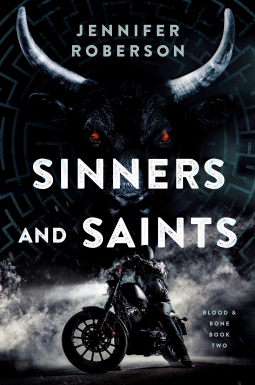
Short Book Reviews: Sinners and Saints by Jennifer Roberson


In my review of Life and Limb, I wrote: “A new Jennifer Roberson novel is always a treat, but a new Jennifer Roberson series is a cause for celebration.” Sinners and Saints, which continues the story of Gabe and Remi, an ex-con biker and a Texas cowboy, is even better! The two unlikely brothers-in-spirit share part-angelic ancestry and all-too-human limitations. Now, abandoned by their heavenly guide and thrown on their own resources, they’re about to face an unexpected menace: the spirit of Jack the Ripper (yes, that Jack the Ripper) who is bent on savagely murdering women who share the names of his historical victims. As if that weren’t enough of a challenge, Lucifer’s own shock troops are out to destroy the two.

Sinners and Saints succeeds on so many levels: fascinating world-building that draws from diverse folklore, myths, and legends, plot twists and superbly handled tension to keep the pages turning, and a mystery worthy of a volume of its own. The best part for me, though, is the hallmark of Roberson’s work: the depth and intricacy of her characters. Gabe and Remi are not only heroes to fall in love with over and over, but reminders that even fallible humans are capable of tremendous courage, loyalty, and self-sacrifice. No matter what the odds and reversals, no matter how many times they stumble, they never give up. The world is a better, more hopeful place with them in it.


Friday, February 26, 2021

Short Book Reviews: Magical Hands as a Tool of Racial Justice


Trouble the Saints
, by Alaya Dawn Johnson (Tor)

The core of the magic in this edgy, often disturbing fantasy is that the anguish of slaves was so deep, so powerful, that it created a spell persisting to the modern age. This takes the form of bespelled hands – hands that can detect a person’s darkest secrets, hands that can tell the future – and hands that crave justice. In 1940s New York, the descendants of those slaves, men and women gifted with magical hands, often end up on the wrong side of the law. Phyllis, the first of these characters, is an enforcer for a white mobster, his “avenging angel.” Her best friend, Tamara, dances with a snake and tells fortunes at the mobster’s night club. And Dev, who loves them both, is a bartender by night and police informant by day. But someone has been targeting Blacks and harvesting their hands…

Trouble the Saints is a difficult book to describe. It’s not an easy or comfortable read, but it is an important book, fearlessly delving into issues of racism, injustice, murder, greed, and forgiveness.


Monday, July 20, 2020

Author Interview: Helen Harper

Today I chat with Helen Harper, author of the delightful fantasy, Wishful Thinking (How To Be The Best Damn Faery Godmother In The World (Or Die Trying), which I reviewed here.


Deborah J. Ross: Tell us a little about yourself.  How did you come to be a writer?

Helen Harper: I always thought of myself as a reader rather than a writer. I grew up
entirely immersed in books of all sorts, but fantasy was always my
favourite. In my early twenties I had vague notions of trying to write
for Mills and Boon but, when I tried to write something, I realised it
was far harder than I thought so I abandoned my efforts. Much later on,
when I found myself under a great deal of stress at work, I discovered
that writing was the perfect way to take a step back from life and
immerse myself in other worlds. Instead of slobbing out in front of the
television, I would write. I didn't have any plans to share what I
wrote. It was purely a release for myself. Nobody was more surprised
than myself when I realised that not only had I managed to write
complete books but that other people wanted to read them.

DJR: What inspires your books?
HH: I'm a pantser rather than a plotter so I tend to make things up as I go
along. However, I always start with a germ of an idea that can come from
anywhere. With The Lazy Girl's Guide to Magic, it was a chat with a good
friend about how we would make useless book heroines because we were too
lazy. With Highland Magic, the ideas came from wondering about the
divide between the Highlands and the Lowlands of Scotland and the
Dreamweaver series was inspired by an article I read about adult night
terrors.

Friday, June 26, 2020

Short Book Reviews: The Bureau of Faery Godmothers


Wishful Thinking (How To Be The Best Damn Faery Godmother In The World (Or Die Trying), Book 1) by Helen Harper (Harperfire)

Saffron may be the best drug faery ever, creating hallucinations to guide addicts back to sobriety or at least sanity, but her own ambition is to join the august company of faery godmothers. The most wonderful job she can imagine is to grant the dearest wish of her human client. When she at last receives a coveted invitation to join that elite organization, she is thrilled . . . until she discovers that faery godmothers are going missing and she is to be the bait for the kidnapper. Her welcome is anything but warm as the other godmothers, male and female alike, ignore, spurn, or attack her. To make matters worse, the darkly sinister and intimidating Devil’s Advocate arrives to investigate the situation.

Saffron’s personality shines through the story. She’s warm and funny and earthy, and compassionate in a way few other faeries are. The story achieves a nice balance between dramatic tension, action, and quieter but no less fascinating events. The magic is innovative, the setting (London) a quixotic blend of mundane and otherworldly, and all the characters grow and change. I especially love stories in which both the protagonist and her adversaries reveal hidden depths, becoming more complex and appealing (or revolting, as the case may be). Needless to say, I’m looking forward to the next adventures of Saffron and her friends.


Friday, November 8, 2019

Short Book Reviews: Teaming up To Stop the Apocalypse


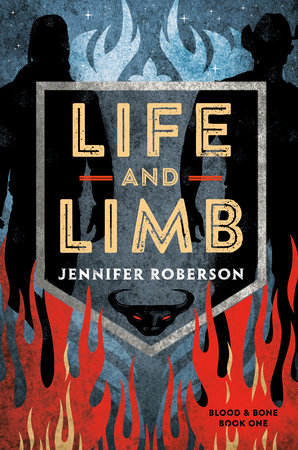
Life and Limb, by Jennifer Roberson (DAW)

A new Jennifer Roberson novel is always a treat, but a new Jennifer Roberson series is a cause for celebration. It should be obvious from my opening sentence that I am a huge fan. I’ve been an avid reader since her debut, Shapechangers (1984, the first “Cheysuli” novel). The way she combines action, ideas, internal struggle, and romance hit just the right notes for me. More importantly, I love how her work has matured and deepened over time. It seems to me that every time she takes a break or begins something new, I see a quantum leap in skill and insight.

Life and Limb, the first volume in her new “Blood and Bone” series, is no exception. She’s begun with a nifty concept: an ex-con biker (Gabriel Harlan) teams up with a clean-cut cowboy (Remi McCue) to fight supernatural nasties and stop the looming apocalypse. And oh yes, they both grew up with a mysterious grandfather, Grandaddy Jubal Horatio Tanner who isn’t human, and neither are they, or not entirely.

In many ways, Life and Limb is the set-up for that conflict, the origin story. Certainly, there’s plenty of action, both internal and external, and a host of adversaries and allies. Grandaddy Jubal has other teams to enlist, so he leaves our heroes in the care of Lily Morrigan (as in “The” Morrigan, the Celtic goddess of war, fate and death). Hell’s vents have opened, pouring forth an army of mythological nasties (ghosts, vampires, black dogs, and the like) which now can get infected by demons. Their skills are complementary: Gabe is a crack shooter with guns, but Remi is expert with throwing knives. Gabe has an unerring sense for the rightness (or wrongness) of a place, while Remi’s gift is reading people. And while they’re sniffing out and doing away with demonic presences, the Morrigan tells them, “hell knows you’re here.”

The narrative voice, from Gabe’s first-person perspective, is richly evocative, and the handling of detail, setting and nuance is top-notch, flavored with my favorite cultural references. Therein lies both the book’s strength and its challenge. The heart of the book’s energy, its center, is the emotional and spiritual journey of these two characters. Neither just accepts at face value their angelic nature or their destiny. Much of the story revolves around challenging what they have been told, grappling with how their lives will never the same, figuring out what each means to the other, and along the way making near-fatal mistakes, either from inflated self-confidence or ignorance. They learn by slow steps, often circling around to the same questions before moving on. This is how we humans deal with events and information that changes our entire understanding of the cosmos and our role in it. We question, we negotiate, we accept, then we question some more. Sometimes we have to ask the same questions over and over in different ways until the answers make sense. All the while, these characters get to know one another, overcoming skepticism and distrust. Much of the pleasure of reading a character-rich novel is in falling in love with those characters.


Bottom line: I adored this awesome urban fantasy and can’t wait for the next volume.

Friday, August 2, 2019

Short Book Reviews: Paranormal Romance Reads Like Failed Thriller, or Vice Versa

American Witch (American Witch: Book 1), by Thea Harrison (Victory Editing NetGalley Co-Op)

I read a little romance and a lot of fantasy, so I tend to prefer stories that are heavy on magic/plot/dramatic tension and tender love stories, and light on heaving bosoms and overwhelming lust for inappropriate partners. So now you know my prejudices.

American Witch begins promisingly enough with forty-something Molly Sullivan discovering that her attorney husband has been unfaithful to her . . . again. She wigs out, confronts him before the senior partner of his firm, the newly elected District Attorney, and all the guests at their elegant party, throws the contents of their safe into her suitcase, and decamps. From there, matters spin utterly out of control as she discovers banking records for an account in the Seychelles and her soon-to-be-ex comes after her in a near-lethal attack. She fights back, using magical Powers she had no idea she possessed. Soon she’s entangled with Josiah Mason, the above-mentioned DA, who is an ancient, powerful witch himself, and has gathered a coven to track down and eliminate an even older and very wicked witch (one of whose past lives will be immediately recognizable). In other words, the story hits the ground running.

Alas, all that action comes to a near halt as Molly and Josiah become increasingly mired in their mutual lust and repulsion. Finally they tumble into bed together, drenched in overwhelming sexual need, with tons of pretty nicely described sexual acts. There’s even a brief discussion about birth control, for which the author would get a gold star from me except it’s not about responsible, mutually respectful sex, it’s a set-up for the inevitable contraceptive failure and resulting pregnancy.

Friday, November 30, 2018

Short Book Reviews: Bram Stoker and the Raiders of Ancient Egypt

The Night Crossing, by Robert Masello (47North)

Loosely falling into the category of historical urban fantasy, this delicious tale places Bram Stoker, author of Dracula, center-stage. Literally, since Stoker ran the theater that featured Henry Irving, the first actor to be knighted. And figuratively, since this is essentially Bram’s adventure. In the 19th Century, “Egyptomania,” enthusiasm for all things ancient Egyptian, swept Western Europe. Ordinary travelers as well as serious scholars pillaged archaeological sites looking for treasure and curiosities, which they of course brought back to England. Never mind the damage done by amateurs to the archaeological sites. To be sure, some artifacts ended up with serious collectors who cared about provenance and preservation. Accounts relate “mummy unwrapping parties.” People apparently considered a fine way to pass an evening with port wine and removing the coverings of a mummy, searching for small articles folded in the bandages, which were then distributed as trinkets. (Some scholars now dispute these accounts, although not those of scholars holding similar public events.)

In the world of urban historical fantasy, Egyptian burial practices involve supernatural elements, including the ability to prolong life and reanimate the dead. Bram, searching for a high-concept premise to launch his literary career from obscurity into best-seller territory, takes notice when he runs afoul of a brother and sister duo who are using Egyptian magic to do just that.

Enter (Minerva) Mina Harcourt, intrepid Anglo-Romany adventurer, her century’s female Indiana Jones. While investigating the monumentally huge Carpathian sphinx (there really is such a thing), she comes into possession of a mysterious golden box (see the cover image). Enter also Lucinda Watts, a timid young woman who works in a match factory (owned by the brother of the above-referenced nefarious pair), suffers from phossy jaw (formally known as phosphorus necrosis of the jaw, from the white phosphorus used in match manufacture) and is the mother of an illegitimate son (the brother being a rapist, as well) who dies when the evil duo suck out his soul. (That’s an approximate summation of the process, which is actually more than a bit more complex.)

Before long, Bram and Mina are on the hunt not only for the Egyptian immortality thieves but the origin of her golden box and the shadows that mysterious escape from it. The mash-up of historical setting and real personages, the fictional inspirations for Stoker’s Dracula, and the dramatic twists and turns make this a delicious and occasionally shiver-producing thriller. The narrative style, rich in detail, atmosphere, and well-drawn personalities, kept me turning pages even through the parts of slower action. The variation in pace allowed for context, nuance, and emotional resonance, making The Night Crossing more than just a “fun read.” I’ll be on the lookout for more from this sensitive, skillful writer.

The usual disclaimer: I received a review copy of this book, but no one bribed me to say anything about it.

Friday, November 23, 2018

Short Book Reviews: Vampires and Ogres and Were-Dragons, Oh My!

Shadow's Bane, by Karen Chance (Berkley)

Elsewhere I have written about the challenges of picking up a book in the middle of a series, and it’s worth repeating here:

 “Series” can mean a number of things, from stand-alone complete-in-themselves novels set in the same universe to one long story that extends over several volumes. Recently I listened to an interview with Peter Jackson in which he discussed the decision to not put a recap at the beginning of The Two Towers, the second part of The Lord of the Rings. He felt that one year between film was a short enough time for viewers (those few not intimately familiar with the books) to remember and anyone who went to see it without having seen or read The Fellowship of the Ring, oh well… I admit to not being as careful as I might about checking to see if a book is a sequel, so I rely on the skill of the author to furnish necessary backstory without inundating me with it, and to draw me into the story so that even if I have to work a little harder to figure out what has gone before, I’m already hooked. 

I began Shadow’s Bane without realizing it was “yet another adventure” in a series. To the ultimate credit of the author, for most of the book, I honestly could not tell if there was separate backstory (previous volumes) or if this was a brilliantly executed, complex novel that wove in aforementioned backstory, world-building, and characters, all while sweeping me up in a dramatic, action-driven plot.

The world is fascinating, multi-layered, and rich in its own history. Vampires exist, as do dhampirs (vampire-human hybrids, heartily loathed by both parent races), ogres, fae, mermaids, were-creatures, and magicians. Relations between the various races are uneasy at best and impossible to summarize here. Our heroine, Dory/Dorina, in addition to being dhampir, suffers from split personality that’s the result of her (vampire) father attempting to save her from her worser (waaaay worser) nature. So there’s a nice internal conflict, as well as rather spicy romance with a master vampire, a sweet friendship with a human woman who has (a) given birth to the heir to a fairy kingdom; (b) turns out to be a were-dragon, so don’t get her pissed, and various other friendships and enemyships.

Friday, June 29, 2018

Short Book Reviews: Amusement Park Urban Fantasy


Tricks for Free by Seanan McGuire (DAW)

Seanan McGuire’s “InCryptid” series just keeps getting better, her world-building more detailed, and her characters growing and changing as they struggle against inner as well as outer demons. Antimony Price comes from a family of cryptozoologists, dedicated to the study, protection, and sometimes containment of “incryptids,” creatures like Bigfoot, but who live disguised as humans. The last episode, Magic for Nothing, sent Antimony undercover, infiltrating the Covenant of St. George (yes, the  dragonslayer), whose aim is the destruction of all incryptids, no matter how benign. While in disguise and investigating a traveling carnival, she met Sam, a trapeze artist whose natural form resembles a graceful simian. Sparrow Hill Road, a related novel, introduced us to the world of road ghosts, crossroads bargains, and route-witches, many of which play crucial roles in this new novel.

Now, at the beginning of Tricks for Free, Antimony is on the run from the Covenant and hiding from her family. As she says:

I never wanted my life to be a wacky sitcom about a human girl and her inhuman roommates struggling to get by at what many people consider to be the second-happiest place in the world.

She’s taken a job working for Lowryland, a not-quite-second-rate Disneyland. Sharing an employer-provided apartment are her friends Fern (a sylf capable of altering her physical density), who enacts one of the many Fairyland princesses, and Megan, a (Pliny’s) gorgon, who in real life is a medical resident. In between the byzantine company politics, trying to stay off the Covenant’s radar and also to not burn down the theme park with her increasingly erratic ability to set fires, Antimony unearths a secret cabal of witches and sorcerers bent upon harvesting the good luck of the patrons to boost their own power. Things go awry as one terribly unlucky accident leads to another. Then Sam shows up, as well as various ghostly aunts, and the plot races right along.

McGuire writes complex, interconnected series in which every (or almost every) volume stands on its own, fast-paced, absorbing, and satisfying. She weaves in backstory and setting with such a deft touch that the reader is neither baffled nor inundated by chunks of indigestible exposition. Although I had read Magic for Nothing and Sparrow Hill Road fairly recently and enjoyed the references, I think Tricks for Free would work just as well as an introduction. So even if you’re new to the delights of the InCryptid and road ghost worlds, dive right in for a great read.

Friday, October 13, 2017

Short Book Reviews: A Magical Bed and Breakfast, with Occasional Werewolf

The Innkeeper Chronicles, Volume One, by Ilona Andrews, Subterranean Press, 2017. (Clean Sweep, Sweep in Peace, One Fell Sweep).


This husband and wife writing team, using her name, Ilona Andrews, obviously had a terrifically good time with their free, serialized urban fantasy “Innkeeper” novels. 

A charming young innkeeper, Dina Demille (from the innkeeper family of the same name), is like any other innkeeper bonded to her sentient and extremely powerful and magical inn, Gertrude Hunt. Scattered over Earth, these inns provide neutral havens for interstellar creatures. Dina is dedicated to the safety and comfort of her guests, many of whom would otherwise be at each other’s throats. Predictably, events and blood-thirsty, revenge-driven and otherwise unlaw-abiding forces collude to interrupt that peace. 

Although blessed with supernatural powers within the inn’s grounds, Dina becomes ordinary the farther she gets from home. To meet the various threats, she therefore acquires allies and (sometimes would-be lovers) in the form of sexy werewolves and equally sexy vampires, but the real charm of these stories lies in her courage and resourcefulness, coupled with a not inconsiderable thread of whimsy. 

Humor, romance, and suspense are nicely balanced against each other, and the central characters are so appealing, I was sad when I finished the last page. (Not to be too sad: the Innkeeper website assures me there will be more! Check it out here: http://innkeeper.ilona-andrews.com/)

Friday, May 19, 2017

Short Book Reviews: Urban Fantasy Circa 1991

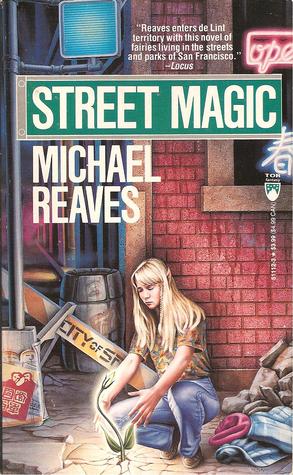
Street Magic, by Michael Reaves, Tor 1991. This isn’t a new book, as you can see by the date. In fact,
I believe it’s the first urban fantasy I read, along the lines of “elves in Manhattan.” In this case, the city is San Francisco, but it could be any big, grimy, noisy city that draws runaways, abandoned kids, and the disillusioned. It’s a fairly short book, and by today’s standards quite simple, but in its time, the tropes were sufficiently new to stand on their own without an overly elaborate plot. I tried to step aside from the urban fantasy of the last 15 years and re-read it with fresh eyes. The characters and elements that appealed to me then still do. The ones that didn’t (like the street kid to whom magical creatures are drawn) still don’t; however, what was once annoying I now see as a not-so-successful exploration of a literary shorthand we now take for granted and that has not weathered the years well.

My favorite characters included an elderly woman bookstore owner (of course!) and the photographer who once glimpsed a door into Faerie (at Muir Woods, of all places – where I visited many times as a teen and college age student, hiking in the “back way” from my parents’ house – well, redwood grove and magic do go together, or so I have always thought), botched his chance to step through that door, and now has descended into a haze of alcohol and regret. He’s not a major character and doesn’t drive the plot, but the way he grapples with his yearning to find Faerie again (and this time, seize the chance he missed before) in conflict with living an ordinary, mortal life in an ordinary, mortal world touched me deeply. Isn’t that what we all do – try to balance and integrate the unrealistic, idealistic dreaming and the humdrum, hoping to forge lives that in some way connect and nurture the miraculous?


The verdict: If you haven’t read it, do take a look. It’s a short book and moves right along, and even after all these years has something to offer, especially in the secondary characters. If you missed it and you love urban fantasy, I commend this historical perspective on the genre.

Tuesday, July 17, 2012

Is This Story Too Big…Or Is The Book Too Small?


Recently, I read two novels that left me chewing over the issue of story size. The two novels were Love On The Run by Katharine Kerr and A Discovery of Witches by Deborah Harkness. Both were absorbing, with characters I cared about and nifty plot twists, ideas to chew on, and interesting locales. In other words, they were respectable novels by competent authors. I enjoyed them, yet each in a different way left me wishing the book had been either longer or shorter.

Love On The Run is the fourth in a series about a paranormal investigator, Nola O'Grady, her sweetheart Ari who is by no means mundane, the various doings of the super-secret agency that employs her, and her family, variously gifted and not always on the right side of the law on this and several other worlds. By the time Love On The Run takes place, we've had a chance to get to know these characters and worlds. The multiplicity of related alternate universes reminded me of some of my favorite early Andre Norton science fiction.

A Discovery of Witches is actually the first volume in a trilogy, but for some reason I did not realize that until I sat down to write this essay. I was thoroughly prepared to enjoy it -- what a delight to begin a story in the research shelves of the Bodleian Library, tracking down and deciphering ancient manuscripts.

Thursday, April 7, 2011

A Handful of Easy Reading Fantasies

I've been having way too much fun with these,

Enchanted Glass by Diana Wynne Jones. Any new book by Jones is a delicious treat, a reason to put down whatever else I'm doing and curl up with a cup of tea. This one, however, came with special poignancy because I received it just after I learned of her death. So I opened the pages with a kind of sadness, not wanting to admit that in many ways, this was farewell. (If there is another book to be published posthumously, I don't know of it.)

And found magic. Within a few paragraphs, her clear prose and unaffectedly direct storytelling had drawn me into a world in which magicians bequeath not only fine old houses but fields-of-care as well. Only in this case, the old magician left it "rather too late," meaning without personal instruction as to exactly what a field-of-care is and how one cares for it. A few pages later, Andrew Hope is struggling not only with his magical inheritance but with the two classically-Jones abrasive and recalcitrant retainers, Mr. Stock (who expresses his disapproval in the form of boxes of gigantic and inedible vegetables) and Mrs. Stock (no relation to Mr. Stock, who expresses hers by waging war as to the positioning of the piano in the living room). By the time young Aidan (the boy on the rainbow-hued cover) arrived, I had become part of the household as well.