Monday, September 28, 2026

[Reprint] How Trauma Shapes Memory


Traumatic memories are often fragmented – a psychologist explains how and why that happens

Young Asian woman sits on a sofa looking sad and worried.
Traumatic memories are not recalled the same way pleasant memories are. Filmstax/E+ via Getty Images
Michele Patterson Ford, Dickinson College

When survivors of trauma recount their experiences, they are often questioned because of how they relay their stories. They may have problems remembering what happened, or their memories may be jumbled or even contradictory. People hearing those stories – attorneys, reporters, healthcare workers or friends – may expect a clearer, linear narrative.

Those unaffected by trauma may also be surprised to hear how the person acted in the moment. It’s easy to assume that someone experiencing a traumatic event would have a “fight or flight” response, instinctively fighting off a perpetrator or fleeing the scene – but that might not be the case.

Understanding the science of how trauma affects memory and behavior reveals why these responses can actually be expected and are not contradictory.

In both my academic and clinical work as a psychologist, I have witnessed the impact trauma has on people’s memories and behaviors, especially when an event in their present life triggers something from their past.

Research shows that taking a trauma-informed approach, which prioritizes understanding and curiosity about someone’s experience as opposed to judgment or critical evaluation, increases empathy for survivors’ thoughts, feelings and behaviors.

How trauma affects the brain

According to the World Health Organization, approximately 70% of people worldwide report experiencing a traumatic event in their lifetime. The majority of these people do not develop PTSD, a clinical diagnosis of symptoms, such as having nightmares and flashbacks about the event, avoiding places that are reminders of it, and increased arousal that can make concentration and sleep difficult. Many survivors don’t meet criteria for PTSD but struggle with feeling distressed, depressed or anxious.

In traumatic situations, people often respond in unexpected ways, and they may second-guess themselves. This may happen particularly when someone experiences a repeated trauma, which is more likely than not due to how many people experience traumatic events.

Trauma also distorts how memories are stored and retrieved.

Research indicates that people experience traumatic memories differently than memories of other significant events, such as sad or positive experiences. Two of the main brain structures scientists believe are involved in storing traumatic memories are the hippocampus – responsible for memory storage – and the amygdala, which is responsible for processing emotions.

During trauma, the amygdala becomes highly active, processing emotions such as fear, and the hippocampus becomes overwhelmed by stress, leading to problems with memory storage.

Traumatic memories do not follow a neat, linear story. Instead, people may experience the memory as disconnected fragments of sensations, emotions, smells or images. Such memories cause the body to reexperience the past threat as if it is happening in the moment. This may cause a person to feel like running away or fighting back – flight or fight. Or they may freeze.

In other words, people don’t have the distant perspective they often feel with other memories from the past. Rather, they may feel they are reliving the original experience.

Single working mother and her teenage daughter talk with much emotion in the kitchen.
Emotionally intense conversations can bring up past traumas, causing a person to freeze or feel numb. Olga Rolenko/Moment via Getty Images

Misinterpreting victims’ behaviors

With this understanding, consider someone who experiences a trauma at the hands of a professional during an appointment. They may appear outwardly calm while it happens and then leave the session as they typically would – checking out, providing payment and possibly even scheduling the next appointment. While their response to act normally may seem odd, such behavior makes sense for someone trying to escape a threat.

Fight, flight or freeze responses have become widely known in popular culture. In a freeze response, a person’s mind goes blank and they may be unable to speak, leading to a “deer in the headlights” behavior.

On the other hand, a person may act paradoxically – perhaps by going on about their day as if nothing happened. They may not report the event or may question whether the incident even occurred. This represents another survival response – the lesser-known fawn response. This way of handling stress occurs when someone acts calm, appeases the threatening person and retreats to de-escalate the situation. Instead of literally backing away, in this example, the person metaphorically backs away by completing the session and exiting as expected without further conflict.

Outsiders may misconstrue these behaviors as evidence that a trauma did not actually happen or that a survivor lacks credibility. But that logic reflects common misconceptions about how people “should” remember or respond to trauma.

Monday, September 14, 2026

[Reprint] What to do if your vote is challenged


What to do if your vote is challenged: Practical advice for midterm elections

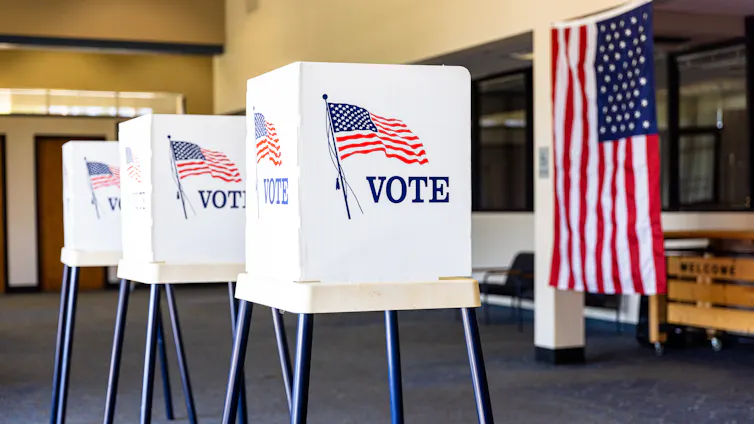
Three voting booths and an American flag.
Many states allow same-day registration at the polling site. adamkaz/Getty Images
Karen Figueroa-Clewett, USC Dornsife College of Letters, Arts and Sciences

As the 2026 midterm elections enter the final stretch, it’s important to know your rights in case your vote is challenged.

The best way to ensure that your vote is counted is to advocate for yourself. I’m a an attorney and lecturer for the University of Southern California’s undergraduate civil rights advocacy initiative, Agents of Change. Here are several straightforward ways to ensure your vote is counted and two practical remedies for you to consider if your vote remains challenged.

A major part of ensuring that you are able to vote is doing the necessary preparation before you even get to the polling place. Read on to find out how and where to register, where and when you can cast your ballot, and what numbers to call for any information you can’t find online.

Are you registered to vote? Check it out

Before you vote, you need to ensure that you’re registered to vote. You can verify your registration status using this tool. If you can’t use an online tool, then call your local election office or a voter help line like the ones listed in the hotline section below.

If you find you’re not registered, you can use this tool from the National Conference of State Legislatures to find your state’s online registration application. If you need to do this in person, then call your local election office for instructions.

At this point, you may have missed your state’s deadline for voter registration. But it may not be too late to register.

Many states allow same-day registration at the polling site. You can find your state’s same-day voter laws detailed here. Ask the poll worker, at the correct polling location, for a same-day registration form; complete the form and then ask for a “conditional ballot.” A conditional ballot allows election officials to count your vote after verifying your voter eligibility. If you can’t research online, you can call your local election office to find out if you can register on Election Day.

Three young men with backpacks, talking; one of them is reading something on a clipboard he's holding.
Marchellos Scott, right, helps Morehouse College students fill out a voter registration form at a college registration booth on Aug. 19, 2024, in Atlanta. Elijah Nouvelage/AFP via Getty Images

Gather documents to verify your identity

If you live in a state that requires identity verification to vote in person, gather the required documents – which may range from a driver’s license to bank statements with identifying information – before traveling to the correct polling place. You can find your county election office’s contact information here. This webpage includes a table listing each state’s acceptable ID documents and possible exceptions for some people. You may also call your local election office to find out what’s required.

Absentee voters: Locate your state’s identity verification rules here.

Find the correct polling location

You can ensure that you’re headed to the right polling place with this tool. Or call your county election office to find your polling place and its hours of operation; you can look up your county’s election office contact information here.

Once you know your polling place and its hours, you can go there and check in. In most cases, you’ll be handed a ballot, shown where to vote and asked to put your ballot in a machine or a box, and then you can go merrily along your way.

But the moment of check-in is where things might go wrong.

Problems at your polling place

Friday, September 11, 2026

Book Review: A Hilarious Guide to Querying Literary Agents

 Fake Query Letters by Dead Authors: A Satirical Craft Guide to Writing Queries That Survive the Slush Pile, by David Brown and Michelle Barker (Darling Axe Publishing)


How-to books for authors abound in today’s market. Not all the advice is worth taking. Indeed, much of it seems to be based on outdated practices, flawed “conventional wisdom,” or is intended for novice self-published authors. Very little is aimed at serious authors interested in traditional publishing or established midlist authors scrambling to keep up with today’s rapidly changing market. Much of it is contradictory and involves a great deal of telling the author how to get an agent instead of showing pitfalls and best practices.

The latest entry in this field is the delightful, highly informative book, Fake Query Letters by Dead Authors: A Satirical Craft Guide to Writing Queries That Survive the Slush Pile, by David Brown and Michelle Barker of Darling Axe. They open with this intriguing premise:


 What if the greatest novels ever written had to survive today's slush pile? No reputation to fall back on—just a cover letter and first page... and an agent who's already read 200 queries before lunch.

Spoiler: most of them wouldn't make it. 

Using five classic novels (Pride and Prejudice, Wuthering Heights, The Scarlet Letter, Anne of Green Gables, and Jane Eyre) they first demonstrate the worst possible way the authors could query an agent and how to fix their disastrous mistakes.

 Query guidelines for literary agents vary, but most include a letter, synopsis, and sample pages, which are often the first chapter). We already know (and, hopefully, love) the text, which gives us a foundation to evaluate each horrible, rejection-guaranteed sample letter and synopsis. The authors invite us to imagine ourselves as literary agents at the end of a punishing work week, facing an Inbox jammed with queries. (So much fun!) What would tempt us to read the entire query and then—oh joy!—request the entire manuscript?

Highly recommended for fiction writers at all stages of their careers for whom a literary agent is appropriate. Also highly recommended for indie (self-published) writers for invaluable insights into how to craft a compelling novel and then present it at its best. After all, in today’s overcrowded market, readers will decide to pick up a book on the same basis of a dynamite pitch.