Showing posts with label democracy. Show all posts

Monday, September 14, 2026

[Reprint] What to do if your vote is challenged


What to do if your vote is challenged: Practical advice for midterm elections
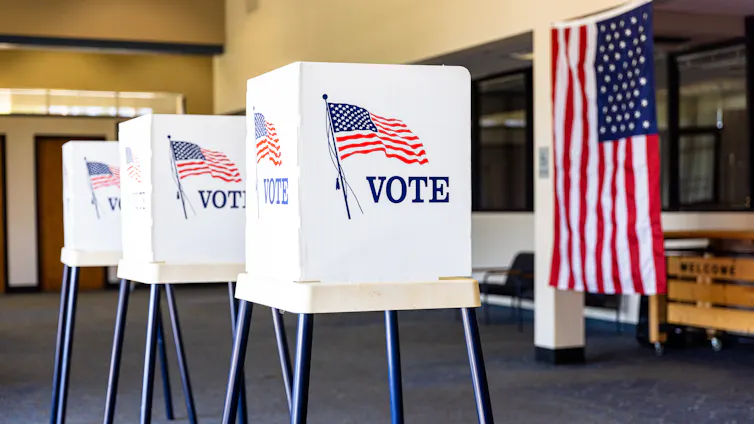
Three voting booths and an American flag.
Many states allow same-day registration at the polling site. adamkaz/Getty Images
Karen Figueroa-Clewett, USC Dornsife College of Letters, Arts and Sciences

As the 2026 midterm elections enter the final stretch, it’s important to know your rights in case your vote is challenged.

The best way to ensure that your vote is counted is to advocate for yourself. I’m a an attorney and lecturer for the University of Southern California’s undergraduate civil rights advocacy initiative, Agents of Change. Here are several straightforward ways to ensure your vote is counted and two practical remedies for you to consider if your vote remains challenged.

A major part of ensuring that you are able to vote is doing the necessary preparation before you even get to the polling place. Read on to find out how and where to register, where and when you can cast your ballot, and what numbers to call for any information you can’t find online.

Are you registered to vote? Check it out

Before you vote, you need to ensure that you’re registered to vote. You can verify your registration status using this tool. If you can’t use an online tool, then call your local election office or a voter help line like the ones listed in the hotline section below.

If you find you’re not registered, you can use this tool from the National Conference of State Legislatures to find your state’s online registration application. If you need to do this in person, then call your local election office for instructions.

At this point, you may have missed your state’s deadline for voter registration. But it may not be too late to register.

Many states allow same-day registration at the polling site. You can find your state’s same-day voter laws detailed here. Ask the poll worker, at the correct polling location, for a same-day registration form; complete the form and then ask for a “conditional ballot.” A conditional ballot allows election officials to count your vote after verifying your voter eligibility. If you can’t research online, you can call your local election office to find out if you can register on Election Day.

Three young men with backpacks, talking; one of them is reading something on a clipboard he's holding.
Marchellos Scott, right, helps Morehouse College students fill out a voter registration form at a college registration booth on Aug. 19, 2024, in Atlanta. Elijah Nouvelage/AFP via Getty Images

Gather documents to verify your identity

If you live in a state that requires identity verification to vote in person, gather the required documents – which may range from a driver’s license to bank statements with identifying information – before traveling to the correct polling place. You can find your county election office’s contact information here. This webpage includes a table listing each state’s acceptable ID documents and possible exceptions for some people. You may also call your local election office to find out what’s required.

Absentee voters: Locate your state’s identity verification rules here.

Find the correct polling location

You can ensure that you’re headed to the right polling place with this tool. Or call your county election office to find your polling place and its hours of operation; you can look up your county’s election office contact information here.

Once you know your polling place and its hours, you can go there and check in. In most cases, you’ll be handed a ballot, shown where to vote and asked to put your ballot in a machine or a box, and then you can go merrily along your way.

But the moment of check-in is where things might go wrong.

Problems at your polling place

Monday, November 3, 2025

Reprint: What Can We Do After NoKings?


10 effective things citizens can do to make change in addition to attending a protest

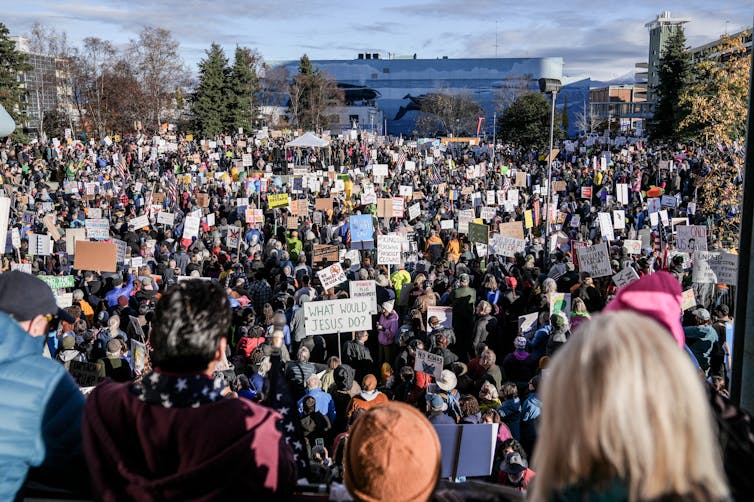
A crowd gathered for a “No Kings” protest on October 18, 2025 in Anchorage, Alaska. Hasan Akbas/Anadolu via Getty Images
Shelley Inglis, Rutgers University

What happens now?

That may well be the question being asked by “No Kings” protesters, who marched, rallied and danced all over the nation on Saturday, Oct. 18, 2025.

Pro-democracy groups had aimed to encourage large numbers of Americans to demonstrate that “together we are choosing democracy.” They were successful, with crowds turning out for demonstrations in thousands of cities and towns from Anchorage to Miami.

And while multiple GOP leaders had attacked the planned demonstrations, describing them as “hate America” rallies, political science scholars and national security experts agree that the current U.S. administration’s actions are indeed placing the world’s oldest continuous constitutional republic in jeopardy.

Once a democracy starts to erode, it can be difficult to reverse the trend. Only 42% of democracies affected by autocratization – a transformation in governance that erodes democratic safeguards – since 1994 have rebounded after a democratic breakdown, according to Swedish research institute V-Dem.

Often termed “democratic backsliding,” such periods involve government-led changes to rules and norms to weaken individual freedoms and undermine or eliminate checks on power exercised by independent institutions, both governmental and non-governmental.

Democracies that have suffered setbacks vary widely, from Hungary to Brazil. As a longterm practitioner of democracy-building overseas, I know that none of these countries rival the United States’ constitutional traditions, federalist system, economic wealth, military discipline, and vibrant independent media, academia and nonprofit organizations.

Even so, practices used globally to fight democratic backsliding or topple autocracies can be instructive.

In a nutshell: Nonviolent resistance is based on noncooperation with autocratic actions. It has proven more effective in toppling autocracies than violent, armed struggle.

But it requires more than street demonstrations.

One pro-democracy organization helps train people to use video to document abuses by government.

Tactics used by pro-democracy movements

So, what does it take for democracies to bounce back from periods of autocratic rule?

Broad-scale, coordinated mobilization of a sufficient percentage of the population against autocratic takeover and for a renewed democratic future is necessary for success.

That momentum can be challenging to generate. Would-be autocrats create environments of fear and powerlessness, using intimidation, overwhelming force or political and legal attacks, and other coercive tactics to force acquiescence and chill democratic pushback.

Autocrats can’t succeed alone. They rely on what scholars call “pillars of support” – a range of government institutions, security forces, business and other sectors in society to obey their will and even bolster their power grabs.

However, everyone in society has power to erode autocratic support in various ways. While individual efforts are important, collective action increases impact and mitigates the risks of reprisals for standing up to individuals or organizations.

Here are some of the tactics used by those movements across the world:

1. Refuse unlawful, corrupt demands