Monday, May 25, 2026

Reprint: Strongmen Doomed to Fail!


The ‘warrior ethos’ promises victory — history says it leads to defeat

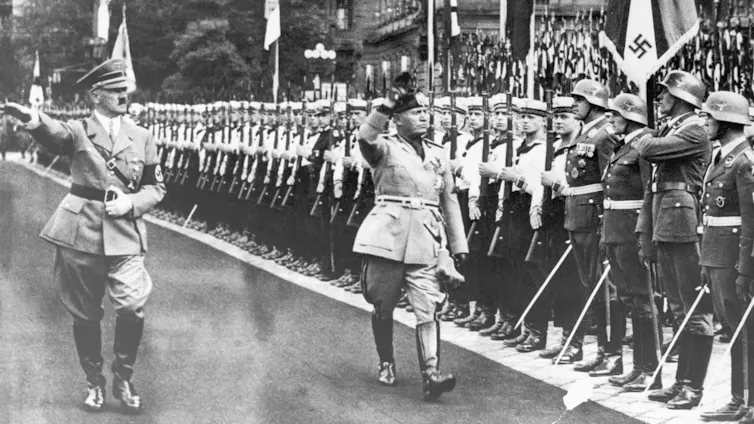
Hitler and Mussolini salute Nazi troops in 1937. Bettmann/Getty Images
John Broich, Case Western Reserve University

At Marine Corps Base Quantico in September 2025, Defense Secretary Pete Hegseth promised assembled generals “maximum lethality” and no “stupid rules of engagement.” Under his leadership, the newly rebranded Department of War would “untie the hands of our warfighters to intimidate, demoralize, hunt, and kill.” Troops would be held to the “highest male standard,” he said. “Weak men won’t qualify.”

Hegseth also restricted anonymous whistleblower and discrimination complaints and limited how long past misconduct can be held against a service member, weakening internal rules and oversight processes the military had built over decades.

Months later, with the Iran war underway, he told reporters at a Pentagon briefing that the U.S. was “punching (Iran) while they’re down, which is exactly how it should be.” He has also said the U.S. will give “no quarter, no mercy” to its enemies, language legal experts say can constitute a war crime under international law.

Hegseth calls his military doctrine the “warrior ethos.”

Historians of fascism have catalogued similar rhetorical patterns — strongman posturing, contempt for constraint — for decades.

I’m a historian of race and nationalism and author of “Blood, Oil and the Axis,” a book about World War II and nationalism in Iraq and Syria. I’ve studied how fascist regimes fight. At its core, fascism is ultranationalism fused with a cult of masculine strength, racial hierarchy, paranoia about socialism and contempt for democracy. It also has a theory of war: Victory belongs to the ruthless and the ideologically pure. Rules are for the weak.

Nazi Germany, fascist Italy and Imperial Japan all built their military strategies on some version of this ideology in the run-up to the Second World War. And in each case, the strategy failed, undone by its own contradictions.

The fascist theory of war

Democracies don’t necessarily fight clean wars. During World War II, the Allies firebombed cities, created internment camps and dropped atomic bombs.

What distinguishes fascist powers from democracies is their contempt for rules based on their sense of superiority. In 1933, Adolf Hitler’s propaganda minister Joseph Goebbels announced that the Nazis would claim the absolute right to override democratic constraints. “This contemptible parliamentarianism … is gone,” he said.

Italian dictator Benito Mussolini said it more bluntly in 1936: “We do not argue with those who disagree with us, we destroy them.”

But rules of engagement function as a control system that ties tactical decisions to strategy, law and the risk of escalation. Discarding them tends to produce the atrocities and strategic blowback that lose wars.

Democratic procedure does similar work: Political scientists who studied 197 conflicts from 1816 to 1987 found that democracies won about 76% of their conflicts and non-democracies 46%, in large part because accountable leaders and public access to information force a government to notice when a plan isn’t working.

A fascist regime that treats democratic constraints as obstacles is likely to decide inconvenient information is an obstacle too. Because of this, in fascist governments, loyalists rank higher than experts. Fascist systems don’t remove people for being wrong; they remove them for insufficient loyalty. The man who tells the leader what he wants to hear rises. The man whose report contradicts the leader’s views endangers himself.

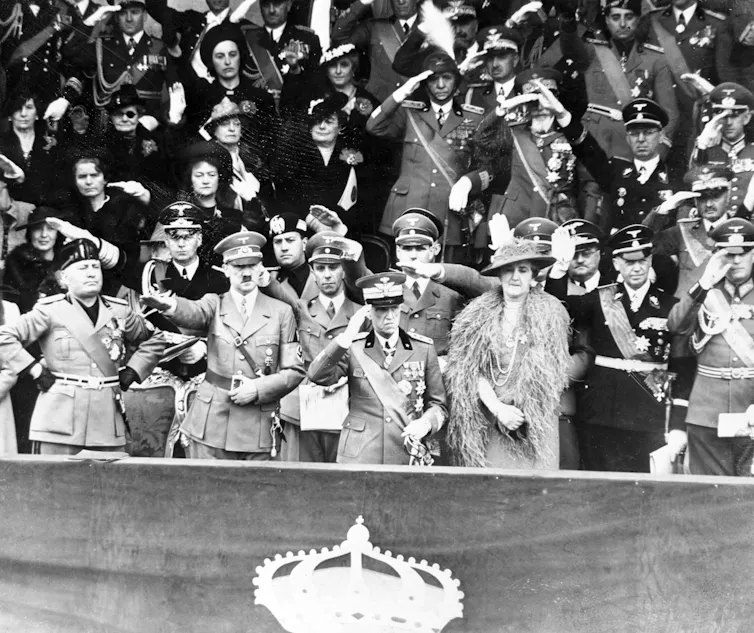
Benito Mussolini stands beside Adolf Hitler as they watch a military parade
Benito Mussolini, Adolf Hitler, King Victor Emmanuel III and Queen Elena watch a parade held in Hitler’s honor in 1938. Behind them, from left: Joachim von Ribbentrop, Galeazzo Ciano, Joseph Goebbels and Rudolf Hess. Bettmann/Getty Images

Friday, May 8, 2026

#BookReview: Middle-Grade Fantasy With Universal Appeal (and a Hedgehog)

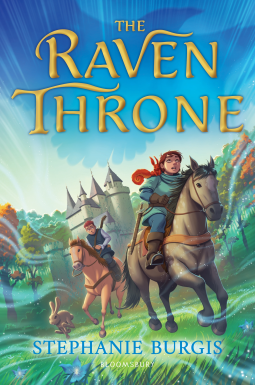
 The Raven Throne, by Stephanie Burgis (Bloomsbury Children's Books)


My introduction to the marvelous fantasy novels of Stephanie Burgis was through her adult novels. I loved the combination of humor, romance, dramatic tension, and quirky, lovable characters. When I snatched up The Raven Throne, I failed to notice that (a) it is a MG novel; (b) it is a sequel. Nevertheless, I dove in, trusting that I was in good authorial hands. I was not disappointed.

Instead, the story picked me up and carried me away, with adolescent triplets struggling to balance their new lives in the royal court of Corvenne with their unique talents, their psychic bond to the land and its creatures, not to mention the dastardly schemes of the self-serving aristocrats they have supplanted.

Cordelia now occupies the Raven Throne, and she’s deeply bonded to the ancient, powerful Raven spirits. But at the opening of the story, she has fallen ill and slips into a coma that threatens not only her life but that of the land itself. Her triplet siblings, warrior Rosalind and musician Giles, are facing their own challenges from the courtiers who surround them, persuading them to behave like “proper” royals and to forsake their unique magical gifts. Their allies turn out to be a hedgehog and a red squirrel (thereby earning my loyalty, since those are my daughter’s favorite animals, besides wolves). I love how universal their plight is. What child has not felt pressure to “behave” and ignore what their intuition tells them—in other words, to become less and different from who they truly are? As an adult reader who has had my share of life experiences that tried to silence or mold me into conformity, my heart went out to these children. Bravo, hedgehog and squirrel, for helping them be themselves!

As the story progresses, there are more instances that struck me as universal choices, ones that Giles and Rosalind rise to with the courage of clear-sighted children. They make mistakes, trust the wrong people, and give in to flattery and false hope. But through it all, their quest to save their sister and all of Corvenne shines through as universal.

A true delight.