Showing posts with label fascism. Show all posts

Monday, May 25, 2026

Reprint: Strongmen Doomed to Fail!


The ‘warrior ethos’ promises victory — history says it leads to defeat
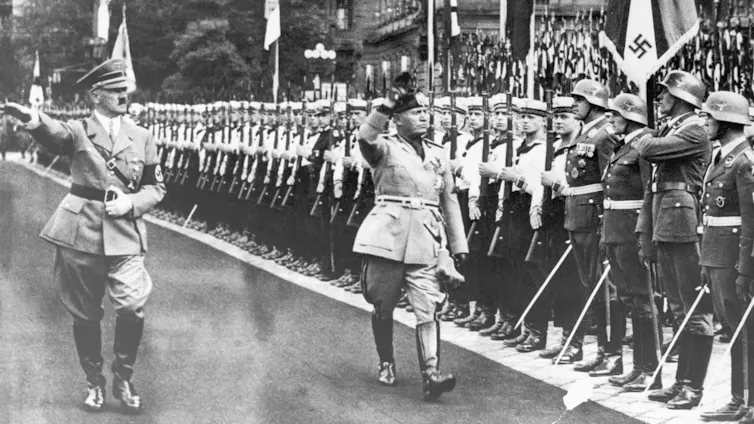
Hitler and Mussolini salute Nazi troops in 1937. Bettmann/Getty Images
John Broich, Case Western Reserve University

At Marine Corps Base Quantico in September 2025, Defense Secretary Pete Hegseth promised assembled generals “maximum lethality” and no “stupid rules of engagement.” Under his leadership, the newly rebranded Department of War would “untie the hands of our warfighters to intimidate, demoralize, hunt, and kill.” Troops would be held to the “highest male standard,” he said. “Weak men won’t qualify.”

Hegseth also restricted anonymous whistleblower and discrimination complaints and limited how long past misconduct can be held against a service member, weakening internal rules and oversight processes the military had built over decades.

Months later, with the Iran war underway, he told reporters at a Pentagon briefing that the U.S. was “punching (Iran) while they’re down, which is exactly how it should be.” He has also said the U.S. will give “no quarter, no mercy” to its enemies, language legal experts say can constitute a war crime under international law.

Hegseth calls his military doctrine the “warrior ethos.”

Historians of fascism have catalogued similar rhetorical patterns — strongman posturing, contempt for constraint — for decades.

I’m a historian of race and nationalism and author of “Blood, Oil and the Axis,” a book about World War II and nationalism in Iraq and Syria. I’ve studied how fascist regimes fight. At its core, fascism is ultranationalism fused with a cult of masculine strength, racial hierarchy, paranoia about socialism and contempt for democracy. It also has a theory of war: Victory belongs to the ruthless and the ideologically pure. Rules are for the weak.

Nazi Germany, fascist Italy and Imperial Japan all built their military strategies on some version of this ideology in the run-up to the Second World War. And in each case, the strategy failed, undone by its own contradictions.

The fascist theory of war

Democracies don’t necessarily fight clean wars. During World War II, the Allies firebombed cities, created internment camps and dropped atomic bombs.

What distinguishes fascist powers from democracies is their contempt for rules based on their sense of superiority. In 1933, Adolf Hitler’s propaganda minister Joseph Goebbels announced that the Nazis would claim the absolute right to override democratic constraints. “This contemptible parliamentarianism … is gone,” he said.

Italian dictator Benito Mussolini said it more bluntly in 1936: “We do not argue with those who disagree with us, we destroy them.”

But rules of engagement function as a control system that ties tactical decisions to strategy, law and the risk of escalation. Discarding them tends to produce the atrocities and strategic blowback that lose wars.

Democratic procedure does similar work: Political scientists who studied 197 conflicts from 1816 to 1987 found that democracies won about 76% of their conflicts and non-democracies 46%, in large part because accountable leaders and public access to information force a government to notice when a plan isn’t working.

A fascist regime that treats democratic constraints as obstacles is likely to decide inconvenient information is an obstacle too. Because of this, in fascist governments, loyalists rank higher than experts. Fascist systems don’t remove people for being wrong; they remove them for insufficient loyalty. The man who tells the leader what he wants to hear rises. The man whose report contradicts the leader’s views endangers himself.
Benito Mussolini stands beside Adolf Hitler as they watch a military parade
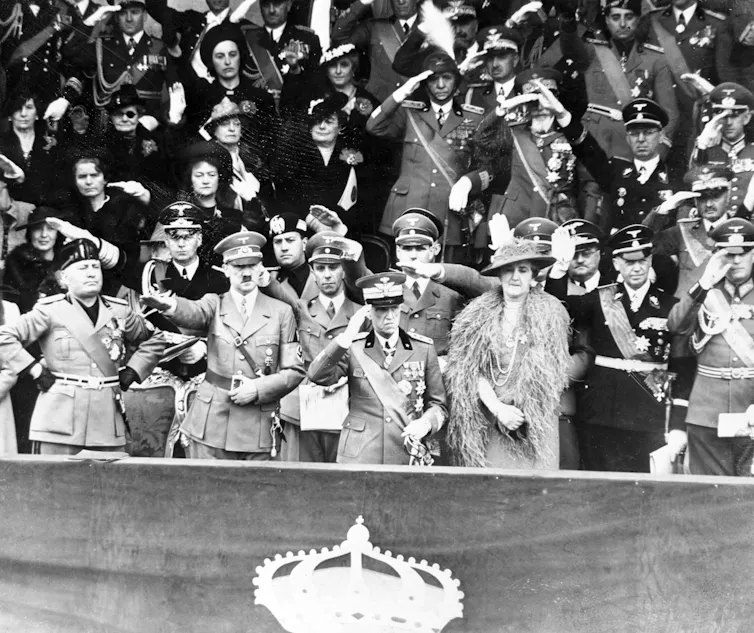
Benito Mussolini, Adolf Hitler, King Victor Emmanuel III and Queen Elena watch a parade held in Hitler’s honor in 1938. Behind them, from left: Joachim von Ribbentrop, Galeazzo Ciano, Joseph Goebbels and Rudolf Hess. Bettmann/Getty Images

Friday, March 7, 2025

Refuse Consent!

 I refuse my consent to #fascism. I also refuse my consent to despair. I affirm that I will cling tenaciously – relentlessly – to #hope, and I invite you to do so, too.

Monday, August 7, 2017

[political rant] Trump Adviser Spews Stalinist Antisemitic Insults

A few days ago, the news featured an exchange between Trump adviser Stephen Miller* and CNN White House reporter James Acosta, in which Miller dismissed Acosta's questions as evidence of "cosmopolitan bias." (Cosmopolitan, by the way, means "familiar with and at ease in many different countries and cultures," as opposed to provincial or nationalist.) For much of America, the story came and went. Neo-Nazis and the alt-right erupted with glee. Those of us with somewhat longer memories, especially those whose families perished or narrowly escaped either the Holocaust or the pogroms of the early 20th Century, or Stalin's persecution of Jews (among others), we were horrified.

"Cosmopolitan" is a coded insult, aimed at Jews (and others), in much the same way veiled references to The Protocols of the Elders of Zion (a document now proven to be forged, used to drum up animosity against Jews in pre-Revolutionary Russia and then Nazi Germany and still circulated in alt-right circles today) or white hoods and burning crosses are.

Jeff Greenfield of Politico provides some historical background:
One reason why “cosmopolitan” is an unnerving term is that it was the key to an attempt by Soviet dictator Josef Stalin to purge the culture of dissident voices. In a 1946 speech, he deplored works in which “the positive Soviet hero is derided and inferior before all things foreign and cosmopolitanism that we all fought against from the time of Lenin, characteristic of the political leftovers, is many times applauded.” It was part of a yearslong campaigned aimed at writers, theater critics, scientists and others who were connected with “bourgeois Western influences.” Not so incidentally, many of these “cosmopolitans” were Jewish, and official Soviet propaganda for a time devoted significant energy into “unmasking” the Jewish identities of writers who published under pseudonyms.

Greenfield focuses on the way the term has been used to target anyone suspected of not putting nationalistic loyalty above all. The word "cosmopolitan" implies citizenship and loyalty not to any one nation but to a global community. In Trump's highly divisive world-view, anything that detracts from lock-step patriotism (and personal loyalty to him, has he has demanded of his nominees) amounts to treason. But let us not forget that this was yet another tactic in the underlying persecution of Jews. The "canary in the mine" warning of impending crackdown on anyone who dares to think, speak, or belief in ways that threaten the tyranny of the administration may be Jews this time. Or blacks or transgender people. Or immigrants or Muslims. Make no mistake, an attack against one is an attack against us all.

Terms like "cosmopolitan" serve as a surrogate identity test, separating "us" from "them," the "us-we-can-count-on" who are "just-like-us" versus the "them-who-don't-conform." In the way Miller used the term, it was also an ad hominem argument. That's the "you're only saying this because you are/believe x" method of invalidating another's opinion. It doesn't address the issue itself, it discredits the speaker instead. Even without the history of the term "cosmopolitan," such a response from a government official would be outrageous. It is a mark of the breakdown of civil discourse that a reporter's question be negated by such tactics.

This administration has become notorious for its scorn and animosity for the press. It is by far not the first to be the object of scathing editorials and even more devastating investigative journalism. But always before there has been a recognition of the essential role of journalism in a thriving democracy. In 1954, President  Dwight D. Eisenhower declared that "no institution is more necessary to our way of life than a free press." Trump, through his surrogate, has placed his own vanity above the health of the nation's political life. Now journalists' questions are not only an affront to his self-image, they are at risk of becoming the brands of treason. Not to the United States or its people, but to a petty child aspiring to be Stalin's pale echo.

In summation -- Do we really want the representative of the President of the United States using the same hate speech that Stalin did?

*Stephen Miller is now also under consideration for White House communications director.