Showing posts with label trauma. Show all posts

Monday, September 28, 2026

[Reprint] How Trauma Shapes Memory


Traumatic memories are often fragmented – a psychologist explains how and why that happens

Young Asian woman sits on a sofa looking sad and worried.
Traumatic memories are not recalled the same way pleasant memories are. Filmstax/E+ via Getty Images
Michele Patterson Ford, Dickinson College

When survivors of trauma recount their experiences, they are often questioned because of how they relay their stories. They may have problems remembering what happened, or their memories may be jumbled or even contradictory. People hearing those stories – attorneys, reporters, healthcare workers or friends – may expect a clearer, linear narrative.

Those unaffected by trauma may also be surprised to hear how the person acted in the moment. It’s easy to assume that someone experiencing a traumatic event would have a “fight or flight” response, instinctively fighting off a perpetrator or fleeing the scene – but that might not be the case.

Understanding the science of how trauma affects memory and behavior reveals why these responses can actually be expected and are not contradictory.

In both my academic and clinical work as a psychologist, I have witnessed the impact trauma has on people’s memories and behaviors, especially when an event in their present life triggers something from their past.

Research shows that taking a trauma-informed approach, which prioritizes understanding and curiosity about someone’s experience as opposed to judgment or critical evaluation, increases empathy for survivors’ thoughts, feelings and behaviors.

How trauma affects the brain

According to the World Health Organization, approximately 70% of people worldwide report experiencing a traumatic event in their lifetime. The majority of these people do not develop PTSD, a clinical diagnosis of symptoms, such as having nightmares and flashbacks about the event, avoiding places that are reminders of it, and increased arousal that can make concentration and sleep difficult. Many survivors don’t meet criteria for PTSD but struggle with feeling distressed, depressed or anxious.

In traumatic situations, people often respond in unexpected ways, and they may second-guess themselves. This may happen particularly when someone experiences a repeated trauma, which is more likely than not due to how many people experience traumatic events.

Trauma also distorts how memories are stored and retrieved.

Research indicates that people experience traumatic memories differently than memories of other significant events, such as sad or positive experiences. Two of the main brain structures scientists believe are involved in storing traumatic memories are the hippocampus – responsible for memory storage – and the amygdala, which is responsible for processing emotions.

During trauma, the amygdala becomes highly active, processing emotions such as fear, and the hippocampus becomes overwhelmed by stress, leading to problems with memory storage.

Traumatic memories do not follow a neat, linear story. Instead, people may experience the memory as disconnected fragments of sensations, emotions, smells or images. Such memories cause the body to reexperience the past threat as if it is happening in the moment. This may cause a person to feel like running away or fighting back – flight or fight. Or they may freeze.

In other words, people don’t have the distant perspective they often feel with other memories from the past. Rather, they may feel they are reliving the original experience.

Single working mother and her teenage daughter talk with much emotion in the kitchen.
Emotionally intense conversations can bring up past traumas, causing a person to freeze or feel numb. Olga Rolenko/Moment via Getty Images

Misinterpreting victims’ behaviors

With this understanding, consider someone who experiences a trauma at the hands of a professional during an appointment. They may appear outwardly calm while it happens and then leave the session as they typically would – checking out, providing payment and possibly even scheduling the next appointment. While their response to act normally may seem odd, such behavior makes sense for someone trying to escape a threat.

Fight, flight or freeze responses have become widely known in popular culture. In a freeze response, a person’s mind goes blank and they may be unable to speak, leading to a “deer in the headlights” behavior.

On the other hand, a person may act paradoxically – perhaps by going on about their day as if nothing happened. They may not report the event or may question whether the incident even occurred. This represents another survival response – the lesser-known fawn response. This way of handling stress occurs when someone acts calm, appeases the threatening person and retreats to de-escalate the situation. Instead of literally backing away, in this example, the person metaphorically backs away by completing the session and exiting as expected without further conflict.

Outsiders may misconstrue these behaviors as evidence that a trauma did not actually happen or that a survivor lacks credibility. But that logic reflects common misconceptions about how people “should” remember or respond to trauma.


Monday, August 3, 2026

[Reprint] How Childhood LGBTQ+ Stigma Can Harm Adult Relationships

This is so important to those affected by LGBTQ+ stigma and those who love them, I am reprinting it in its entirety (under Creative Commons license).

Childhood experiences of LGBTQ+ stigma can harm romantic relationships decades later – psychologists explain how to reconnect with yourself and your partner

Person looking into the distance as their partner smiles at them
Difficult experiences you had as a child may be putting a wedge between you and your partner. Dmytro Betsenko/Moment via Getty Images
Melissa Gates, Binghamton University, State University of New York and Christina Balderrama-Durbin, Binghamton University, State University of New York

Childhood rejection, discrimination and bullying can affect your well-being as an adult. If your friends, family or community pushed you away because of your sexuality or gender, these childhood experiences of prejudice can also affect your future relationships.

Many LGBTQ+ people encounter difficult experiences as children, including abuse, neglect and challenges at home, because of their sexuality or gender. Other negative experiences – including bullying, witnessing your peers be harassed or ostracized, and the need to conceal your identity to protect yourself – may make it especially challenging to accept your sexuality or gender as an adult.

Developing a negative self-view as a result of these harmful experiences during your formative years is not uncommon. Feelings of shame or unworthiness can carry into your 20s, 30s and beyond, harming your mental health along with your ability to form and maintain romantic relationships.

Fortunately, making meaning of your early experiences can help you heal, reconnecting and strengthening your relationships as a result.

Internalized stigma harms relationships

Our psychology research team focuses on understanding the connection between childhood anti-LGBTQ+ experiences, well-being and relationship health.

We found that a factor called internalized stigma can notably affect the romantic relationships of LGBTQ+ people. Internalized stigma refers to when society’s negative views and biases toward a part of your identity shapes how you think and feel about yourself. This can influence how you view romantic relationships and how you interact with your romantic partners.

People with higher levels of internalized stigma report more conflicts and less satisfaction in their relationships. Research suggests that internalized stigma can negatively affect key aspects of romantic relationships that keep people satisfied with their partners, including trust, connection and intimacy.

Monday, August 11, 2025

Reprint: Traumatic Bereavement and How to Help


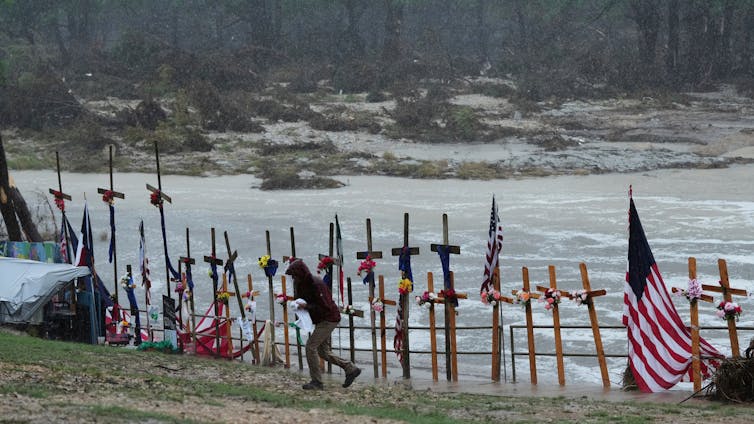
When grief involves trauma − a social worker explains how to support survivors of the recent floods and other devastating losses

Rain falls over a makeshift memorial for flood victims along the Guadalupe River on July 13, 2025, in Kerrville, Texas. AP Photo/Eric Gay
Liza Barros-Lane, University of Houston-Downtown

The July 4, 2025, floods in Kerr County, Texas, swept away children and entire families, leaving horror in their wake. Days later, flash floods struck Ruidoso, New Mexico, killing three people, including two young children.

These are not just devastating losses. When death is sudden, violent, or when a body is never recovered, grief gets tangled up with trauma.

In these situations, people don’t only grieve the death. They struggle with the terror of how it happened, the unanswered questions and the shock etched into their bodies.

I’m a social work professor, grief researcher and the founder of The Young Widowhood Project, a research initiative aimed at expanding scholarship and public understanding of premature spousal loss.

I was widowed when I was 36. In July 2020, my husband, Brent, went missing after testing a small, flat-bottomed fishing boat called a Jon boat. His body was recovered two days later, but I never saw his remains.

Both my personal loss and professional work have shown me how trauma changes the grieving process and what kind of support actually helps.

To understand how trauma can complicate grief, it’s important to first understand how people typically respond to loss.

Grief isn’t a set of stages

Many people still think of grief through the lens of psychiatrist Dr. Elisabeth Kübler-Ross’ five stages of grief, popularized in the early 1970s: denial, anger, bargaining, depression and acceptance.

But in fact, this model was originally designed for people facing their own deaths, not for mourners. In the absence of accessible grief research in the 1960s, it became a leading framework for understanding the grieving process – even though it wasn’t meant for that.

Despite this misapplication, the stages model has shaped cultural expectations: namely, that grief ends once people reach the “acceptance” stage. But research doesn’t support this idea. Trying to force grief into this model can cause real harm, leaving mourners feeling they’re grieving “wrong.”

In reality, mourning is often lifelong. Most people go through an acute period of overwhelming pain right after the loss. This is usually followed by integrated grief, where the pain softens but the loss is still part of everyday life, returning in waves.

Although grief is unique to each person and relationship, researchers have found that mourners often strive to a) make sense of the death; b) adjust to a world without their loved one; c) form an ongoing connection with their deceased loved one in new ways; and d) figure out who they are without their loved one.

It’s difficult and at times disorienting work, but most people find ways to carry their grief and keep living.

Tuesday, January 21, 2025

In Times of War: A Flood of Horrific News

This was originally posted in April, 2022, as the Russian invasion of Ukraine was getting underway. It seems just as urgent now. 

After the 2016 Presidential election, I wrote a series of blog posts, “In Troubled Times.” In them I explored my evolving feelings of disbelief, shock, horror, despair, fury, and rising determination. “Nevertheless, She Persisted” became our mantra. I hoped that my words provided solace and inspiration to others, and the process of putting them down did for me.

Now we face new, often overwhelming challenges to sanity. I find myself reacting to the news of the war in Ukraine, and yet being unable to look away. Then my friend, Jaym Gates, wrote this on her Facebook page, posted here with her permission. 

Be really careful on social media for the next few days, friends. A lot of footage of Russian Federation war crimes, torture, rape, and murder just came out from Mariupol and other occupied cities. It is *horrific.* While it needs to be seen, shared, and remembered, it is going to be extremely traumatic to engage with.

If you're a survivor of abuse or trauma, in particular, please be especially careful.

And send support to Ukraine if you can. What's happening there is awful beyond words.

 My daughter, a psychology student, spotted this article by Heather Kelly in the Washington Post: How to stay up-to-date on terrible news without burning out.

It can be hard to look away from your phone and live your life while terrible events are unfolding, Kelly writes. There’s an unrelenting flow of images, videos and graphic updates out of Ukraine, filling social media, messaging apps and news sites.

It’s important to stay informed, engaged and even outraged. But it’s also important to pay attention to our own limits and mental health by taking breaks, looking for signs of burnout and consuming news in the smartest way possible.

That means setting some ground rules for the main portal connecting us to nonstop tragedy: our phones [or computers]. Here are some suggestions:

1.       Give yourself permission to take a break

It is okay to hit pause on the doom and go live your life, whether that means going outside with the kids or just losing yourself on the silly side of TikTok. It’s necessary for everyone’s mental health.

2.      Take time for self-care

A break is not a few minutes away from Twitter. Start with real breaks of at least 30 minutes to an hour so that your brain has time to come down from what you were last watching or reading. Ideally, you’ll put your phone down and take a technology break … or do some activities known to help with stress reduction, including exercise, mindfulness and meditation, journaling, engaging in hobbies and other activities you enjoy, spending time with family and friends, and doing faith-based activities if you practice.

3.      Change your news habits

Disinformation like propaganda is designed to capture your attention and elicit strong emotions, which can contribute to any anxiety you’re already feeling. Instead, stick with reputable sources. If you can wait, opt for deeply reported stories at the end of the day over constant smaller updates. Avoid using social media for news, but if you do, follow sources and people that contribute to your understanding of an issue rather than those that just generate more outrage.

4.      View your phone in black and white

In your smartphone’s accessibility settings there is an option to make the screen black and white instead of color. Some studies have indicated that turning this on leads to less screen time.

5.      Know when to ask for help

Look for signs that you are burned out or experiencing serious anxiety. First, consider whether you’re predisposed to reacting strongly to a particular issue. Anyone who has personally dealt with similar trauma or war in the past might find constant vivid social media posts about Ukraine to be triggering. [Italics mine.]


In conclusion: be kind to yourself, friends. Practice healthy boundaries and filters, and good self-care. Ask for help, whether it’s a friend or family member screening news for triggers, or a companion on a hike through the redwoods. Find safe people to reach out to. I'll be writing more about our journey together.


Monday, April 25, 2022

In Times of War: Taking a Break

These days I’m very aware of the need to click off social media, put down the newspaper, or turn off the radio. All too often the war news becomes overwhelming. The increased bombardment, the discovery of more atrocities, threats and counterthreats, nightmares and triggers. Every day the reports are the same or worse, or so it seems. I go out in my garden or take a walk in the redwoods or call a friend.

I’m acutely aware that being able to step away is a privilege. Ukrainians can’t take a break in the same way I, living in my nice safe neighborhood in a country not at war, can. They may have times when life goes on as usual, depending on where they live, but somewhere else in their country, cities are being pulverized and ordinary people—perhaps their friends or loved ones—are the targets of unspeakably brutal attacks. I don’t see how they can pretend that isn’t happening. Perhaps they find islands of mental refuge in the small joys of family and friends, human and furred. I hope so.

That bears repeating: When I see the smiles of my loved ones or feel the tiny leap of joy when one of my cats comes running to me, clearly delighted to see me, or a moment of awe in music or dance, or breathless wonder beneath the stars, I wish the same for people living in the war zone.

I fear for them, for their lives and mental health. At the same time, I am reminded how adaptable human beings are. I remember, in the midst of thrashing through my own PTSD recovery, my therapist remarking on the amazing ability we all have to overcome what has happened to us. That we are more than those events. I find stories of people who have survived war and torture, the Holocaust and similar devastating experiences, who are nonetheless compassionate, loving people capable of great joy. With shadows on their hearts, to be sure. I can never go back to the person I was before my own trauma. There is no magic to erase the memories in the very fibers of our selves. But we can and do heal into a new pattern. I so much wish that for the people whose lives are currently being torn apart.

Sooner or later, the war will end. The cost, already horrendous, will be even greater. I hold on to the hope that every moment of kindness and every shred of our collective experience recovering from violence will help to mend this broken world. Taking a break is not turning away or shutting down. It’s recharging our spiritual batteries for the work yet to come. My hope for Ukraine helps to keep me engaged in ways that will not leave me exhausted when the time for healing comes.

That time will come.

Meanwhile, take it easy.

On a parting note, Ukrainians are not the only ones suffering in today’s world. I’ll write about that in an upcoming post.

Friday, December 18, 2020

Book Reviews: Surviving Trauma in a Magical Plague


 The Electric Heir (Feverwake, Book 2), by Victoria Lee (Skyscape)

This is a sequel to Fever King, which I reviewed here. Although I loved the premise of magic being carried by a highly contagious, near-fatal virus, and the virus having been unleashed on a fractured United States by a single power-mad man, I expressed reservations about the depiction of the moral consequences of actions, specifically politically motivated murder. Yet the world and its principle characters were powerful enough to linger in my memory, so I decided to give this next volume a try. And in it I found everything I missed in the first book. To be sure, this isn’t an easy, light-hearted read. It’s a brutally honest delve into the abuse of power. And as such, I found the story powerful and emotionally fearless. Lee doesn’t shy away from difficult or distressing aspects of the deep trauma suffered by the victims or the pernicious nature of the way their thinking and reactions become warped as the result of repeated abuse. In all the essentials, The Electric Heir completes and redeems The Fever King.

Calix Lehrer rose to power by first creating magically gifted “witchings” (the few survivors of the plague he himself unleashed) and then defending them against neighboring nations. Now over a century old, he chooses apprentices from the elite Level IV school – but these teens are not merely students, they are the targets of his seduction, manipulation, and abuse. In the first volume, refugee Noam is first overwhelmed by the privilege of Level IV, filled with hero worship for Lehrer, and first repelled and then fascinated by his fellow student, the charismatically beautiful telepath, Dara. In the course of that story, Noam falls in love with Dara even as he comes under Lehrer’s influence, to the point of becoming Lehrer’s assassin. It becomes clear that not only is Dara’s sexual relationship with Lehrer non-consensual because of the disparity in age and power and the impossibility of refusal, but it involves repeated brutal physical abuse, masked over by Lehrer’s healing magic. The book closed with Dara’s escape and likely death.

Now Lehrer has lured Noam into Dara’s place, forcing him through psychological manipulation and increasingly violent physical abuse into a model of himself: ruthless, exploitive, and devious. In short, to become Lehrer’s carbon-copy heir. Noam, like Dara before him, craves Lehrer’s approval at first, although it is unclear how much of this stems from Noam’s youthful vulnerability and how much is Lehrer making himself charming and magically persuasive. As it turns out, Dara is not dead, although he no longer possesses magic; he has returned with an underground cabal with one purpose: to end Lehrer and his international reign of terror. Lehrer has planted a spy in their midst, perhaps more than one. Noam, after an uncomfortable, divisive reunion, insists on remaining with Lehrer as part of the plot – even though it puts his sanity and his very life at risk. Meanwhile, Lehrer launches a pre-emptive strike against the neighboring nation of Texas, using weaponized magic. As Noam and Dara separately and together come to terms with both the overt and the subtle effects of abuse, it’s a race against time to stop Lehrer. 

It’s a high-wire act to portray slow, intense, personal change and fast-paced action at the same time. Lee deserves immense credit for not abbreviating or minimizing the painful process by which Lehrer’s victims peel back the layers of guilt and shame, discarding the excuses born of what their abuser has led them to believe about themselves. This second volume fully addresses my concerns about the first with courage and compassion. It’s definitely not the place to start the story, but neither is the first book the place to stop. I’m glad I gave The Electric Heir a chance to take me with Noam and Dara in their journey into darkness and the emergence of hope.


Monday, December 23, 2013

Writing Through Crisis


 For much of my early career, I used to joke that I couldn't afford writer's block. I began writing
Cemetery, New Orleans, 2012
professionally when my first child was a baby and I learned to use very small amounts of time. This involved "pre-writing," going over the next scene in my mind (while doing stuff like washing the dishes) until I knew exactly how I wanted it to go. Then when I'd get a few minutes at the typewriter (no home computers yet), I'd write like mad. I always had a backlog of scenes and stories and whole books, screaming at me to be written. The bottleneck was the time in which to work on them.
 
I kept writing through all sorts of life events, some happy, others really awful and traumatic. Like many other writers, I used my work as escape, as solace, as a way of working through difficult situations and complex feelings. I shrouded myself with a sense of invulnerability: I could write my way through anything life threw at me!

Unfortunately, I was wrong.

Wednesday, August 24, 2011

Telling the Truth

Elsewhere I've written about how my experience as a family member of a murder victim has led me to public advocacy to abolish the death penalty. This isn't a discussion of the pros and cons of the death penalty; it's about story-telling. In general, I use this blog for writerly professional stuff and put more personal issues into my LiveJournal. But I think the process by which we learn to tell the truth in our personal lives is related to the process of excavating the truth in our fiction.

I'm not a political activist. In fact, I've often described myself as allergic to it. I certainly have opinions, but the prospect of placing myself in a confrontational, adversarial position (with those nutsos who don't agree with me, right?) has been overwhelmingly intimidating. It took me a long time to find a way that was at all emotionally possible for me to state my case.

That way, it turns out, was to tell my story.