Showing posts with label death penalty. Show all posts

Tuesday, November 24, 2026

Letter to the Editor: No Killing in My Name

This letter appeared in the November 24, 2026 edition of the San Francisco Chronicle:


Gov. Gavin Newsom announced he would commute over 500 California death sentences to life in prison during his final months in office. As a surviving family member of a murder victim, I agree with Newsom’s action.

In my experience, capital punishment harms the survivors by interfering with the natural recovery process. When we focus on revenge instead of healing, we never heal.

Anger and the craving for revenge are normal reactions when someone you love is killed. These feelings fuel the illusion that retribution erases pain, and popular media constantly reinforces this illusion.

For many family members of a murder victim, they have not only lost a loved one, but also their belief in the decency of fellow humans and their sense of safety in the world.

I’ve listened with an open heart to families of those who have been executed; their loss is the same as mine. The life of their loved one was not taken in a moment of anger or passion but by the cold, deliberate malice of the government.

I don’t want anyone to suffer as I have. I refuse to allow my personal tragedy to be used as justification for deliberate, state-sanctioned murder.

No killing in my name.


Deborah J. Ross, Boulder Creek, Santa Cruz County

Note: The links were added by the editors. The last two direct you to research papers supporting my view that the death penalty does not bring "closure" to the co-victim survivors.

Monday, October 26, 2026

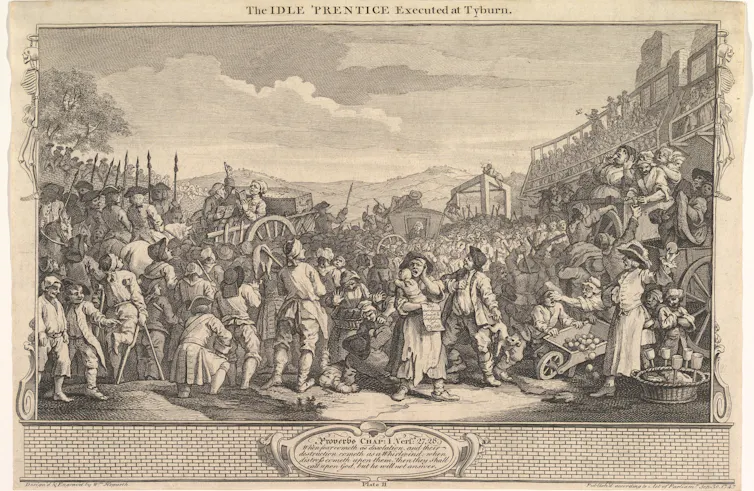
[Reprint] Are public executions true to American values?


In newly independent US, Americans debated whether public executions taught a lesson or just showed off the state’s power to destroy

A crowd of people in an 18th century scene of a public hanging.
A 1747 print of a public execution at the so-called Tyburn Tree, a gallows in London that served for hundreds of years as a site of hangings. William Hogarth
Maurizio Valsania, Università di Torino

The proposed livestream of Nidal Hasan’s execution by a U.S. military firing squad gives an old question a new audience. Hasan, an Army psychiatrist convicted by a military court of killing 13 people at Fort Hood in Texas in 2009, is scheduled to be executed on Dec. 3, 2026.

Explaining the plan to make his death public, Defense Secretary Pete Hegseth said that “people need to understand … there’s serious consequences for these types of things.”

Whether the broadcast will proceed remains uncertain. But as a historian of the early American republic, I recognize a familiar expectation behind it: that watching someone die will teach a useful lesson. Americans at the republic’s founding debated that premise — and doubted what the lesson might be.


The power of government

On Aug. 17, 1797, New Yorkers gathered to watch John Young hang.

An English musician and music publisher struggling with debt, Young had shot and killed Robert Barwick, a deputy sheriff taking him into custody. Barwick left a widow and nine children.

Young’s conviction by a jury brought him to a scaffold surrounded by soldiers, before an immense crowd.

Governor John Jay, a leading Federalist who placed greater faith in firm government than in popular judgment, had authorized the military presence after the sheriff reported fears of a rescue. But Jay also wanted the execution to impress its witnesses with the power of the government carrying it out.

Writing to James Kent, New York City’s chief municipal legal officer, two days before the hanging, Jay stressed that the authority of law should prevail visibly. The occasion should be “particularly solemn and impressive,” he said. The “authority of the law should be seen to bear down (on) all opposition.”

Solemnity, however, proved difficult to arrange. The military escort played lively music as the procession made its way to the scaffold. One newspaper critic thought an uninformed passerby might mistake the spectacle for “the celebration of some Festival.”

Soldiers formed a square around the gallows. The crowd remained orderly. Young addressed a few words to the minister, sang a psalm “and with great composure pulled his cap over his face,” reported one newspaper. Then, before the assembled witnesses, he was hanged.

Loss of government’s dignity

Whatever the crowd’s reaction that day, the public execution had already become an argument about the nature of government.

Monday, October 19, 2026

My Mother Was Murdered, and That's Why I Oppose the Death Penalty


I am appalled by the recent rush to executions, horrified by the possibility of a televised firing squad, and deeply disturbed by the two botched attempts, and this is why:

In 1986, my 70-year-old mother was asleep in her own bed when a teenage neighbor broke into her home, raped her, and then beat her to near death and left her face down in a partially filled bathtub. It was a spectacularly brutal, banner headline crime, called by the District Attorney one of the most heinous in the history of the county.

Even in light of what happened, I am opposed to capital punishment, and I'd like to tell you why. I want to emphasize that I do not speak for anyone else. We all have different experiences, different histories, different internal and external resources. If there is one thing I'd like you to take away from my story, it is that not all the families of murder victims want the perpetrators to be executed.

I believe that capital punishment harms the survivors by interfering with the natural recovery process. In other words, when we focus on revenge instead of healing, we never heal.

A number of years ago, when I was being interviewed about my mother's death, the interviewer said to me, “You seem like such a sweet person. Most of us just aren't that spiritual.” What she meant was, “How could you not want revenge?” What I thought was, You have no idea how angry I was and how much I wanted to hurt the man who did this.

The rage I felt and that I've heard expressed by other murder survivors is so overwhelming, it's hard to find words to describe it. You feel as if your skin is going to crack open and out will pour enough molten hatred to incinerate the entire world. For years after my mother's murder, I obsessed over exactly how I would kill the perpetrator with my bare hands and how much I wanted him to suffer for every moment of terror and pain he'd caused her. The images were so vivid, I couldn't tell if I was awake or dreaming.

Adrenaline-fueled anger enables us to get through those early days and weeks. It sharpens our senses and focuses our thoughts. Our hearts pump faster. Biologically, we are primed to do whatever is necessary to meet the threat. We don't feel our own injuries, either of body or of mind or spirit. All our resources are devoted to our immediate survival. In some circumstances, this lasts only a short period of time. I know people who have lost loved ones to murder, but in that same incident, the murderer was also killed. At the other extreme are instances where the perpetrator is never discovered and the survivors must cope with the nightmare of walking down the street, suspecting every passer-by or wondering if the murderer has taken another life. I know people in that situation, too.

Anger and the craving for revenge are normal reactions when someone you love has been viciously attacked, their dignity as well as their lives stripped from them.  At the same time, these feelings fuel the illusion that retribution erases pain, and popular media constantly reinforce this illusion.

Monday, June 1, 2026

[ARCHIVES] Do Not Murder In My Name: The Rush to Federal Executions

This post first appeared in 2020. 


Now, in the waning days of 2020, the criminal in the White House has pushed through a string of murders. I realize I have used inflammatory language, but nothing less conveys the intensity of my outrage and revulsion. Simply put, someone who initiates and demands the ending of a human life is a criminal. The deliberate, calculated, cold-blooded taking of a human life is murder. 


From the BBC: 

As President Donald Trump's days in the White House wane, his administration is racing through a string of federal executions.

Five executions are scheduled before President-elect Joe Biden's 20 January inauguration - breaking with an 130-year-old precedent of pausing executions amid a presidential transition.

And if all five take place, Mr Trump will be the country's most prolific execution president in more than a century, overseeing the executions of 13 death row inmates since July of this year.

The five executions began this week, starting with convicted killer 40-year-old Brandon Bernard who was put to death at a penitentiary in Terre Haute, Indiana. The execution of 56-year-old Alfred Bourgeois will take place on the evening of 11 December.

I am the family member of a murder victim, and I speak from personal experience of the impulse to revenge the taking of my mother's life. I also know that this is a natural expression of grief, and that with healing, it passes. To me it is essential that those left behind be given the support and time to process that loss and to re-engage with their lives. To focus on killing someone else freezes us in retaliation mode. 

Over the years, I have spoken out against the death penalty, telling my story to groups as diverse as city councils, law students, death penalty abolition activists, and state legislators. In 2012, I was invited to participate in an international conference put on by Murder Victim Families For Human Rights. Then I met others like me, who had lost a single family member to violence, those whose loved ones had been executed or were on death row, and those who experienced both. Every single person who had experienced both was Black. There is no escaping the racial injustice in the way the death penalty is applied (or the way crimes are investigated and prosecuted). Yet the most moving part of that weekend was listening with an open heart to mothers weeping for their executed sons -- and realizing their grief and loss was no less than mine. 

If you, who are reading this, take away nothing else, remember this: every person who is put to death is or has been loved by someone, and is grieved by someone, and missed like an aching hole in the heart by someone.

In 2019, I penned a blog for Death Penalty Focus, called "When we focus on revenge instead of healing, we never heal." You can read it below.

Tuesday, September 4, 2012

The Season Political

Whether I agree with them or not, it seems that many other folks are holding forth in much more articulate and media-savvy, not to mention louder, ways than I. While I occasionally pass on links to suchlike, I don't generally jump into the fray.

But this is an election year.

I'm not going to hold forth on candidates or political parties. Most of you either agree with me or there's nothing I can say to change your mind and certainly not worth damaging a valuable relationship by screaming at each other.

But this is an election year.

And there's an issue on the California ballot that I do feel strongly about. It's Measure 34, the SAFE California Act, that replaces the death penalty with life imprisonment without the possibility of parole. I can give you all the calculations about how many tens of millions of dollars it's going to save and the risks of executing innocent people and the percentages of violent crimes that go unsolved because the funds go to a system that even its advocates admit is broken beyond repair. You can look them up for yourself. For me, such arguments are best left to activists.

I'm not an activist. I'm the family member of a murder victim, the very person who might be expected to support capital punishment.

Tuesday, February 7, 2012

Murder, the Death Penalty, and Cancer, a personal perspective

Twenty-five years ago, my mother was raped and beaten to death by a teenaged neighbor on drugs. My mother was 70 years old and had been his friend since the time he was a small child. For a long time, I didn't talk much about it except in private situations. This was not to keep it a secret, but to compartmentalize my life so I could function. At first, it was too difficult and then, as the years passed, I refused to let this single incident be the defining experience of my life. Recently, however, I have felt inspired to use my own experience of survival and healing to speak out against the death penalty. I don't write this to convince you one way or another on that particular issue, but to try to illuminate how the two issues are related for me.

My mother's murder was a spectacularly brutal, headline-banner crime, but it was only part of a larger tragedy, for the perpetrator's family had suffered the murder of his older brother some years before. I knew this, but for a long time it didn't matter. My own pain and rage took center stage. But with time and much hard work in recovery, I came to the place of being able to listen to the stories of other people.

We all lose people we love. Tolstoy wrote that happy families are all alike, but every unhappy family is unhappy in its own way. I would interpret that to mean that each loss, each set of relationships and circumstances is unique, but there are things we share.

What might it be like if one family member were murdered -- and another family member had killed someone? What does it feel like to watch the weeks and days pass while the execution of someone you dearly love draws ever nearer? How can we wrap our minds around loving someone and accepting that they have caused such anguish to another family? I've had a chance to talk with people in all these circumstances. It's been a humbling experience.

Saturday, October 15, 2011

Death Penalty Statement - October 13, 2011

A number of people have asked about the statement I made in opposition to the death penalty, before the Santa Clara County Human Relations Commission. Much of it was taken from "September Grieving," which appeared both in my LiveJournal and on the Book View Cafe blog. Because the different social media sites reach different audiences, I'm posting this statement here, behind the cut.

Tuesday, September 13, 2011

September Grieving, part three

For those of you who are following this essay here, rather than on the Book View Cafe blog (or my LiveJournal), here's the third and final part.

What has changed for me this year is that I have begun to work for the abolition of the death penalty. Speaking only for myself, I see strong parallels between a murder victim family seeking this form of revenge and the vilification of the Muslim community concurrent with the invasion of Iraq. Of course, justice is desirable. Criminal acts call for appropriate consequences. I would never say that it’s okay for my mother’s killer to walk the streets or that those responsible for the 9/11 attacks should not be prosecuted according to law. Setting aside the politics of that invasion and the problems with the application of capital punishment, however, my concern is with whether retaliative actions help or hinder the recovery of the survivors.

My own experience is that revenge does not. I want to emphasize that I do not speak for anyone else. We all have different experiences. For me, focusing on wishing harm to the one who had harmed my mother might well have kept me locked — incarcerated — in a state of bitterness and hatred. While I was in no way to blame for what happened, I still bear the responsibility for what I do with it. It’s like the adult child of an alcoholic getting herself into therapy instead of whining helplessly, attributing all her problems to her upbringing.

I have to ask myself, What do I need? What do I want? One of my inspirations was a woman of astonishing kindness and grace, whose daughter and son-in-law were murdered and whose bodies she discovered. She told me that she faced a choice of whether or not to let herself be driven crazy by what she experienced. I think we all have that choice — to succumb to the darkness of our anguish and righteous fury, or to walk through it, to move beyond it.

I remember the scene in The Princess Bride where Inigo Montoya finally tracks down Count Rugen, who begs for his life and offers anything. Inigo says, “I want my father back!” (and then kills him). I want my mother back, too. All those who lost loved ones and colleagues want them back. We know that’s impossible, but what is possible is to get our own lives back. Our own selves. Our best selves.

My experience of healing is that I get myself back when I focus on re-engaging with life, on fully experiencing my feelings, on understanding what I have lost and what can never be replaced, but what can be restored. The more I stop looking to an external event (the execution of the murderer) to somehow make me feel better or “achieve closure,” and instead focus on taking care of my insides — my heart, my spirit, my body — the better I fare.

So I’ve been talking about my own healing process and what I’ve learned. I’ve been meeting with other family members and with people who’ve been sentenced to death and then exonerated. I’ve been looking for ways to build bridges, to nourish tolerance and reconciliation, to create understanding. I make an ongoing conscious decision to not harbor hatred in my heart, but to fill it instead with what I want in my life.

Love. Compassion. Gratitude. Joy. Wonder. Peace.

I can think of no more fitting memorial for my mother . . . or for those who died on 9/11.

Wednesday, August 24, 2011

Telling the Truth

Elsewhere I've written about how my experience as a family member of a murder victim has led me to public advocacy to abolish the death penalty. This isn't a discussion of the pros and cons of the death penalty; it's about story-telling. In general, I use this blog for writerly professional stuff and put more personal issues into my LiveJournal. But I think the process by which we learn to tell the truth in our personal lives is related to the process of excavating the truth in our fiction.

I'm not a political activist. In fact, I've often described myself as allergic to it. I certainly have opinions, but the prospect of placing myself in a confrontational, adversarial position (with those nutsos who don't agree with me, right?) has been overwhelmingly intimidating. It took me a long time to find a way that was at all emotionally possible for me to state my case.

That way, it turns out, was to tell my story.