Showing posts with label grief. Show all posts

Monday, April 27, 2026

Reprint: Resilience and "Bouncing Back"

‘Bouncing back’ is a myth – resilience means integrating hard experiences into your life story, not ignoring them
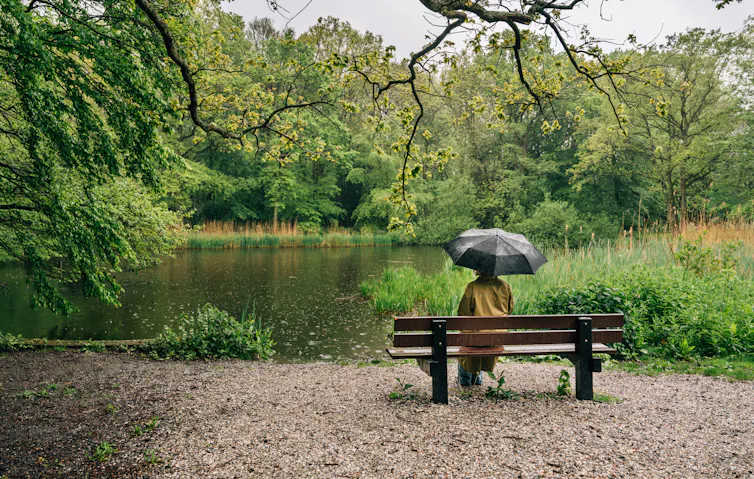
Into each life some rain must fall. Anastasiia Voloshko/Moment via Getty Images
Keith M. Bellizzi, University of Connecticut

When Maria looked at herself in the mirror for the first time after her mastectomy, she stood very still.

One hand rested on the bathroom counter. The other hovered near the flat space where her breast had been. The scar was raw and angry. The loss was quiet but enormous. Her body felt foreign.

In moments like these, people are often urged to be resilient – which can feel like being told to show no weakness, to push through no matter what. Or they imagine resilience as bouncing back: returning somehow unscathed to be the person you were before.

But standing in that bathroom, Maria knew there was no going back. And toughness wouldn’t change what had happened. The real question was how she could move forward, carrying this experience into her new reality.

Maria’s story, one I came to know personally, is far from unique. Loss, trauma and illness often bring the same wrenching questions of identity and the painful uncertainty of what comes next.

I’ve spent more than two decades studying resilience, particularly among individuals and families navigating these kinds of life-changing events. I am also a four-time cancer survivor and author of a new book, “Falling Forward: The New Science of Resilience and Personal Transformation.” If there is one myth I wish society would retire, it’s the idea that resilience means “toughness” or “bouncing back.”

woman wearing hat seated in wheelchair looks outside
Resilience doesn’t rely on relentless positivity in the face of traumatic challenges. pocketlight/iStock via Getty Images Plus

Rethinking resilience based on research

Moments like Maria’s reveal something important: The way people tend to talk about resilience often doesn’t match how people actually live through adversity.

In popular culture, resilience is often equated with grit, toughness or relentless positivity. People celebrate the warrior, the fighter, the triumphant survivor.

But across research, clinical practice and lived experience, resilience is something far more nuanced, raw and human.

It’s not a personality trait that some people simply have and others lack. Decades of research show resilience is a dynamic process. It’s shaped by the small, everyday decisions and adjustments individuals make as they adapt to significant adversity while maintaining, or gradually regaining, their psychological and physical footing over time.

And importantly, resilience does not mean the absence of distress.

Research on people facing serious life disruptions shows that distress and resilience often coexist. For example, in my study of adolescent and young adult cancer survivors, participants reported being upset about finances, body image and disrupted life plans, while simultaneously highlighting positive changes, such as strengthened relationships and a greater sense of purpose.

Resilience, in other words, is not about erasing pain and suffering. It is about learning how to integrate difficult experiences into a life that continues forward.

Monday, August 11, 2025

Reprint: Traumatic Bereavement and How to Help


When grief involves trauma − a social worker explains how to support survivors of the recent floods and other devastating losses

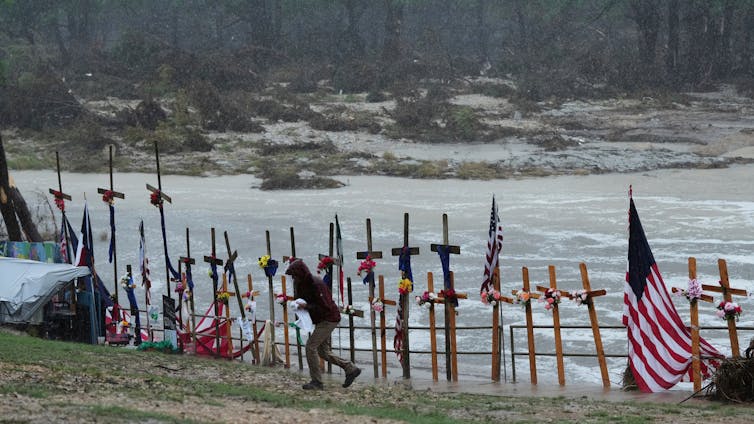
Rain falls over a makeshift memorial for flood victims along the Guadalupe River on July 13, 2025, in Kerrville, Texas. AP Photo/Eric Gay
Liza Barros-Lane, University of Houston-Downtown

The July 4, 2025, floods in Kerr County, Texas, swept away children and entire families, leaving horror in their wake. Days later, flash floods struck Ruidoso, New Mexico, killing three people, including two young children.

These are not just devastating losses. When death is sudden, violent, or when a body is never recovered, grief gets tangled up with trauma.

In these situations, people don’t only grieve the death. They struggle with the terror of how it happened, the unanswered questions and the shock etched into their bodies.

I’m a social work professor, grief researcher and the founder of The Young Widowhood Project, a research initiative aimed at expanding scholarship and public understanding of premature spousal loss.

I was widowed when I was 36. In July 2020, my husband, Brent, went missing after testing a small, flat-bottomed fishing boat called a Jon boat. His body was recovered two days later, but I never saw his remains.

Both my personal loss and professional work have shown me how trauma changes the grieving process and what kind of support actually helps.

To understand how trauma can complicate grief, it’s important to first understand how people typically respond to loss.

Grief isn’t a set of stages

Many people still think of grief through the lens of psychiatrist Dr. Elisabeth Kübler-Ross’ five stages of grief, popularized in the early 1970s: denial, anger, bargaining, depression and acceptance.

But in fact, this model was originally designed for people facing their own deaths, not for mourners. In the absence of accessible grief research in the 1960s, it became a leading framework for understanding the grieving process – even though it wasn’t meant for that.

Despite this misapplication, the stages model has shaped cultural expectations: namely, that grief ends once people reach the “acceptance” stage. But research doesn’t support this idea. Trying to force grief into this model can cause real harm, leaving mourners feeling they’re grieving “wrong.”

In reality, mourning is often lifelong. Most people go through an acute period of overwhelming pain right after the loss. This is usually followed by integrated grief, where the pain softens but the loss is still part of everyday life, returning in waves.

Although grief is unique to each person and relationship, researchers have found that mourners often strive to a) make sense of the death; b) adjust to a world without their loved one; c) form an ongoing connection with their deceased loved one in new ways; and d) figure out who they are without their loved one.

It’s difficult and at times disorienting work, but most people find ways to carry their grief and keep living.

Friday, July 22, 2022

Book Review: Overcoming Deepest Grief, by Mary Aviyah Farkas


Overcoming Deepest Grief, A Woman’s Journey: Grief, Acceptance, Gratitude and Joy
, by Mary Aviyah Farkas

Mary Aviyah Farkas’s book, based mostly on her journal entries, is an intensely personal record of her passage through grief. It begins with a stark retelling of three major losses: the death of her sister, with whom she was very close, followed by discovering the dead body of her long-time lover and the consequent removal of her lover’s possessions from their home by the lover’s family, an incident she describes as “a rape.” The opening essays, written after the journal entries, speak eloquently of the depth of loss, the shock and the grief—experienced by the author. The simplicity of her diction expresses the complexity of her emotions, stemming not only from the deaths of two people she dearly loved but also from the sense of violation when her home was invaded by her in-laws in what she experienced as a callous and rapacious manner.

I think every reader would identify with Farkas’s feelings of shock and horror. As much as we might like to think that physical possessions aren’t important, when we have suffered the loss of someone we love (in this case, two people), items that they owned or shared become precious. Most of us aren’t ready to let go of them until we have done considerable grieving. (Example: I still have my mother’s aprons, 40 years later!) As someone who has experienced grief under complicated circumstances, I understood why Farkas didn’t respond with legal action or even simply kicked them out, and why she could no longer remain in the home she had shared for decades.

The remainder of the book consists of essays and poetry in chronological order, written as Farkas struggled to rebuild her life and rediscover joy and connection. Here is where the universality of the opening shifts into the specificity of her experiences and beliefs. Farkas states clearly that her book is not intended to be a “how-to,” although a few sections contain suggestions; this is a record of what comforted and helped her. Some of her experiences may fall outside the interests or means of ordinary people, for example, her sessions with her bodyworker or her guru. So, too, her use of capitalization denotes esoteric definitions of otherwise common words. I wondered, for example, what was the precise difference between accepting a loved one’s death and Accepting it. Clearly, the choice of diction and punctuation has special meaning for the author, reinforcing the presentation of her unique, personal experience.

Farkas offers her healing journey with remarkable honesty and courage. She is as open about her anguish as about her renewed joy. The importance of her spiritual life shines through the pages. The book won the Silver Nautilus Book Award for “books that support Nautilus’ Four Pillars: Conscious Living & Sustainability; High-Level Health & Wellness; Spiritual Growth; and Positive Social Change & Social Justice.”


I was given a free copy of this book in exchange for an honest review.


Monday, May 30, 2022

In Perilous Times: Sorrow

I was going to write a post about the war in Ukraine.

Then another mass shooting happened here. Another one. Children and teachers.

The Russians have slaughtered hundreds of Ukrainian children. 

We slaughter our own.


Monday, October 4, 2021

A COVID loss: anger, grief, and healing

The COVID-19 pandemic has been raging for many months now, marked from the onset by lies about the disease, its origins, its treatment, and its prevention. No aspect of the pandemic has been free from controversy and misinformation. In the middle of flame wars and whack-a-mole efforts to squelch anti-vaccine, anti-mask internet sites lies the confusion and grief of those who have lost loved ones to this disease (over 700,000 in the US and 4,800,000 worldwide).

Like many others who believe in science, I was first puzzled and then appalled by the cloud of outright falsehoods that grew up around vaccination. Refusing the vaccines based on illogical and unfounded internet rumors struck me as downright suicidal. Equally troubling were the friends who bought into those lies.

One was a long-time, very dear friend, who had supported me through dark times and whom I had supported in turn. Early in 2020, L told me that she didn’t trust the mRNA vaccines and besides, she thought she’d had a mild case of COVID-19, although she was never tested. But she was diligently wearing a mask at work, and it was clear that further discussion would only be confrontational, so I backed off. For the next year, all appeared to be going well. Then she moved to another part of the country, one with low vaccination and mask-wearing rates. I heard from her while she was waiting at an urgent care center for a persistent cough. Her COVID-19 test was positive. A few days later, she was admitted to the ICU. We talked and texted frequently as her condition deteriorated. After a week and a half, she was placed on a ventilator. She died two weeks later. Her last text to me was, “I love you.”

During her hospitalization, I felt not only growing concern for her, but anger. Anger at so many things. After her diagnosis, I wanted to scream at her, “How could you fall for that conspiracy nonsense?” Then my fury spread to everyone who spread those lies, manipulated statistics, and otherwise terrified people into refusing the one thing proven to save their lives. Anger at the last administration and the former president, who failed to take action at the onset of the pandemic. Anger at the officials in her state for their lax measures and cavalier attitudes to the virus. Anger at everyone who touted ineffective remedies in order to make a profit. And most of all, guilt that I hadn’t pressed the vaccine issue harder and been persuasive enough to save my friend’s life.

Grief mixed with anger and guilt isn’t logical. Nor is it simple.

Friday, September 11, 2020

9/11: A Personal Grief

I first posted this back in 2015. It seems to be as valid now as then, although I have made significant progress in my recovery from PTSD since then. 9/11, while still powerful, is no longer the single defining tragedy of our time. The COVID-19 pandemic and the criminally negligent US reaction are. My heart goes out to all those who lost loved ones in NYC, and more recently in hospitals, hospices, and alone at home. May these words lighten your grief.


At this time of year, I often feel out of step with the rest of the country. Like just about everyone else I know who's old enough to remember the events of 9/11, I have a vivid memory of how I learned about them. I was driving my younger daughter to high school and we were listening to the news on the car radio. We heard the announcer cry, "The second Tower is down!" and the rest of the story tumbled out. The way the events unfolded reminded me poignantly of John F. Kennedy's assassination. I was in high school in 1963, just about the same age my daughter was on 9/11. Listening to the news broadcast with her, I experienced a parallel of my own youthful experience. Once again, the world became to be a dangerous and unpredictable place, but for me it was not the first time. I too responded with a feeling that the world has changed forever, but I also had the memory of having walked through this before -- and not just the Presidential assassination.

For me, Septembers will never be solely about 9/11. In this month in 1986, my mother was raped and beaten to death by a neighbor kid on drugs. It was a spectacularly brutal, headline-banner crime, but only part of a larger tragedy, for his own family had suffered the murder of his older brother by a serial killer some years before. My body knows when the anniversary is approaching, even when my thoughts are distracted. The shift in the quality of the light at summer's end reaches deep into my nervous system. The scar tissue on my heart aches. The ghosts of things that once held the power to drive me crazy stir in the darkness. My sleep becomes fragile, even though I no longer have nightmares. It's a hard time, an intensely personal time.

One thing I have learned over the years is that grief isn't fungible; you can't compare or exchange one person's experience with another's or say, This one's pain is two-thirds the intensity of that one's. Grief is grief; loss is loss. There's no benefit to anyone in comparisons. And no one else can do the hard emotional work of healing for us.

Around me and in the media, I see public displays of remembrance and more often than not, I feel reluctant to share mine. For one thing, I've lived with my story for over three decades and I've had extensive trauma therapy, but the person I tell it to is hearing it for the first time. "My god," they say, "how did you live through that?" At most times of the year, it's a gift to be able to sit with them, give them time to catch up, and to share a little of what I've learned about healing. But not this season. I need to have a time just for my own grief, a time that is just for my mother.

Monday, June 17, 2019

Guest Blog: Barb Caffrey on Writing After Widowhood


"Writing After Widowhood"
By Barb Caffrey

A while back, Deborah J. Ross asked me to talk about the differences between writing while my beloved husband Michael was still alive, and writing now. As I've had many years since my husband's unexpected death in 2004 to contemplate this, I agreed to talk about it. Just know in advance that it's not easy, but it is possible. (Spoiler alert!)

Anyway, when Michael was alive, we wrote some short stories together despite having very different writing styles. We could do this because we'd heard Eric Flint, in 2002, discuss how he collaborated with other authors. It was all about communication, Flint said, “Also, if you could check your ego at the door, that would help immensely.”

That wasn't all Michael did, mind you. He edited for me, as I edited for him. He and I talked about our stories for many hours a day, every day of the week, a great gift…and he made sure to do all the things a good husband does for his wife without prompting—and without fanfare.

It was because of all of this that I was able to write 230,000 good words in thirteen months back in 2002 and 2003. And into mid-September of 2004, I believe I wrote around 100,000 words, which isn't bad at all when you consider we had a big move across-country and had to find work and lodgings in the process.

Then, disaster struck. Michael died in September of 2004 of four massive heart attacks. He was awake after the first, but before the rescue squad could get to him, he had his second heart attack. He was clinically dead for eighteen minutes, and then was revived at the hospital. He later had heart attacks three and four…within eleven hours of the first heart attack, my beloved husband was gone.

There was absolutely no warning of this.

Not long after my husband died, I moved back to Wisconsin to be closer to my family. I wasn't much good for anyone for several years; I admit this freely. I was in deep shock, and in some ways I never completely came out of mourning. But I was able to write again within a few years, partly because my husband had left behind stories of his own that were unfinished.

To my mind, it was bad enough that my husband was dead. It would be even worse if the stories he'd worked so hard on died with him.

So even though I wrote in a completely different way, and had never written any space opera or military science fiction before (Michael's work mostly straddled those two lines), I decided I was going to finish at least some of his work and put it up for sale on my own. It would allow me to keep at least part of my husband alive, and doing that—even though most of the people around me, including several professional authors, did not believe I should be wasting my effort this way—was my salvation.

Tuesday, April 2, 2019

Monday, March 24, 2014

[rant] Ethics in Fiction: Don't Glamorize Murder

I've been thinking about my best friend, who died last year from ovarian cancer, and about my mother, who was raped and murdered by a neighbor teenager on drugs in 1986. Over the last couple of decades since the latter, I've exchanged stories (and tears, and laughter, and anguish) with other family members of murder victims. Sometimes when I read a story in which killing someone is presented as praiseworthy, I want to scream at the author, "Do you have any idea what you're doing? Do you understand how much pain your characters are causing?" I want to sit down with the writers and make them listen to what it's like to lose someone you love and all the years you might have had together for no good reason. I'm feeling really angry about it right now. Hence the rant below.


I admit that I cannot comprehend why anyone would think that deliberately ending someone's life is laudable. Yes, things happen by accident. People drive around in lethal weapons all the time. People get angry or frightened and lash out. But writing a story is not something that's over in a flash and can never be taken back. It's an act of deliberate creation and as such, calls on us to be mindful. Listen, folks. Life is all too brief, and incredibly precious. It's totally not okay with me to deliberately cut short a human life. For greed, for bigotry, for revenge, for patriotism. In fiction we often do kill off characters. If you do it, do it with full awareness of the cost.

Don't say it's only entertainment. That is such a bullshit excuse for not paying attention to human suffering. Go shoot up tin cans or climb a mountain instead of filling your stories with shooting galleries. Scream at clouds. Get some professional help - but don't pretend that blowing up characters left and right has no consequences. It's even worse if your "hero" is laughing and spouting nonsense like "That'll teach them" or "They had it coming."

Monday, March 17, 2014

Grief in Real Life and Fiction

My best friend died last October, and I spent 7 weeks taking care of her and her family. I just finished a draft of a memorial for our college alumni magazine, to be reviewed by her husband, so I've been thinking about loss and grief. Because we haven't lived in the same state for -- oh, 40 years, I think -- I didn't see her on a daily basis. Our contacts were more along the lines of picking up the phone to chat or convey some noteworthy news or ask for support. So periods of time will go by in which I would not normally see or speak to her, and in these times, I'm not aware of sadness at her absence.

For her husband, though, her death means a daily -- maybe hourly -- reminder that she is no longer there. He is surrounded by physical reminders, not to mention the rhythms of their daily lives. Our grief therefore has a different pattern.

The first deep grief of my life came in my late 20s, when my father died. It was after a series of strokes over the course of 6 months or so, following a period of declining health. Even so, I felt overwhelmed by the pain of his loss. In retrospect, I believe I wasn't fully adult, even though I was married and working full time. I could not imagine a life without my parents, their constant love and support, their kindness, their lively intellectual conversations. The intensity of my grief lessened, and then returned. After a while, I began to recognize the wave-like rhythm. I knew that the pain would subside and then rise up again - "This too shall pass." One of the most helpful things I did was to give myself time. I told myself it would take 5 years to do the majority of the grieving, and as it turns out, I was right.

Mourning my mother was far more complicated because of the suddenness and violence involved. She'd been in excellent health, and the murder/rape was exceptionally brutal. My sister and I had to deal with the criminal justice system -- the police investigation, the indictment and sentencing of the perpetrator,  his subsequent parole hearings, etc. -- as well as the newspaper headlines and how shocked everyone around us was at the same time as  attempting to negotiate the natural grieving process. Five years wasn't nearly enough to grapple with the emotional pain. But time and lots of therapy, seeking out healing, slowly loosened the knots, let sunshine into wounded places, and brought me to a place where it felt I would have been if my mother had died naturally.

Saturday, September 21, 2013

Singing Kaddish


Because my friend is dying
I went on to the land she loves
            To say Kaddish for my mother,
Under fir trees, through overgrown thistles
Past the echoing barn,
The last holdouts of summer blackberries,
Following a horse trail,
            a goat trail,
            a deer trail,
            a labyrinth carved by the generations: Exodus.

A cricket told me where to rest,
There by the single daisy,
            the Queen Anne’s lace.
Thorns snatched at the fringes of my prayer shawl.
I prevailed.

We do prevail, said the twilight.
We prevail from our ashes,
            in the sea
            in the cedar grove
            on the mount
            on the mountain
at the wall
at the wailing of the day.

I traced the Aramaic letters,
            stumbling like a stranger to my own faith.
And then, as if in the beginning,
            Bereshit,
A voice rose up through me,
A song that made itself up as it went.

This memory is all I have of you.
This moment is all we have ever had of one another.
This grief is a verb.
This peace is always, always becoming what it will be.

Deborah J. Ross
17 Tishrei 5774

Saturday, August 31, 2013

Puppy, Loss, and Change

Darcy at 16 weeks

On Book View Cafe blog, my husband has been blogging about our life and adventures with Darcy, which are now coming to a close. Darcy will be returning to his breeder, who will find him an owner capable of training him to his full potential.

Despite all our care and knowledge about dogs, our age (both of us in our mid-60s) and other competing demands on our energy made it increasingly difficult to give Darcy the training and attention that an smart, intense, high-drive dog needs. This was especially true since at 4 months, Darcy is entering adolescence and testosterone is upping the intensity. Even so, we have given him a foundation of house manners, basic commands (sit/down/come/leave-it/loose-leash walking) and excellent socialization with other dogs. He plays happily with the neighbor's two Labradors, who are big enough to enjoy the kind of rough and tumble that so often characterizes German Shepherd Dogs. At his breeder's, he'll have a chance to play with his sister until he goes to a new home. He's a confident, outgoing dog.

What brings our "temporary parenthood" to a close is a larger, human drama. Today I will be leaving for another state to help care for my dear friend and her family in the final weeks or months of her life. I posted pictures of us a few days back. She's asked me to be present when she dies. I feel honored and humbled by the request. One of the hard realities is that Dave, my husband, cannot manage Darcy alone. So life changes act like dominoes, one cascading into another. Life gets shaken up, fractured into pieces we sometimes don't even recognize. The shapes and colors are foreign, and yet as they settle into their new configuration, they find a harmony there as well. We know, intuitively if not in so many words, that change has brought us everything we love, but that all those things are ours "on loan." We are stewards, not owners. Of land, of animals, of the hearts of those we love and who love us. When these things pass from us, we honor them with our grief.

Darcy goes to the prospect of a full and happy life, doing work he and his ancestors were bred for. I go to offer myself to help ease my friend's passage, to fill her days with the joys of a long friendship, to care for her family. Dave has farewells and awakenings of his own. Our journeys are not identical, nor should they be. He will hold the space for me to return, my anchor, just as I do for him.

Lesson for today: Don't wait to tell the people you love how you feel.

Monday, April 22, 2013

Music and grief

Our elderly and Highly Opinionated tortoiseshell cat, Cleopatra, died Saturday morning. She's made it to her 20th birthday last month, which astonished us all. Privately, I think she wasn't about to let the dog outlast her. (Oka, our wonderful German Shepherd Dog, died on Wednesday.)

It's a bit much to take in, the loss of two pets within a week. We're keeping an eye on the black cat who was Oka's buddy. He wanders around the house, clearly looking for Oka. (He still has a cat friend, one-eyed lady pirate Gayatri.)

I've been studying piano as an adult for about 7 or 8 years now. I play mostly classical, but add in fun stuff, too, like music from The Lord of the Rings. Earlier this spring, I began working on "Into the West." It's an easy setting, and it's flowing nicely, although in a key I can't sing. That's okay. Since Oka died, I've played it with tears streaming down my face. "All dogs pass...into the west." The music brings up grief in a way words can't. A healing way, a gentle way that lets me go as deep as is right for me at the moment. It's not the same as listening to music because I'm inside of it, I'm creating it right now in this moment and no two performances are ever the same. It reminds me poignantly of how pets live in the "now."

Today's practice was a little different. One of my serious pieces is the 3rd Gymnopedie by Satie. The tempo is Lento e grave. I slowed it a bit, focusing on the full tone of each chord, and realized I was playing it for both animals. The right hand melody soars above the funeral bass rhythm in that aeolian mode. Sweet and sad and profoundly honoring the memory of these friends-in-fur.

Sunday, September 11, 2011

A Personal Essay: September Grieving, part one

This is the first part of a post I wrote about my experience of a private grief in the midst of national remembrance. I'll put up a second installment tomorrow. The entire essay will appear Tuesday in the Book View Cafe blog.

At this time of year, I often feel out of step with the rest of the country, at least as portrayed by the media and demonstrated by election results. This year is different.

Like just about everyone else I know who's old enough to remember the events of 9/11, I have a vivid memory of how I learned about them. I was driving my younger daughter to high school and we were listening to the news on the car radio. We heard the announcer cry, "The second Tower is down!" and the rest of the story tumbled out. The way the events unfolded reminded me poignantly of John F. Kennedy's assassination. I was in high school in 1963, just about the same age my daughter was on September 11. Listening to the news broadcast with her, I experienced a parallel of my own youthful experience. Once again, the world became to be a dangerous and unpredictable place, but for me it was not the first time. I too responded with a feeling that the world has changed forever, but I also had the memory of having walked through this before -- and not just the Presidential assassination.

For me, Septembers will never be solely about 9/11. Twenty-five years ago this month, my mother was raped and beaten to death by a neighbor kid on drugs. It was a spectacularly brutal, headline-banner crime, but only part of a larger tragedy, for his own family had suffered the murder of his older brother by a serial killer some years before. My body knows when the anniversary is approaching, even when my thoughts are distracted. The shift in the quality of the light at summer's end reaches deep into my nervous system. The scar tissue on my heart aches. The ghosts of things that once held the power to drive me crazy stir in the darkness. My sleep becomes fragile, even though I no longer have nightmares. It's a hard time, an intensely personal time.

One thing I have learned over the years is that grief isn't fungible; you can't compare or exchange one person's experience with another's or say, This one's pain is two-thirds the intensity of that one's. Grief is grief; loss is loss. There's no benefit to anyone in comparisons. And no one else can do the hard emotional work of healing for us.

Thursday, April 28, 2011

Can I Write If I'm Grieving?

In a way, this post follows from ones I've previously written, about how to "settle" into writing, how and whether to write when the inspiration isn't there. And writing as a path to healing. Yesterday I had a nice topic all picked out, and then in the early evening, I received news that my dear friend and Quaker mentor had died. I spent most of last evening in shock and sorrow, and today's not much better. I keep a box of tissues handy. But one thing I've learned is that as long as I can write, I can move through even terrible and dark times.