Showing posts with label vampires. Show all posts

Friday, August 18, 2023

Book Reviews: Silver Under Nightfall, by Rin Chupeco

 Silver Under Nightfall, by Rin Chupeco (Saga)


I grabbed this book on the strength of Chupeco’s previous novel, The Bone Witch, which I enjoyed. The opening engaged me immediately, with its world of constant friction between humans and vampires, with their own internal divisions. The central character is Remy Pendergast, elite bounty hunter of rogue vampires and social outcast, forced by his powerful noble father to provide sexual favors to courtly ladies in exchange for secret information. There’s so much potential there, with action, political tension, and a wounded hero. But that’s not all, for a new breed of vampires arrives on stage, infected with a toxic Rot that renders them impossible to kill, transforming instead into unstoppable, immortal monstrosities.

I was right with Remy in the opening chapters. My heart went out to him for his loveless life, his fighting prowess in the service of those who neither know nor care for him, and his longing for approval. Then he’s off on a quest to find the source of the Rot and a way to counter it, accompanying a vampire princess and her fiancĂ©. It’s soon evident there’s a great deal of sexual tension all around, which leads to the inevitable intimacies. Many readers will just love the intricacies of the characters, a polyamorous love triad, vampires and more vampires, and a very cool medical mystery.

Alas, I wasn’t one of them. The author could have played on the trope of vampirism as a metaphor for eroticism or explored how acceptance and validation can aid in recovery from sexual abuse, or formed the basis for an extraordinary, cooperative fighting unit. But for me, the book did none of these things beyond token mention of Remy’s enduring PTSD and lots of bed action once he gives in to his lovers. I felt as if I were reading two quite different books, maybe more. The focus jumped around rather than finding a resonance with each genre enhancing and mirroring the other. Still, I was willing to keep reading, carried along by the strength of the opening and concept.

About three-quarters through the book, when each event ought to have jacked up the tension even more, the book ran out of steam. It felt to me as if everything stopped. The three have escaped from the clutches of the evil vampire and for the moment, all other threats recede while research goes on. Then the city where they’ve taken refuge is about to be swarmed by yet more mobs of Rot-infected vampires, Remy leaves, then changes his mind and comes back. And so forth. All the elements were set up well before in terms of mention but not in terms of emotional immediacy and growing-ever-closer, escalating danger.

I was left puzzled as to the disconnect between the dynamic, engaging beginning, and the piecemeal experience of the latter part of the book. This was complicated by a serious challenge to my suspension of disbelief regarding the ecology of vampires in this world. Various writers have tackled the question of the minimum sustainable ratios of vampires to humans. While their solutions vary, they all agree that there need to be quite a few more humans than vampires, anywhere from 1 vampire per 15,000 to 1 per 100,000, depending on how frequently vampires feed (and a bunch of other factors). I had trouble wrapping my mind around the siege where hundreds or thousands of vampires, original, newly turned, and Rot-infected, form a ravening horde. I wonder if this is a case in which the author had already strained my credulity, whereas if I had not had occasion to question the world-building, I might not have had a problem with it.

As I said before, other readers may not have these issues, but may instead love the complex world, polyamorous bisexual romance, and action, not to mention vampires and a very nifty weapon called Breaker. If these appeal to you, give the book a try.

Friday, January 21, 2022

Short Book Reviews: The Dark World of Mexican Vampires

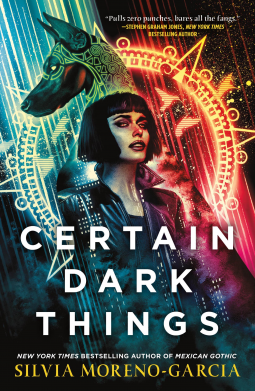
 Certain Dark Things, by Silvia Moreno-Garcia (Tor)


Silvia Moreno-Garcia continues to knock my socks off, literarily speaking. Her Gods of Jade and Shadow was nothing short of breath-taking. Now she turns her wild and dark imagination to a vampire tale set in Mexico City. In this world, there are not one but many kinds of vampires, each with its own history, weaknesses, and predilection for bloodshed. Certain Dark Things tells the story of the perilous friendship between street-kid Domingo and Atl of the Aztec line of vampires whose family has been wiped out by the viciously violent narco-vampire clan. Atl is young and inexperienced in vampire terms and has led a carefree life, never having to make hard choices. Now she’s on the run for her immortal life. She’s the most beautiful woman Domingo has ever seen, and he can hardly believe his luck when she accepts his help. Atl’s only hope for a way to safety lies in fleeing Mexico, but to do that she needs documents available only through a secret and highly elusive vampire underground. Unfortunately, she soon attracts the attention of both crime bosses and a cop dedicated to exterminating her kind.

I’d classify this book as dark urban fantasy rather than horror, but it should appeal to readers of both genres. If you’ve never read Moreno-Garcia, you’re in for a treat.


Friday, November 23, 2018

Short Book Reviews: Vampires and Ogres and Were-Dragons, Oh My!

Shadow's Bane, by Karen Chance (Berkley)

Elsewhere I have written about the challenges of picking up a book in the middle of a series, and it’s worth repeating here:

 “Series” can mean a number of things, from stand-alone complete-in-themselves novels set in the same universe to one long story that extends over several volumes. Recently I listened to an interview with Peter Jackson in which he discussed the decision to not put a recap at the beginning of The Two Towers, the second part of The Lord of the Rings. He felt that one year between film was a short enough time for viewers (those few not intimately familiar with the books) to remember and anyone who went to see it without having seen or read The Fellowship of the Ring, oh well… I admit to not being as careful as I might about checking to see if a book is a sequel, so I rely on the skill of the author to furnish necessary backstory without inundating me with it, and to draw me into the story so that even if I have to work a little harder to figure out what has gone before, I’m already hooked. 

I began Shadow’s Bane without realizing it was “yet another adventure” in a series. To the ultimate credit of the author, for most of the book, I honestly could not tell if there was separate backstory (previous volumes) or if this was a brilliantly executed, complex novel that wove in aforementioned backstory, world-building, and characters, all while sweeping me up in a dramatic, action-driven plot.

The world is fascinating, multi-layered, and rich in its own history. Vampires exist, as do dhampirs (vampire-human hybrids, heartily loathed by both parent races), ogres, fae, mermaids, were-creatures, and magicians. Relations between the various races are uneasy at best and impossible to summarize here. Our heroine, Dory/Dorina, in addition to being dhampir, suffers from split personality that’s the result of her (vampire) father attempting to save her from her worser (waaaay worser) nature. So there’s a nice internal conflict, as well as rather spicy romance with a master vampire, a sweet friendship with a human woman who has (a) given birth to the heir to a fairy kingdom; (b) turns out to be a were-dragon, so don’t get her pissed, and various other friendships and enemyships.

Wednesday, October 12, 2016

Short Book Reviews: Immortality and That Special Occult Book

Two recurring motifs in fantasy literature, both historical and contemporary, are the conquest of death and the book of secrets. The search for immortality — and its advantages and drawbacks — ranges from a fascination with immortal creatures (vampires, gods, Tolkien’s elves) to The Fountain of Youth and the cure for all bodily ills. The book or scroll or other text takes as many forms, from ancient books of magic, grimoires, H. P. Lovecraft’s Necromonicon, and other sorts of occult texts.

The Apothecary’s Curse by Barbara Bennett (Pyr, October 2016)  reads a bit like a Dan Brown thriller. Immortality (or rather, the ability to heal from almost any disease or injury) has been achieved, thanks to an ancient text, a compendium of remedies based on various herbs and chemicals, derived from knowledge millennia before its time and rooted in a Celtic-like myth. The ingredients and procedures must be followed with scientific accuracy, and any deviation is likely to cause disastrous results. In this story, the two viewpoint characters — one a 17th Century apothecary, the other a physician from almost two centuries later — have achieved immortality and found it to be a curse. The book, however, has been lost, along with any hope of restoring them to normal human lives. In every era, they must deal with those who seek this knowledge for their own nefarious purposes. 

I loved the premise that an ancient text, written is such a way that only an adept can unravel its secrets, holds a treasure trove of scientific lore equal to what contemporary medicine possesses. The characters appealed to me, especially the apothecary struggling with PTSD after being tortured for decades in a madhouse. The one misstep came near the end with a sudden detour into conventional fantasy and divine intervention that was not only unnecessary but for me detracted from the “ancient science” theme. Still, the book was an enjoyable read, a nice combination of two time-honored themes with a medical thriller twist.


The Fall of the House of Cabal by Jonathan L. Howard (St. Martin’s Press, Thomas Dunne Books, Sept. 2016) presented a delightful read from the first page, with its quirky humor and even quirkier characters. This is not the first adventure of Johannes Cabal, necromancer and social misfit, and his debonair vampire brother, Horst, but it’s a dandy place to jump in. Johannes and Horst are off on a quest across virtual dimensions, one that involves both immortality that That Special Occult Book. On their way, they're accompanied by assorted comrades — living, dead, and demonic. My favorite was the latter, a gigantic half-woman, half-spider who wears an angora sweater and is as enthusiastic about sex as she is about murder. When introduced to Johannes's (human) woman detective companion, someone he cannot bring himself to admit his feelings for, the first thing our spider-demon asks is, "Is she your lover?" No, he sputters, of course not. "But here is Horst, my brother." "Oh," says the spider. "Is he your lover?" 
You've got to love a creature who thinks that way.

The story is a witty, endlessly entertaining, fast-moving romp through Hell and London (via a few other places) that left me cheering and wanting more. I have no doubt that the House of Cabal shall rise again!

Friday, March 29, 2013

Reaching More Than One Audience

2013-03 F & SFI sometimes joke that my work is fiction -- "I make it all up" -- but that isn't true. All writers draw to some extent on our own experiences and environments, not to mention what we've studied, heard about from other people, or researched properly. Whether we take a real-world element and put it unchanged into a work of fantasy or science fiction or whether we use that element as a springboard to create something "new" (AKA, a fantastical variation), we weave things, people, and events that actually exist into our fictional worlds.

For my novelet, "Among Friends," (F & SF March/April 2013), I drew heavily on the history of Quakers and the Underground Raillroad. The sfnal element in this story, which might be categorized as antebellum steampunk, revolves around the interaction of the Quaker community and a slave-catching automaton. While history, particularly the biography of Thomas Garrett, provided a wealth of plot points and setting details, the heart of the story was how this community of people might question whether a mechanical device partakes of the Inward Light. I used the Quaker community because it's one I know well, at least in its present progressive version. My husband is a member of the Religious Society of Friends, Pacific Yearly Meeting, and I've attended meeting regularly for a number of years. I'm not a theologian, Quaker or otherwise, but I have first-hand familiarity with the ways of thinking and speaking about spiritual issues in that tradition. Quakers today, as then, strive to see "that of God in every person." So how would they regard an entity that looks human -- would they "try what love can do"? Would that entity, treated as if it had moral agency, then acquire the ability to seek the good? With the goal of creating a vivid and internally consistent culture, one that is familiar enough to the average reader to be comprehensible and different enough to be fascinating, I wove together historical research, personal experience, and a fantastical element. Mindful of my own limitations, I asked several "weighty Friends" to review the draft for background accuracy.

Wednesday, January 30, 2013

GUEST BLOG: Lois Gresh on Paranormal Romance

Lois Gresh's new novel, Nightfall, is a New Adult Paranormal Romance. Here she talk about her writing career and what she's learned about crafting good stories (oh, and a few words about Nightfall, too!)
When I first learned how to read, I instantly loved books.  I actually remember the moment.  I spent a lot of time at the library and reading an ancient (1930s!) set of encyclopedias that my mother kept in the hallway outside my bedroom. At 9, I wrote a 55-page science fiction story; at 12, a 220-page “report” about ancient Egypt; at 16, a 250-page book about poverty; at 22, a 500-page novel; at 23, a 400-page novel; and during college classes, I wrote horror stories featuring my professors. In my early twenties, I wrote two full-length mystery novels that twisted themselves into dark comedies. I switched to dark fiction, what's called weird fiction -- a blend of fantasy, paranormals, science fiction, and psychological horror -- and sold a bunch of stories. I ended up writing a thriller novel for Ballantine/Del Rey, then went on to write a fleet of pop culture books while continuing to work on my novels and short stories.

I usually have a pre-planned idea of how the story will end, but does it end that way? Very rarely. Typically, the characters take on lives of their own and twist my endings for me. I don’t get writer’s block (knock on wood, etc.) I always have too many stories floating in my mind that I want to tell for the amount of time I’m able to write. As for where I write, anything will distract me. So I write in a secluded environment, and I even blast a white noise machine to drown out household noises. 
The most important elements of good writing are the triad of character, plot, and theme. You need characters with real emotions and needs. Your characters require conflicts to overcome.  One or more themes -- such as “be good to other people” or “it’s not cool to lie to somebody who loves you” or “love can overcome anything” or “love is more important than where you live or what you have” -- provides your story with emotional impact.

Tuesday, January 8, 2013

January 2013 - What I’ve Been Reading…


The What We’re Reading Wednesday meme is making the rounds. True to form, I offer up some reflections on what I have been and am reading Not On A Wednesday.

I’ve been slowly working my way through two series: Bernard Cornwell’s “Richard Sharpe” books and the Sookie Stackhouse “Southern Vampire” novels of Charlaine Harris. Each of these is a story in itself, about which more is forthcoming below. I say “slowly” because I want to make them last, so I ration them out a chapter here, a book there, with breaks for other reading.

The Cornwell is undoubtedly Ioan Gruffud’s fault. When my younger daughter still lived at home, we watched the A & E “Horatio Hornblower” series together (a precursor to her inflicting Dr. Who upon her unsuspecting mother, who then retaliated by knitting her The Scarf, but that’s another tale entirely). Years later, my husband – who normally does not care for movies in general and anything with fighting in particular – expressed willingness to indulge me with Friday night videos. We noodle around with every dramatization of the life of Queen Elizabeth I we could find and then advanced to Horatio Hornblower, both the series with Gruffudd and the movie with Gregory Peck. From there, it was just a hop, skip, and a jump to the infantry’s role in the Napoleonic Wars. Sean Bean’s “Richard Sharpe” to the rescue. Having watched the series, I of course grabbed for the books. They are interesting in many ways. For one thing, they aren’t written in order. The series begins in the early middlish part, when Sharpe has already saved the life of Sir Arthur Wellesley (later the Duke of Wellington) and become an officer “up through the ranks,” an elevation much frowned upon by both his fellow officers and the common soldiers he is to command. Then, after quite a number of adventures, Cornwell goes back to the beginning, as it were, fills in a lot of background, so you can read them in the order in which they were written or in chronological order. For another, each book centers on one battle. One battle! And has not a speck of flab anywhere.

Wednesday, December 26, 2012

GUEST BLOG: Pati Nagle on "What's Next?"

Pati Nagle was born and raised in the mountains of northern New Mexico. An avid student of music, history, and humans in general, she has a special love of the outdoors, particularly New Mexico’s wilds, which inspire many of her stories. Her fiction has appeared in Asimov’s Science Fiction, The Magazine of Fantasy & Science Fiction, Cricket, Cicada, and in anthologies honoring New Mexico writers Jack Williamson and Roger Zelazny. Her fantasy short story ”Coyote Ugly“ was honored as a finalist for the Theodore Sturgeon Award. She has also written a series of historical novels as P.G. Nagle. She is a founding member of Book View CafĂ©.
 
Q: What is the working title of your book? 
A: CURSE OF THE FALLEN or CURSE OF THE ALBEN, not sure which.  What do you think?  Is CURSE OF THE ALBEN confusing?

Q: Where did the idea come from for the book?
A: Short answer: This is book 4 of my Blood of the Kindred series, inspired by my short story, "Kind Hunter" (which you can read at Book View Café - it's the free sample from the anthology DRAGON LORDS AND WARRIOR WOMEN).

Q: What genre does your book fall under?
A: Fantasy

Q: Which actors would you choose to play your characters in a movie rendition?
A: Well, Orlando Bloom is the quintessential elf in my eyes, so I'd cast him as Turisan.  For Eliani - yanno, Zooey Deschanel might work!  For Shalár, I think Kaley Cuoco would do a very good job.  And for Luruthin, perhaps Matthew Gray Gubler.

Tuesday, July 17, 2012

Is This Story Too Big…Or Is The Book Too Small?


Recently, I read two novels that left me chewing over the issue of story size. The two novels were Love On The Run by Katharine Kerr and A Discovery of Witches by Deborah Harkness. Both were absorbing, with characters I cared about and nifty plot twists, ideas to chew on, and interesting locales. In other words, they were respectable novels by competent authors. I enjoyed them, yet each in a different way left me wishing the book had been either longer or shorter.

Love On The Run is the fourth in a series about a paranormal investigator, Nola O'Grady, her sweetheart Ari who is by no means mundane, the various doings of the super-secret agency that employs her, and her family, variously gifted and not always on the right side of the law on this and several other worlds. By the time Love On The Run takes place, we've had a chance to get to know these characters and worlds. The multiplicity of related alternate universes reminded me of some of my favorite early Andre Norton science fiction.

A Discovery of Witches is actually the first volume in a trilogy, but for some reason I did not realize that until I sat down to write this essay. I was thoroughly prepared to enjoy it -- what a delight to begin a story in the research shelves of the Bodleian Library, tracking down and deciphering ancient manuscripts.

Thursday, April 19, 2012

GUEST BLOG: In Which Sarah Zettel Reveals The Culinary Secrets of Vampires


Hello. My name is Sarah Zettel. And I’m a science fiction writer (Hi, Sarah). The thing is, I’m a science fiction writer who is currently writing mysteries. About vampires. And food.

I wish I could take credit for the idea of the vampire chef, but I can’t. The idea itself came from the late, great publisher and editor, Marty Greenberg, and I was just lucky enough to be an author with time enough to take on the project (truth was, I was out of work when the chance came). The first thing I did — after contacting a food critic friend and buying KITCHEN CONFIDENTIAL — was start reading every vampire-starring book I could get my hands on. I was not really a reader of the modern vampire before this, and I needed to know what I was talking about before I settled into making jokes about it.

Thing is, as I’m a science fiction writer by nature, there was no way I was going to be able to write about vampires in Manhattan without going into the history of vampires, and the world of vampires “real” and literary. And there was no way all the results of that research were going into the books. Nor was there anyway all of it should.

This used to be a problem for authors. We had reams of research and strange ideas we had to squirrel away in our mental attics, and sometimes our real attics. Fortunately, in the 21st century, we have blogs.

So, with the kind indulgence of our hostess, I give you, dear readers, a history of the literary vampire, in dialogue form.

HANGIN’ WITH A VAMPIRE

[In which the author is discovered standing at her front door behind a pile of rice, holding her crucifix and holy water and calling out sacred names. Soundlessly, a silhouette slips up to the window, a pale hand is laid on the glass, and a rich voice, impossibly old and dangerously young at the same time begins to speak]
            “Hey, can I come in? ‘Cause, like, the sun’s comin’ up and I’m gonna start sparkling any minute here.”
            “Edward?”
            “Yeah. Can you, like, let me in, please?”