Showing posts with label fantasy. Show all posts

Friday, December 19, 2025

Short Book Review: Baking as a Magical Art

 The Wizard’s Guide to Defensive Baking, by T. Kingfisher

 I don’t know how I missed this delightful fantasy when it first came out, winning the Hugo and Locus Awards in 2021. It combines some of my favorite story elements: an intrepid young heroine, weird forms of magic, and baking. Yep, baking. Fourteen-year-old Mona’s magical talent is, by any standards, quite modest. She can’t summon lightning, resurrect a cavalry troop of dead horses, or control a flood. As an apprentice in her aunt’s bakery, she uses her magic to encourage bread to rise and, upon occasion to delight the customers, she makes gingerbread men dance. Her life of quiet joys takes a drastic turn when she discovers a dead body on the floor of the bakery. Before she knows it, she’s on the run, either suspected of being the murderer or convinced she is the next target. Worse yet, by the time the dastardly plot is revealed, the super-wizard who is the city’s primary defense has been lured away and Mona has only herself and a ragtag bunch of friends to keep everyone safe.

I loved Mona, her friends, the unusual twists on magic, and most of all, the voice of the author shining through these adventures. I think my favorite part was Mona’s gigantic bread “golem” defending the city gates against the ravening horde. And the zombie horses, who manage to retain both their personality and their loyalty, like true horses across time and imagination.

Recommended.

Friday, August 15, 2025

Short Book Reviews: A Cozy Battle-Orc Fantasy

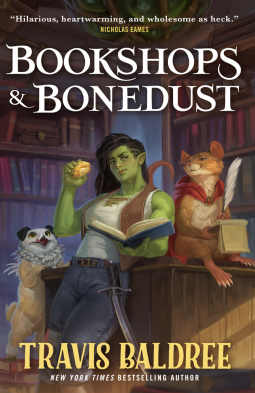
 Bookshops & Bonedust, by Travis Baldree (Tor)


Is there such a thing as a cozy high fantasy with a female battle-orc heroine? Elves, dwarves, enchanted swords, necromancers…and spicy romance novels? Yes to all of this, because Travis Baldree has invented the subgenre!

Bookshops & Bonedust is a delightful prequel to Legends and Lattes, although each works beautifully on its own.

Recuperating from wounds incurred in the hunt for a powerful necromancer, battle-orc soldier-of-fortune Viv finds herself in the sleepy beach town of Murk with nothing to do. In desperation born of overwhelming boredom, she follows the literary suggestions of Fern, the ratkin owner of a dying bookstore. Any fantasy reader worth their salt knows what comes next! Not only is Viv drawn into the enchanted world of novels but she sets about reviving the bookstore, complete with a surprise appearance by the elf author of fabled romance adventures. Along the way, Viv encounters a gnome with a chip on her shoulder, a retired mercenary turned baker extraordinaire, a mysterious traveler in gray, and a talking bag of bones. All is not hunky-dory in Murk, however, for the necromancer responsible for Viv’s injury is still on the loose…

I loved every page of it!

Saturday, August 9, 2025

Northlight has a new cover!

Northlight

She's a Ranger, a wild and savvy knife-fighter, determined to get help in finding her partner who's lost on the treacherous northern border. He's a scholar who sees visions, eager to escape the confines of city life and the shadow of his charismatic mother. With the assassination of a beloved leader and the city in turmoil, the two have only each other to turn to. What begins as a rescue mission turns deadly as together they unravel the secret that lies beneath Laurea's idyllic surface.


Reviews:

 "A beautifully constructed fantasy with characters who grow and mature before the reader's eyes and who are engagingly human while being fantastically heroic. Her writing flows and the point of view switches are interesting and exciting. This book is a keeper." Rickey Mallory, Affair de Coeur

 "A style and manner reminiscent of McCaffrey's Crystal Singer series." The Bookwatch

 "An unusual saga that starts slowly but builds to a startling climax." Sherry S. Hoy, Kliatt

 "Solid characters and a well-designed world make for good reading." Philadelphia Press

"The plot moves briskly from crisis in Laureal to capture by the Norther barbarians to discovery of the true meaning of the Northlight of the title, with ample foreshadowing from the mysterious spooky something in the air of the frontier. And the culmination quite satisfactorily evokes the sense of wonder." Tom Easton, Analog

Amazon: https://tinyurl.com/2czh4mef

Barnes and Noble: https://tinyurl.com/3pvx9cp6

Everywhere else: https://books2read.com/u/3L7GXb


Friday, April 4, 2025

Book Reviews: Two Fantasies by Martha Wells

Martha Wells has become one of my favorite authors. I loved her “Raksura” series and was bowled over by her “Murderbot” novellas. I thought I would follow her across genres. Two of her recent releases soar in terms of world-building imagination, but fall short in dramatic shaping and plot structure.

Witch King, by Martha Wells (Tor)

Witch King opens with a mystery as demon Kai (not “a” demon, THE demon) wakes up in captivity with a mage attempting to seize control of his magic. His immediate goal is to free himself and locate his companions. This proves to be both easier and far more challenging than it appears on the surface. For one thing, Kai’s last (dead) host body has been murdered and he’s in another, quite unfamiliar (and much less fit) body; for another, he has no idea how much time has elapsed since he’s been unconscious (a lot), what political changes are afoot in the world, and where the wife of his closest ally has disappeared to.

So far, so good, and Wells does a superb job in introducing complex characters, an unusual system of magic, and millennia of history and world-building without dumping expository lumps on the reader.

Wells then shifts to the distant past when Kai inhabited a volunteer body and lived in a rich, joyful, and emotionally warm culture. From here, the two timelines alternate chapters. A few characters, such as Kai who is almost immortal, appear throughout, but many others (many, many others) are specific only to one. Still more are alive and active in the past but distant memories in the present. Because the focus is on Kai and a few others who are present in both times, I had to search for other clues as to where and when I was.

Both storylines are filled with action and wonderful characters, situations, and relationships. Each one would be more than enough for a novel in itself. Some readers will love the weaving back and forth and all the myriad ways the past informs and shapes the present. I was one of them, but only at first. As the book went on, however, I found it increasingly frustrating trying to orient myself—which time is this? what’s been going on? who’s still alive? and, most importantly, what is the present goal or threat for the protagonist? There didn’t seem to be a single plot arc, a building dramatic tension that carried through in both past and present. It didn’t help that my favorite character from the past is long since dead in the present. Within each timeline, unrelated problems arise and are resolved. I could never figure out what the overall “Big Bad” was, especially after one candidate villain after another is eliminated. The “Big Bad” at the end seemed to come out of nowhere. Mark Twain famously said that life is “one damned thing after another.” Fiction must play by a different set of rules.

Witch King is hugely ambitious, filled with imaginative elements, compelling personal drama, and a huge landscape across time as well as space. Wells handles these elements with the effortless skill of a seasoned professional, but fails to shape them into a single dramatic story.


Wheel of the Infinite, by Martha Wells (Tor)


Wheel of the Infinite
starts with a fortuitous encounter on the road between Maskelle, a confident and immensely powerful magic wielder, and handsome, enigmatic swordsman Rian. After she saves his life, he and a band of motley other characters accompany Maskelle to the heart of the Celestial Empire. Much later, we learn that she’s returning from exile after being judged a traitor and much, much later, that her task is to help remake the beautiful, orderly mandala known at the Wheel of the Infinite, thereby ensuring peace and harmony for the Empire. At turns, the action moves swiftly with leaps of dramatic tension or as slowly as any travelogue. In this, it reminded me of The Lord of the Rings (the books, not the movies), which alternated between seat-of-the-pants action and pages upon pages of passing scenery. Also that there’s a quest, although in Rings, the mission is much more clear and consistently present.

Maskelle was one of my favorite characters in a long while. She’s an older woman, always a plus with me, she’s quite comfortable with her sexuality (double plus), and she’s terrifyingly competent as a magician (triple plus). Once the question of whether she’ll decide it wise to take Rian as her lover is settled, he pales by contrast as a character. Many, many other characters appeared (and disappeared, some temporarily, others not so much) but weren’t around for long enough to engage my sympathy.

As with Witch King, the premise, world-building, magical system, and protagonist in Wheel of the Infinite were all marvelous. The book is highly ambitious, offering fresh, original takes on time-honored tropes. Its sheer size and scope break down under their own weight. It’s as if Wells, whose novellas and shorter novels are tightly plotted gems, hasn’t quite made the leap to books of this length and complexity. Nevertheless, both are enjoyable reads with many twists and innovations. While neither worked perfectly for me, I’m eager to read her next project.


Monday, October 21, 2024

Guest Post: A Story’s Genesis: The Wind’s Kiss, by Dave Smeds

Readers often ask where the idea for a story came from. Here, veteran fantasy author Dave Smeds offers a peek behind the scenes in the creation of his wonderful short fiction piece, "The Wind's Kiss." Its first publication was in Lace and Blade 4, which I edited. It's a marvelous story, exquisitely written, full of pitch-perfect heart. Now it's also available in Dave's collection Swords, Magic, and Heart (see the cover below). 

A Story’s Genesis: The Wind’s Kiss
by Dave Smeds


The headstone — as you can see in the photograph I’ve included here — stood alone, at least thirty paces from any other marker in the little one-acre graveyard. Still, it was there, intact and still upright, and I was grateful for that fact. The cemetery had been used for less than four decades, from its founding in 1881 to the final burial in 1920. Once the small chapel on the accompanying acre ceased to exist, no one consigned their loved ones to rest there. The place became so forgotten that its decorative lilac bushes grew into a huge patch, concealing nearly all of the stones. People would drive right and be unaware of the nature of the site, even though they could have thrown a tennis ball out a window and the ball could easily have landed on one of the graves. Nowadays local volunteers keep the shrubbery trimmed and mow the turf. If not for that, even I, who knew where to go, might have struggled to find it.

I had always meant to stop there, sooner or later. The problem was, I had kept saying to myself that I would do it when I happened to be passing through Nebraska. But given that I live in California and always have, I reached my sixtieth birthday having found no occasion in my adult life when I had cause to be “just passing through” Nebraska. My path-of-least-resistance approach was inadequate. I had to make the goal a bucket-list item.

In 2016, I was in Kansas City, MO to attend the World Science Fiction Convention. My wife joined me on the final day, and the next morning off we went on a long, snaking course to visit family graves in not only Nebraska, but South Dakota and Iowa as well — all three of them states outside the scope of previous explorations on my part, or hers. We arrived at the lonely little graveyard on the third day, reaching it about ten minutes after we had rolled through the forlorn village of Creighton, population 1125. After paying our respects, we would go north about three miles to Winnetoon, population 63. Vacant as those communities were, we would see encounter smaller ones the next day, including, as we crossed into South Dakota, the hamlet of Wewela, population FIVE.

Friday, January 12, 2024

Short Book Reviews: A Lady Adventurer-Scholar Takes on Faerie


Emily Wilde's Encyclopaedia of Faeries
(Book One of the Emily Wilde Series), by Heather Fawcett (Del Rey)

In many ways, Emily Wilde's Encyclopaedia of Faeries by Heather Fawcett reminded me of Marie Brennan’s best-selling A Natural History of Dragons and the “Amelia Peabody” mysteries by Ellis Peters: the Victorian lady adventurer-scholar genre. In all of these, the narrative voice (that is, the personality of the l adventurer-scholar) grabs my interest and keeps it for page after page. The stories are as much about the protagonist’s inner emotional journey from adamantly self-reliant spinster to emotionally awakened, relationship-literate partner as they are about external action. Emily Wilde's Encyclopaedia of Faeries fits neatly into this model with a delightful array of plot and character twists. In this case, Cambridge professor Emily Wilde takes her sabbatical in the far North (Norway?) to complete her magnum opus on all things Faerie, particularly the “Hidden Ones,” what we would call high elves. Her tone-deaf social skills alienate the villagers upon whom she must depend not only for the folk tales that will form the heart of her treatise but for sustenance and rescue. She has no idea what she’s done wrong or how she’s going to cope with her insufferably handsome academic rival, Wendell Bambleby, who arrives unexpectedly and manages to charm the townsfolk, muddle Emily’s research, and alternately bewilder and frustrate her.

This book is familiar enough to relax into and enjoy the ride, and a fresh enough rendering to surprise and delight me with the original, often whimsical elements. Footnotes and references perfectly enhance the “scholarly” voice. If there were moments when Wendell felt tempted to grab Emily and shake some sense into her before kissing her, I was right there with him.

The bottom line: Marvelous fun!

Monday, October 16, 2023

GUEST BLOG: Sherwood Smith on Monarchy in Fantasy

What is it with fantasy stories and monarchies? Isn't there any other form of government?

Two words, power and privilege.

What’s not to like?

What’s not to hate?

Whatever those words evoke to us, it’s usually not boredom. Human beings are hierarchical. You take any group, no matter how determined they are to interact with sensitivity and equality, and a leader somehow emerges. That’s in situations that have the luxury of safety. In emergencies or danger, people turn desperately to anyone who can show them the way out, whether it’s by fighting or fleeing. The successful commander who becomes monarch is as old as history.

Monarchs make government personal, and most readers want stories about people more than they want stories about the function of politico-economic theory, for pretty much the same reason people at work gossip about the boss’s likes, dislikes, and private life. The doings of people in power are interesting, especially when they can impact you, but even when they won’t. Look at all
the celebrity chasers busily reporting on the often fatuous actions, opinions, marriages and breakups of our king-substitutes, actors.

We moderns seem to prefer stories about kings and queens from the days when monarchs were colorful figures in preference to today’s reclusive royalty who, wearing business suits like everyone else, appear only for photo ops and ribbon-snipping. The old kings had more power, but they also had to generate their own PR by looking like kings: when they traveled past you, with outriders and banner snapping and horses caparisoned to a fare-thee-well, you knew a king was passing.

Friday, June 23, 2023

Short Book Reviews: Speaking With Ghosts Can Get You Killed

 Daughter of Redwinter, by Ed McDonald (Tor)


What a great read! From the first page, this book grabbed me and carried me along. Superb action, wonderful characters, ever-escalating stakes, and mystery. The story opens with Raine, our heroine, creeping out the back way from a monastery under military siege, looking for an escape route, only to encounter a mysterious wounded woman who is desperate to get back in. On the woman’s heels are a group of warrior-magicians, bent on stopping her even if it means tearing down the walls. The military besiegers are willing to aid the magicians, but what they’re after is inside — people with “grave-sight” that allows them to see, and sometimes speak with, the dead. Raine is one of those with the talent that means execution, should it be discovered. All her life she has hidden, lied, and run away to save her skin, and she’s made some spectacularly bad choices along the way.

The book was full of drama and poignant emotion, hard-bitten action and sweet romance. The balance between slowly unfolding mystery, lightning reversals and betrayals, and coming of age of a most remarkable heroine was exceptionally well handled. Most of all, from the very first paragraphs, I found myself relaxing into the hands of a master storyteller, confident that wherever the tale took me, it would be a wild and infinitely satisfying ride. I was never disappointed.


Monday, February 13, 2023

Author Interview: Joyce Reynolds-Ward

Joyce Reynolds-Ward and I met the pre-pandemic days when I regularly traveled to conventions in the Pacific Northwest. She’s warm, funny, endlessly curious, and a fantastic writer. And a knowledgeable and enthusiastic horse person. So when I heard she’d just put out a new book, I couldn’t wait to find out about it.


Deborah J. Ross: Tell us a little about yourself.  How did you come to be a writer?

Joyce Reynolds-Ward: I've been making up stories to entertain myself since I was little. At first, they were about books I'd read or TV shows I watched. Then I started writing stories off and on, starting with my junior high literary magazine continuing through the present day. I've gotten somewhat serious about writing since the late '00s, however, and have been writing regularly since 2008 or so.


DJR: What inspired your book? 

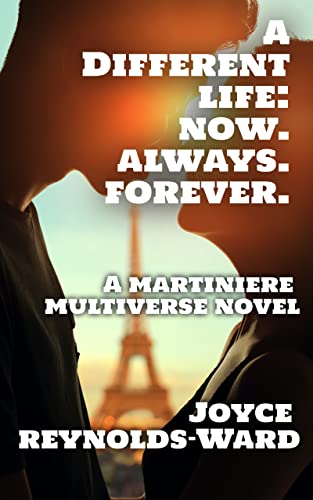
JRW: My most recently published book, A Different Life: Now. Always. Forever. was an attempt to write something light. Um. Well. Maybe. It's set in what I call the Martiniere Multiverse, a spinoff from my main series, The Martiniere Legacy and the People of the Martiniere Legacy.

When writing A Different Life: What If?, I half-toyed with the idea of writing about my main characters, Ruby and Gabe, from the perspective of Ruby's best friend in college, Linda Coates, who Ruby hires to be her executive assistant. The more I thought about it, the more I liked the idea, and I figured that it would make a nice, light little story, which was what I needed to think about after several years of Covid and my worries about the 2022 election.

Things kinda happened from there. The book took a more political tone after the reversal of Roe v. Wade, with Linda's brother-in-law becoming a rising reactionary political leader who has nefarious designs involving Linda. But there are still light moments, and we have a bit of biobot action where Ruby and Linda release the latest version of Ruby's bots that are intended to counter climate change by helping plants absorb and retain moisture better. Plus--Linda's reaction to living in an Art Nouveau palace in Paris, France. That was fun to visualize.


DJR: What authors have most influenced your writing?  What about them do you find inspiring?

JRW: My influences come from several very odd and unusual places, especially for a writer in the speculative fiction genre. One of my earliest influences was Mary O'Hara, of My Friend Flicka fame. If you have only read the first book, especially in an abridged edition considered suitable for children, you miss a LOT of the deeper undercurrents of O'Hara's writing. The other two books in the trilogy, Thunderhead and Green Grass of Wyoming, delve into spirituality (O'Hara had become involved with early versions of Eastern mysticism) and conflicted, difficult marital relationships. Writing this, I suddenly realize that my character Gabriel Martiniere owes a little bit to O'Hara's Rob McLaughlin. Not a lot--but there's a little bit of Rob in Gabe.

One thing to consider, though, about O'Hara, is that she was one of the original script doctors in Hollywood during the silent film era. While she only cites a few instances where she got called in to work on scripts gone wrong, it's enough to make me wish that she had written a memoir about that Hollywood experience. Nonetheless, her life story (as related in Flicka's Friend) is quite fascinating.

John Steinbeck is another literary influence that I frequently cite from my early days of writing. One of my high school English teachers used his Travels with Charley as a textbook for her advanced writing class. From Charley, I moved on to his Journal of a Novel, drafted while he was writing East of Eden. Then I went on to read all of his books. Steinbeck, along with O'Hara, taught me a lot about the use of settings in my work that I think really still shows up.

Otherwise, there are many writers who have influenced my work and made me think more about the process of writing and what I was doing while writing. Obviously, I read widely and well beyond the genre. Recent influences include C.J. Cherryh, Beverly Jenkins, Aliette de Bodard, Kate Elliott (especially her so-underestimated Jaran books), Craig Johnson, N. K. Jemisin, Mary Robinette Kowal, and many, many more. I am always eager to discover a new writer and new works. My ebook library card gets a LOT of use these days.


DJR:
Why do you write what you do, and how does your work differ from
others in your genre?

JRW: Originally, I started writing what I do because I wasn't finding the books I wanted to read. I wanted to read about more strong women, but I also wanted to read fantasy in settings that weren't quasi-medieval Europe, as well as science fiction that wasn't set in Southern California or New York. I wanted to see more work that included the things I was interested in, including realistic horses, the inland West as a setting, examination of political power that didn't make me want to throw the book across the room, and other things.

 I write politics from my training in political science and the nearly two decades I spent as a political organizer. Some writers in genre have that knowledge and understanding, but many don't. While my understanding is more on the state and local level, it's enough to extrapolate for larger settings. Additionally, because I spent many years as a corporate wife at the middle management level in sales, I know somewhat more about some of the stuff that goes on in that realm than most people. The ins and outs of management fads, the degree to which certain things get done, the internal politics...all of that. I focus on multigenerational privately-held corporate entities rather than larger publicly-held companies because that's easier to control in a story.

Friday, January 27, 2023

Short Book Reviews: A Complex, Brilliant Character-Driven Fantasy


The Bone Orchard
, by Sara A. Mueller (Tor)

With a style reminiscent of Tanith Lee and a world as complex and byzantine as M. A. Carrick’s, Sara A. Mueller spins a tale of magic, identity, politics, and hidden pain. The Bone Orchard is difficult to describe in terms of premise or plot because so much of the reading experience involves following the development of unreliable narrators who may or may not be the severed aspects of a single person. But who that person truly is and how much autonomy the other aspects possess pose questions that Mueller reveals gradually and with consummate skill.

We know that severe early trauma increases the risk of dissociative identity disorder, formerly called multiple personality. Suppose, then, that it were possible to create a synthetic version of yourself, using bones grown on trees, for example, a “you” that would bear that unbearable pain? Or take away your shame upon herself? At what point would you cease to be you? How many aspects of yourself must you lose to become someone else, and what would be left?

From the very first pages, I was enthralled by The Lady, Charm, Pain, Pride, Shame, and Justice, and how they each survived (or perished) in the game of ruthless, often lethal magical politics. I especially loved how each found a wellspring of compassion in her burden, especially Pain. The unexpected love story was like a chocolate left on a pillow.

Mueller writes that it took her many years to create this story, and the care she took shines through the depth and complexity of the world and its people. All too often, a debut novel that is the product of long development is followed by another that is comparatively rushed by early success. I hope Mueller is given the same scope for her next novel. If The Bone Orchard is any indication of what we can look forward to, it will be a treasure. She is definitely a talent to watch.


Monday, January 2, 2023

Revisiting Nightmares: Fantasy/Horror Crossovers and Trauma Recovery


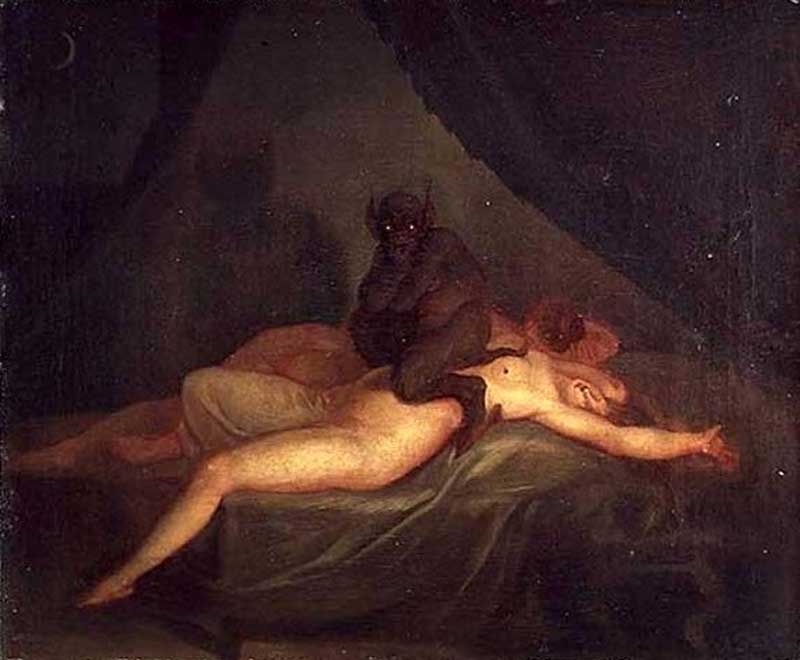
Nightmare by Abildgaard

Fantasy and horror have a natural affinity, one that goes back to the pre-literate times when people sat around the campfire, terrifying each other with stories of ghosts and skin-walkers and things-that-go-bump-in-the-night or that-are-not-quite-dead. Supernatural elements infused these tales with delightful spine-tingling shivers. One might speculate that way back then, the entire world must have seemed a perilous place, filled with phenomena beyond human understanding. I think that does a discredit to peoples who might have a much lower level of technology than we do but were nonetheless extremely sophisticated in their conceptualization and emotional understanding of the world around them. For all our computers and skyscrapers, we are just as enthralled by the uncanny and that jolt of adrenaline.
 
Nightmare by Gauguin
Of course, as individuals we vary in what is pleasurable to us. One person’s fun may be the trigger that causes months of terrifying nightmares for another person. This is especially true for people who have themselves been the victims of trauma, whether the assault has come in the form of physical violence or from psychological or emotional abuse. Reading horror or dark fantasy is not an approved method of psychotherapy, but encountering these stories mindfully can shift our perspective. Good fiction of any kind does not “stay on the page” but has the power to change the way we see ourselves and our lives. Horror, by its focus on frightening elements, carries a particular emotional punch.

Friday, November 26, 2021

Short Book Reviews: A Transgender Heroine Defends Her Homeland

 Gifting Fire, by Alina Boyden (Ace)


I enjoyed this sequel to Alina Boyden’s wonderful debut fantasy novel, Stealing Thunder, for many reasons. With power and authenticity, the story of her heroine, Razia Khan, a transgender royal who ran away from unendurable abuse to work as a prostitute thief, find true love, rescue her feathered-dragon zahhuk, and discover her military genius, came alive. If Stealing Thunder was about discovering who you really are and being willing to fight for yourself, Gifting Fire elaborates that theme, centering on creating community and loyalty. Both stories are set in an alternate pre-Raj India, a refreshing departure from the usual Western European fantasy worlds. In our world, as in Boyden’s, transfeminine people called hijras have recognition, joining together in communities, even if as individuals they are rejected and scorned.

Razia has finally created the life she longed for, as a princess cherished by her soulmate, Prince Arjun, guardian to her sister-hijras, whom she deeply loves. But such bliss cannot endure. Her ambitious father, having maneuvered her into the governorship of an unstable province, Zindh. He now joins forces with her childhood nemesis, Prince Karim, who brutally raped her as an adolescent. In order to save her prince and his city from certain destruction, Razia agrees to marry Karim. Soon she is imprisoned in the women’s quarters at Karim’s palace, her good behavior ensured by threats against her sister-hijras whom he holds hostage. All is not lost, however, for Razia has now found a community of empowered transgender women, led by the rightful ruler of Zindh. It will take all of Razia’s military brilliance and courage to organize a successful conquest while playing the part of a submissive bride.

Boyden brings an unusual sensitivity to her portrayal of Razia, not as a stereotype or object of curiosity defined only by her gender identity, but as a person discovering her strengths in an often hostile world. Highly recommended for all fantasy readers. For anyone interested in positive portrayals of transgender characters, defined by much more than their gender, these two books are a treasure.

Monday, May 24, 2021

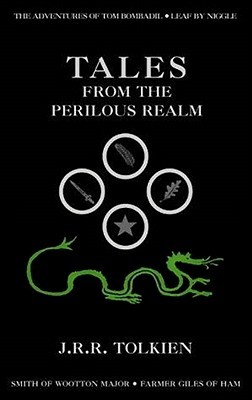
J. R. R. Tolkien on Fantasy

A lovely quote, worth re-reading over time:

Recovery (which includes return and renewal of health) is a re-gaining—regaining of a clear view. I do not say “seeing things as they are” and involve myself with the philosophers, though I might venture to say “seeing things as we are (or were) meant to see them”—as things apart from ourselves. We need, in any case, to clean our windows; so that the things seen clearly may be freed from the drab blur of triteness or familiarity—from possessiveness. Of all faces those of our familiares are the ones both most difficult to play fantastic tricks with, and most difficult really to see with fresh attention, perceiving their likeness and unlikeness: that they are faces, and yet unique faces. This triteness is really the penalty of “appropriation”: the things that are trite, or (in a bad sense) familiar, are the things that we have appropriated, legally or mentally. We say we know them. They have become like the things which once attracted us by their glitter, or their colour, or their shape, and we laid hands on them, and then locked them in our hoard, acquired them, and acquiring ceased to look at them.
[…]
Creative fantasy, because it is mainly trying to do something else (make something new), may open your hoard and let all the locked things fly away like cage-birds.

The whole article is here.

Monday, January 6, 2020

Sexuality in Fantasy

For a number of years, I had the privilege of editing the anthology series, Lace and Blade. The concept was a certain flavor of elegant, romantic sword and sorcery, witty and stylized, sensual yet with plenty of swashbuckling action (think The Scarlet Pimpernel with magic). Because the publishers wanted to release the first volume for Valentine’s Day, I contacted a group of seasoned professional authors, people I could depend on to understand what I was looking for and to deliver top quality stories to deadline. For various reasons, the publisher insisted that the second volume be open to submissions. If I had any idea what I was getting myself into, I would have refused. Insulated in the world of competent fantasy writers and readers who are versed in the grandeur of everyone from J.R.R. Tolkien to Tanith Lee, I was ill-prepared for what mundanes think of when they hear “fantasy.”

Needless to say, when I talk about sexuality or eroticism or sensuality or gender issues in fantasy, I do not mean pornography. It seems that for far too many people, sexuality is such an emotionally difficult subject that instead of facing it honestly, discussing it openly, they shroud it in prurience and embarrassment, or else turn it into something salacious or forbidden. Yet just about every human being over the age of puberty has had sexual feelings (notice my delicate use of qualifiers). So if sexuality in fantasy does not mean “your most lascivious and pornographic imaginings, regardless of whether you’d really like to do these things, because how would you know what you enjoy if you’ve never been permitted to experiment?” what is the role of sexuality in fantasy? Does it even have one? Should we keep sex out of fantasy literature, restrict the love stories to a chaste kiss now and again, and keep the hero/ine’s mind firmly fixed on nobler causes?


I believe that sex is such a powerful force in human lives that it is impossible to portray the full scope of emotions and motivations without it. People might not, for a whole panoply of reasons, act on their sexual desires, but they have them. They have them in wildly inappropriate situations, as well as those times and places that nurture genuine emotional intimacy. The feelings are ignored or fulfilled, misdirected or frustrated, overly indulged or denied utterly. Freud had a few things to say about what happens when such a basic drive does not find healthy expression, and although his theories were dead wrong on many counts, he was not mistaken about the fact that sex will not go away simply because society (aka The Authorities, secular or clerical) disapprove. So already, we have two ways in which considerations of sexuality are important to any story: character development and world-building.


What are the attitudes and practices regarding sexuality in this culture? Is it permissive, repressive, or a combination? Is marriage live-long or fixed-term? Monogamous, polygamous, polyandrous? Do different cultures in your world treat love, sexuality, and marriage in the same way? (For example, how are sexual fidelity and jealousy regarded? Is marriage a personal or a business relationship? Who determines what is acceptable in sexual behavior? Have norms changed over time and if so, why? What are the social, moral or legal consequences of transgressions? Are there times, places, or partners for whom “anything goes”?

Friday, October 11, 2019

Short Book Reviews: A Steampunk Detective, with Centaurs


The Clockwork Detective, by R.A. McCandless (Ellysian)

The last couple of years have brought a slew of wonderful steampunk adventures with resourceful, kick-ass heroines, and this one by McCandless is a worthy addition. Aubrey Hartmann is a veteran of recent war, having lost the lower part of one leg, and now works as a constable. Her prosthetic is a clockwork device that needs to be rewound regularly and isn’t a perfect fit but does keep her mobile, if in pain. As a result, she’s become addicted to laudanum (opium). Her current assignment involves investigating the murder of a druwyd (druid, local witch-doctor holy man) in a little town near the Fae-ruled Dark Wood. Here is where the world-building of The Clockwork Detective sharply deviates from the usual Victorian gears-and-whistles steampunk. Magic is not only real, it’s part of everyday life, and the human wars are overshadowed by the possibility of a terrible conflict with the Fae.

Aubrey’s research leads her into the Dark Wood to question the denizens there, those being centaurs, who are not only fierce fighters but wonderfully oblique and weird. The blending of Victorian mechanistic steampunk, mythology, and magic is seamless and believable. The story moves from murder mystery to international thriller to magical encounters of the terrifying kind. Aubrey herself is a wonderful combination of vulnerable addiction, resourcefulness, keen intelligence, and general all-around bloody-mindedness. I look forward to reading her further adventures!

The usual disclaimer: I received a review copy of this book, but no one bribed me to praise it. Although chocolates and fine imported tea are always welcome.


Monday, June 10, 2019

[Archives] Sexuality in Fantasy

by Gustave Courtois
A version of this post appeared on my blog in 2012

A few years ago, I had the privilege of editing a new anthology series, Lace and Blade, from Norilana Books. The concept was a certain flavor of elegant, romantic sword and sorcery, witty and stylized, sensual yet with plenty of swashbuckling action (think The Scarlet Pimpernel with magic). Because we wanted to release the first volume for Valentine’s Day, I contacted a group of seasoned professional authors, people I could depend on to understand what I was looking for and to deliver top quality stories to deadline. For various reasons, the publisher wanted the second volume to be open submissions. If I'd had any idea what I was getting myself into, I would have refused. Insulated in the world of competent fantasy writers and readers who are versed in the grandeur of writers from J.R.R. Tolkien to Tanith Lee, I was ill-prepared for what mundanes think of when they hear “fantasy.”

Needless to say, when I talk about sexuality or eroticism or sensuality or gender issues in fantasy, I do not mean pornography. It seems that for far too many people, sexuality is such an emotionally difficult subject that instead of facing it honestly, discussing it openly, they shroud it in prurience and embarrassment, or else turn it into something salacious or forbidden. Yet just about every human being over the age of puberty has had sexual feelings (notice my delicate use of qualifiers). So if sexuality in fantasy does not mean “your most lascivious and pornographic imaginings, regardless of whether you’d really like to do these things, because how would you know what you enjoy if you’ve never been permitted to experiment,” what is the role of sexuality in fantasy? Does it even have one? Should we keep sex out of fantasy literature, restrict the love stories to a chaste kiss now and again, and keep the hero/ine’s mind firmly fixed on nobler causes?

Friday, May 3, 2019

Short Book Reviews: D B Jackson Ventures into Time-Traveling Fantasy

Time's Children, by D B Jackson (Angry Robot)

I loved D B Jackson’s “Thieftaker” Chronicles, set in pre-Revolutionary Boston, with an appealingly flawed hero and a system of magic that extorts a dreadful toll. The plots moved right along, part police procedural, part magical battle, part romance. My interest never wavered, and at the end, I counted many of the characters as friends or at least recognizable enemies I must never trust. So I dove happily into this fantasy with its intriguing premise of magic wielders who can not only cross distances but time itself. I assumed the setting would be vivid, the characters compelling, and the magic itself carefully thought through and integral to the world and the plot.

The description was promising: Fifteen year-old Tobias Doljan, a Walker trained to travel through time, is called to serve at the court of Daerjen. The sovereign, Mearlan IV, wants him to Walk back fourteen years, to prevent a devastating war which will destroy all of Islevale. Even though the journey will double Tobias' age, he agrees. But he arrives to discover Mearlan has already been assassinated, and his court destroyed. The only survivor is the infant princess, Sofya. Still a boy inside his newly adult body, Tobias must find a way to protect the princess from assassins, and build himself a future... in the past.

As I read, I found my expectations were not amiss: the world was complex and interesting, and the characters, particularly the demons, got me curious. I loved the system of magic. An auspicious beginning, I thought. But as page after page went by, each one piling up more secondary characters that seemed to serve no purpose but to be left behind in an unending prequel to the plot promised by the description, I found myself looking around for something else to read. Add to that, the descriptions went on and on…and on, Robert Jordan style. As I’m not a fan of Jordan except as a cure for insomnia, this didn’t work for me.

Tuesday, October 2, 2018

NORTHLIGHT on sale, this week only!


 October 2-8, 2018, Nortlight in multi-format ebook edition from Book View Cafe for only $1.50.

She’s a Ranger, a wild and savvy knife-fighter, determined to get help in finding her partner who’s lost on the treacherous northern border. He’s a scholar who sees visions, eager to escape the confines of city life and the shadow of his charismatic mother. With the assassination of a beloved leader and the city in turmoil, the two have only each other to turn to. What begins as a rescue mission turns deadly as together they unravel the secret that lies beneath Laurea’s idyllic surface.

REVIEWS
“A beautifully constructed fantasy with characters who grow and mature before the reader’s eyes and who are engagingly human while being fantastically heroic. Her writing flows and the point of view switches are interesting and exciting. This book is a keeper.” — Rickey Mallory, Affair de Coeur
“A style and manner reminiscent of McCaffrey’s Crystal Singer series.” — The Bookwatch
“An unusual saga that starts slowly but builds to a startling climax.” — Sherry S. Hoy, Kliatt
“Solid characters and a well-designed world make for good reading.” — Philadelphia Press
“The plot moves briskly from crisis in Laureal to capture by the Norther barbarians to discovery of the true meaning of the Northlight of the title, with ample foreshadowing from the mysterious spooky something in the air of the frontier. And the culmination quite satisfactorily evokes the sense of wonder.” –Tom Easton, Analog

Friday, May 11, 2018

Short Book Reviews: A Classic Nancy Springer Fantasy


The Oddling Prince, by Nancy Springer (Tachyon Publications) is pure, classic Nancy Springer. In a faroff land, not unlike northern England, a king returns from a mysterious absence, wearing a magical ring that rapidly drains his life force. Just as he is about to perish, a young man appears, riding a steed of untamed light, and lifts the curse. The narrator, the king’s son and heir, befriends this stranger, his half-fae half-brother. But all is not well, as residual evil poisons the king’s mind and danger lurks just beyond the borders. Springer’s style sometimes reminds me of Tanith Lee, yet is completely her own. The love and fidelity of the two brothers, the steadfast discernment of the queen, the twists and turns and unexpected character developments, all kept me enchanted, page after page. Springer is in fine style!


Friday, June 2, 2017

Short Book Reviews: Another Marvel from Juliet Marillier

Juliet Marillier is a marvel; she makes deep, complex, compelling stories read in an effortless fashion. And it doesn’t matter where in a series you pick up a book; they all read as if they are stand-alone novels, with the story being part of a larger world. I love that her characters have past histories and how those histories affect them – and how they either go on to be victims or manage to transcend what has happened to them to shape their own lives. 

Although I’d read Marillier’s early work, Den of Wolves was my first foray into the adventures of Blackthorn, wounded healer, and her friend Grim, her comrade during the darkest time of her life. Now, for the first time, she has the chance to bring the sadistic tyrant who tortured her and many others to justice. But her life has become entangled with others, including Cara, a lord’s daughter sent to court under mystifying circumstances. Together Grim and Blackthorn unfold Cara’s secret and learn her true identity. In the end, Blackthorn has to make a choice between old revenge and the new life she has created for herself. The two story lines are woven together seamlessly, with dramatic tension beautifully balanced with character development and the daily rhythms of a non-industrialized sort-of mythic Ireland. I enjoyed the sense of spaciousness within the tale; nothing seems hurried, even when the action is intense. There’s a great sense of a world beyond the pages, and even minor characters have their own lives, motives, and sorrows. If you have not yet had the pleasure of exploring Marillier’s worlds, come on in. Sit down, have a cup of brew and listen to a tale or two. You’ll want to stay for a long while.