Joyce Reynolds-Ward and I met the pre-pandemic days when I regularly traveled to conventions in the Pacific Northwest. She’s warm, funny, endlessly curious, and a fantastic writer. And a knowledgeable and enthusiastic horse person. So when I heard she’d just put out a new book, I couldn’t wait to find out about it.
Deborah J. Ross: Tell us a little about yourself. How did you come
to be a writer?
Joyce Reynolds-Ward: I've
been making up stories to entertain myself since I was little. At first, they
were about books I'd read or TV shows I watched. Then I started writing stories
off and on, starting with my junior high literary magazine continuing through
the present day. I've gotten somewhat serious about writing since the late
'00s, however, and have been writing regularly since 2008 or so.
DJR: What inspired your book?
JRW:
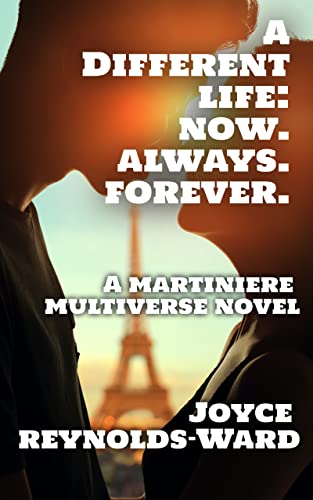
My most recently published book, A Different Life: Now. Always.
Forever. was an attempt to write something light. Um. Well. Maybe.
It's set in what I call the Martiniere Multiverse, a spinoff from my main
series, The Martiniere Legacy and the People of the Martiniere Legacy.
When writing A Different Life: What If?, I half-toyed with the idea of writing about my main characters, Ruby and Gabe, from the perspective of Ruby's best friend in college, Linda Coates, who Ruby hires to be her executive assistant. The more I thought about it, the more I liked the idea, and I figured that it would make a nice, light little story, which was what I needed to think about after several years of Covid and my worries about the 2022 election.
Things kinda happened from there. The book took a more political tone after the reversal of Roe v. Wade, with Linda's brother-in-law becoming a rising reactionary political leader who has nefarious designs involving Linda. But there are still light moments, and we have a bit of biobot action where Ruby and Linda release the latest version of Ruby's bots that are intended to counter climate change by helping plants absorb and retain moisture better. Plus--Linda's reaction to living in an Art Nouveau palace in Paris, France. That was fun to visualize.
DJR: What authors have most influenced your writing? What about them do you find inspiring?
JRW: My
influences come from several very odd and unusual places, especially for a
writer in the speculative fiction genre. One of my earliest influences was Mary
O'Hara, of My Friend Flicka fame. If you have only read the
first book, especially in an abridged edition considered suitable for children,
you miss a LOT of the deeper undercurrents of O'Hara's writing. The other two
books in the trilogy, Thunderhead and Green Grass of
Wyoming, delve into spirituality (O'Hara had become involved with early
versions of Eastern mysticism) and conflicted, difficult marital relationships.
Writing this, I suddenly realize that my character Gabriel Martiniere owes a
little bit to O'Hara's Rob McLaughlin. Not a lot--but there's a little bit of
Rob in Gabe.
One thing to consider, though, about O'Hara, is that she was one of the
original script doctors in Hollywood during the silent film era. While she only
cites a few instances where she got called in to work on scripts gone wrong,
it's enough to make me wish that she had written a memoir
about that Hollywood experience. Nonetheless, her life story (as related
in Flicka's Friend) is quite fascinating.
John Steinbeck is another literary influence that I frequently cite from my early days of writing. One of my high school English teachers used his Travels with Charley as a textbook for her advanced writing class. From Charley, I moved on to his Journal of a Novel, drafted while he was writing East of Eden. Then I went on to read all of his books. Steinbeck, along with O'Hara, taught me a lot about the use of settings in my work that I think really still shows up.
Otherwise, there are many writers who have influenced my work and made me think more about the process of writing and what I was doing while writing. Obviously, I read widely and well beyond the genre. Recent influences include C.J. Cherryh, Beverly Jenkins, Aliette de Bodard, Kate Elliott (especially her so-underestimated Jaran books), Craig Johnson, N. K. Jemisin, Mary Robinette Kowal, and many, many more. I am always eager to discover a new writer and new works. My ebook library card gets a LOT of use these days.
DJR: Why do you write what you do, and how does your work differ from
others in your genre?
JRW: Originally, I started writing what I do because I wasn't finding the books I wanted to read. I wanted to read about more strong women, but I also wanted to read fantasy in settings that weren't quasi-medieval Europe, as well as science fiction that wasn't set in Southern California or New York. I wanted to see more work that included the things I was interested in, including realistic horses, the inland West as a setting, examination of political power that didn't make me want to throw the book across the room, and other things.
