Showing posts with label coming of age stories. Show all posts

Friday, September 22, 2023

Book Review: A New Shapeshifter Novel from Samaire Wynne

 Awakening Fae: A Fated Mates ~ Wolf Shifter Magical Adventure (The Meridian Pack Book 1) by Samaire Wynne (Black Raven Books)

“It’s good to read outside one’s familiarity zone” is oft-quoted advice. Usually, it means to try something darker, grimmer, and grittier than usual. But when I’d had my fill of dark/grim/gritty/depressing tales about sociopaths I really didn’t care about, I happily agreed to take a look at Samaire Wynne’s new wolf shifter novel. I dove into it without preconceptions and soon found it to be not only romantic in the best sense but also delicately layered.

Cameron, a foster kid about to age out of the system, is thrown into the world beyond the mundane when a puppy falls from the sky. I know what I’d do—everything I could to save it! In Cameron’s case, although it takes her a while to realize how she’s done it, this involves reaching out with a magical talent she had no previous idea she possessed.

Despite being forced to grow up too quickly when faced with an uncertain future, Cameron is still half a child. She has some, but by no means all, of the skills she’ll need to survive in the outer world. She’s got the grades but not the money for college; her foster parents do their loving best but cannot afford to keep her once she passes the age cutoff. The author perfectly captured Cameron’s loneliness and insecurity about the future and transforms it into loving protectiveness. In bonding with the puppy, Cameron places the welfare of another before her own, an essential step in growing up.

As Cameron encounters the puppy’s wolf shifter pack and her first terrifying encounter with the Nightmare Fae that are now stalking her, she embarks upon a journey into a new world of reincarnating wolf shape-shifters and magic. Much of what she learns comes from the wolf shifter pack. She struggles to define and understand her place among them. Often, their unqualified acceptance of her is puzzling, as are the gaps in their explanations. Later, it’s revealed that the shifter pack recognizes Cameron as a rare, immensely powerful Moon Fae, which is why they treat her with reverence and take on the responsibility of her education. Like a reader faced with too much exposition, Cameron is handicapped in her ability to understand it all at once, but even more so to put together the new relationships with her changing abilities—and her rapidly evolving identity. Being a normal human teenager is difficult enough, not knowing who you’ll be or what you’ll feel from one day to the next (thank you, hormones!). Added to that, Cameron as a Moon Fae is changing—awakening, as the title indicates. As the story progresses, Cameron matures in her understanding of her new world and herself.

Underlying the supernatural elements and slow-burn romance is a beautifully rendered portrait of a family-of-the-heart, and I think this is what gives this story its emotional depth. As Cameron herself puts it:

Me, who had fleeting connections to a dozen foster parents; me, who had never had a real family; me, who had just two black trash bags to hold every last bit of my life and belongings when I moved from foster family to foster family. I had finally found a family that cared about me. And the monsters had risen up, camouflaged in the most devious, deceptive way, and had descended on us and ravaged them.

The world of the Meridian Pack is an interesting blend of wolf shifters, fae, reincarnation, fated mates, teenage sexuality, nightmare menaces, action, and rational discussion. The author draws a distinction between wolf shifters, shapeshifters who transform into the form of a large wolf, as opposed to werewolves (as in the Underworld movies) and which appear in Book 2 of The Meridian Pack series. One of the more fascinating aspects of wolf shifter lore is the rate of aging; handsome Asher appears to be in his 20s, a little older than Cameron, but is in fact only much younger, with predictable and sometimes humorous consequences.

Although there’s plenty of dramatic (and romantic) tension, Awakening Fae: A Fated Mates often has an almost cozy quality. There was plenty to keep me turning pages but not enough to compel me to stay up all night. As I was puzzling this over, I attended a webinar about what keeps readers engaged. One thing that stood out for me was the importance of how the author makes you feel. That is based in the consistency and reliability of the reading experience, conveyed through the implied contract between author and reader. The author says, in effect, “In exchange for your time (and your trust), I promise this kind of story.” Part of this offer is conveyed through authorial voice, but pacing, character development, and more subtle aspects of story-telling are just as important. In order to repay the reader’s trust, the author had better come through. Wynne’s strong, sure command of these elements means the reader can relax into the story journey, knowing that whatever the ups and downs of dramatic tension and plot twists, the reading experience will unfold as promised, consistent and true.

Fans of Wynne’s other urban fantasies will love this one. It’s also a great place to start, especially if wolf shifters, fae, and coming-of-age stories are your jam. It's available now here and on Kindle Unlimited.


Samaire Wynne is a Puerto Rican author of over 20 novels in various genres, including horror and urban fantasy. She is Editor in Chief of Black Raven Books. She has been writing professionally for over 11 years.

A longtime Californian, you can find her skulking about in southern Virginia. If you were to visit her at twilight, she might serve you flower tea or butter whiskey on her back deck. If she excused herself and strolled into the forest, you might be tempted to wander after her. Past a stream, you’d see a stone well at the edge of her property, and you might hear voices coming from deep inside.

If you were to trip and tumble down the embankment, you might be stolen away by faeries keen to offer you a cookie or a bit of mead in a flower cup.

And if you were to drink it, you’d awake to find that a hundred years had passed...


Next Monday, I'll be interviewing Samaire here on my blog. Don't miss it!


Friday, July 29, 2022

Book Reviews: Naomi Novik's Deadly Magical School


The Last Graduate
, by Naomi Novik (Ballantine)

I’ve loved Naomi Novik’s work since discovering her “Napoleonic Wars With Dragons” series (Temeraire). It seemed to me that with each book, both in that series and more recent publications, she has grown in skill and depth. I read the first two volumes of “Scholomance” back-to-back. It’s fair to say I inhaled them, they were so good.

I’ve been reading a bunch of magical school stories recently, and the Scholomance books redefine the genre. Many of the other books use a boarding school-like setting, whether it’s Hogwarts or the school of magical juvenile delinquents in Promise Me Nothing, by Dawn Vogel or the more troubled environment of D. R. Perry’s Sorrow and Joy. The schools and their teachers are charged with educating (and sometimes reforming) their students. Not so the Scholomance. Created by elite wizards to protect their adolescent offspring from being the prime targets of supernatural nasties (“maleficaria”), the school exists in a pocket carved out of the void, with only a narrow access to the outer world. There are no teachers, mail service or messengers except to a limited degree the incoming freshman classes, and the school may be sentient, trying to do its job regardless of the cost. Students take their classes as seriously as if their lives depended upon them, which they do. At the end of the senior year, the doors of the graduation hall open and all the incoming and resident nasties flood in, forming a gauntlet that only a few students survive. Even so, their odds are better than if the kids had stayed at home.

Into this world comes Galadriel (who hates her name, so she’s “El”), daughter of an unrepentant hippie witch who lives in a yurt in Wales (wrap your mind around that!) and gives away her best spells for free in a world of precisely measured tit-for-tat. A prophecy has marked El as destined for destruction and dark magic, and she’s become a self-isolating pariah noted for her uncensored rudeness. When heroic Orion Lake keeps saving her life, she can’t get rid of him. Gradually, they become friends (and more than friends). Much to her amazements, El gathers together a small team of fellow students, since cooperation and coordination will provide their only hope for surviving the graduation ordeal. At the end of their junior year, El and her friends joined forces with the graduating seniors, with surprising success.

Now it’s their turn, as graduating seniors. El has grown from a grouchy recluse to a young woman of courage and compassion, a born leader. She can inspire, cajole, and persuade the other seniors to work together to save the entire class, but that will leave successive generations of students to face the same heavy mortality. El wants to save them all and put an end to the yearly massacre. She comes up with a plan to graduate every single student, culminating in a mass extinction of the maleficaria. Her scheme will take every scrap of ingenuity, persuasion, and sheer magical power she possesses. To make matters worse, the school itself seems to have turned against her…

Novik combines a different and much grittier take on the “magical school” trope with a compelling central character who changes and grows. El faces her fears and insecurities, as well as the temptation of evil sorcery, to become a passionate and compassionate leader. Her voice drives the movement of the books. I can hardly wait to see what impossible-seeming tasks she tackles next!

Friday, July 10, 2020

Book Reviews: A Jewish Teen in 1950s Atlanta


In the Neighborhood of True, by Susan Kaplan Carlton (Algonquin Young Readers)

In the Neighborhood of True is the most powerful, compelling book I have read this year. The story immediately captivated with the first-person narrative of a teenage girl, a secular Jew, who relocates with her widowed mother and younger sister from New York to Atlanta. But the year is 1958, just at the beginning of the Civil Rights movement, and Jim Crow, the KKK, lynchings, and segregation are very much alive. Sent to an elite private (and Christian) high school, Ruth is initially sheltered from these tumultuous events as she is drawn into the world of Southern belles, debutante balls, and a fairy-tale boyfriend. Her mother’s response is to begin regular family attendance at the nearest synagogue, which is already involved in protesting racism. Although torn between the glamour and romance of the conventional white world and the deeper values her Jewish roots, Ruth “passes” as a WASP.

From the opening courtroom scene, though, Ruth’s narrative conveys her understanding of overt and covert bigotry. She’s aware that whites and Negros, to use the terminology of the time, swear on different Bibles, but nowhere is there a copy of her own scripture, Tanakh. Her grandmother hands her a little pink book of Southern feminine etiquette, and her history teacher refers to the Civil War as “The War of Northern Aggression.” Brown v Board of Ed (1954), the decision that desegregated schools, was considered a day of mourning.

Ruth struggles to keep the two worlds separate. She wants desperately to make herself into the ideal of Southern womanhood and for a romance with the most devastatingly cute boy she’s ever met. But her Jewish and her Southern selves move onto a collision course when the synagogue is vandalized with the words, JEWS ARE NEGRO LOVERS and a giant swastika. And from there, the violence against both Blacks and Jews escalates, and Ruth must make hard choices about where her commitment lies – to what is beguiling and easy, or to what is hard and terrifying.

The text is readily accessible and the story moves along with engrossing, page-turning speed, while at the same weaving a tapestry of complex moral issues. Teens may lack the life experience of their parents, but they are also capable of discernment and courage. Even as Ruth wrestles with her youthful insecurity, the longing for approval, and the seductive nature of rewritten history, she also responds to the call to justice that is the heart of her true heritage.

Highly recommended, relevant, and a meaningful read for both teens and their parents.


Friday, November 15, 2019

Short Book Reviews: The Princess Bride Meets Princess Leia on a Space Station with Magic


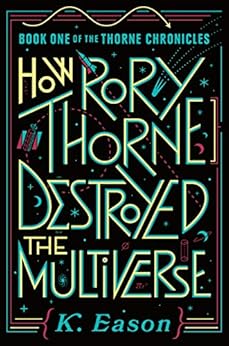
How Rory Thorne Destroyed the Multiverse, by K. Eason (DAW)

The blurb for this entertaining coming-of-age in a weird mix of space opera and magic reads, The Princess Bride Meets Princess Leia. While I appreciate the ease of film references, I found the book more strongly reminiscent of Frank Herbert’s Dune. Most of the action takes place on a space station habitat rather than a desert planet, but many of the cultural and world-building elements are eerily similar. The young heroine (named Rory out of family tradition) is, like Paul Atreides, the heir to the throne. She’s protected and educated by a pair of extraordinary, dedicated teachers. From a early age, she learns not only personal self-control but the nuanced maneuvers of controlling others. And, like Paul, she’s caught up, in over her depth, in a complicated interplanetary struggle. In Rory’s world, however, computer nets are controlled by hexes and spells, and at her birth, fairies granted her various gifts, including the ability to detect falsehoods. This is indicated in the text by offset italics of what the person is actually thinking, with often humorous results.
            like this…
A peace treaty between Rory’s widowed mother and the scheming villain who murdered her father locks her into a betrothal (to a prince whose only public appearances are by his short-lived, imbecilic clones) and exile on the afore-mentioned space station. Cut off from her teachers, she’s forced to find new (and surprising) allies and most of all, to come into her own power. I love that she makes mistakes, and that her opponents are formidable. The risk to her, the people she cares about, and her home world are equally daunting.

Enormous fun. Highly recommended.


Wednesday, August 15, 2012

GUEST BLOG: Kyell Gold on Writing From The Heart

I had to become someone else to write the things that were important to me.

Let me back up a little. You’ll hear this phrase, “write from the heart,” a fair amount as you navigate the world of writing advice. When I suggested the topic to Deborah, she immediately pointed me to a podcast in which Betsy Wollheim of DAW spent fifteen minutes giving just that advice. So I want to talk a little about why it’s important, why many people don’t do it, and how you can.

Writing from the heart is scary. It means exposing yourself to the world. In a way, it’s like having an intimate conversation with hundreds or thousands or (if you’re lucky) millions of strangers. It’s talking about the pain of breaking up, the fear of not having enough to eat, the loneliness of losing a parent, the depressing reality of falling short. It’s talking about falling in love, about the joy of discovery, about those words your mother said when you were six that you carried with you all your life. It can mean describing your journey from realizing you’re different to realizing that that’s okay.

If this scares you or disturbs you (in an emotional sense rather than a horror sense), that’s good. Tap into a place where you’re not comfortable: those are the raw places from which powerful writing comes. You guard them because they are important to you. And when they are important to you, that passion comes across in your writing. When you put yourself on the page, the reader can feel that, because your characters reactions feel authentic.