Showing posts with label Regency romance. Show all posts

Friday, September 2, 2022

Short Book Reviews: A YA Regency Comedy, With Dragons


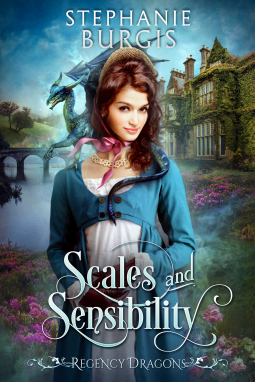
Scales and Sensibility
(Regency Dragons Book 1), by Stephanie Burgis (Five Fathoms Press)

About 15 years ago, Jane Austen mashups were the hot new thing. Pride and Prejudice and Zombies by Seth Grahame-Smith came out in 2009, followed by a glut of similar parodies and even a film or two. The fad didn’t last, especially as the stories got more derivative and less creative. Stephanie Burgis’s Scales and Sensibility opens with an homage to Austen: “It is a truth universally acknowledged…” Other than an occasional textual reference to Austen’s prose, it has nothing in common with the earlier, vapid parodies. Instead, it takes off in its own whimsical and engaging direction. The protagonist is named Elinor, like the heroine of Austen’s Sense and Sensibility and she is indeed sensible, but there the resemblance ends. She is an orphaned cousin, not the eldest daughter, and her counterpart is not her romantic, good-hearted sister but her wealthy, narcissistic cousin, Penelope. When witnessing Penelope’s abuse of her fashionable miniature dragon becomes intolerable, Elinor kidnaps the tiny creature and runs away. Little does she know the dragon’s secret or guess the adventures the two will embark upon.

This novel rests comfortably in the intersection between Young Adult fantasy, Regency romance, and romantic comedy. It’s an engaging, quick read with enough schemes and mistaken identities to satisfy the reader.

Monday, August 26, 2019

Guest Interview: Heather Albano, Author of the Keeping Time Trilogy

Welcome Heather Albano, author of the wonderful steampunk time-travel novel, Timepiece, and its sequels. I reviewed it here. She's graciously agreed to give us a peek behind the scenes.

What inspired your novel?

(I love telling this story.) It started when afriend of mine told me about a dream she’d had, in which a package arrived in the mail for her then-infant son. Inside the package addressed to him was a package addressed to me (how odd, she thought) and inside that was a velvet bag containing a pocket watch. Opening the pocket watch, my friend discovered the period casing contained a futuristic-looking screen cycling through images of different historical times and places. “I think I had your dream, Heather.”

I tried to write a story about her son and me and the pocket watch, including a reason for the nested packages, but I couldn’t get it to gel. A pocket watch seemed to belong to an older era anyway…so maybe this wanted to be a Victorian time travel story. Maybe steampunk—huge mechanical monsters stomping down a gaslit street? Yeah. Stomping after what? What would mechanical Victorian monsters hunt? Something natural run amuck, of course. The Victorians would totally build monstrous scientific artificial things to constrain monstrous natural things.

Okay, so where did the run-amuck natural things come from? And when? It would have to be long enough before the Victorian era for the organic monsters to become a problem, for a solution to be generated, and for the solution to become its own problem. Seventy to eighty years, say? The “Victorian era” spanned a long time, of course, but I meant the Sherlock Holmes / Jack the Ripper / Dracula / H.G. Wells part of it—so call it 1880 to 1895. What was going on in England seventy to eighty years before, say, 1885?

Five seconds later, I was scrambling for Wikipedia to look up the dates of the Battles of Trafalgar and Waterloo. Five seconds after that, I knew exactly what the story was about.


What was your favorite part of writing the Keeping Time trilogy?

My favorite type of reading experience is the one in which I suddenly realize the story I thought I was reading is not the story I am actually reading—the moment when the addition of a perspective or a backstory changes the context entirely. So it’s not entirely true that I wrote the first two books just so I could rewrite the scenes from a different character’s perspective in the third…but it was my favorite part of writing the third. Other people were in the middle of their lives when Elizabeth’s exuberant bildungsroman intersected with them, after all, and their stories have a different shape than hers…

Friday, July 19, 2019

Short Book Reviews: Jane Austen Heroine, Time Travel, and Frankenstein's Monsters Win the Battle of Waterloo


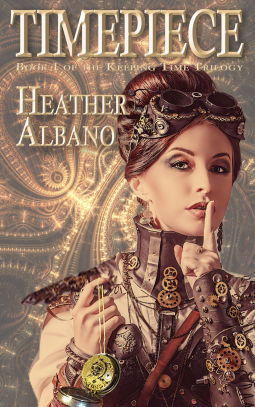
Timepiece (Book 1 of the Keeping Time Trilogy) by Heather Albano (Stillpoint Digital Press Prometheus)

The concept: Jane Austen-style characters travel through time to keep Frankenstein’s monsters from saving the Battle of Waterloo and transforming Victorian London into a nightmare of pollution and Orwellian robots.

The execution: Deft prose, careful characterization, and meticulous historical research brought the story alive from the opening pages; On the eve of the Battle of Waterloo, Wellington’s position is dire. The French have inflicted massive losses on his forces and he fears with good reason that his lines cannot hold another determined assault. The Prussians, whom he had counted on for relief and reinforcement, have been delayed, despite promises of imminent arrival. His only hope: the “special battalion” troops, descendents of the monsters created by “the Genevese” student (presumably a historical Dr. Frankenstein) a generation ago. He makes a choice and sends for them. That’s the set-up.

Across the Channel in England, a young woman, straight of the pages of Jane Austen and very much an homage to Elizabeth Bennett, aptly named Elizabeth, befriends William, a disabled veteran of those same Napoleonic wars. A mysterious gift, a watch-like device with multiple dials whose purposes are unfathomable, catapults the two to London half a century later, where the city has become an inferno-esque nightmare of pollution, poverty, child labor, and an Orwellian spy state, enforced by gigantic robots. The robots, it turns out, were developed against the “monsters,” who did not simply go away after Waterloo but were used as slaves in hazardous occupations like mining, rebelled, and were driven to Scotland behind “Moore’s Line” (shades of Hadrian, anyone?) Here they meet enigmatic Maxwell, possessor of a second time-travel watch, whose goal has been to prevent the current catastrophe by changing history. His multiple attempts – convince the Genevese to not create a monster, prevent Wellington from using the “special batallion,” etc., have all been unsuccessful. Now our stalwart team, aided by a few sundry folks from 1885 and a few more allies they make upon the way, embark upon the same mission. Needless to say, the following adventures are vastly entertaining, full of poignant moments, character development, and perspectives on the cultural shifts between 1815 and 1885, particularly for women. When they finally return to 1885, the initial signs are good: clear skies, fresh air, streets bustling with normal commerce…except they have inadvertently broken history. And obviously must go on to fix it in the second volume.