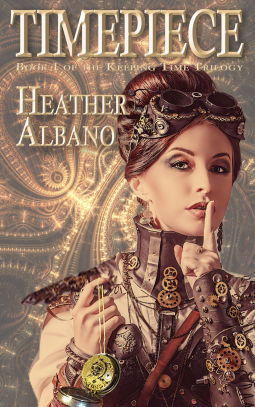
Welcome Heather Albano, author of the wonderful steampunk time-travel novel, Timepiece, and its sequels. I reviewed it here. She's graciously agreed to give us a peek behind the scenes.
What inspired your novel?
(I love telling this story.) It started when afriend of mine told me about a dream she’d had, in which a package arrived in the mail for her then-infant son. Inside the package addressed to him was a package addressed to me (how odd, she thought) and inside that was a velvet bag containing a pocket watch. Opening the pocket watch, my friend discovered the period casing contained a futuristic-looking screen cycling through images of different historical times and places. “I think I had your dream, Heather.”
I tried to write a story about her son and me and the pocket watch, including a reason for the nested packages, but I couldn’t get it to gel. A pocket watch seemed to belong to an older era anyway…so maybe this wanted to be a Victorian time travel story. Maybe steampunk—huge mechanical monsters stomping down a gaslit street? Yeah. Stomping after what? What would mechanical Victorian monsters hunt? Something natural run amuck, of course. The Victorians would totally build monstrous scientific artificial things to constrain monstrous natural things.
Okay, so where did the run-amuck natural things come from? And when? It would have to be long enough before the Victorian era for the organic monsters to become a problem, for a solution to be generated, and for the solution to become its own problem. Seventy to eighty years, say? The “Victorian era” spanned a long time, of course, but I meant the Sherlock Holmes / Jack the Ripper / Dracula / H.G. Wells part of it—so call it 1880 to 1895. What was going on in England seventy to eighty years before, say, 1885?
Five seconds later, I was scrambling for Wikipedia to look up the dates of the Battles of Trafalgar and Waterloo. Five seconds after that, I knew exactly what the story was about.
What was your favorite part of writing the Keeping Time trilogy?
My favorite type of reading experience is the one in which I suddenly realize the story I thought I was reading is not the story I am actually reading—the moment when the addition of a perspective or a backstory changes the context entirely. So it’s not entirely true that I wrote the first two books just so I could rewrite the scenes from a different character’s perspective in the third…but it was my favorite part of writing the third. Other people were in the middle of their lives when Elizabeth’s exuberant bildungsroman intersected with them, after all, and their stories have a different shape than hers…
What inspired your novel?
(I love telling this story.) It started when afriend of mine told me about a dream she’d had, in which a package arrived in the mail for her then-infant son. Inside the package addressed to him was a package addressed to me (how odd, she thought) and inside that was a velvet bag containing a pocket watch. Opening the pocket watch, my friend discovered the period casing contained a futuristic-looking screen cycling through images of different historical times and places. “I think I had your dream, Heather.”
I tried to write a story about her son and me and the pocket watch, including a reason for the nested packages, but I couldn’t get it to gel. A pocket watch seemed to belong to an older era anyway…so maybe this wanted to be a Victorian time travel story. Maybe steampunk—huge mechanical monsters stomping down a gaslit street? Yeah. Stomping after what? What would mechanical Victorian monsters hunt? Something natural run amuck, of course. The Victorians would totally build monstrous scientific artificial things to constrain monstrous natural things.
Okay, so where did the run-amuck natural things come from? And when? It would have to be long enough before the Victorian era for the organic monsters to become a problem, for a solution to be generated, and for the solution to become its own problem. Seventy to eighty years, say? The “Victorian era” spanned a long time, of course, but I meant the Sherlock Holmes / Jack the Ripper / Dracula / H.G. Wells part of it—so call it 1880 to 1895. What was going on in England seventy to eighty years before, say, 1885?
Five seconds later, I was scrambling for Wikipedia to look up the dates of the Battles of Trafalgar and Waterloo. Five seconds after that, I knew exactly what the story was about.
What was your favorite part of writing the Keeping Time trilogy?
My favorite type of reading experience is the one in which I suddenly realize the story I thought I was reading is not the story I am actually reading—the moment when the addition of a perspective or a backstory changes the context entirely. So it’s not entirely true that I wrote the first two books just so I could rewrite the scenes from a different character’s perspective in the third…but it was my favorite part of writing the third. Other people were in the middle of their lives when Elizabeth’s exuberant bildungsroman intersected with them, after all, and their stories have a different shape than hers…
