Showing posts with label survival as writers. Show all posts

Wednesday, June 14, 2023

[Archives]: Mary Rosenblum on How To Handle Bad Reviews

In light of the recent story about an author who was dropped by her publisher after she engaged in a heated discussion with a reviewer, here are some thoughts from writer and teacher Mary Rosenblum (1952-2018), first published here in 2014 and still relevant.


How To Handle Bad Reviews
by Mary Rosenblum


Paul Klee
What do you do when you get a really nasty review?

You know, we don't teach writers about reviews and reviewers and we should. Everybody thinks of 'good' and 'bad' writing as a standard. If it's 'good' editors and readers will love it! If it's 'bad' nobody will publish the story and readers will hate it. Alas, that mean that many authors who had a really good story felt like failures when they couldn't sell it to a publisher, when it was a matter of simply not suiting the publisher's target audience. The quality of the book was excellent, the publisher felt it wouldn't get the huge numbers of sales they needed in order to show a profit.

Self-publishing has let authors take their stories directly to readers and they vote with their mouse-clicks. You either sell or you don't, but we all know that it's a bit of a slow process at first, that self-publishing is all about the long tail. Meaning your sales are probably not stellar at first, with only one or two books out. So, the feeling of 'success' or 'failure' gets put on hold. Gotta wait to see how many people like it…

Enter the reviewers.

We love Authority. Authorities Know A Lot. Authorities Pass Judgment and They Are Gods. Reviewers Are Authorities And Therefore, They Are Gods.

Really?

You know what? That has never ever ever been the case. Reviewers are people who are willing to read lots and lots of books quite quickly and write down a judgment about the quality of that book to meet a regular deadline. You know what skills are involved? You must be able to read and you must be able to write a relatively coherent commentary and -- most importantly -- do that on a daily, weekly, or monthly basis, reliably.

See anything missing? How about a 'standard of excellence' or some other measuring tool so that you can effectively winnow 'good' from 'bad'? Don't see one, do you? You can become a reviewer. You should become a reviewer. It's a great way to meet new potential fans. One of my clients, from prison, has become a regular reviewer for a large circulation magazine.

Reviewers express their opinions. Their opinions. Remember that lacking 'standard of excellence'? Keep it in mind here. Some reviewers only review books they like, others review books they don't like. And the reasons they don't like them may have nothing to do with lots of other people liking your book. Mr. Reviewer may hate cats and is disposed to pick holes in any story that features a cute cat as a player. So your cozy mystery with the Miss Marple type sleuth who owns a cat gets picked to pieces. Will Mr. Reviewer come out and say 'I hate stories with cats'? No, of course not. How unprofessional! But he got even with you for putting that silly feline in there, didn't he? He called your cozy mystery weak, with an obvious ending.

And it really isn't weak and most readers are surprised by your clever ending.

Should you slit your wrists?

Monday, May 13, 2019

Print Release: Ink Dance: Essays on the Writing Life

Ink Dance: Essays on the Writing Life


A cup of inspiration, a dash of understanding, a bouquet of wisdom for writers new and old. From the desk of writer and editor Deborah J. Ross comes a collection of warm, insightful essays on “the writing life” – from getting started, negotiating with the Idea Fairy and creating memorable characters, to writing queries, surviving bad reviews, dealing with life’s interruptions and creative jealousy, to nourishing yourself and your creative muse. With space for personal notes.

This collection of my blog posts over a number of years ranges in topic from writing craft to daily rhythms and self-care to staying motivated over the long haul of a career. A number of readers asked for a print version so they could jot down their own notes. It's available now from Amazon, Barnes & Noble, and your local bookstore through Ingram (ISBN 978-1-61138-757-5)


To whet your appetite, here's an excerpt from the introduction by Mary Rosenblum, and table of contents:

This collection of essays guides you through the craft and career of writing with all the useful information of a shelf full of ‘how to’ books, but offered with the warm personal energy of a conversation across the kitchen table.  
From her advice on how to actually get started,  her craft and career tips, to her really excellent counsel on how to survive writing in real life and still nourish yourself and your spirit, this collection offers an in depth look at what it means to be a writer.  
 Every day. All the time.  
While Deborah’s career has been New York oriented, most of what she has to say works for today’s author going the small press or Indie route as well. She speaks of the things that helped her succeed or got in her way with a refreshing personal honesty that invites us to examine our own behaviors.  There’s a lot here for any aspiring writer who takes his or her craft seriously. No matter what you write or how you publish.  
Read it, learn, and enjoy! You’ll come away nourished. 


Just You and a Blank Page
Getting Started in Writing
Negotiating with the Idea Fairy
Warm Ups
Open Here
More On Story Beginnings
Structure, Shape, and Interest
Do You Outline Your Novel? Should You?
Dream A Little Dream
It’s Only Fiction
Not Just Another Funny Forehead: Creating Alien Characters
Villains, Evil, and Otherness
Revenge and Retaliation
First Person Perils

Friday, August 12, 2016

Supporting a New Writer 1: Introduction

Recently, I received this letter from Wendy, a fan with whom I’d been corresponding. It spoke deeply to me, and rather than answer it alone, I asked some of my writer friends to join in a series of round table blogs on the issues raised. If you’ve been there, too, I hope you’ll follow along and offer your own wisdom.

I've been trying to reconnect with writing friends after a hiatus from the creative life.  I've spent the past year or so taking care of my mom and working to pay the bills.  Mom passed away in October. 
When your last parent passes away, it changes you in many ways.  That foundation you always relied on -- even as an adult -- is gone for good.  Whether you're ready or not, you are truly on your own in the world and must somehow carry on without their nurturing presence.  One of the most difficult aspects of my mother's final days was the fact that she had so many regrets about life.  She once had goals and dreams, but left them behind out of fear and a belief that these dreams were just not possible.  
I'm 54 years old.  More than half of my life is over.  Writing has been a dream/goal of mine since childhood.  My mom was the only one who believed in me. I don't want to leave this world regretting the fact that I never pursued this dream to the fullest. To be honest, my writing "career" never took off.  I let fear, doubt and the negativity of others keep me from my dreams.  I want so much to be brave, to take risks with my creative life. I truly wish for a group of fellow writers who are willing to give me the encouragement and support I need to write with my heart and soul, to grow as a writer and a human being. And I want to be a support for others as well.  
How do I get back into the writing life after leaving it on the back burner for so long? 


Effie Seiberg: I hear you. Writing is such an inherently lonely business, spending that much time in your own head, that a good support group is critical. When I first started writing I went though wild mood swings ranging from "OMG this is the most hilarious thing ever" to "Why did I ever think I could English? This is total crap," and I began to fear that I wasn't emotionally stable enough to write. It was only after I found a community of supportive writers that I understood that this is just how writing works, and the only thing that improves is your ability to enjoy the highs and survive the lows. A good support group bolsters you through both.

Effie Seiberg is a fantasy and science fiction writer. Her stories can be found in the "Women Destroy
Science Fiction!" special edition of Lightspeed Magazine (winner of the 2015 British Fantasy Award for Best Anthology), Galaxy's Edge, Analog, Fireside Fiction, and PodCastle, amongst others. She is a graduate of Taos Toolbox 2013, a member of SFWA and Codex, and a reader at Tor.com. She lives in San Francisco, recently and upcoming (but not presently) near a giant sculpture of a pink bunny head with a skull in its mouth. She likes to make sculpted cakes and bad puns. You can follow her on twitter at @effies, or read more of her work at www.effieseiberg.com.


Barb Caffrey: For now, though...I can say this much to Wendy. It's never too late to do what you feel you must, as a creative artist. I have often felt like it's too late for me due to how my husband passed away suddenly; I'm now trying to carry on his work, and mine, and sometimes this seems like an overly heavy weight.

The important thing is that I'm doing it. No matter how long it takes, no matter what is up against me -- bad health or family health issues or foreclosures or anything -- I keep on working. Some days, all I can do is look at my works-in-progress and say, "Hmmm," and do a little fiddling but add nothing tangible. The next day, or maybe the day after that, the dam bursts and I have more new words again.

The most important thing you can do -- and it unfortunately is also the hardest -- is to believe in yourself, and that what you are doing is valuable. No matter what anyone else says, no matter what anyone else does, you are going to do what you feel you must.


I wish I had a better answer, but persistence has mostly worked for me.

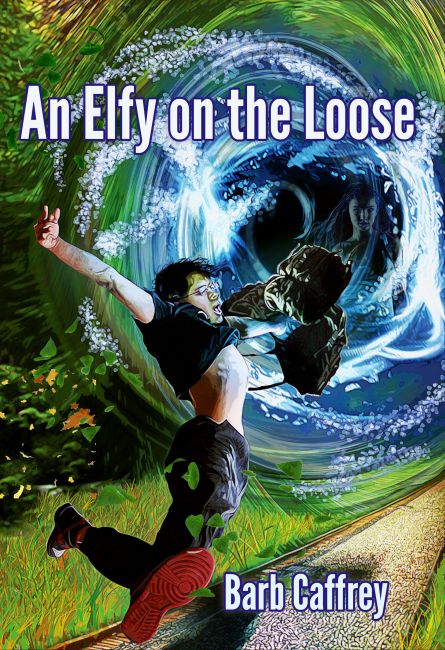
Barb Caffrey has written three novels, An Elfy On The Loose (2014), A Little Elfy in Big Trouble (2015), and Changing Faces (forthcoming), and is the co-writer of the Adventures of Joey Maverick series (with late husband Michael B. Caffrey) Previous stories and poems have appeared in Stars Of Darkover, First Contact Café, How Beer Saved The World, Bearing North, and Bedlam's Edge (with Michael B. Caffrey).


Alma Alexander: I'm roughly of an age with you, Wendy, and I think ours is now the generation which has to grapple with some of life's truths.  I’m technically only "half" an orphan at this point - my dad left us three years ago, my mother is still around, in her eighties now, frailer and more fragile than she's ever been before, both physically and psychologically, and it's something that it's up to me to deal with, I am in full defend and protect mode with her, often, and it takes up a huge swathe of mental and physical resources. But there will come a time when she too is gone and at this point it will be as you say - the foundation is gone. Until that moment you can always "go home". Afterwards, that first home, the foundation home, is gone, forever, and it takes a shift of thinking to adjust to it. So before anything else is said... there's that. There's the acknoledgment, and the understanding. We've been here, or we're coming up on that milestone, and we can look into that shadow and know exactly where you're coming from.