Showing posts with label memoirs. Show all posts

Monday, December 1, 2025

Reprint: How Writing Builds Resilience

 As a writer, I find this to be doubly true for fiction. Except for the part about writing by hand. I think it's fine to compose stories, especially novels, on a keyboard.


Writing builds resilience by changing your brain, helping you face everyday challenges

Writing is a way of thinking and doing. AscentXmedia/iStock via Getty Images Plus
Emily Ronay Johnston, University of California, Merced

Ordinary and universal, the act of writing changes the brain. From dashing off a heated text message to composing an op-ed, writing allows you to, at once, name your pain and create distance from it. Writing can shift your mental state from overwhelm and despair to grounded clarity — a shift that reflects resilience.

Psychology, the media and the wellness industry shape public perceptions of resilience: Social scientists study it, journalists celebrate it, and wellness brands sell it.

They all tell a similar story: Resilience is an individual quality that people can strengthen with effort. The American Psychological Association defines resilience as an ongoing process of personal growth through life’s challenges. News headlines routinely praise individuals who refuse to give up or find silver linings in times of hardship. The wellness industry promotes relentless self-improvement as the path to resilience.

In my work as a professor of writing studies, I research how people use writing to navigate trauma and practice resilience. I have witnessed thousands of students turn to the written word to work through emotions and find a sense of belonging. Their writing habits suggest that writing fosters resilience. Insights from psychology and neuroscience can help explain how.

Writing rewires the brain

In the 1980s, psychologist James Pennebaker developed a therapeutic technique called expressive writing to help patients process trauma and psychological challenges. With this technique, continuously journaling about something painful helps create mental distance from the experience and eases its cognitive load.

In other words, externalizing emotional distress through writing fosters safety. Expressive writing turns pain into a metaphorical book on a shelf, ready to be reopened with intention. It signals the brain, “You don’t need to carry this anymore.”

Person sitting at a table writing in a notebook
Sometimes you can write your way through difficult emotions. Grace Cary/Moment via Getty Images

Translating emotions and thoughts into words on paper is a complex mental task. It involves retrieving memories and planning what to do with them, engaging brain areas associated with memory and decision-making. It also involves putting those memories into language, activating the brain’s visual and motor systems.

Writing things down supports memory consolidation — the brain’s conversion of short-term memories into long-term ones. The process of integration makes it possible for people to reframe painful experiences and manage their emotions. In essence, writing can help free the mind to be in the here and now.

Taking action through writing

The state of presence that writing can elicit is not just an abstract feeling; it reflects complex activity in the nervous system.

Brain imaging studies show that putting feelings into words helps regulate emotions. Labeling emotions — whether through expletives and emojis or carefully chosen words — has multiple benefits. It calms the amygdala, a cluster of neurons that detects threat and triggers the fear response: fight, flight, freeze or fawn. It also engages the prefrontal cortex, a part of the brain that supports goal-setting and problem-solving.

In other words, the simple act of naming your emotions can help you shift from reaction to response. Instead of identifying with your feelings and mistaking them for facts, writing can help you simply become aware of what’s arising and prepare for deliberate action.

Even mundane writing tasks like making a to-do list stimulate parts of the brain involved in reasoning and decision-making, helping you regain focus.

Making meaning through writing

Friday, March 14, 2025

Book Reviews: A tale of two memoirs

I love to listen to audiobooks while I work in the garden, take a walk, or cook a meal. Recently, I borrowed two memoirs from my public library and was struck by the contrast. Both were written by famous people and narrated by themselves. I was curious enough about each of them to listen to their stories.

The first was Spare, by Prince Harry (Random House), mostly because it popped up on my screen. Okay, I thought, his perspective on growing up in the shadow of Princess Diana’s death should be be interesting. His life has been very different from (or, in Brit: to) mine.

Being in the public spotlight does not qualify a person to write a compelling memoir, nor does belonging to a royal family confer the ability to narrate with clarity and emotion. Spare fails on both counts. The charm of Harry’s accent lasted about five minutes, long enough for the emotional shallowness—a combination of the dry text and the manner in which it was read aloud—and lack of awareness of his elite white privilege to wear thin. Since I know from my own experience what it’s like to lose a parent unexpectedly, I hoped I’d be able to connect with Harry’s loss. I found his denial of Diana’s death understandable as a child. The problem was that Harry, the adult looking back, seemed to not have gained any insight or grown beyond denial as a childish survival strategy. I heard no understanding of how much he’d matured through adversity, the pain he’d walked through. No connection between that loss and the subsequent estrangements from other members of his family or the mental health issues with which he struggled later in life. But there was lots about the privileged life where everything was provided without him having to work for it and which he accepted without question.

I finally gave up, so I never got to hear about his military service or his courtship with Meghan Markle and how they made a life for themselves apart from his royal relatives. I wish them well, but I found little in this audiobook memoir to attract and hold my interest in who Harry is as a person.


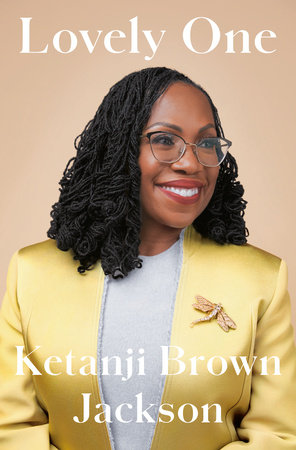
 In contrast, Lovely One, A Memoir, by Ketanji Brown Jackson (Random House) was a joy from start to finish. Jackson is the newest member of the US Supreme Court and the first Black woman to be
confirmed to that post. As a student, she excelled in public speaking and debate, tackling challenging topics with determination and extraordinary eloquence. Her facility with communicating complex ideas shines through her narrative, as does her love for her family, her capacity for enduring friendship, her passion for justice, and her unwavering courage. Whether she is talking about the African origin of her name, the environment of racism and misogyny prevalent in here field even today, her and her husband’s struggles to maintain separate careers while raising two daughters, one of whom is autistic, she speaks with unusual clarity and persuasiveness. I loved every minute of her story. In another life, I want to be her best friend.

Highly recommended.


Monday, November 22, 2021

Memoir, Cancer, And Tent Camping: My Friend Connie

 When a friend or family member is diagnosed with cancer, the effects ripple through the community. If we and our friend are relatively young, we may feel shock but also a sense of insulation. We have not yet begun to consider our own mortality, or the likelihood of losing our peers to accident or one disease or another. It hasn’t happened to us yet and the odds are still in our favor, particularly if we don’t smoke or drive drunk, we exercise and eat many leafy green vegetables. As the years and the decades go by, most of us will see an increase in morbidity if not mortality in our friends. They – and we – may develop osteoarthritis or Type 2 diabetes, high blood pressure, high cholesterol, all those common ailments of aging.  

Some of us will get Covid-19. Some of us will get cancer.

When my best friend, Bonnie, was diagnosed with ovarian cancer, she was the closest friend I had who had cancer. Since then, other friends have been diagnosed and some have died; Bonnie died in 2013 (peacefully, at home). One of the things Bonnie did way back when was find support groups for women with cancer. Maybe it’s a holdover from the consciousness-raising groups of the 1970s, but it’s practically a reflex: whatever is going on in your life, you grab a bunch of women to talk it through. Do men do this, too? If so, it’s a secret from me.

It turned out that a cluster of women who were at college with us at the same time and who still lived in the area wandered through these groups at one time or another, or were otherwise associated with this community. Some have also died, some weren't doing too well the last I heard, and some are thriving. One of those I lost was my friend, Constance Emerson Crooker.

Connie and I weren’t close in college, but it was a small school and everybody pretty much knew one another in passing. She wasn’t an avid folk dancer or a Biology major like me, but she and Bonnie stayed in touch so I’d hear about her from time to time. Connie was one of those who stepped up to the plate in Bonnie’s final weeks, and I was not only grateful for the extra and very competent pair of hands but for the chance to get to know her better.

Connie was a long-term melanoma survivor, a “late-stage cancer patient,” and made no bones about being one of the lucky ones. 

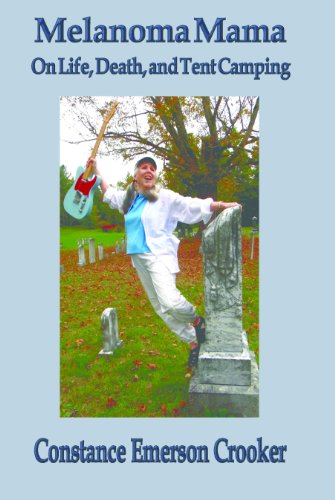
One of the things Connie did was to go tent camping across America. Another thing was to write about it and her cancer. I slowly read and savored her memoir, MelanomaMama: On Life, Death, and Tent Camping. Tent camping does not rank high on my list of favorite things to do. I didn’t grow up camping, and I’m poor at it at best. But as I wended my way through her breezy story-telling, I realized it didn’t matter whether it was tent camping or ice skating or tango dancing (which Bonnie did, clear through the week she went on hospice) or anything else that gives us intense joy.

William Blake wrote that if a fool would persist in his folly, he will become wise. I think that if we’re blessed to have enough time and reflection we can move through the shock and terror and sheer awfulness to some other place, one of “sucking the juicy joy out of life.” Which is why Connie’s tent camping spoke to me and I’m grateful she wrote her book.

When something awful happens to us or when we at last glimpse it in the rear-view mirror, many of us want to write about it. If we’re fiction writers, we use our imaginations to spin out stories in our preferred genre. A huge weight, a pressure of all the intense experience, the fear, the relief, the unhealed and oozing wounds, cries out for us to make sense of the whole thing. That’s one of the things that fiction does, and often it does it much better than straight memoir narrative. Fiction requires emotional coherence, at least genre fiction does. I make no promises about literary or experimental stuff. We think, If I could just nail this down in a story, it would make sense. I understand that longing, that temptation, and at the same time, in my own life, I’ve had the good fortune to pay attention to my gut feeling that I wasn’t ready. Maybe I’ll never be ready to “tell my story.”

But Connie was and she did, with wit and the ferocious clear-sightedness of one who knows she has been reprieved and what it has cost her. Some parts are travelog, some parts are survivalog, some are the observations of an intelligent, thoughtful person who has had a long time to decide how she wants to live each day. I couldn't read very much of it at a time; it was too “chewy,” too emotionally dense. I needed to reflect on what she shared and what it meant in my own life.

In Connie’s writing, I recognized something quite different from the impulse to tell our story to make sense out it. It was the even more powerful need to take what we have suffered and have it make a difference. Have our lives make a difference.

“Hey world,” she seems to be saying, “I was here. Me, the only Connie there is or will ever be.” 


“So now, I’m back to scans every three months. Watch and wait. Watch and wait. Wait for the pink and turquoise sneaker to drop. But I keep enjoying my miraculous recovery.

“When I say miraculous, I don’t mean a conventional miracle. … It’s miraculous that a Monarch butterfly can wing its way from Canada to one small patch of breeding ground on a Michoacan hillside. It’s miraculous that a black hole’s sucking gravity can pull everything, including light into is gaping maw. It’s miraculous that there are billions of stars in our galaxy and billions of galaxies in our universe…

“And I’m still here, gazing with wonder at it all.”


And sharing that wonder with us. Thanks, Connie, wherever you are tent-camping now.

Wednesday, December 18, 2013

Memoir, Cancer, And Tent Camping: My Friend Connie


When a friend or family member is diagnosed with cancer, the effects ripple through the community. If we and our friend are relatively young, we may feel shock but also a sense of insulation. We have not yet begun to consider our own mortality, or the likelihood of losing our peers to accident or one disease or another. It hasn’t happened to us yet and the odds are still in our favor, particularly if we don’t smoke or drive drunk, we exercise and eat many leafy green vegetables. As the years and the decades go by, most of us will see an increase in morbidity if not mortality in our friends. They – and we – may develop osteoarthritis or Type 2 diabetes, high blood pressure, high cholesterol, all those common ailments of aging.  Some of us will get cancer.


When my best friend Bonnie was diagnosed with ovarian cancer about 5 years ago, she was the closest friend I had who had cancer. Since then, other friends have been diagnosed and some have died; Bonnie died in October (peacefully, at home). One of the things Bonnie did way back when was find support groups for women with cancer. Maybe it’s a holdover from the consciousness-raising groups of the 1970s, but it’s practically a reflex: whatever is going on in your life, you grab a bunch of women to talk it through. Do men do this, too? If so, it’s a secret from me.

It turned out that a cluster of women who were at college with us at the same time and who still lived in the area wandered through these groups at one time or another, or were otherwise associated with this community. Some have also died, some aren’t doing too well the last I heard, and some are thriving. One of these is my friend Constance Emerson Crooker.

Connie and I weren’t close in college, but it was a small school and everybody pretty much knew one another in passing. She wasn’t an avid folk dancer or a Biology major like me, but she and Bonnie stayed in touch so I’d hear about her from time to time. Connie was one of those who stepped up to the plate in Bonnie’s final weeks, and I was not only grateful for the extra and very competent pair of hands but for the chance to get to know her better.