When a friend or family member is diagnosed with cancer, the effects ripple through the community. If we and our friend are relatively young, we may feel shock but also a sense of insulation. We have not yet begun to consider our own mortality, or the likelihood of losing our peers to accident or one disease or another. It hasn’t happened to us yet and the odds are still in our favor, particularly if we don’t smoke or drive drunk, we exercise and eat many leafy green vegetables. As the years and the decades go by, most of us will see an increase in morbidity if not mortality in our friends. They – and we – may develop osteoarthritis or Type 2 diabetes, high blood pressure, high cholesterol, all those common ailments of aging.
Some of us will get Covid-19. Some of us will get cancer.
When my best friend, Bonnie, was diagnosed with ovarian cancer, she was the closest friend I had who had cancer. Since then, other friends have been diagnosed and some have died; Bonnie died in 2013 (peacefully, at home). One of the things Bonnie did way back when was find support groups for women with cancer. Maybe it’s a holdover from the consciousness-raising groups of the 1970s, but it’s practically a reflex: whatever is going on in your life, you grab a bunch of women to talk it through. Do men do this, too? If so, it’s a secret from me.
It turned out that a cluster of women who were at college with us at the same time and who still lived in the area wandered through these groups at one time or another, or were otherwise associated with this community. Some have also died, some weren't doing too well the last I heard, and some are thriving. One of those I lost was my friend, Constance Emerson Crooker.
Connie and I weren’t close in college, but it was a small school and everybody pretty much knew one another in passing. She wasn’t an avid folk dancer or a Biology major like me, but she and Bonnie stayed in touch so I’d hear about her from time to time. Connie was one of those who stepped up to the plate in Bonnie’s final weeks, and I was not only grateful for the extra and very competent pair of hands but for the chance to get to know her better.
Connie was a long-term melanoma survivor, a “late-stage cancer patient,” and made no bones about being one of the lucky ones.
One of the things Connie did was to go tent camping across America. Another thing was to write about it and her cancer. I slowly read and savored her memoir,
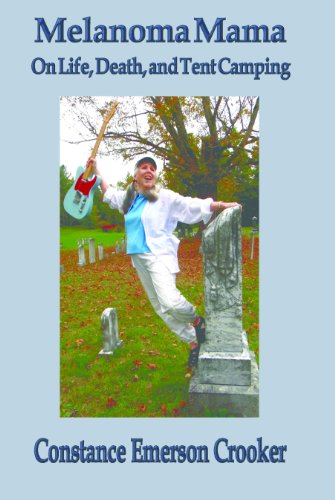
MelanomaMama: On Life, Death, and Tent Camping. Tent camping does not rank high on my list of favorite things to do. I didn’t grow up camping, and I’m poor at it at best. But as I wended my way through her breezy story-telling, I realized it didn’t matter whether it was tent camping or ice skating or tango dancing (which Bonnie did, clear through the week she went on hospice) or anything else that gives us intense joy.
William Blake wrote that if a fool would persist in his folly, he will become wise. I think that if we’re blessed to have enough time and reflection we can move through the shock and terror and sheer awfulness to some other place, one of “sucking the juicy joy out of life.” Which is why Connie’s tent camping spoke to me and I’m grateful she wrote her book.
When something awful happens to us or when we at last glimpse it in the rear-view mirror, many of us want to write about it. If we’re fiction writers, we use our imaginations to spin out stories in our preferred genre. A huge weight, a pressure of all the intense experience, the fear, the relief, the unhealed and oozing wounds, cries out for us to make sense of the whole thing. That’s one of the things that fiction does, and often it does it much better than straight memoir narrative. Fiction requires emotional coherence, at least genre fiction does. I make no promises about literary or experimental stuff. We think, If I could just nail this down in a story, it would make sense. I understand that longing, that temptation, and at the same time, in my own life, I’ve had the good fortune to pay attention to my gut feeling that I wasn’t ready. Maybe I’ll never be ready to “tell my story.”
But Connie was and she did, with wit and the ferocious clear-sightedness of one who knows she has been reprieved and what it has cost her. Some parts are travelog, some parts are survivalog, some are the observations of an intelligent, thoughtful person who has had a long time to decide how she wants to live each day. I couldn't read very much of it at a time; it was too “chewy,” too emotionally dense. I needed to reflect on what she shared and what it meant in my own life.
In Connie’s writing, I recognized something quite different from the impulse to tell our story to make sense out it. It was the even more powerful need to take what we have suffered and have it make a difference. Have our lives make a difference.
“Hey world,” she seems to be saying, “I was here. Me, the only Connie there is or will ever be.”
“So now, I’m back to scans every three months. Watch and wait. Watch and wait. Wait for the pink and turquoise sneaker to drop. But I keep enjoying my miraculous recovery.
“When I say miraculous, I don’t mean a conventional miracle. … It’s miraculous that a Monarch butterfly can wing its way from Canada to one small patch of breeding ground on a Michoacan hillside. It’s miraculous that a black hole’s sucking gravity can pull everything, including light into is gaping maw. It’s miraculous that there are billions of stars in our galaxy and billions of galaxies in our universe…
“And I’m still here, gazing with wonder at it all.”
And sharing that wonder with us. Thanks, Connie, wherever you are tent-camping now.