Showing posts with label historical fantasy. Show all posts

Friday, June 9, 2023

Short Book Reviews: Great Concepts, Disappointing Execution

Dark Earth, by Rebecca Stott (Random House)


I requested this book from Netgalley based on the description. I loved the idea of an underworld of rebel women living secretly amid the ruins. Alas, the opening was so sedate and the characters so bland and unrelatable, I gave up in the middle of the second chapter. There simply wasn’t enough to keep me reading. By contrast, the next book I picked up grabbed me right away, so I saw no reason to take another look.


The Hundred Loves of Juliet
, by Evelyn Skye (Del Rey)

What a great premise — Romeo and Juliet, reincarnated many times over the centuries, always drawn together and always linked in tragedy. In an added twist, Romeo is immortal and remembers all his previous loves. He knows, for example, that whoever Juliet is in any given lifetime, she will die within two years. Juliet, on the other hand, has no idea of their history together. Now in the 21st Century, writer “Juliette” and sea captain “Romeo” find themselves thrown together by fate and consuming attraction. Can they break the cycle?

Well, maybe, if he would just sit down with her and have a candid conversation. Clearly, he’s failed to do that before, only to watch his beloved-of-this-century die, usually horribly. You would think he’d learn from his disasters. Of all the failings of a typical romance novel, the stupidity of keeping secrets ranks top of my list. Even if “Juliet” thinks he’s delusional and doesn’t believe him, at least he would have given her a rationale for him walking away from her. Which he tries to do, but because she has no idea why, it doesn’t work.

I had other quibbles, including the passages supposedly diaries and so forth from past centuries but laden with contemporary sensibilities, that the heroine tries way too hard to be likeable, that the hero is an example of “female-gaze” and not a real person. Although the prose is for the most part pretty good, it slips into tone deafness all too often.

I suspect that this is a romance with fantastic elements, rather than a reincarnation/time-travel fantasy with a love story, and that science fiction/fantasy readers like myself will have a much harder time with it than romance readers. Regardless, I gave up around the 24% mark. I simply didn’t care what happened next as long as the characters were being so dishonest with each other and themselves.


Friday, February 10, 2023

Short Book Reviews: A Dark and Gorgeous Hollywood

Siren Queen, by Nghi Vo (Tordotcom)

 From childhood, the Chinese American girl who calls herself Luli Wei has been fascinated by motion pictures. It’s the 1930s and silent films are giving way to talkies. But this isn’t the Hollywood we know. Magic lurks in strange corners, from the ticket-taker who swaps a bit of Luli’s hair (and a bit of her life) for tickets to the Wild Hunt rampaging through the studio lot in the dead of night. To Luli herself, who comes from a family in which the women possess a bit of immortality. Beginning with a chance encounter on a set to an offer of a contract, Luli rises through the ranks of girls desperate for stardom. She’s all too aware that the roles for Asians are limited to maids and fainting ladies who talk funny. So when the opportunity to play a monstrous siren queen comes along, she throws herself into the role. Along the way, she acquires friends, makes enemies, finds women lovers, and becomes a pioneer. The story is powerful, gorgeously written, and both dark and luminous.

Friday, December 9, 2022

Short Book Reviews: A Disappointing "Elemental Master"

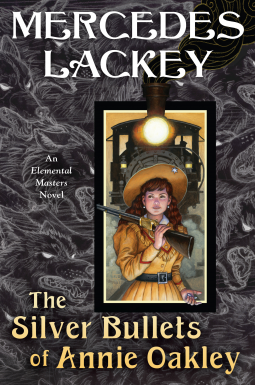
 The Silver Bullets of Annie Oakley (An Elemental Masters Novel), by Mercedes Lackey (DAW)

I have been a fan of Mercedes Lackey’s “Elemental Masters” series for a long time. My favorite so far is Phoenix and Ashes, a Cinderella story where the prince is a WWI veteran with PTSD. I grabbed the latest with anticipation. Annie Oakley with Elemental Master powers? How will she use her silver bullets?

The story begins with a nightmare memory of her impoverished childhood and the malevolent nature of the couple she’s hired out to work for. I expected the man whom she calls “He-Wolf” and who plants a curse on her would loom throughout the book as the Big Bad, that her internal struggle would free herself of her fears, and that a showdown would involve silver bullets (against werewolves, according to canon). The action itself opens on a European tour of Buffalo Bill's Wild West Show and the introduction of Frida, a German woman sharpshooter, who happens to be an Elemental Master of Air. To no one’s surprise, not mine, both Annie and her husband have rare magical abilities, which they proceed to hone by studying with Frida and her husband. During the winter, they join in the hunt for nasty supernatural creatures, and Annie’s superb marksmanship and magical abilities prove an asset.

Most of the story reads like a leisurely travelogue of Europe, with details of places they travel through, the meals they eat, daily life in the show, how to take down and put up tents, their hosts in every town, and so forth, not to mention the magical exercises and mystical creatures, all lovingly laid out on page after sedate page. Characters talk at length about what is going to happen and who they are going to meet before the events themselves. Everything is so predictable that the sense of danger is minimal when it’s present at all, even during the nocturnal hunts. The confrontation with He-Wolf doesn’t come about until the very last pages, and even then, Annie is not in any real danger. She has one brief moment of childhood panic before she resolves the situation. There’s no internal struggle, no doubt of the outcome, and no remorse at what she’s done. While she was notable in negotiating with supernatural creatures during the Hunt, she never attempts to do that with the He-Wolf, which would have been a compassionate overture but also a huge step toward recovery from her childhood trauma.

The pacing, the resolution, the flat dramatic arc, and the overall sedate pace lag when compared to earlier “Elemental Masters” books. I’ve noticed that Lackey’s recent Valdemar books are written less tightly than the early ones, but they have more dramatic impact than this one. I presume that long-time fans enjoy a leisurely stroll through their favorite fantasy world. The “Elemental Masters” books are stand-alones, so the stories must be complete and engaging. I hope The Silver Bullets of Annie Oakley is not a forewarning of a tedious future.


Friday, October 21, 2022

Short Book Reviews: A Great New Supernatural Mystery Series

 Uncanny Times, by Laura Anne Gilman (Saga)

This new turn-of-the-20th-Century supernatural hunter series boasts engaging characters, a gigantic magical hound, and a murder mystery. Siblings Rosemary and Aaron Harker come from a long tradition of hunting monsters. When an elderly cousin dies under mysterious circumstances, they journey to a small town, along with their oversized hound, Botheration. On the surface, the death appears to be natural, but as Hunters of the uncanny, the Harkers know something sinister is at work. At every turn, their investigation leads nowhere, even when one corpse after another turns up.

That’s the setup, but it falls short of conveying my experience of reading the book. Gilman’s a skillful writer, and here she perfectly balances the tension of a murder mystery with exploring a world that’s just enough skewed from the mundane to be endlessly fascinating, and best of all, to hang out with three really interesting characters (I definitely include the dog in this category!) Even the minor characters bring vivid quirks that deepen the journey through this town and its mysteries.

Despite the dramatic elements, plot twists, and escalating danger, the pacing is measured rather than thriller-taut, yet I found myself turning page after page, reluctant to put the book down. If the opening of a novel is an invitation to the reader, Uncanny Times provides superb hospitality, chapter after chapter. I hope this is only the beginning of a long-running series of the Huntsmen adventures.


Friday, July 12, 2019

Short Book Reviews: Fairy Tales, Dragons, and the Russian Revolution


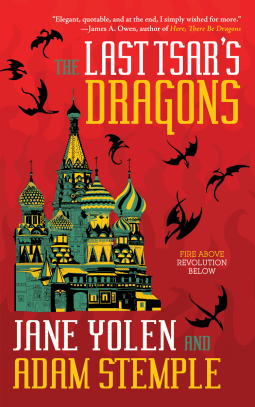
The Last Tsar's Dragons, by Jane Yolen and Adam Stemple (Tachyon)

This dramatic yet playful re-telling of the days leading up to the Russian Revolution (with dragons!) offers a variety of delights, from the courtly intrigues and madness of Rasputin, to the Jews huddling in the burrows to avoid the tsar’s dragons, to the machinations of the revolutionaries, to an entirely new meaning of the term “red death.” I believe the authors, seasoned professionals both, had way too much fun concocting this tale.

A little knowledge of the Russian Revolution is desirable for enjoying this book, and I fear that younger readers, who think “Putin” when they hear “Russia,” had little understanding of the tumultuous events leading to the formation of the Union of Soviet Socialist Republics, and the principle movers and shakers of those days. On the other hand, The Last Tsar’s Dragons would make a great addition to a serious class about the early part of the 20th century. By shifting the narrative of power to metaphor, while preserving actual historical and occasionally fictional characters, this could and should provoke lively discussion.

How to Fracture a Fairy Tale, by Jane Yolen (Tachyon Publications)


When it comes to giving classic (and not-so classic) fairy tales a new twist, nobody does it better than Jane Yolen. This collection includes her children’s book, Sleeping Ugly, which I read aloud innumerable times to my own daughters. Best of all, though, are Yolen’s own comments on the tales, the nature of fairy tales, and how we grow and heal through story-telling.

The usual disclaimer: I received review copies of these books, but no one bribed me to say anything in particular about them. Although chocolates and fine imported tea are always welcome.

Friday, May 4, 2018

Short Book Reviews: Guy Fawkes with Magic

Fawkes, A Novel by Nadine Brandes (Thomas Nelson)

This YA novel centers around two brilliant premises. The first is the setting, England on the eve of the Gunpowder Plot (1605) and the origin of Guy Fawkes Day. The second involves a fascinating new system of magic in which power arises from the various colors, focused by specially constructed masks, constructed by the practitioner’s same-sex parent. A third strength arises from the protagonist narrator, son of the conspirator Guy Fawkes, and his inner turmoil as he is drawn deeper and deeper into a plot to blow up King James I’s Parliament.

Therein, however, lie the book’s weaknesses. Few Americans, unless they are English History buffs, are familiar enough with the Gunpowder Treason Plot to appreciate the cultural, political, and legal aspects. The plot in the book follows the historical order fairly closely but not always in the most logical fashion. Magic is tacked on to historical events; practitioners use their powers only when they don’t change the way things really happened. But any world in which people wield those powers is going to operate very differently than ours, and that requires careful working through all the implications of those powers, of which I see little here.

The attempt to translate the historical Protestant-Catholic struggle into a battle between those who adhere to the color system (“Keepers”) and those devoted to the primal White Light (“Igniters”) is awkward and often confusing. The real struggle was based not only in religious dogma but in politics, arising from the establishment of the Church of England with King Henry VIII and consequent independence from Rome. Queen Elizabeth, Henry’s daughter, did much to establish religious tolerance, although even her emphasis on secular loyalty could not eliminate the plots to restore a Catholic ruler. Without the context of the struggle, the rift between Keepers and Igniters, each hating the other for no apparent reason, come across as superficial. This is all the more so because for most of the story, I had trouble remembering which side was which. Everyone has access to the White Light (which is a snappy, smart-ass voice, quite apart from any references to direct experience of the divine, which also strikes me a reversal of the Catholic-Protestant quarrel). Anachronisms of speech and social attitude added to the confusion.

Besides the system of magic, this story includes a supernatural “Stone Plague” that infects the victim and gradually ossifies both skin and internal organs, resulting in death. Somehow Igniters have concluded that the plague is the fault of the Keepers and the only way to bring it to a halt is to slaughter all of them. Since no one offers any other explanation for how this fascinating disease works, and apparently the magical healers are just as ignorant and incurious, this persecution is arbitrary and baffling.

Despite its significant shortcomings, this novel has many appealing moments. If it sends readers to the history books to find out what really happened, or generates conversations about prejudice and religious persecution, so much the better.

The publisher asked that I include a disclaimer saying I'd received a complimentary review copy through NetGalley and my opinions do not represent theirs.


Thursday, August 24, 2017

A Jewish Heroine of the Renaissance

Here's the story behind the story: "Unmasking the Ancient Light," in Nevertheless, She Persisted (ed. Mindy Klasky, hot off the press at Book View Cafe and other vendors)

Back in the 1990s, when themed anthologies were all the rage, I heard about one that was right up my alley and open to submission. Ancient Enchantresses, to be edited by Kathleen M. Massie-Ferch and Martin H. Greenberg for DAW. The editors wanted historical fantasy featuring strong women characters and magic, as is clear from the title. As I cast about for a subject, I found myself more and more – excuse the pun – disenchanted with Western European historical characters. It seemed to me that the women of interest had been portrayed more than frequently enough, and I had little interest in Celtic mythology. When I lamented my lack of inspiration to a friend – not a fantasy writer, but the director of a pre-school at a Jewish community center – she suggested I take a look at Written Out of History: Our Jewish Foremothers, by Sondra Henry and Emily Taitz (3rd ed, Biblio Press, 1988). Posthaste, I ordered a copy of the book and then pored through it. The chapters were short, more summations than in-depth histories. Although quite a few of them piqued my interest, only one suggested a story, that of Dona Gracia Nasi. The section began:

Unlike Benvenida Abrabanel, Beatrice de Luna belonged to a family that had chosen to become Marranos [converts to Catholicism – also known as conversos] so that they could remain in their home in Portugal. They had a successful business and a rich life. Beatrice was born in 1510, thirteen years after the expulsion of all practicing Portuguese Jews. Those remaining in Portugal worked hard to hide any Jewish allegiance from the world…

I devoured the section, all four pages of it, from Beatrice inheriting her husband’s share of an immense commodities business to her flight from one country after another, the Inquisition hot on her heels, to her imprisonment in Venice, her transformation into Dona Gracia Nasi (her childhood Jewish name), to her eventually settling in Turkey. But all this was so abbreviated as to be tantalizing without deep substance.

In the footnotes, however, I discovered that historian Cecil Roth had written an entire book about Gracia, The House of Nasi: Dona Gracia (Jewish Publication Society of America, 1947). Although the book was out of print, I was able to borrow a copy from a local university library. Within those scholarly pages, I discovered a story as dramatic, tragic, and inspiring as anything out of Hollywood or New York.

I could have tried to tell Gracia’s entire story, but that would have meant either another Il Ghetto, the old foundry district. I cut out an image from a tourist brochure of a person in the traditional Mardi Gras costume called bauta (including a white mask, tricorne hat, and a black tabarro, a short cloak) and pinned it on my bulletin board, hoping to find a story that would capture the sense of brooding menace. (As an aside, I’m not comfortable with clowns, either.) Armed with image, memory, and scholarly text, I embarked upon the tale.
abridged version or an extensive tome. I decided, therefore, to focus on a shorter period of her life: the flight from Antwerp (when Queen Marie of Burgundy, Regent of the Low Countries and sister to Charles V of the Holy Roman Empire, schemed to marry off Gracia’s young daughter to one of her courtiers) to Venice. I’d visited Venice briefly during the time I lived in France (1991) and had vivid memories of the shadows under the bridges over the canals, the ancient plazas and towers, and the omnipresence of the sea. I wandered through the original ghetto,

“Unmasking the Ancient Light” is a tribute to the perseverance of a woman under extraordinary reversals and dangers. Life was perilous for European Jews in the Renaissance, as it had been in centuries earlier. Jews had been expelled from (among others) England (1290), France (1182, 1306, 1321, 1394), Spain (1492), and Portugal (1497). The series of expulsions forced Jewish communities to find safe (or safer) havens, in the Netherlands, Venice, and Islamic countries, such as the Ottoman Empire. They developed international systems of commerce and banking, as well as close familial and communities ties. Gracia’s family was no exception. From Spain (“convert, leave, or die!”) they relocated to Portugal, then to Antwerp, and so forth. While in Italy, Gracia dropped the pretense of a converso and began finding ways to support her fellow exiles, whether lending material aid to individuals to becoming a patron of the arts to creating a printing house to publish Jewish texts in Hebrew and also Spanish (the Ferrera Bible) for those unable to read the ancient languages.

The list of Gracia’s accomplishments could easily fill the word count of a piece of short
fiction, but I wanted her story to be more than a list of the amazing things she had done. I wanted to capture the spirit of the woman – if not historically accurate, as is always the challenge with fantasy – but one that would speak to the hearts of readers as Gracia had spoken across the centuries to me. I focused, then, on her struggle to survive the political intrigues and animosities of her time while preserving and nourishing the spirit of her people. The magic, as it were. Here I found a second inspiration in various treatments of the feminine aspect of the divine and the equivalence of the Shekhinah, sometime called the Indwelling Spirit, with light, without getting too dogmatic or theological.


As a final note, since I dutifully returned Cecil Roth’s book to the university library, my husband presented me with a copy of The Woman Who Defied Kings: The Life and Times of Dona Gracia Nasi, A Jewish Leader During the Renaissance (Andree Aelion Brooks, Paragon House, 2002). If you want to know more about her, I recommend this highly accessible book (which has a ton of footnotes, for the historians among you).

Wednesday, August 9, 2017

An Anthology of Persistent Women

My story, "Unmasking the Ancient Light," about Jewish Renaissance pioneer and visionary Dona Gracia Nasi, appears in the newly-released anthology, Nevertheless, She Persisted, from Book View Cafe, edited by Mindy Klasky. You can also find the ebooks and print edition at Amazon.com and Barnes & Noble.


“She was warned. She was given an explanation. Nevertheless, she persisted.”
Those were the words of Mitch McConnell after he banned Senator Elizabeth Warren from speaking on the floor of the United States Senate.
In reaction to the bitter partisanship in Trump’s United States of America, nineteen Book View Café authors celebrate women who persist through tales of triumph–in the past, present, future, and other worlds.
From the halls of Ancient Greece to the vast space between stars, each story illustrates tenacity as women overcome challenges–from society, from beloved family and friends, and even from their own fears. These strong heroines explore the humor and tragedy of persistence in stories that range from romance to historical fiction, from fantasy to science fiction.
From tale to tale, every woman stands firm: a light against the darkness.
Table of Contents:
“Daughter of Necessity” by Marie Brennan
“Sisters” by Leah Cutter
“Unmasking the Ancient Light” by Deborah J. Ross
“Alea Iacta Est” by Marissa Doyle
“How Best to Serve” from A Call to Arms by P.G. Nagle
“After Eden” by Gillian Polack
“Reset” by Sara Stamey
“A Very, Wary Christmas” by Katharine Eliska Kimbriel
“Making Love” by Brenda Clough
“Den of Iniquity” by Irene Radford
“Digger Lady” by Amy Sterling Casil
“Tumbling Blocks” by Mindy Klasky
“The Purge” by Jennifer Stevenson
“If It Ain’t Broke” by Maya Kaathryn Bohnhoff
“Chatauqua” by Nancy Jane Moore
“Bearing Shadows” by Dave Smeds
“In Search of Laria” by Doranna Durgin
“Tax Season” by Judith Tarr
“Little Faces” by Vonda N. McIntyre

Friday, May 13, 2016

Become a Literary Patron (and Support a Lipizzan Horse!)

Pooka hug
I am constantly heartened by the community of readers/writers/horse-lovers and the many ways we support one another. Now one of our own -- a true treasure of our field -- needs our help. Judith Tarr is an icon of historical fantasy; she's also written other sorts of fantasy and even some very nifty space opera. She's inspired a generation of new writers. In addition, she breeds and trains Lipizzan horses ("dancing white horses")
-- check them out
here. And now she needs our help.  See her letter below.

What you can do:

  • Pledge a few dollars a month through Judy's Patreon
  • Sponsor a horse (see below) in full or part
  • Buy her books. If you have an ereader, buy them from Book View Cafe, which gives authors a whopping 95%. You'll find a wonderful range of books, including the essential guide "Writing Horses"
  • Post reviews of her books on sites like Amazon, Barnes & Noble, and GoodReads
  • Tell your friends! (Maybe get together to sponsor a horse?)
  • If you're a writer, especially a newer writer, consider engaging her services as a mentor or editor
  • Boost this signal!


From Judith Tarr: May 3, 2016: I'm continuing the editing and Horse Camp sale, and the Patreon page for new fiction is ongoing--many thanks to those who have joined the adventure so far.

Those who know me well know that when I break down and offer a sale, it's because I've run out of options. The past few years have been increasingly difficult, and last year was brutal. This year has been, emotionally, much less awful--and I have my writing mojo back. But in all other ways it's been worse than any year before it.

Right now I do not know how I'm going to feed the horses for the rest of the month. I have managed to scrape out enough to pay for the last load of hay (if that late check finally gets here), but once it's eaten, which it will be in about ten days, I don't know what I'm going to do. The farm will be gone by midsummer unless I find a steady source of sufficient income. I've been hustling like a hustling thing but so far with minimal results.

The market does not want either me or the horses. The horses are all old and therefore retired and unsalable, or else would require thousands of dollars' worth of training and show fees to have any sale value. No one can take them. The market is saturated with unwanted horses and the rescues are overloaded. I am over 60, hearing impaired (ergo, unable to use the phone), and with chronic fatigue syndrome which makes office or minimum-wage work difficult to impossible. And minimum wage would not support the animals, let alone me. All my income streams from backlist books, editing, writing, etc. have shrunk to a trickle or dried up. No one has booked a Camp in over a year.

I have had a few small things come through, but as with everything else, they've fallen short or failed to produce. I continue to push, and with the fiction writing regaining its old fluidity, I may manage to make something happen there. I've been urged to try an Indiegogo for a short novel, and I am closing in on that. (Indiegogo, unlike Kickstarter, offers an option that pays even if the goal is not met. The goal would be enough to cover mortgage, horses, and utilities for a month.) Since for the first time in my life I'm able to write more than one project at a time, that means I can continue to meet my obligation to backers of last November's Kickstarter for a science-fiction novel, and also write the novella (and short stories, too).

Tuesday, April 28, 2015

New Collection: Transfusion and Other Tales of Hope

I have a new collection of short fantasy fiction, just out from Book View Cafe. And am quietly, quiveringly proud of it. I hope you'll enjoy it, too. You can download a free sample from the BVC site.


Here's the skinny:

The vampire has known only evil since he was made, until an unlikely friendship reconnects him with life… Two women mourning two dead mothers tread the boundaries between grief and obsession… A ghoulish spirit haunts a refugee in Renaissance Venice… A healer discovers a dying man with the heart of a dragon on her doorstep… Two boys travel back in time to discover the true nature of Tyrannosaurus rex… A mother vampire, struggling to raise two vampire children in Hollywood, encounters her biggest challenge yet: the PTA.

From the ancient Indus Valley to post-apocalyptic California come fourteen tales of love, redemption, and hope…and occasional humor.