Showing posts with label Mars. Show all posts

Friday, December 6, 2024

Water on Ancient Mars?

 We all need a break from political news, so here's a cool story, slightly condensed, from Universe Today on the presence of water on ancient Mars.


There was Hot Water on Mars 4.45 Billion Years Ago


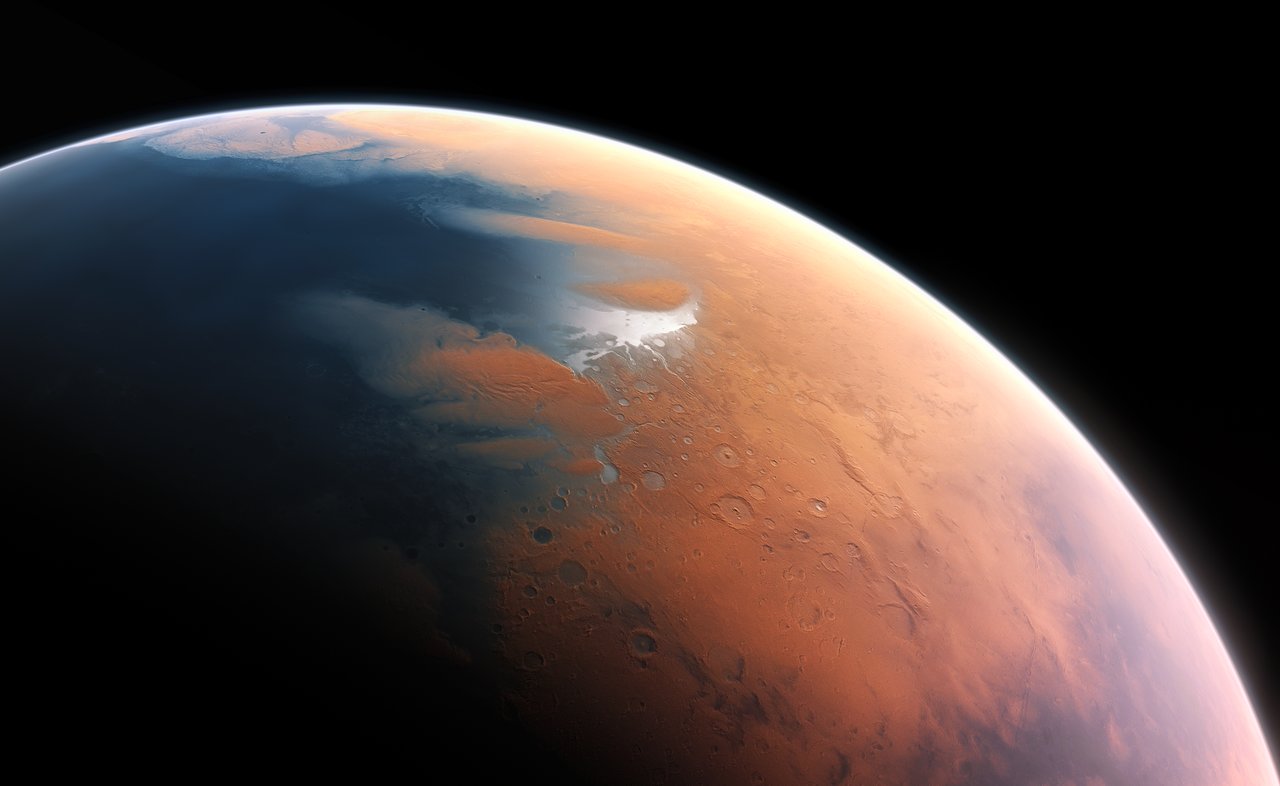
Earth and Mars were very similar in their youth. Four billion years ago, both planets had vast, warm seas. But while Earth retained its oceans, the waters of Mars evaporated away or froze beneath its dusty surface. Based on geological studies, we know that Earth’s water cycle seemed to have stabilized early. From about 4.5 billion years ago to today, water has had a stable presence on Earth. For Mars, things are less clear. Clay minerals cover about 45% of the Martian surface and date to what is known as the Noachian period, which ranges from 4.1 to 3.7 billion years ago. During the Amazonian period, which dates from 3 billion years ago to today, Mars seems to have been mostly dry. We have little evidence of the earliest period of Mars, known as the pre-Noachian. But a new study peels back the Martian ages to give us a glimpse of the first epoch of Mars, and it comes from a Martian meteorite known as Black Beauty.

This new study doesn’t focus on Black Beauty as a whole, but rather on small crystals of zircon embedded within it. These crystals can be dated to 4.48–4.43 billion years, meaning they formed in the Pre-Noachian period. What’s interesting is that the crystals have layers of iron, aluminum, and sodium in a pattern known as oscillatory zoning. Since zircon is igneous in origin, this kind of banding is almost unheard of in zircon crystals. On Earth, there is only one place where such a pattern occurs, which is in hydrothermal geysers such as those found in Yellowstone National Park.

The presence of these crystals in Black Beauty proves not only that Mars was wet during the Pre-Noachian period, but that it was geologically active with warm thermal vents. Similar vents on Earth may have triggered the formation of life on our world. Whether life ever existed on Mars is still an unanswered question, but it is clear that the conditions for life on Mars did exist in its earliest history.

Reference: Gillespie, Jack, et al. “Zircon trace element evidence for early hydrothermal activity on Mars.” Science Advances 110.47 (2024)

Monday, September 9, 2024

[science] Dark Oxygen, Quark Matter, and Terraforming Mars

So much exciting astronomical news! Click through for all the juicy details.


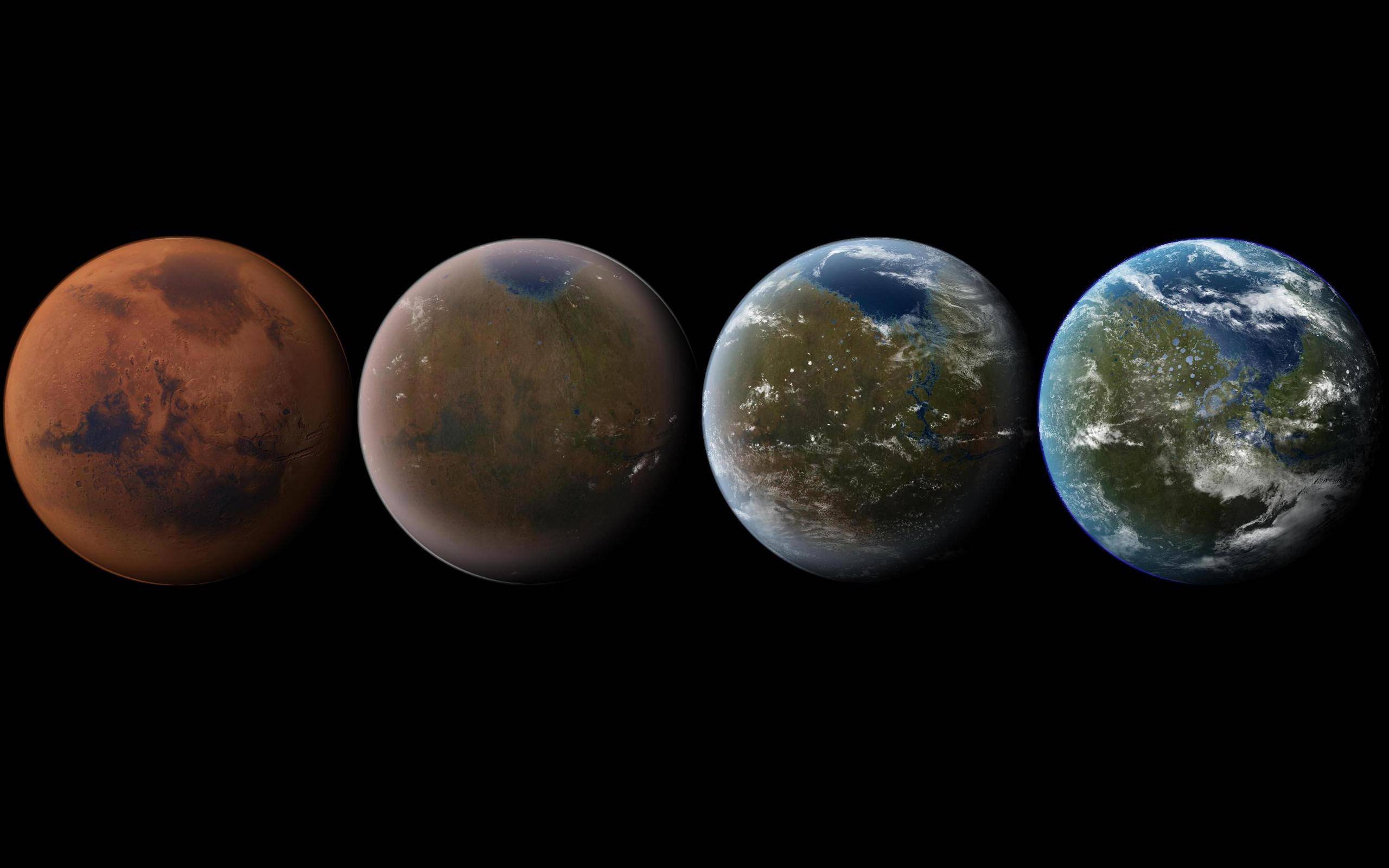
Mars Could be Terraformed Using Resources that are Already There 


A team of engineers and geophysicists led by the University of Chicago proposed a new method for terraforming Mars with nanoparticles. This method would take advantage of resources already present on the Martian surface and, according to their feasibility study, would be enough to start the terraforming process.


Neutron Star Mergers Could Be Producing Quark Matter


When neutron stars dance together, the grand smash finale they experience might create the densest known form of matter known in the Universe. It’s called “quark matter, ” a highly weird combo of liberated quarks and gluons. It’s unclear if the stuff existed in their cores before the end of their dance. However, in the wild aftermath a neutron-star merger, the strange conditions could free quarks and gluons from protons and neutrons. That lets them move around freely in the aftermath. So, researchers want to know how freely they move and what conditions might impede their motion (or flow).


Recently, two researchers looked at what would happen if a ship with warp drive tried to get into a black hole. The result is an interesting thought experiment. It might not lead to starship-sized warp drives but might allow scientists to create smaller versions someday.

Monday, October 3, 2022

Let's Build a World: New Astronomical Finds for Your SF Stories

I've got a file (actually a dozen files) of cool science stories that I might use in science fictional world-building. What sf author doesn't? Even fantasy stories need good science. For instance, an urban fantasy involving werewolves really should depict the phases of the moon accurately. This week, images and data from the Hubble and James Webb Space Telescopes have furnished a treasure trove of research ideas. Rather than post them separately, I've gathered a few that I find particularly exciting.


There Could be Many Water Worlds in the Milky Way

Astronomers are curious about how many terrestrial planets in our galaxy are actually “water worlds.” 
These are rocky planets that are larger than Earth but have a lower density, which suggests that volatiles like water make up a significant amount (up to half) of their mass-fraction. According to a recent study by researchers from the University of Chicago and the Instituto de AstrofĂ­sica de Canarias (IAC), water worlds may be just as common as “Earth-like” rocky planets. These findings bolster the case for exoplanets that are similar to icy moons in the Solar System (like Europa) and could have significant implications for future exoplanet studies and the search for life in our Universe.

“We have discovered the first experimental proof that there is a population of water worlds, and that they are in fact almost as abundant as Earth-like planets. We found that it is the density of a planet and not its radius, as was previously thought, which separates dry planets from wet ones. The Earth is a dry planet, even though its surface is mostly covered in water, which gives it a very wet appearance. The water on Earth is only 0.02% of its total mass, while in these water worlds it is 50% of the mass of the planet.”

However, planets around M-type stars typically orbit so closely that they are tidally locked, where one side is constantly facing toward its sun. At this distance, any water on the planet’s surface would likely exist in a supercritical gas phase, increasing their sizes. As a result, Luque and PallĂ© theorized that in this population, water is bound to the rock or in closed volumes below the surface, not in the form of oceans, lakes, and rivers on the surface. These conditions are similar to what scientists have observed with icy moons in the outer Solar System, such as Jupiter’s moon Europa and Saturn’s moon Titan.

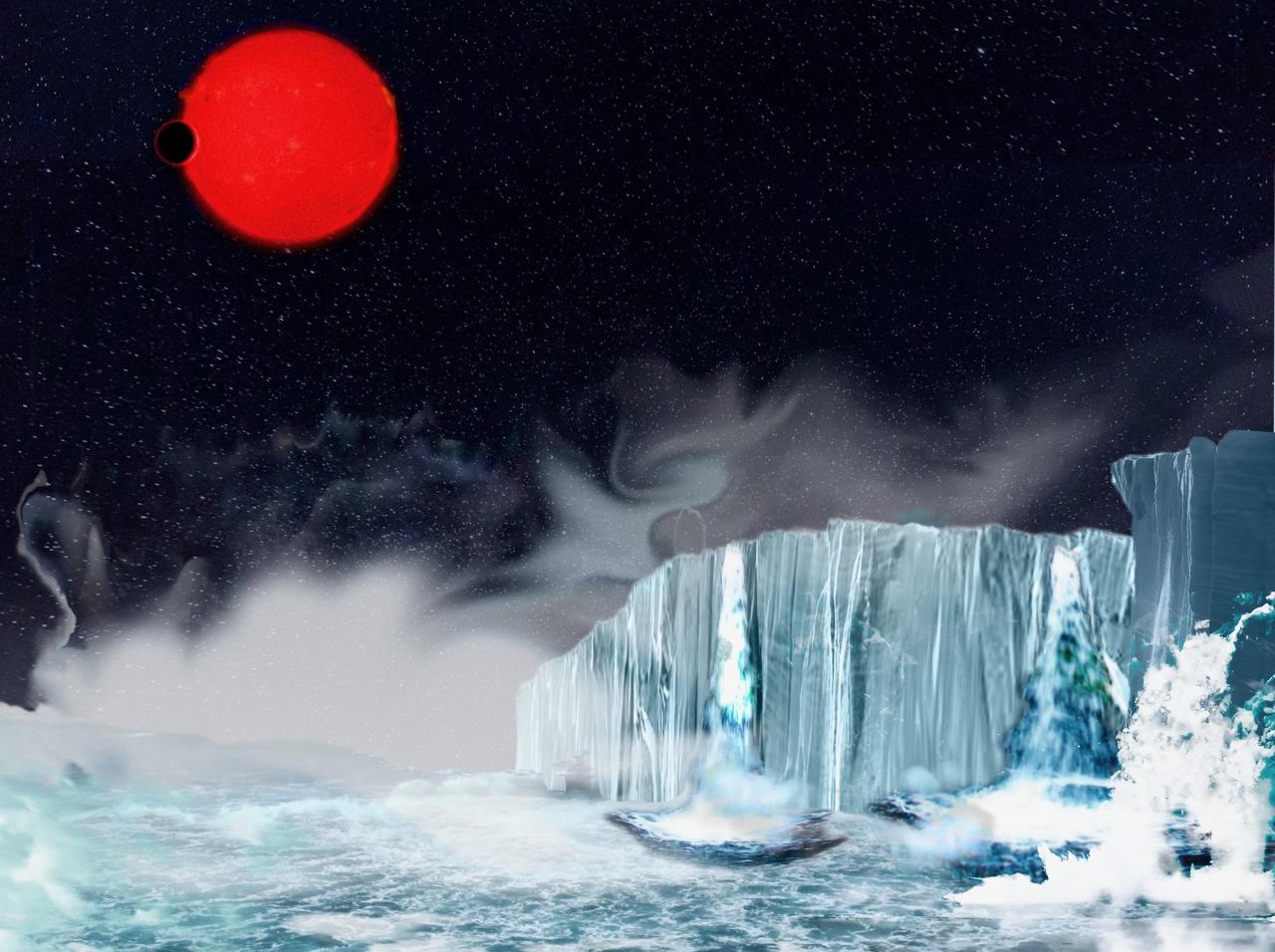
Given that they are tidally locked to their suns, these planets may also have liquid oceans on their sun-facing side but frozen surfaces everywhere else – colloquially known as “eyeball planets.” While astronomers have speculated about the existence of this class of exoplanet, these findings constitute the first confirmation for this new type of exoplanet. They also bolster the growing case for water worlds that form beyond the so-called “snow line” in star systems (the boundary beyond which volatile elements freeze solid), then migrate closer to their star.
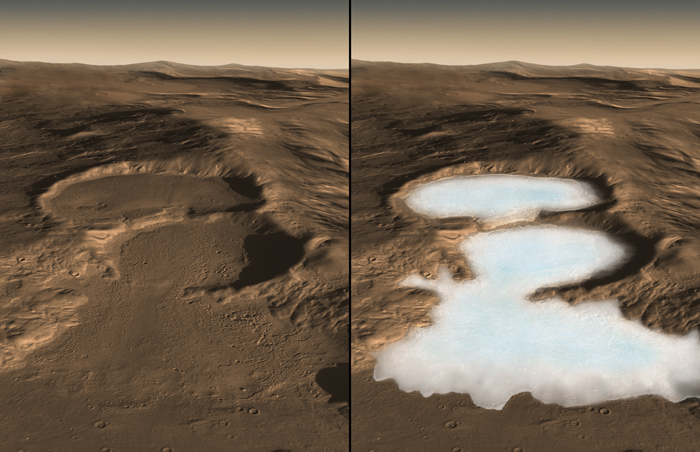


In the past, glaciers may have existed on the surface of Mars, providing meltwater during the summer to create the features we see today. Credit: NASA/JPL-Caltech/ESA

Mars Had Moving Glaciers, but They Behaved Differently in the Planet's Lower Gravity

On Earth, shifts in our climate have caused glaciers to advance and recede throughout our geological history (known as glacial and inter-glacial periods). The movement of these glaciers has carved features on the surface, including U-shaped valleys, hanging valleys, and fjords. These features are missing on Mars, leading scientists to conclude that any glaciers on its surface in the distant past were stationary. However, new research by a team of U.S. and French planetary scientists suggests that Martian glaciers did move more slowly than those on Earth.
These findings demonstrate how glacial ice on Mars would drain meltwater much more efficiently than glaciers on Earth. This would largely prevent lubrication at the base of the ice sheets, which would lead to faster sliding rates and enhanced glacial-driven erosion. In short, their study demonstrated that lineated landforms on Earth associated with glacial activity would not have had time to develop on Mars.

In addition to explaining why Mars lacks certain glacial features, the work also has implications for the possibility of life on Mars and whether that life could survive the transition to a global cryosphere we see today. According to the authors, an ice sheet could provide a steady water supply, protection, and stability to any subglacial bodies of water where life could have emerged. They would also protect against solar and cosmic radiation (in the absence of a magnetic field) and insulation against extreme variations in temperature.
Tuesday, May 28, 2019

[ARCHIVES] Guest blog: Chaz Brenchley Steampunks Mars (With Added Hockey Sticks)

Chaz Brenchley is an amazing writer -- I've been an unabashed fan ever since I read Bridge of Dreams, which led me to write to him, begging for a story for my editorial debut, Lace and Blade. (That story, "In the Night Street Baths," was reprinted in Wild Stories 2009.) Now, many literary adventures later, Chaz sets his sights on Mars, complete with steampunk and a girl's boarding school placed in a failed hotel that was once a Norman castle. Read on for the delicious details...

One of the joys of living in the heart of Silicon Valley is that NASA Ames is just over there, and SETI HQ is even Chaz Brenchleycloser. We live among the cool kids - and the cool kids like to share. I went to NASA for the recent transit of Venus; and ever since I moved here, I’ve been going to SETI’s weekly colloquium where planetary scientists and cosmologists talk about the latest discoveries, or the specific projects they have on a new mission, or the latest weird theory that’s almost a guaranteed Nobel prize if it should ever prove true (“but right now there are only two people who believe it, and they’re both in this room”), and like that.
So there I was with planetary scientists at my fingers’ ends for the asking, and lots of Mars talk going on around the time of Curiosity’s landing, so it’s really no wonder that I started thinking about Mars fiction. Real Mars, not so much, for it is dry and inhospitable and I have written my desert books already - but old Mars, Mars with canals and an atmosphere and aliens? Oh, yes. Very much yes.
And very much within that spirit, I wanted to steampunk it up a bit; and there was a lot of talk at that time in my social media about how steampunk tended to assume British Empire overtones, as though that were the only choice, and how it so very much was not. So I thought somewhat about that - but I did keep coming back to the British Empire, because I am far from home and the more time I spend in California the more inveterately Brit I become, and because I am the son of an Empire brat (Grandad was a major in the Scots Guards; Mum was born in Rangoon and grew up in Kuala Lumpur and Singapore, speaking Malay more readily than English), and because above all I was really curious. If Mars were a province of the British Empire, how would that actually work? How could it happen, and what would it mean - to the Empire, and to European and world history? And to Mars, and to the presumptive Martians? How do you impose colonial rule on a race that has no concept of empire, or statehood, or governance? And does it make a difference if you’re there by their courtesy, via their aetherships, for reasons you still don’t understand? And how do you negotiate even the broadest heads of agreement where you can barely communicate at all? 

Tuesday, October 17, 2017

Horse Fodder and Other Incredibly Cool Science Stuff

Grazing horses on better pastures

Annual grasses offer options during summer slump


Sudangrass and sorghum-sudangrass showed the greatest yields and regrew the most after grazing. Siberian millet was the lowest yielding grass. Horses most preferred the annual cool-season ryegrass, but among the warm-season grasses, they highly preferred teff and sudangrass. All of the grasses were found to supply adequate nutrition for horses. 


Citrus fruit peel: Potential alternative to mosquito control discovered


The essential oils were extracted in large amounts from the peel of a fruit similar to an orange, which is available throughout many countries in the world. With such ease of access and productions of the oils, it could potentially be used in areas which have little or no access to an alternative.
Believed to be the first ever example of such an experiment, it was found that the essentials oils were highly effective in mosquitocidal activity on the larvae, leading researchers to conclude it could be used as an eco-friendly alternative in mosquitoes control programs.


Bizarre Dwarf Planet Haumea Has Rings


"We started to see something weird in the light curve," Santos Sanz said. The light dimmed just before and after Haumea passed in front of the star, as if something else were obscuring it. "I remember that José Luis, from the first [moments], said, 'OK, this could be a ring,'" Santos Sanz said. Months of scrutiny bore out the scientists' initial suspicions: The results suggest that Haumea's equator is encircled by a 43-mile-wide (70 km) ring of debris located about 620 miles (1,000 km) from the dwarf planet's surface.


Ancient Mars Likely Had Deep-Sea Hydrothermal Vents


"Ancient, deep-water hydrothermal deposits in Eridania basin represent a new category of astrobiological target on Mars," researchers said in the statement. "Eridania seafloor deposits are not only of interest for Mars exploration, they represent a window into early Earth."

Thursday, October 12, 2017

Martian Sand and Other Wonders


"The mantle of the Earth is made mostly of a mineral called olivine, and the assumption is usually that all planets are like the Earth," said Jay Melosh, Distinguished Professor of Earth, Atmospheric and Planetary Sciences at Purdue University, who led the study. "But when we look at the spectral signature of rocks exposed deep below the moon's surface, we don't see olivine; we see orthopyroxene."
Around 4 billion years ago, an asteroid collided with the moon and created the largest and deepest impact on the moon: the South Pole-Aitken basin. The collision exposed lunar mantle in the basin and splashed up material onto the far side of the moon.


Discovered in images from the Context Camera, this region exhibits dark material that is being eroded from dark layers in the bedrock of a semicircular depression near the boundary of the Southern highlands and the Northern lowlands. Downslope lineations support the notion that these dark sediments are derived locally, and did not accumulate here by coincidence because of the winds.
Sand grains can also roll along the ground as they are blown by the wind, and they are also jostled by other sand gains that are similarly flying across the surface. All of these repeated impacts tend to wear down the sand grains, smoothing them into a more spherical shape and breaking off small fragments that supply the vast dust deposits of Mars. This process (known as comminution) ultimately destroys sand grains and limits the length of time that the particles exist. The fact that we see active sand dunes on Mars today requires that sand particles must be resupplied to replace the grains that are lost over time. Where are the modern day sources of sand on Mars?

Best Way to Recognize Emotions in Others: Listen


Across all five experiments, individuals who only listened without observing were able, on average, to identify more accurately the emotions being experienced by others. The one exception was when subjects listened to the computerized voices, which resulted in the worst accuracy of all.

Jupiter and Two of Its Biggest Moons


Io and Europa are two of Jupiter's four Galilean moons, which are so named because famed Italian astronomer Galileo Galilei discovered them back in 1610. (The other two Galilean satellites are Callisto and Ganymede.) Io is the most volcanic object in the solar system, and astrobiologists regard the ocean-harboring Europa as one of the best bets to host life beyond Earth. 


Unusual Mountain Ahuna Mons on Asteroid Ceres


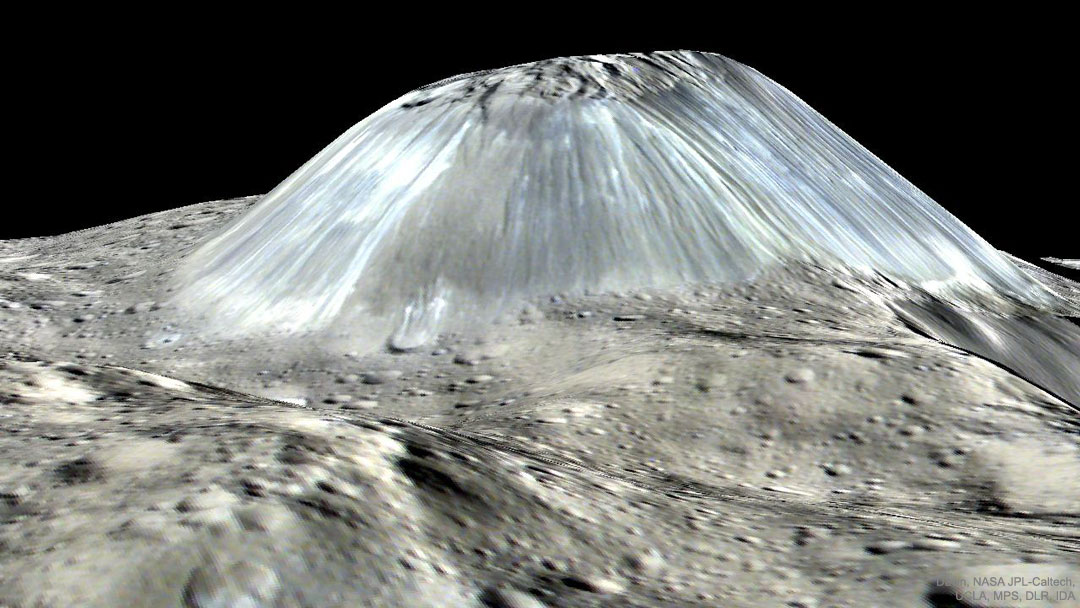
Ahuna Mons is the largest mountain on the largest known asteroid in our Solar System, Ceres, which orbits our Sun in the main asteroid belt between Mars and Jupiter. Ahuna Mons, though, is like nothing that humanity has ever seen before. For one thing, its slopes are garnished not with old craters but young vertical streaks. One hypothesis holds that Ahuna Mons is an ice volcano that formed shortly after a large impact on the opposite side of the dwarf planet loosened up the terrain through focused seismic waves. The bright streaks may be high in reflective salt, and therefore similar to other recently surfaced material such as visible in Ceres' famous bright spots.

Thursday, July 16, 2015

[links] A Poodle Velociraptor and Other Cool Stuff

Lori Duron, who writes the blog Raising My Rainbow, offers 8 Books That Teach Kids About the
Fluidity of Gender and the Importance of Acceptance.  She says:

My husband and I have been committed to showing our son positive examples of differently gendered people in literature. We’ve read the following books countless times and always encourage an open dialogue about what it means to be a boy, a girl, a human. More importantly, we use these books to teach about love, acceptance, equality, empathy, and the beauty of diversity. Read these books to your child to help them better understand their gender identity and be a better friend to the boy who has long hair and wears a skirt or the girl with the short spiked hair who only wears pants.


An ancestor of Velociraptor had feathers, and most likely so did the Jurassic World terror.

Velociraptor would have been a feisty little feathered poodle from hell, not a drab scaly reptilian monster like in the Jurassic Park films,” added Brusatte, who is a paleontologist at the University of Edinburgh’s School of GeoSciences. He co-authored the study, published in the journal Scientific Reports, with paleontologist Junchang LĂĽof of the Chinese Academy of Geological Sciences. The scientists came to their conclusions after studying the near-complete and exceptionally well-preserved skeleton for Z. suni, which lived around 125 million years ago in what is now the Liaoning Province of northeastern China. Like Velociraptor, it was adromaeosaurid -- fast-running, feathered, sickled-clawed dinosaurs that were close relatives of birds. Z. suni weighed around 25 pounds and, most strikingly, had short, 14-inch-long arms covered with long feathers that looked like quill pens. Today’s eagles and vultures sport a similar type of feather.


Images of Pluto from New Horizons are in the news, but we're continuing to discover new things about Mars, including that its crust may contain silica-rich rock typical of continents.

With the help of a rock-zapping laser, NASA's Mars rover Curiosity has detected Red Planet rocks similar to Earth's oldest continental crust, researchers say.
This discovery suggests that ancient Mars may have been more similar to ancient Earth than previously thought, scientists added.

Mostly, I try to keep this blog a politics-free zone (with a few exceptions that touch on my personally, like the death penalty). But occasionally a bit of news tickles my fancy so much, I need to share it:

The Board of Supervisors in Santa Cruz County, California, have taken a bold step. The County has decided that they will not do business, including investment services or bond issuances, with five major banks that the Justice Department found to be associated with felonious acts in May of this year. 

Thursday, May 21, 2015

[links] Fishing With Horses and other cool links

Fishing With Horses:  There are only about 11 horse fishermen in the area of Oostduienkerke but the two men I have photographed are the only ones who actually drag for the shrimp for part of their income the rest just do it for tourism of the town. I am not sure how much longer this old tradition will stay alive in this actual form but I am glad to have a chance to photograph these amazing draft horses and the men that work with them. The horses are so relaxed and I realized after going into the sea my self how much the waves have so much force and the sand shifts under you feet as you sink slowly into the wet sand. I think for these horses it is such a unnatural thing for them to do, but you can see that they have total trust that their riders will guide them and that is what true horsemanship really is, working with a trusted partner to get the required job done easily.Before mules were used for the job but because of the weight of the larger nets the Brabant draft horse is now used because of their tremendous strength and easy going attitudes. They could not have picked a better breed.


The Evolution of Snakes: “We infer that the most recent common ancestor of all snakes was a nocturnal, stealth-hunting predator targeting relatively large prey, and most likely would have lived in forested ecosystems in the Southern Hemisphere,” said Dr Allison Hsiang of Yale University, lead author on the study.


Science Fiction Fodder: Ether-Based "DNA":In the search for life beyond Earth, scientists have justifiably focused on water because all biology as we know it requires this fluid. A wild card, however, is whether alternative liquids can also suffice as life-enablers. For example, Saturn's frigid moon Titan is awash in inky seas of the hydrocarbon methane. Here on warm, watery Earth, the molecules DNA and RNA serve as the blueprints of life, containing creatures' genetic instruction manuals. An immense family of proteins carries out these instructions. A new study proposes that molecules called ethers, not used in any genetic molecules on Earth, could fulfill the role of DNA and RNA on worlds with hydrocarbon oceans. These worlds must be a good deal toastier though than Titan, the study found, for plausibly life-like chemistry to take place.

Monday, May 11, 2015

What Color Are Sunsets on Mars?

Blue!

Wonder how many science fiction novels got that one wrong?


"The colors come from the fact that the very fine dust is the right size so that blue light penetrates the atmosphere slightly more efficiently," said Mark Lemmon of Texas A&M University, College Station, the Curiosity science-team member who planned the observations. "When the blue light scatters off the dust, it stays closer to the direction of the sun than light of other colors does. The rest of the sky is yellow to orange, as yellow and red light scatter all over the sky instead of being absorbed or staying close to the sun."

You can read the whole article on the JPL site or here for a cool animation.