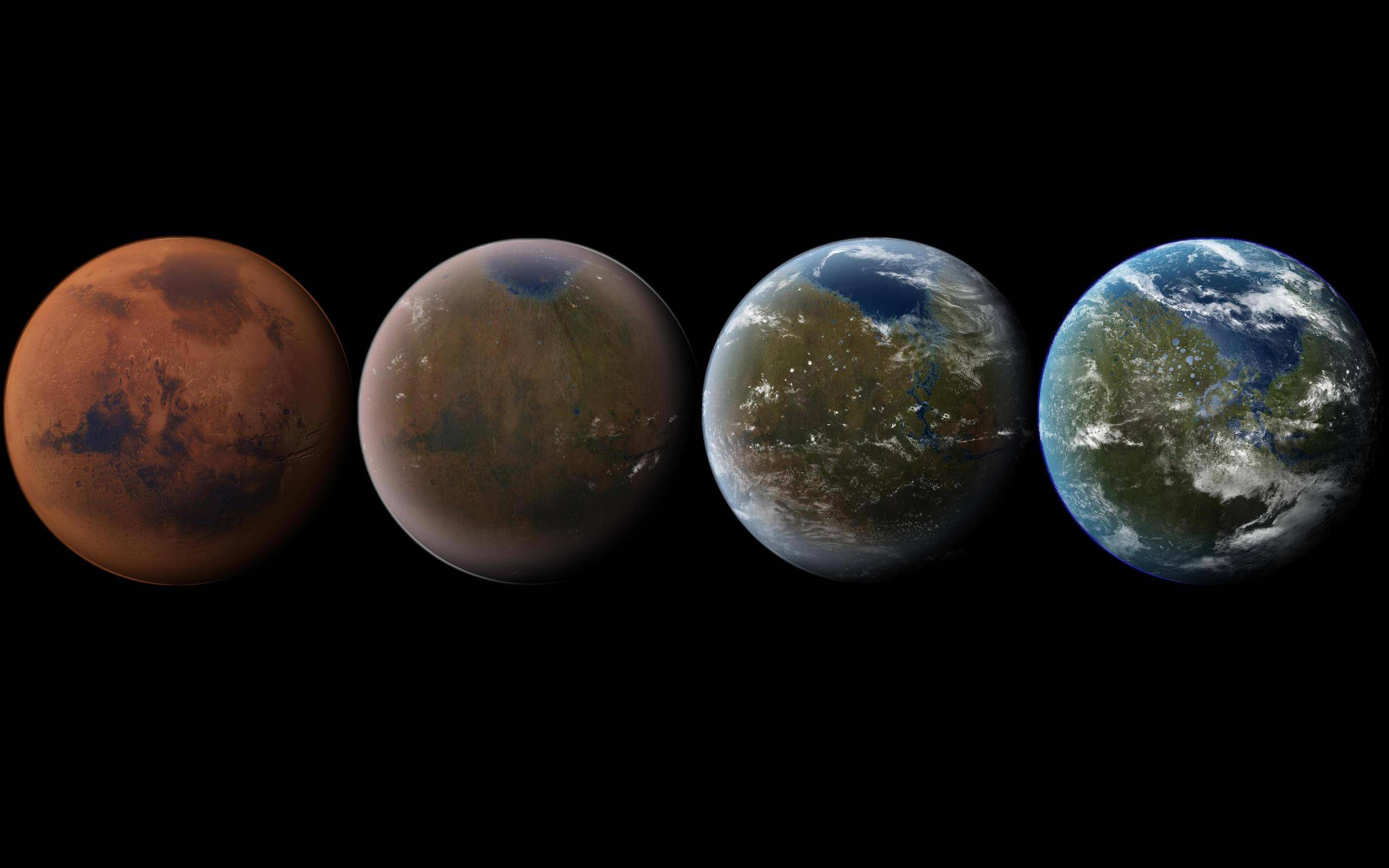
A team of engineers and geophysicists led by the University of Chicago proposed a new method for terraforming Mars with nanoparticles. This method would take advantage of resources already present on the Martian surface and, according to their feasibility study, would be enough to start the terraforming process.
When neutron stars dance together, the grand smash finale they experience might create the densest known form of matter known in the Universe. It’s called “quark matter, ” a highly weird combo of liberated quarks and gluons. It’s unclear if the stuff existed in their cores before the end of their dance. However, in the wild aftermath a neutron-star merger, the strange conditions could free quarks and gluons from protons and neutrons. That lets them move around freely in the aftermath. So, researchers want to know how freely they move and what conditions might impede their motion (or flow).
Recently, two researchers looked at what would happen if a ship with warp drive tried to get into a black hole. The result is an interesting thought experiment. It might not lead to starship-sized warp drives but might allow scientists to create smaller versions someday.
I'm always on the lookout for great information about world-building, especially fascinating astronomy discoveries. This is an excerpt from an article in Universe Today by Evan Gough. Check it out for the full story. (I find this image evocative and beautiful -- do you?)
Stars end their lives in different ways. Some meet their end as supernovae, cataclysmic explosions that destroy any orbiting planets and even sterilize planets light-years away. Our Sun is not massive enough to explode as a supernova. Instead, it’ll spend time as a red giant. The red giant phase occurs when a star runs out of hydrogen to feed fusion. It’s a complicated process that astronomers are still working hard to understand. But red giants shed layers of material into space that light up as planetary nebulae. Eventually, the red giant is no more, and only a tiny, yet extraordinarily dense, white dwarf resides in the middle of all the expelled material.
Can some planets can survive as stars transition from the main sequence to red giant to white dwarf? Researchers at the Space Telescope Science Institute, Goddard Space Flight Center, and other institutions have found what seem to be two giant planets orbiting two white dwarfs in two different systems.
If the researchers are correct, and the planets formed at the same time as the stars, this is an important leap in our understanding of exoplanets and the stars they orbit. It may also have implications for life on any moons that might be orbiting these planets.
Some white dwarfs appear to be polluted with metals, elements heavier than hydrogen and helium. Astronomers think that these metals come from asteroids in the asteroid belt, perturbed and sent into the white dwarf by giant planets. “Confirmation of these two planet candidates with future MIRI imaging would provide evidence that directly links giant planets to metal pollution in white dwarf stars,” the authors write.
Astronomers have found that up to 50% of isolated white dwarfs with hydrogen atmospheres have metals in their photospheres, the stars’ surface layer. These white dwarfs must be actively accreting metals from their surroundings. The favoured source for these metals is asteroids and comets.
This artist’s illustration shows rocky debris being drawn toward a white dwarf. Astronomers think that giant planets perturb smaller objects like asteroids and comets inside the WD’s Roche limit. They’re destroyed, and the debris is drawn onto the star’s surface. Image Credit: NASA, ESA, Joseph Olmsted (STScI)