Showing posts with label gender issues. Show all posts

Monday, March 2, 2026

Reprint: Whiteness and Gender Inequalities in Protest

 When civil rights protesters are killed, some deaths – generally those of white people – resonate more
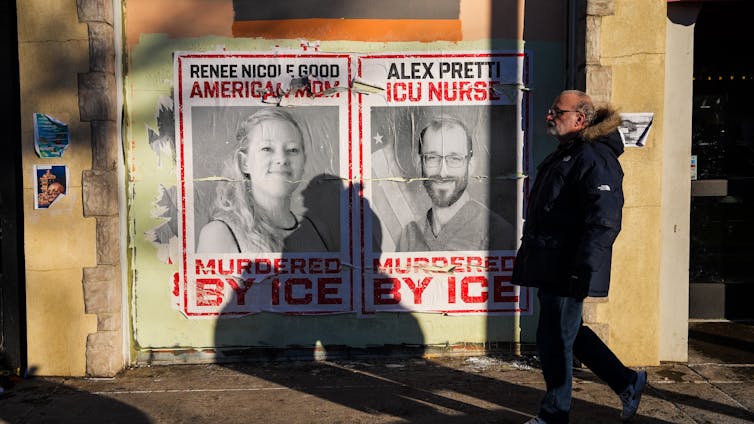
Posters memorialize Renee Good and Alex Pretti, two white Minneapolis residents killed by federal agents. AP Photo/Ryan Murphy
Aniko Bodroghkozy, University of Virginia

Renee Good and Alex Pretti, two white Minneapolis residents killed in January 2026 by federal agents while protesting the Trump administration’s immigration policy, have become household names. National media outlets continue to focus on their deaths and the circumstances around them.

Neither of them was the first person to be shot and killed by immigration enforcement officials over the past year. There have been numerous shootings and some deaths.

In September 2025, Silverio Villegas González was killed in Chicago under circumstances similar to Good’s death. Ruben Ray Martinez was shot multiple times by Immigration and Customs Enforcement agents in Texas in March 2025, but their involvement was not revealed until nearly a year later. Neither Martinez nor Villegas González has become a household name, and their deadly encounters with federal agents have not drawn nearly the same level of media attention as Good’s or Pretti’s.

As a media historian, I’ve been struck by the similarities between the media’s coverage of Minneapolis and its coverage of Selma, Alabama, in 1965, when voting rights protests led to violence that left three people dead, including two white victims.

I’ve written about the Selma campaign, as well as the media’s treatment of white female activists killed during racial justice protests, in my books “Equal Time: Television and the Civil Rights Movement” and “Making #Charlottesville: Media from Civil Rights to Unite the Right.”

These two events reveal that the deaths of white activists often draw and sustain far more attention than the deaths of Black or Latino people in similar contexts. But the Selma and Minneapolis events also show that male and female white activist victims aren’t necessarily treated the same way.

Remembering Selma

Video footage of law enforcement beating and gassing marchers on Selma’s Edmund Pettus Bridge remains an iconic visual document of the Civil Rights Movement. John Lewis, who later became a congressman, was an activist at the head of the march on March 7, 1965, and was beaten in the head at the base of the bridge by Alabama state troopers. But he was not a household name in 1965, and media coverage at the time did not identify him.

Reporters also didn’t pay much attention to what had motivated the march: the killing of Black voting rights activist Jimmie Lee Jackson by an Alabama state trooper during a nighttime march a week earlier.
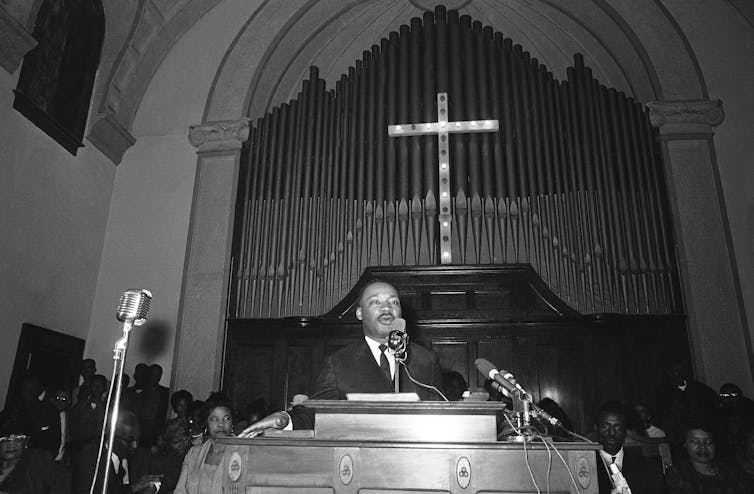
Martin Luther King stands at the pulpit of a church in front of a large crucifix.
Martin Luther King Jr. delivers a eulogy in Selma, Ala., for James Reeb, a fellow minister who was beaten to death. AP Photo

Still, the prime-time television broadcast of footage from “Bloody Sunday” at the Pettus Bridge shocked Americans, just as footage from Minneapolis has similarly distressed and disturbed many people today.

In 1965, a small number of white Americans from around the country, including numerous members of the clergy, descended on Selma to stand with the brutalized voting rights activists. They included James Reeb, a Unitarian minister from Massachusetts, and Viola Liuzzo, a wife and mother of five from Michigan.

Reeb, following a second aborted march across the Pettus Bridge two days after Bloody Sunday, was viciously beaten by a group of white racists and left lying on the ground, mortally wounded. His beating and subsequent death received plentiful media attention.

President Lyndon B. Johnson contacted Reeb’s widow. She gave media interviews about her husband. Johnson also extolled Reeb at the beginning of his joint address to Congress calling for robust voting rights legislation, four days after Reeb’s death. Johnson never mentioned Jackson’s death.

Liuzzo was ferrying people back to Selma from Montgomery on March 25 after the conclusion of the final, successful march to the state capital when a carload of Ku Klux Klansmen, one an FBI informant, chased her down and shot her through her car window. Her death received even more coverage than Reeb’s, keeping Selma in the news.

The Voting Rights Act passed five months later.

Smearing the victim

Friday, February 9, 2018

Guest Post: Nancy Jane Moore on Fighting and Gender

At a recent meeting of my writers’ group, we discussed fight scenes while critiquing an early draft of my novel in progress. The discussion went something like this:

“Women fight differently from men,” one of the guys said in pointing out that the sword fight scenes didn’t vary much.

I didn’t think he was referring to the inaccurate stereotype that women can’t fight, but I also didn’t think his point applied, so I said – speaking as a long-time martial artist and instructor as well as a writer – “In my experience, that’s not always the case, especially with weapons.”

And he replied, “Yeah, but you’re big.”

I let it go at that, because he was right that the fight scenes needed work, but it bothered me. After some reflection, I realized what the problem was: If my experience isn’t key to discussions about how women fight simply because I’m a woman about the size of the average U.S. man, then the issue isn’t biological sex or gender; it’s body size and build. The average man may be bigger than the average woman, but there are plenty of small men – and big women – in the world. Also, there are some people who don’t fit into standard gendered categories, and they, too, come in a variety of body types. As writers, if we make assumptions about fighting styles based on sex or gender, we’re not going to create scenes that reflect the complexity of real fights.

There is only one situation in which writers should give some consideration to the gender of their fighters, and that’s if they are creating a world in which the culture puts distinct rules on gender behavior. Most current societies give girls and boys very different signals from an early age, with the girls getting the message – incorporating it into their bodies – that they aren’t capable of handling themselves physically in dealing with men, and the boys, regardless of size or skill, learning that they have power over women. In a world in which calling men and boys “girls” (or much less acceptable words for female) is a major insult, women who fight will have to deal with the cultural dynamics.

Thursday, July 16, 2015

[links] A Poodle Velociraptor and Other Cool Stuff

Lori Duron, who writes the blog Raising My Rainbow, offers 8 Books That Teach Kids About the
Fluidity of Gender and the Importance of Acceptance.  She says:

My husband and I have been committed to showing our son positive examples of differently gendered people in literature. We’ve read the following books countless times and always encourage an open dialogue about what it means to be a boy, a girl, a human. More importantly, we use these books to teach about love, acceptance, equality, empathy, and the beauty of diversity. Read these books to your child to help them better understand their gender identity and be a better friend to the boy who has long hair and wears a skirt or the girl with the short spiked hair who only wears pants.


An ancestor of Velociraptor had feathers, and most likely so did the Jurassic World terror.

Velociraptor would have been a feisty little feathered poodle from hell, not a drab scaly reptilian monster like in the Jurassic Park films,” added Brusatte, who is a paleontologist at the University of Edinburgh’s School of GeoSciences. He co-authored the study, published in the journal Scientific Reports, with paleontologist Junchang Lüof of the Chinese Academy of Geological Sciences. The scientists came to their conclusions after studying the near-complete and exceptionally well-preserved skeleton for Z. suni, which lived around 125 million years ago in what is now the Liaoning Province of northeastern China. Like Velociraptor, it was adromaeosaurid -- fast-running, feathered, sickled-clawed dinosaurs that were close relatives of birds. Z. suni weighed around 25 pounds and, most strikingly, had short, 14-inch-long arms covered with long feathers that looked like quill pens. Today’s eagles and vultures sport a similar type of feather.


Images of Pluto from New Horizons are in the news, but we're continuing to discover new things about Mars, including that its crust may contain silica-rich rock typical of continents.

With the help of a rock-zapping laser, NASA's Mars rover Curiosity has detected Red Planet rocks similar to Earth's oldest continental crust, researchers say.
This discovery suggests that ancient Mars may have been more similar to ancient Earth than previously thought, scientists added.

Mostly, I try to keep this blog a politics-free zone (with a few exceptions that touch on my personally, like the death penalty). But occasionally a bit of news tickles my fancy so much, I need to share it:

The Board of Supervisors in Santa Cruz County, California, have taken a bold step. The County has decided that they will not do business, including investment services or bond issuances, with five major banks that the Justice Department found to be associated with felonious acts in May of this year. 

Monday, January 5, 2015

GUEST BLOG: Trans Folk, Hormones, and Stress

In the wake of the suicide of a trans youth, I offer this article from the excellent blog, Open Minded Health. It provides evidence that trans people have a better quality of life when their physiology matches their gender identity.

Article Review: Hormonal Treatment Reduces Psychobiological Distress in Gender Identity Disorder, Independently of the Attachment Style (used with permission).

Summary: Research now indicates that cross-sex hormone therapy is associated with a lower cortisol awakening response in trans people, regardless of attachment style. Many confounding variables, however, were present in this study.

Transgender people have long asserted that gender dysphoria can be extremely distressing and that transition, including hormone therapy, helps relieve that dysphoria. Hormone therapy is known to improve self-reported quality of life, as measured by questionnaire. To my knowledge no other study has looked at stress-related biological factors in trans people. Biological factors are important because self-report is notorious for validity problems. This study looked at one such biological factor, called the cortisol awakening response.

Thursday, June 27, 2013

World-Building in Collaborators – Designing a Gender-Fluid Race


I begin with an excerpt from my last post on Thinking About Gender:


In writing Collaborators, I wanted to create a resonance between the tensions arising from First Contact and those arising from differences in gender and gender expectations. It seemed to me that one of the most important things we notice about another human being is whether they are of “our” gender. What if the native race did not divide themselves into (primarily) two genders? How would that work – biologically? romantically? socially? politically? How would it affect the division of labor? child-rearing? How would Terran-humans understand or misinterpret a race for whom every other age-appropriate person is a potential lover and life-mate? Not only that, but in a life-paired couple, each is equally likely to engender or gestate a child.


We humans tend to think about gender as binary, and the concepts of fluidity (changing from one to the other, not necessarily once but perhaps many times during a lifetime) or being both male and female (or neither) are fairly recent additions into conventional public discourse. Fluidity is not the same thing as being transgendered (which is where a person’s gender – their identity – and their sex – their biological/genetic category) are not the same. Both are different from sexual orientation, which has to do with attraction to another person. All too often, if a species that does not fit into the female/male division is portrayed in media, they’re shown as sexless, not only androgynous but lacking in sex drive.

I take exception to this. I see no reason why sexual activity should not be as important to an alien race as it is to human beings. We have sex for lots of reasons, reproduction being only one of them. It feels good – no, it feels great. It creates bonds between individuals, whether as part of lifelong commitments or otherwise. It’s physiologically good for health, both physical and mental. So for my alien race in Collaborators, I wanted sexuality to be important.

Monday, June 17, 2013

World-building in Collaborators: Add Some Characters


The central inspiration for Collaborators – that individuals respond in a variety of complex and contradictory ways to a situation of occupation and resistance – immediately suggested many types of characters: the rebel, the idealist, the opportunist, the political player, the merchant willing to sell to anyone if the profit is high enough, sadist who exploits the powerlessness of others for his own gratification, the ambitious person who doesn’t care who his allies are, the negotiator, the peace-maker, the patriot.

These are all interesting roles, offering scope for compelling confrontations, but they are not in themselves characters. They’re slots into which characters might fit at any given time, as those characters progress along their own life story arcs. The temptation is to take such a slot, insert a character, and then have him behave in that way and only in that way throughout the story. This is the classic “spear-carrier,” whose only function is to come onstage, carry his spear (or throw it, or make a speech, or die in some plot-appropriate way), and then disappear. He might have a few warts or wrinkles or a bit of backstory, but only in service to his predetermined function.

Effective characters work in just the opposite way. They go about their lives in their idiosyncratic ways, with their own histories and families, dreams and neuroses. Interesting as these might be, they do not in themselves constitute a dramatic plot, only a series of linked episodes. Then something – whether it’s an internal event like a new goal or an external one like an invasion by a space-faring race – catapults the character into a dramatic course of action. The overall problem/crisis/goal informs and shapes the character’s choices, but at the same time the character – her personality, history, viewpoint, relationships – drives the action in a unique way.  So I needed to find out who some of these characters were, both alien and Terran, throw them into an escalating situation, and see what they did with it.

Saturday, November 10, 2012

Highly Idiosyncratic Orycon Diary


November 1, 2012. As usual, I began with good intentions to get daily exercise. At home, I typically exercise for half a hour before breakfast, and then get in a walk later in the day. So Friday morning I wended my way to the hotel fitness center. The treadmills, my torture of choice, were equipped with headphones and leeetle television screens. After flipping from one channel to another (which reminded me emphatically why I do not watch television), I discovered a program of videos made by Japanese children in the wake of the tsunami and then a year later. They were lovely, poignant, generous, joyful, grief-stricken, honest as only children can be honest. I wanted everyone to see them. They were all the more powerful in the context of Hurricane Sandy.

November 3, 2012. Writers workshop went well yesterday. Likewise my reading, which was well-attended considering it was 5 pm on Friday. I believe there were a number of snafus with other readings, so I felt grateful that mine actually took place where and when it was supposed to. Today’s panels went really well – as moderator for all of them, I happily accept my fair share of credit. Topics were: what authors influenced you (and what do you see as the wave of the future, which none of us were interested in talking about, so we ignored); gender (as if writing the other); is publishing obsolete. The latter two drew large, engaged audiences, always a nice thing for a panelist. I particularly enjoyed the gender panel; we started with the issue of whether/how we write opposite-gender characters and progressed to larger issues of gender fluidity, gay/queer characters, tolerance in general and how fiction informs and infuriates various audiences. I usually keep my own book pimpage to a minimum (no “wall’o’books” for me!) but I did get to talk about creating a gender-fluid race for my sf novel, Collaborators (forthcoming from Dragon Moon Press, May 2013). The panel gave rise to some pretty amazing connections.

Tuesday, October 2, 2012

Novel sale!

Some of you may remember the science fiction novel I read from at 2004 Gaylaxicon (and have been asking me ever since when it's coming out). To connect it with my previous science fiction, it'll be under the name Wheeler.

Here's the press release: Dragon Moon Press Continues Gender-Exploring Tradition with a New Science Fiction Novel from Deborah Wheeler

Collaborators: a complex tale of occupation and resistance, conspiracies, rebellions, gender, and power.

We’re pleased to announce the acquisition of Collaborators, a new science fiction novel by Deborah Wheeler. Noted for numerous short stories, two novels, and, as Deborah J. Ross, her continuation of Marion Zimmer Bradley’s Darkover series, Wheeler now offers a deep exploration of the gendered gaze and takes the reader behind the eyes of the other, from both directions, in a fast-moving tale of occupation and resistance.

A crippled Terran spaceship makes orbit around Bandar, a planet whose gender-fluid native race teeters on the brink of international war. As misunderstandings mount, violence escalates. Ultimately, it is up to the people on both sides who have suffered the deepest losses to find a way to reconciliation. About Collaborators, acclaimed writer C. J. Cherryh wrote, “This is first-rate world-building from a writer gifted with soaring imagination and good old-fashioned Sense of Wonder.”

“We’re really excited to work with Deborah, and proud to publish Collaborators,” says managing editor Gabrielle Harbowy. “It’s an intimate exploration of power, gender, and sexuality set in a richly-imagined world.”