Showing posts with label transgendered people. Show all posts

Monday, August 24, 2026

[Reprint] How rhetoric promotes anti‑transgender views


How the Trump administration’s rhetoric promotes anti‑transgender views

The U.S. Capitol is seen behind a transgender pride flag
In the past few years, the Trump administration and state legislatures have restricted trans people’s rights and protections, from access to healthcare to passports. Kayla Bartkowski/Getty Images
Julie D. Nelson, University of Tampa

Whether in an Oval Office proclamation signing about commercial fishing or during a Fox News interview while discussing Iran, President Donald Trump finds opportunities to share his views on transgender people.

During a June 2026 signing event, Trump claimed, in response to a question about proposed legislation regarding election procedures, called the SAVE America Act: “We are talking about saving America, right? No men in women’s sports.” He continued, “And we have no mutilization of your children for transgender purposes … where your child leaves your house, and they take your child from you. … In six states, they take the child and do what they want to do. What they do is, is I don’t even want to talk about it. No transgender mutilization of your children.”

Highlighting Trump’s ongoing use of the made-up word “mutilization,” criticism quickly followed his false claims about states forcibly transitioning children. Misrepresentations like these help fuel the transgender moral panic that Trump has provoked since he started instituting restrictions on trans people in his first term.

As a rhetoric scholar for nearly two decades, I have studied how emotions propel rhetoric that goes viral on public platforms like social media and how politicians use emotions for varying purposes, including to bolster anti-trans legislation.

Throughout the Trump administration’s second term, I’ve followed how its officials have invented threats and used provocative language and repulsive imagery to stimulate anti-trans disgust and paranoia in audiences, contributing to public misconceptions and declining support for trans rights and people.

Changing views of trans people and issues

The Trump administration’s anti-trans agenda has flourished since his first term.

Following Republicans’ US$21 million anti-trans and anti-LGBTQ advertising campaign that helped pave Trump’s way to victory in 2024, the administration and its allies have been busy. The White House has denied the existence of trans identity, and states have introduced a deluge of legislation that restricts trans people’s rights and protections, from access to healthcare to passports.

Presidential rhetoric can have a significant impact on public opinion. Since reaching a peak in the early 2020s, overall support for LGBTQ+ issues has since declined in the U.S. Likewise, surveys have shown a decline in support for trans healthcare for minors, a preference for using birth sex on IDs, and increasing support for restrictions in sports for trans people.

Meanwhile, public approval of Trump’s approach to trans issues is relatively high, as compared with his approval ratings on other issues.

A 2024 report by the Human Rights Campaign decried an “epidemic of violence” against trans and gender-expansive people. A 2025 Pew report found that 70% of trans adults have feared for their personal safety, and only 13% of LGBTQ respondents reported social acceptance of trans people.

Though the causes for changing trans views are complex, research suggests Trump’s rhetoric and policies have powerful influence, the ramifications of which are clear. Anti-LGBTQ+ laws and debates negatively affect young queer people, according to the Trevor Project’s 2025 U.S. National Survey on the Mental Health of LGBTQ+ Young People, and are associated with increased stress, discrimination and suicide attempts.
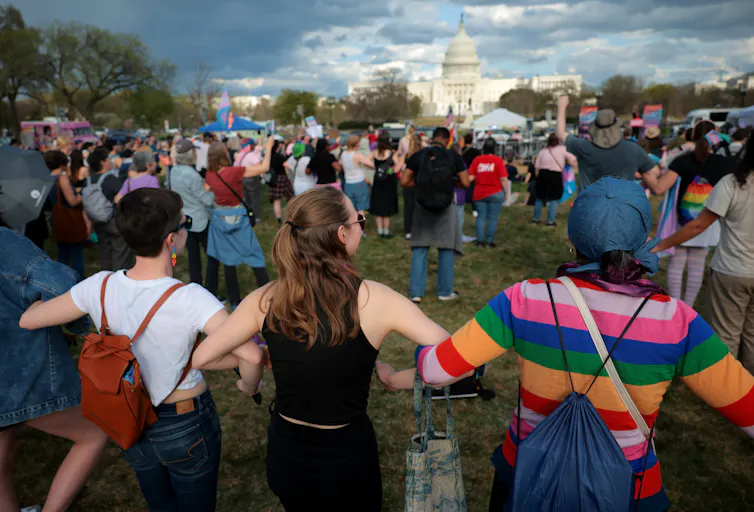
People stand with linked arms in a crowd facing the U.S. Capitol, transgender pride flags among them
Trans people and their allies have pushed back against a recent wave of restrictions. Here, supporters rally for the Transgender Day of Visibility in March 2025. Kayla Bartkowski/Getty Images

Moral panic as political strategy

From the Salem witch trials in the 17th century to the war on drugs in the 20th century, moral panics have emerged across history to stoke fear against a perceived threat to a society’s values or well-being.

Moral panics, coined by sociologist Stanley Cohen in 1972, follow a similar pattern: a threat is defined, media exaggerates the threat, public concern increases, authorities respond with laws and policies, and society is transformed.

Research on anti-trans moral panics illustrates their success in propelling anti-trans lawmaking in the U.S. and suggests they are often initiated by people with power, who use their platforms to shape public discourse.

Moral panics elicit a range of negative emotions, but disgust and paranoia are especially potent. Originally a response meant to protect us from disease and spoiled food, disgust has evolved to also express social inappropriateness. Disgust asserts that its object is inherently bad. Since disgust is culturally dependent, it can also be used to marginalize groups of people.

Meanwhile, paranoia focuses on visualizing and preparing for future threats. When experienced as an emotion – outside of psychiatric disorders – paranoia has a righteous undertone, as it seeks to uncover perceived enemies.

Disgust and paranoia are a powerful combination for sustaining moral panics. While disgust produces an intense, immediate physical feeling, paranoia is long-lasting, stewing and existential.

Stimulating disgust and paranoia

Trump’s offhand remarks often invoke disgust and paranoia against perceived enemies – for example, toward immigrants, whom he has repeatedly described as dangerous criminals. These same patterns emerge in the Trump administration’s formal communication regarding trans issues.

The March 31, 2026, White House press release “President Trump Ended Democrats’ ‘Transgender for Everybody’ Insanity,” which touts the administration’s reversal of protections for trans people, offers several examples.

The release asserts that former President Joe Biden’s 2024 Proclamation of Transgender Day of Visibility “desecrated Easter Sunday with a ‘transgender’ message that elevated radical leftist ideology over faith, family, and biological truth.” Rousing paranoia, “radical leftist ideology” (and later in the release, “gender ideology”) is portrayed as an existential threat that puts Americans and their beliefs in danger.

The release also claimed that “the Trump Administration is celebrating a decisive victory: the swift and unrelenting dismantling of subversive, woke policies that endangered children, eroded women’s rights, assaulted common sense, and dragged America toward moral and cultural decline.”

As a rhetoric scholar, I read these allusions to religion and war – using words like “desecrate” and “victory,” respectively – as implications that the U.S. is in a battle between good and evil. Schools, hospitals, bathrooms, locker rooms, sports facilities and military bases are spaces declared under attack.

The release also condemns “the chemical and surgical mutilation of minors” and “child mutilation programs” – revolting imagery that misleadingly depicts gender-affirming care and incites shock, concern and disgust.

Similarly, invoking images of nonconsenting, victimized children and women, the release denounces “the un-American indoctrination of schoolchildren” and “the unfair, demeaning practice of forcing women to compete against biological men in sports.” Stimulating anger and moral panic, these descriptions encourage anti-trans views and discrimination.

Recognizing these rhetorical patterns is key to understanding how politicians use inflammatory language to denigrate trans people and other marginalized groups, including women, Black people and immigrants.The Conversation

Julie D. Nelson, Associate Professor of English and Writing, University of Tampa

This article is republished from The Conversation under a Creative Commons license. Read the original article.

Monday, June 9, 2025

Reprint: Transgender Saints!


Christianity has long revered saints who would be called ‘transgender’ today

Sarah Barringer, University of Iowa

Several Republican-led states have restricted transgender rights: Iowa has signed a law removing civil rights protection for transgender people; Wyoming has prohibited state agencies from requiring the use of preferred pronouns; and Alabama recently passed a law that only two sexes would be recognized. Hundreds of bills have been introduced in other state legislatures to curtail trans rights.

Earlier in the year, several White House executive orders pushed to deny trans identity. One of them, “Eradicating Anti-Christian Bias,” claimed that gender-affirming policies of the Biden administration were “anti-Christian.” It accused the Biden Equal Employment Opportunity Commission of forcing “Christians to affirm radical transgender ideology against their faith.”

To be clear, not all Christians are anti-trans. And in my research of medieval history and literature, I found evidence of a long history in Christianity of what today could be called “transgender” saints. While such a term did not exist in medieval times, the idea of men living as women, or women living as men, was unquestionably present in the medieval period. Many scholars have suggested that using the modern term transgender creates valuable connections to understand the historical parallels.

There are at least 34 documented stories of transgender saints’ lives from the early centuries of Christianity. Originally appearing in Latin or Greek, several stories of transgender saints made their way into vernacular languages.

Transgender saints

Of the 34 original saints, at least three gained widespread popularity in medieval Europe: St. Eugenia, St. Euphrosyne and St. Marinos. All three were born as women but cut their hair and put on men’s clothes to live as men and join monasteries.

Eugenia, raised pagan, joined a monastery to learn more about Christianity and later became abbot. Euphrosyne joined a monastery to escape an unwanted suitor and spent the rest of his life there. Marinos, born Marina, decided to renounce womanhood and live with his father at the monastery as a man.

These were well-read stories. Eugenia’s story appeared in two of the most popular manuscripts of their day – Ælfric’s “Lives of Saints” and “The Golden Legend.” Ælfric was an English abbot who translated Latin saints’ lives into Old English in the 10th century, making them widely available to a lay audience. “The Golden Legend” was written in Latin and compiled in the 13th century; it is part of more than a thousand manuscripts.

Euphrosyne also appears in Ælfric’s saints’ lives, as well as in other texts in Latin, Middle English, and Old French. Marinos’ story is available in over a dozen manuscripts in at least 10 languages. For those who couldn’t read, Ælfric’s saints’ lives and other manuscripts were read aloud in churches during service on the saint’s day.

A person lying on a bed appears to be getting up as a man in a long red cloak walks toward him.
Euphrosyne of Alexandria. Anonymous via Wikimedia Commons

A small church in Paris built in the 10th century was dedicated to Marinos, and relics of his body were supposedly kept in Qannoubine monastery in Lebanon.

This is all to say, a lot of people were talking about these saints.

Monday, July 22, 2024

[reprint] Sex, Gender, and Genetic Testing

Genetic testing cannot reveal the gender of your baby − two genetic counselors explain the complexities of sex and gender

Gender and sex are more complicated than X and Y chromosomes. I Like That One/Digital Vision via Getty Images
Maggie Ruderman, Boston University and Kimberly Zayhowski, Boston University

Gender reveal parties are best known as celebrations involving pink and blue, cake and confetti, and the occasional wildfire. Along with being social media hits, gender reveals are a testament to how society is squeezing children into one of two predetermined gender boxes before they are even born.

These parties are often based on the 18- to 20-week ultrasound, otherwise known as the anatomy scan. This is the point during fetal development when the genitals are typically observed and the word “boy” or “girl” can be secretly written on a piece of paper and placed into an envelope for the planned reveal.

Now there is a new player in the gender reveal game: genetic screening.

Advancements in genetic research have led to the development of a simple blood test called cell-free DNA prenatal screening that screens for whether a baby has extra or missing pieces of genetic information – chromosomes – as early as 10 weeks into pregnancy. Included in this test are the sex chromosomes, otherwise known as X and Y, that play a role in the development and function of the body.

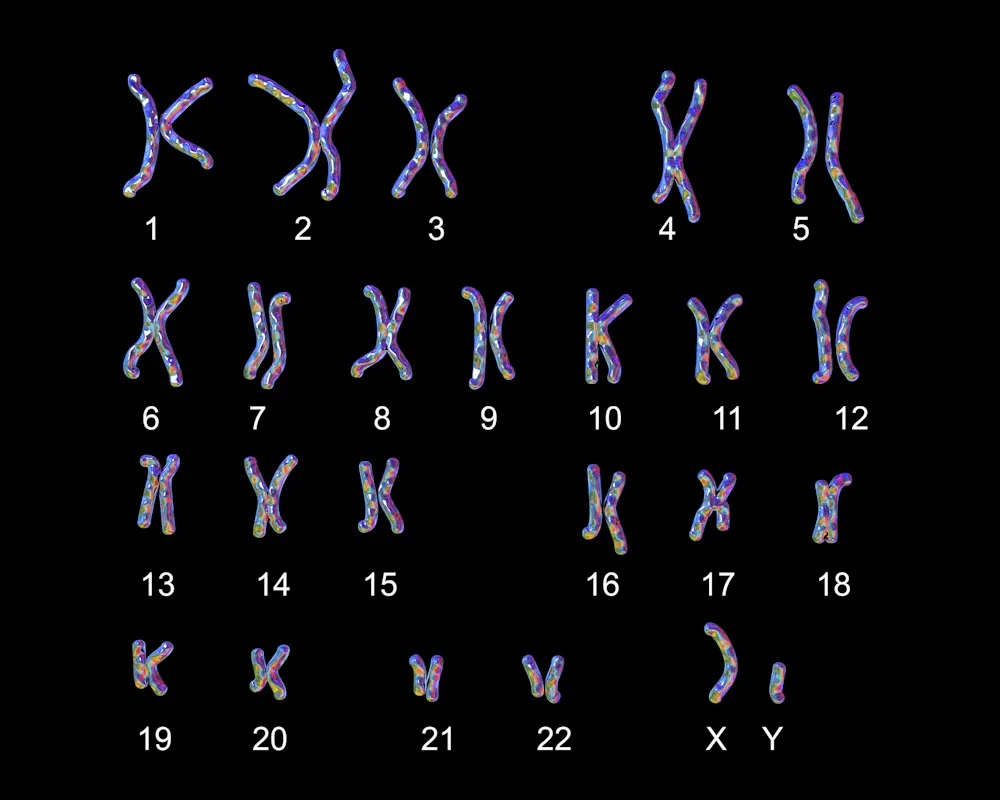
Illustration of human karyotype
Prenatal screening tests look for chromosomal abnormalities. Anastasia Usenko/iStock via Getty Images Plus

This blood test is more informally called noninvasive prenatal testing, or NIPT. Many people refer to it as “the gender test.” But this blood test cannot determine gender.

As genetic counselors and clinical researchers working to improve genetic services for gender-diverse and intersex people, we emphasize the significance of using precise and accurate language when discussing genetic testing. This is critical for providing affirming counseling to any patient seeking pregnancy-related genetic testing and resisting the erasure of transgender and intersex people in health care.

Distinguishing sex and sex chromosomes

Sex and gender are often used interchangeably, but they represent entirely different concepts.

Typically when people think of sex, they think of the categories female or male. Most commonly, sex is assigned by health care providers at birth based on the genitals they observe on the newborn. Sex may also be assigned based on the X and Y chromosomes found on a genetic test. Commonly, people with XX chromosomes are assigned female at birth, and people with XY chromosomes are assigned male. Since cell-free DNA, or cfDNA, prenatal screening can report on sex chromosomes months before birth, babies are receiving sex assignments much sooner than previously possible.

While cfDNA prenatal screening can offer insights into what sex chromosomes an infant may have, sex determination is much more complicated than just X’s and Y’s.

For one, sex chromosomes don’t exactly determine someone’s sex. Other chromosomes, hormone receptors, neural pathways, reproductive organs and environmental factors contribute to sex determination as well, not unlike an orchestra with its ensemble of instruments. Each cello, flute, tympani and violin plays a crucial role in the performance of the final musical score. There is no single instrument that defines the entirety of the symphony.

Expanding social and medical concepts of sex and gender beyond the binary can help patients and doctors.

Intersex people, or those with variations in sex characteristics that deviate from societal norms of binary sex, exemplify the complexities of sex. These variations can manifest in various ways beyond X and Y chromosomes, such as differences in hormone levels, genitalia or secondary sexual characteristics.

The oversimplification of sex based on societal norms has led many to believe that there are only two discrete sexes. The binary framework of sex excludes intersex people and perpetuates their erasure and mistreatment within both health care and society at large.

For instance, many intersex individuals face unnecessary surgeries, such as nonconsensual genital procedures, to conform to binary norms, violating their bodily autonomy.

Where gender comes in

While sex typically describes someone’s anatomical characteristics, gender is an umbrella term that encompasses the way someone views and presents themselves to the world. Countless aspects influence how someone defines their own gender and how the world views their gender, including clothing, haircuts and voice tone. Similar to how Western cultures have historically confined sex to two buckets, it has also created two gender categories: man and woman.

Gender is not dependent on anatomical parts or chromosomes. People are not math equations, and having certain combinations of biological parts does not equal someone’s gender. For example, some people may be transgender, meaning their assigned sex is not congruent with their socially or self-defined gender. Nonbinary people do not identify exclusively with either of the two genders in the binary, regardless of their assigned sex.

Just like sex diversity, gender diversity is not rare. A 2022 Pew Research Center analysis found that approximately 5% of adults in the U.S. under the age of 30 are transgender or nonbinary.

These estimates will likely increase as societal awareness and acceptance of gender-diverse individuals increases. Anti-transgender legislation often oversimplifies gender as strictly binary, conflating it solely with sex assigned at birth.

Intersex and gender-diverse people show that sex and gender are both multidimensional. Gender is not solely determined by biology, and it is erroneous to define someone’s gender by their sex, much less by their sex chromosomes.

Challenging sex and gender norms

The idea that biology plays the largest role in determining who an individual is, or bioessentialism, has governed misconceptions about sex and gender for many years. This concept is used to confine people to buckets and limit their self-determination.

For instance, societal norms dictate that women should be nurturing and gentle, while men are expected to be protective and assertive. Such rigid gender roles, often enforced through the lens of biology, serve to uphold notions of evolutionary destiny and a purported natural order.

Doctor holding stethoscope on belly of pregnant person
Categorizing your child at birth limits their ability to define who they are. Halfpoint Images/Moment via Getty Images

Marketing strategies for children’s toys often adhere strictly to gender roles, steering girls toward dolls and domestic play sets while steering boys toward action figures and construction sets.

Educational systems often reinforce gender norms by directing girls toward subjects such as literature and arts while steering boys toward science and mathematics. This perpetuates the notion that certain traits and interests are inherently linked to one’s sex and gender, thereby reinforcing societal norms and sustaining inequality.

Upholding binary constructs of sex and gender does not allow for individuality and gender fluidity. Categorizing people from the time their chromosomes are analyzed or the moment their genitals are observed at birth restricts their autonomy and authenticity. These simple assumptions set expectations that can be harmful.

Letting children define themselves

If you’re a parent offered cfDNA prenatal screening during pregnancy, remember that it is commenting only on one instrument in the orchestra of sex. It cannot examine all of the other factors that determine sex as a whole. And it most certainly cannot determine gender, which is an entirely different concert.

In recent years, Jenna Karvunidis, the mother considered the inventor of gender reveal parties, shared her regrets for starting the trend and noted that her views on sex and gender have shifted. In a 2019 Facebook post, Karvunidis wrote, “PLOT TWIST. The world’s first gender reveal party baby is a girl who wears suits!” She had also gone on to say, “Celebrate the baby … Let’s just have a cake.”

When the envelope is opened, the balloons are popped and the crafty cake is cut, consider how these practices perpetuate social confinements and a gendered destiny for your little bundle of joy. Perhaps opt simply for a celebration that leaves space for your child to one day define who they are.The Conversation

Maggie Ruderman, Assistant Professor of Medicine, Boston University and Kimberly Zayhowski, Assistant Professor, Boston University

This article is republished from The Conversation under a Creative Commons license. Read the original article.
Friday, July 28, 2023

Reprint: Nonbinary gender in Jewish law


Nonbinary genders beyond ‘male’ and ‘female’ would have been no surprise to ancient rabbis, who acknowledged tumtums, androgynos and aylonot

Jewish law includes acknowledgment that not everyone fits neatly into the categories ‘male’ and ‘female.’ Mishna/Wikimedia Commons, CC BY-SA
Sarah Imhoff, Indiana University

“Genderqueer” and “nonbinary” are contemporary terms for people who don’t fit neatly into male or female categories. But acknowledging that not everyone fits neatly into those two groups has a much longer history than you might suspect.

As a scholar of Judaism and gender, I find that people across the political spectrum often assume religion must be inherently conservative and unchanging when it comes to sex and gender. They imagine that religions have always embraced a world in which there are only men and women.

But for Judaism – and for many other religious traditions, too – history shows that’s just not true.

More than two terms

Traditional Jewish sources discuss the categories “man” and “woman,” but these aren’t the only designations rabbinic texts use for sex and gender.

Rabbinic literature, the body of texts written by Jewish leaders in antiquity, includes several other categories. In these texts, a person with both sets of external genitalia is called an “androgynos,” a term borrowed from Greek. A person with neither is called a “tumtum,” and a person who loses his male sexual organs is called a “saris.” There is also a term for someone whose sex assigned at birth is female but does not develop to female sexual maturity – in some cases, because they develop “male” traits: an “aylonit.”

For example, Genesis Rabbah, a collection of creative Biblical interpretation from late antiquity, records an interpretation of a creation story in the biblical book of Genesis in which God forms the first humans. Genesis 1 includes the phrase, “Male and female He created them,” which many readers interpret to mean that God created a man and a woman.

But some of the rabbis quoted in Genesis Rabbah believed that God had made an androgynos.

One rabbi explained: “In the hour when the Holy One Blessed Be He created the first human, He created an androgynos, as it is written, ‘male and female He created them.’”

Genesis Rabbah continues with another rabbi’s argument that God made the first human with two fronts: a female face and body facing one way, and a male face and body facing the opposite direction. Only later did God split the two, in this rabbi’s reading.

Though the specifics of their interpretations differ, both put an androgynos at the center of God’s creation.

Applying the law

Jewish law, or halakhah, is based on a gender binary. For example, some commandments, such as studying Torah or not shaving sidelocks, apply only to men; others, such as Sabbath candle lighting, apply only to women.

However, some halakhic traditions also recognize that not every person’s body fits that binary.

Women ride up one escalator while men in black suits and hats ride up a second escalator next to it, viewed from above.
Men and women ride separate escalators to their designated seating sections as Orthodox Jews gather during a 2012 event to celebrate religious study in New Jersey. Mario Tama/Getty Images

The Mishnah, a text compiled in the third century C.E. which includes halakhic material, roots its interpretations in the categories men and women, yet also affirms the idea that sex and gender go beyond those terms.

For example, a section called Mishnah Bikkurim explains: “There are some ways the androgynos is like men, and some ways he is like women, and some ways he is like men and women, and some ways he is like neither men nor women.” Another section of the Mishnah explains that, like women, neither a tumtum nor an androgynos is obligated to go to the Temple in Jerusalem as part of certain religious festivals. Meanwhile, an androgynos must dress like a man, and a priest cannot marry an aylonit unless he already has children.

As these examples suggest, gender diversity is woven throughout rabbinic traditions. Yet there is still a hierarchy, with men holding positions of the highest religious obligation.

It is also important to note how these categories differ from the ways people understand gender today. A nonbinary person in the 21st century does not have the same experience as a tumtum in late antiquity. The idea of “aylonit” does not map clearly onto any common gender identity today. Even the term “androgynos” is not quite the same as intersex. And none of the rabbinic categories match current ideas about trans identity.

Forging a future

In spite of this textual tradition, many observant Jewish communities today still tend toward a gender binary. In most Orthodox synagogues, for example, a physical partition divides the worship space into two sections: one for men and one for women. Halakhic rulings about whether and how parents should support medical interventions on intersex children suggest they should be raised as male or female, not as an androgynos or tumtum.

In other Jewish communal spaces, however, traditional texts have become a resource for contemporary LGBTQ+ Jews. Some look to these texts to affirm their beliefs that Judaism has always seen gender diversity as a spectrum. Others use these texts to see themselves within Jewish tradition. Still others use these examples to call for change in the present, countering anti-LGBTQ+ positions.

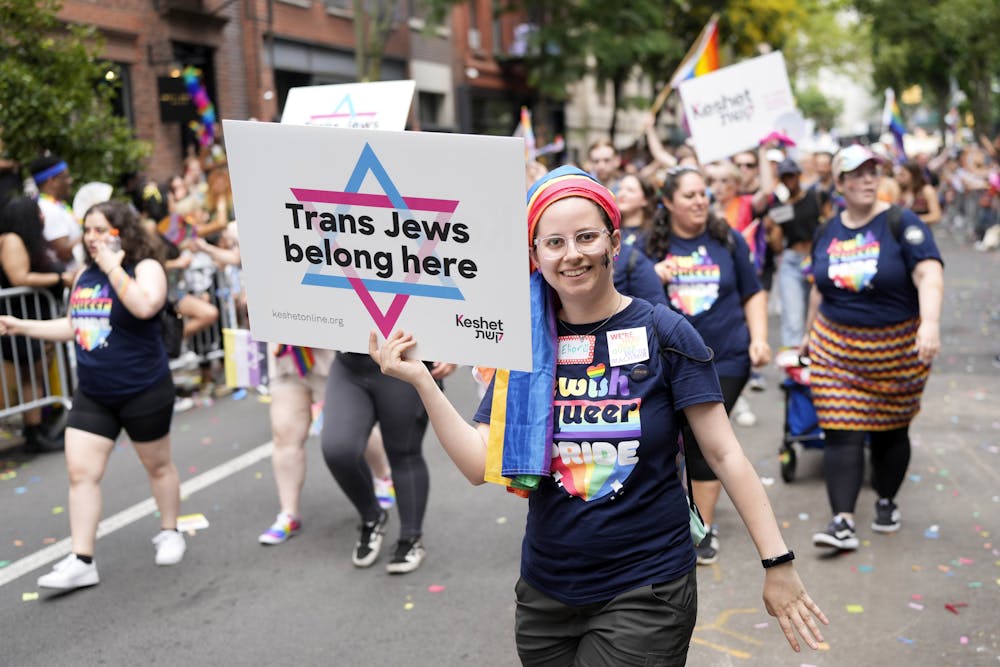
People in t-shirts that include the phrase 'queer pride' walk in a parade, with one holding a sign that says 'Trans Jews belong here.'
Participants from Jewish Queer Youth walk in the New York City Pride March on June 25, 2023. Charles Sykes/Invision/AP

Many of these Jews recognize that the diversity of sex and gender in these ancient texts is different from gender identity today, but they believe the past can still serve as an important tool in the present.

Rabbinic texts illustrate that there is no magical time in the past when every person fit easily and naturally into gender categories.The Conversation

Sarah Imhoff, Professor of Religious Studies, Indiana University

This article is republished from The Conversation under a Creative Commons license. Read the original article.
Wednesday, November 4, 2015

Guest Blog: More on Transgender Genetics

Welcome back! This week let’s look at a different paper that examined potential genetic causes for transgender.
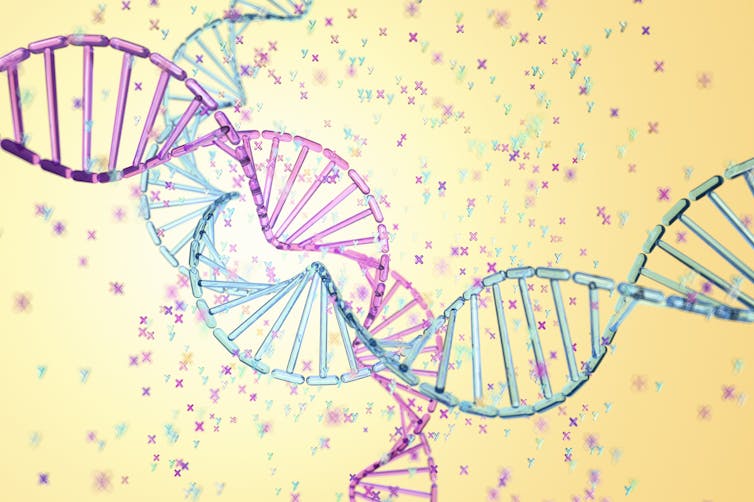
In the last post, we looked at a SNP (“single nucleotide polymorphism” — a very, very tiny mutation at just one “letter” of novel of DNA) as a potential cause. This week’s paper looked at a different type of change: trinucleotide repeats.
There are some sections of human DNA that have funny little repeats of three “letters”. If you remember, DNA has four letters: A, T, G, and C. Some parts of our DNA have long strings that looks like this: CAGCAGCAGCAGACAG. It’s called a trinucleotide repeat. Everybody has sections like this, and it’s not clear why they exist. The sections vary a lot from person to person, and change from generation to generation. Within the same person the repeat doesn’t change. Sometimes these repeats, when a person has a lot of them, can cause disease. Trinucleotide repeat expansions are the cause of both Huntington’s disease and Fragile X syndrome. Most of the time, though, trinucleotide repeats aren’t a problem.
Repeats of other lengths are also found in humans — it can be as small as two letters (e.g., “AGCACACACACACACACACACATG”)
So — what about this study?
This study looked at nucleotide repeat sequences in three specific areas in trans women and cis men: CYP17, AR, and ERBeta. Yes, CYP17 is back! You may recall that’s involved in the creation of sex hormones. AR stands for androgen receptor — it codes for the receptors that testosterone binds to to cause its effects. And ER Beta is one of the estrogen receptor subtypes. Like AR, it is a receptor that estrogen binds to to cause its effect. In essence, this paper asked: “Do the number of nucleotide repeats in genes associated with sex hormones differ between transgender women and cisgender men?”
The results?
Some of them. There were no differences in ERBeta (the estrogen receptor) or CYP17. But the AR (androgen receptor) gene in trans women had longer nucleotide repeats than the cis men did. Since AR codes the androgen receptor, it is an even more important controller of masculinization of a fetus than testosterone itself is. As the researchers state, the difference in nucleotide repeats “might result in incomplete masculinization of the brain in male-to-female transsexuals, resulting in a more feminized brain and a female gender identity.”
It’s an interesting thought and definitely in line with the brain research that’s been published. As always, we need more studies and more data to say that the cause is definitely the androgen receptor gene.
Want to read the study for yourself? The abstract is publicly available!

Friday, October 30, 2015

GUEST BLOG: Transgender Genetics

From Open Minded Health, early research on the genetic differences between cis and trans men and women. We don't know what these findings mean...yet.


The science of transgender is still in its infancy, but evidence so far points to it being biological. Differences in brain have been seen, and I’ve covered them before here on OMH. However, genetic evidence is also being published!
This week, let’s take a look at CYP17. CYP17 is a gene that makes enzymes that are part of sex hormone synthesis. Mutations in CYP17 have been noted in some intersex conditions, such as adrenal hyperplasia.
Now, there’s a SNP that’s been noticed in CYP17. SNPs are “single nucleotide polymorphisms”, which takes some explaining. SNPs are very, very tiny mutations in genes — just one letter in the DNA alphabet changes! SNPs don’t usually change the protein that the gene makes very much.
So we have this gene — CYP17, that is involved in making sex hormones. And we have this tiny mutation, this SNP. Now let’s look at the science!
Specifically, let’s look at this one study that was published back in 2008. They looked at the CYP17 gene in 102 trans women, 49 trans men, 756 cis men, and 915 cis women. They compared the CYP17 of trans women to cis men, and trans men to cis women. Unlike many studies, this comparison makes sense. We’re talking about the DNA in the genes here, not something that’s changed by hormonal status.
They found multiple things:
  • There was no difference between trans women and cis men
  • Trans men were more likely to have a SNP in their CYP17 than cis women were.
  • Cis men, trans women, and trans men all had the SNP more frequently than cis women
What does that mean?
We don’t know yet. But it does appear that CYP17 is a gene that it might be worth looking deeper into to find potential causes for transgender.
Want to read the study for yourself? The abstract is publicly available.

Monday, August 31, 2015

New American Psychological Assn Guidelines On Trans and Non Gender Conforming Folks

The American Psychological Association has released a 55-page document detailing guidelines for psychologists treating transgender and gender non-conforming (TGNC) individuals. 
The purpose of the Guidelines for Psychological Practice with Transgender and Gender Nonconforming People (hereafter Guidelines) is to assist psychologists in the provision of culturally competent, developmentally appropriate, and trans‐affirmative psychological practice with TGNC people. Trans‐affirmative practice is the provision of care that is respectful, aware, and supportive of the identities and life experiences of TGNC people.
Here are the new guidelines:
  1. Psychologists understand that gender is a non‐binary construct that allows for a range of gender identities and that a person’s gender identity may not align with sex assigned at birth.
  2. Psychologists understand that gender identity and sexual orientation are distinct but interrelated constructs.
  3. Psychologists seek to understand how gender identity intersects with the other cultural identities of TGNC people.
  4. Psychologists are aware of how their attitudes about and knowledge of gender identity and gender expression may affect the quality of care they provide to TGNC people and their families.
  5. Psychologists recognize how stigma, prejudice, discrimination, and violence affect the health and well‐being of TGNC people.
  6. Psychologists strive to recognize the influence of institutional barriers on the lives of TGNC people and to assist in developing TGNC‐affirmative environments.
  7. Psychologists understand the need to promote social change that reduces the negative effects of stigma on the health and well‐being of TGNC people.
  8. Psychologists working with gender questioning and TGNC youth understand the different developmental needs of children and adolescents and that not all youth will persist in a TGNC identity into adulthood.
  9. Psychologists strive to understand both the particular challenges that TGNC elders experience and the resilience they can develop.
  10. Psychologists strive to understand how mental health concerns may or may not be related to a TGNC person’s gender identity and the psychological effects of minority stress.
  11. Psychologists recognize that TGNC people are more likely to experience positive life outcomes when they receive social support or trans‐affirmative care.
  12. Psychologists strive to understand the effects that changes in gender identity and gender expression have on the romantic and sexual relationships of TGNC people.
  13. Psychologists seek to understand how parenting and family formation among TGNC people take a variety of forms.
  14. Psychologists recognize the potential benefits of an interdisciplinary approach when providing care to TGNC people and strive to work collaboratively with other providers.
  15. Psychologists respect the welfare and rights of TGNC participants in research and strive to represent results accurately and avoid misuse or misrepresentation of findings.
  16. Psychologists seek to prepare trainees in psychology to work competently with TGNC people.
In the past, some psychologists have attempted to change gender identity (as well as sexual orientation) through so-called "conversion therapy" or other coercive means. The APA’s statement, in effect, states very strongly that attempts to change gender identity should not be attempted. In this statement, the APA underscores the need for ethical treatment of transgender people and of affirming transgender and gender non-conforming people.

Thanks to Open Minded Health for blogging on the APA document.


Saturday, June 6, 2015

GUEST POST: Body weight and transgender hormone therapy

Open Minded Health is back up and running with a timely report on a study about how the hormones used in gender transition affect body fat:

Hormone therapy for trans people has long been known to change body shape and body fat percentage. But by how much? And how much can be expected in the first year? A European study of 77 trans women and 73 trans men found out!
On average over the first year of hormones…
  • Both trans women and trans men gained weight overall. On average they gained around 4-6 pounds (2-3 kg). Both groups started with a BMI around 24 (just barely between normal weight and overweight). For trans men, this weight gain tipped them into the “overweight” category. Trans women stayed in the “normal” weight category.
  • Trans women gained body fat and lost muscle mass. Their body fat went up from 24% to 28%. They lost a kilogram (2.2 pounds) of muscle mass.
  • Trans men lost body fat and gained muscle mass. Their body fat went down from 34% to 30%. They gained 5 kilograms (11 pounds) of muscle mass.
  • There wasn’t much of a significant different in waist sizes.
It may be helpful to remember body fat percentage numbers. For cis women, 21-31% is considered a fit or normal range. For cis men, 14-25% is the fit or normal range. So the trans women in this study started out at an average body fat percentage and stayed there. The trans men in this study started off with too much body fat and stayed there.
During the first year of hormones it seems that around a 4% change in body fat can be expected. Trans men can gain quite a bit of muscle. Trans women will lose some muscle.
As a final note: this was a European study. The hormones used in Europe are different than the ones used in the United States. The results may not be applicable in the United States.
Want to read the study for yourself? The abstract is publicly available!