Showing posts with label bigotry. Show all posts

Monday, August 24, 2026

[Reprint] How rhetoric promotes anti‑transgender views


How the Trump administration’s rhetoric promotes anti‑transgender views

The U.S. Capitol is seen behind a transgender pride flag
In the past few years, the Trump administration and state legislatures have restricted trans people’s rights and protections, from access to healthcare to passports. Kayla Bartkowski/Getty Images
Julie D. Nelson, University of Tampa

Whether in an Oval Office proclamation signing about commercial fishing or during a Fox News interview while discussing Iran, President Donald Trump finds opportunities to share his views on transgender people.

During a June 2026 signing event, Trump claimed, in response to a question about proposed legislation regarding election procedures, called the SAVE America Act: “We are talking about saving America, right? No men in women’s sports.” He continued, “And we have no mutilization of your children for transgender purposes … where your child leaves your house, and they take your child from you. … In six states, they take the child and do what they want to do. What they do is, is I don’t even want to talk about it. No transgender mutilization of your children.”

Highlighting Trump’s ongoing use of the made-up word “mutilization,” criticism quickly followed his false claims about states forcibly transitioning children. Misrepresentations like these help fuel the transgender moral panic that Trump has provoked since he started instituting restrictions on trans people in his first term.

As a rhetoric scholar for nearly two decades, I have studied how emotions propel rhetoric that goes viral on public platforms like social media and how politicians use emotions for varying purposes, including to bolster anti-trans legislation.

Throughout the Trump administration’s second term, I’ve followed how its officials have invented threats and used provocative language and repulsive imagery to stimulate anti-trans disgust and paranoia in audiences, contributing to public misconceptions and declining support for trans rights and people.

Changing views of trans people and issues

The Trump administration’s anti-trans agenda has flourished since his first term.

Following Republicans’ US$21 million anti-trans and anti-LGBTQ advertising campaign that helped pave Trump’s way to victory in 2024, the administration and its allies have been busy. The White House has denied the existence of trans identity, and states have introduced a deluge of legislation that restricts trans people’s rights and protections, from access to healthcare to passports.

Presidential rhetoric can have a significant impact on public opinion. Since reaching a peak in the early 2020s, overall support for LGBTQ+ issues has since declined in the U.S. Likewise, surveys have shown a decline in support for trans healthcare for minors, a preference for using birth sex on IDs, and increasing support for restrictions in sports for trans people.

Meanwhile, public approval of Trump’s approach to trans issues is relatively high, as compared with his approval ratings on other issues.

A 2024 report by the Human Rights Campaign decried an “epidemic of violence” against trans and gender-expansive people. A 2025 Pew report found that 70% of trans adults have feared for their personal safety, and only 13% of LGBTQ respondents reported social acceptance of trans people.

Though the causes for changing trans views are complex, research suggests Trump’s rhetoric and policies have powerful influence, the ramifications of which are clear. Anti-LGBTQ+ laws and debates negatively affect young queer people, according to the Trevor Project’s 2025 U.S. National Survey on the Mental Health of LGBTQ+ Young People, and are associated with increased stress, discrimination and suicide attempts.
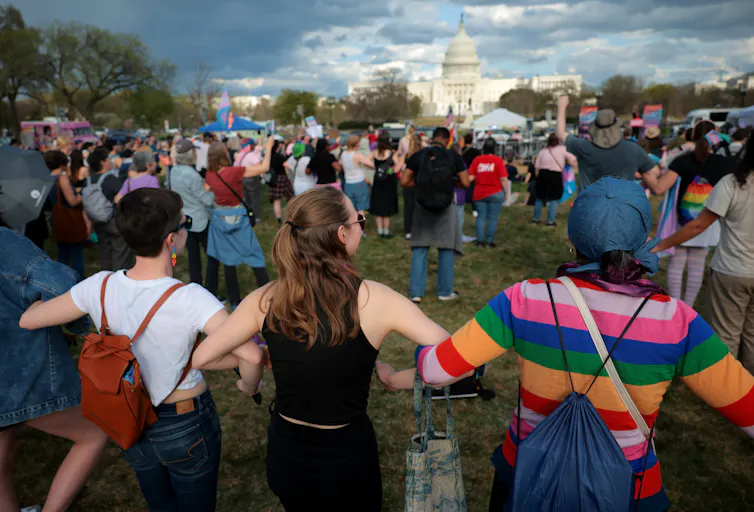
People stand with linked arms in a crowd facing the U.S. Capitol, transgender pride flags among them
Trans people and their allies have pushed back against a recent wave of restrictions. Here, supporters rally for the Transgender Day of Visibility in March 2025. Kayla Bartkowski/Getty Images

Moral panic as political strategy

From the Salem witch trials in the 17th century to the war on drugs in the 20th century, moral panics have emerged across history to stoke fear against a perceived threat to a society’s values or well-being.

Moral panics, coined by sociologist Stanley Cohen in 1972, follow a similar pattern: a threat is defined, media exaggerates the threat, public concern increases, authorities respond with laws and policies, and society is transformed.

Research on anti-trans moral panics illustrates their success in propelling anti-trans lawmaking in the U.S. and suggests they are often initiated by people with power, who use their platforms to shape public discourse.

Moral panics elicit a range of negative emotions, but disgust and paranoia are especially potent. Originally a response meant to protect us from disease and spoiled food, disgust has evolved to also express social inappropriateness. Disgust asserts that its object is inherently bad. Since disgust is culturally dependent, it can also be used to marginalize groups of people.

Meanwhile, paranoia focuses on visualizing and preparing for future threats. When experienced as an emotion – outside of psychiatric disorders – paranoia has a righteous undertone, as it seeks to uncover perceived enemies.

Disgust and paranoia are a powerful combination for sustaining moral panics. While disgust produces an intense, immediate physical feeling, paranoia is long-lasting, stewing and existential.

Stimulating disgust and paranoia

Trump’s offhand remarks often invoke disgust and paranoia against perceived enemies – for example, toward immigrants, whom he has repeatedly described as dangerous criminals. These same patterns emerge in the Trump administration’s formal communication regarding trans issues.

The March 31, 2026, White House press release “President Trump Ended Democrats’ ‘Transgender for Everybody’ Insanity,” which touts the administration’s reversal of protections for trans people, offers several examples.

The release asserts that former President Joe Biden’s 2024 Proclamation of Transgender Day of Visibility “desecrated Easter Sunday with a ‘transgender’ message that elevated radical leftist ideology over faith, family, and biological truth.” Rousing paranoia, “radical leftist ideology” (and later in the release, “gender ideology”) is portrayed as an existential threat that puts Americans and their beliefs in danger.

The release also claimed that “the Trump Administration is celebrating a decisive victory: the swift and unrelenting dismantling of subversive, woke policies that endangered children, eroded women’s rights, assaulted common sense, and dragged America toward moral and cultural decline.”

As a rhetoric scholar, I read these allusions to religion and war – using words like “desecrate” and “victory,” respectively – as implications that the U.S. is in a battle between good and evil. Schools, hospitals, bathrooms, locker rooms, sports facilities and military bases are spaces declared under attack.

The release also condemns “the chemical and surgical mutilation of minors” and “child mutilation programs” – revolting imagery that misleadingly depicts gender-affirming care and incites shock, concern and disgust.

Similarly, invoking images of nonconsenting, victimized children and women, the release denounces “the un-American indoctrination of schoolchildren” and “the unfair, demeaning practice of forcing women to compete against biological men in sports.” Stimulating anger and moral panic, these descriptions encourage anti-trans views and discrimination.

Recognizing these rhetorical patterns is key to understanding how politicians use inflammatory language to denigrate trans people and other marginalized groups, including women, Black people and immigrants.The Conversation

Julie D. Nelson, Associate Professor of English and Writing, University of Tampa

This article is republished from The Conversation under a Creative Commons license. Read the original article.

Monday, February 10, 2025

In Troubled Times: This, Too, Shall Pass

I first posted this in April 2023. It's a good reminder.

I started a blog series, “In Troubled Times” after the 2016 presidential election. Folks I trusted said that things were going to get a lot worse before they got better. That’s true now, too. You can read the first installment, "Becoming Allies," here.


I came of age in the 1960s, demonstrating for civil rights and marching against the Viet Nam War. I never burned my bra, but I volunteered for Planned Parenthood in the years before Roe v Wade. I am not bragging about my activist bona fides. I was one of many, and rarely in the forefront. However, I remember all too well the feelings of both elation and futility. The energy and inspiration of being surrounded by thousands of like minds, filling the streets of San Francisco, chanting and singing. We thought that if we could sing loudly enough and joyfully enough, we could change the minds and hearts of the nation’s leaders. And then came a day when many of us realized they were not about to listen to us. The war raged on, now captured on television in our living rooms.

That feeling of powerlessness was one of the driving forces behind my debut science fiction novel, Jaydium, by the way. My heroine is initially trapped on a dusty, barely-habitable planet at the back end of nowhere, and through a series of shifts through time and parallel dimensions, she ends up on an alien planet where she has the chance to change history by stopping a war. It’s about both re-engagement and the quest for peace (and I was tickled when Tom Easton of Analog praised the latter as unusual and laudable.) Writing it reflected my personal journey from withdrawal to participation.

I vividly remember how, in the late 1960s, my father, who was born in 1907 and lived through two world wars, pogroms, the McCarthy witch hunts, and more, would talk me down from desperation. When I was in a panic about the Cold War maneuver of the moment, he never dismissed my concerns; he was just coming from a broader perspective. And he was right. We got through those years without blowing the planet up.

Now I find myself in the position of being an elder—a crone, if you will. My earliest political memories date from the mid-1950s, including the terror of HUAC, the pervasive suspicions, racism, misogyny, and antisemitism that no one questioned. When I was a bit older, the anti-communist hysteria had faded somewhat (depending on where you lived), but not the rest. And always, in the years before oral contraception, sex meant fear of pregnancy. I knew girls in high school who got sent out of the country and returned the following year or so without their babies. Later, in the late 1960s/early 1970s but still before Roe v Wade, I volunteered at Planned Parenthood. And heard many stories. Looking back, I cannot believe how ignorant I was about so many other issues.

I do not mean to brag about my life experiences or to enter into a contest of which times were worse. Each generation faces its own trials, and each generation is convinced that theirs are world-ending, worst-ever scenarios. This is one of many reasons why we need generational memory (not to mention history books!)

Wednesday, May 17, 2023

In Troubled Times: Bystander Intervention Training

In January 2018, I attended a seminar entitled Stand! Speak! Act! A Community Bystander Intervention Training. The subheading suggested I would learn how to nonviolently support someone who was being harassed. The event was presented by the local chapter of CAIR (Council on American-Islamic Relations), the Muslim Solidarity Group, and the local rapid response team. The idea of becoming a nonviolent ally in directly ameliorating the harm from harassment greatly appealed to me. I found the seminar enlightening, although not always in ways I expected.

To begin with, although two of the event’s three sponsors were specifically Muslim solidarity groups, the techniques and strategies apply whenever a person is being targeted. Although hate crimes against Muslims have increased drastically (first after 9/11 and then ongoing since Trump's election), racism (anti-black, anti-Hispanic, anti-Asian) still accounts for the majority of incidents, and anti-LGBTQ violence continues. Most of my friends and relatives who have been harassed have been targeted because of race, sexual orientation, or gender identification, but by far the greatest number have been because of race. The principles of intervention remain the same, and if in the future some other group becomes a target for extremism and violence, allies will step forward.

The workshop drew its guidance and inspiration from the principles set out by Dr. Martin Luther King, Jr.:
  • Nonviolence is a way of life for courageous people
  • Nonviolence seeks to win friendship and understanding
  • Nonviolence seeks to defeat injustice, not people
  • Nonviolence holds that suffering can educate and transform
  • Nonviolence chooses love instead of hate
  • Nonviolence believes that the universe is on the side of justice.

It’s tempting to lash out when you or someone you observe is a target of violence, whether physical or verbal. We’ve all seen enough superhero movies to want to jump in, swirling our capes, and single-handedly take on the offender. Outrage at what we perceive to be hateful and wrong fuels our adrenaline. It’s hard to remain calm, to think clearly, and to act from principle instead of reactive emotion. That’s why practice is so important. Harassment can escalate very quickly, and unless we have some experience in how we are vulnerable to engagement, we can become swept up in the confrontation.

Bystander intervention isn’t about confronting the person spewing hatred, it’s about supporting the person being targeted.

Monday, August 15, 2016

Book Review: Small Great Things by Jodi Picoult

From the very first page of Small Great Things by Jodi Picoult (Random House, October 2016), I knew that I was in the hands of a master storyteller, one who would effortlessly guide me into the lives of her characters, with all their unexpected twists and turns, without a single jolt or bump in the road that was not intentional and expertly handled. Very early in the book, I kept thinking what it must have been like to read To Kill a Mockingbird by Harper Lee for the very first time, without knowing how it was going to turn out. I am a little leery of applying superlatives to a work which has not yet withstood the test of time, but I would be surprised if Small Great Things does not have the same impact and enduring popularity. Picoult has taken one of the defining issues of our age and woven it into a story with universal appeal.

The book begins simply with a day in the life of woman who has attained a high degree of skill and no small amount of professional recognition. Ruth is a labor and delivery nurse with over twenty years of experience, who enjoys the respect of her colleagues and the gratitude and trust of her patients. She is rightly proud of her educational achievements, being the daughter of a housekeeper who has spent her entire life in sacrifice and hard work so that her children might know a better life. All goes smoothly, with mothers giving birth and babies being evaluated, until Ruth and the reader are taken by surprise when two young parents of a newborn react to her performance of her duties with antagonism. Soon Ruth is forbidden to care for the baby and finds herself in the untenable position of obeying those instructions from her supervisor or standing by when the baby stops breathing. Ruth’s dilemma soon becomes a moot point when, despite her heroic intervention and that of the hospital pediatrician and her fellow nurses, the baby dies.

Now comes the conflict that will furnish the emotional and political driving force of this book: Ruth is black and the parents of the unfortunate baby are not only white, they are racist skinheads of the most violent sort. Unable to cope with the loss of their baby, they bring charges that quickly result in Ruth being charged with murder.

The second viewpoint character is the husband of this couple, and I cannot begin to tell you how much I did not want to be inside his head. From beginning to end, I found his behavior inexcusable and reprehensible, but I must acknowledge that such people exist. It seems that every few days I read a story in the news of some outrage perpetrated by people like him. They may not call themselves white supremacists or skinheads, but they promulgate the same vile philosophy. As I was reading this book, I saw a clip on social media of a young white woman screaming racist epithets at a black person. In Picoult’s book such people have not disappeared simply because they are not in the news. They have changed tactics, using the internet and coded language to disguise their agenda. Their hatred extends also to guys, immigrants, Jews, and many others, but in this story it is directed with full force against black people.

With sensitivity, insight, and consummate skill, Picoult examines the question of whether a white person — in this case Kennedy, the public defender who represents Ruth — can ever understand what it is like to be black in America. The author herself acknowledges the limitations of any story that is told by an outsider. Perhaps the most moving parts of the book center around the struggles of Ruth and Kennedy — to understand and to be understood. Kennedy’s initial priority, based on her legal expertise, is Ruth’s acquittal, and her strategy calls for ignoring the racial aspects of the charges to focus purely on the medical and legal. But is it possible to ignore the elephant in the middle of the living room — the reality that race can and does color every aspect our society? Given that truth, what must we — black and white and every color in between — do to overcome it?