This is an excerpt from the above-titled article in Live Science. I highly recommend clicking through to read the whole thing!
Females have one active X chromosome and one dormant X chromosome in each cell. But a study suggests that genes on the dormant X get "reawakened" later in life, potentially giving the brain a boost.
Dormant genes on the X chromosome may reawaken in old age, potentially giving the aging female brain a boost that the male brain doesn't receive. This phenomenon may help to explain why, on many measures, females show a higher level of cognitive resilience in old age than males do.
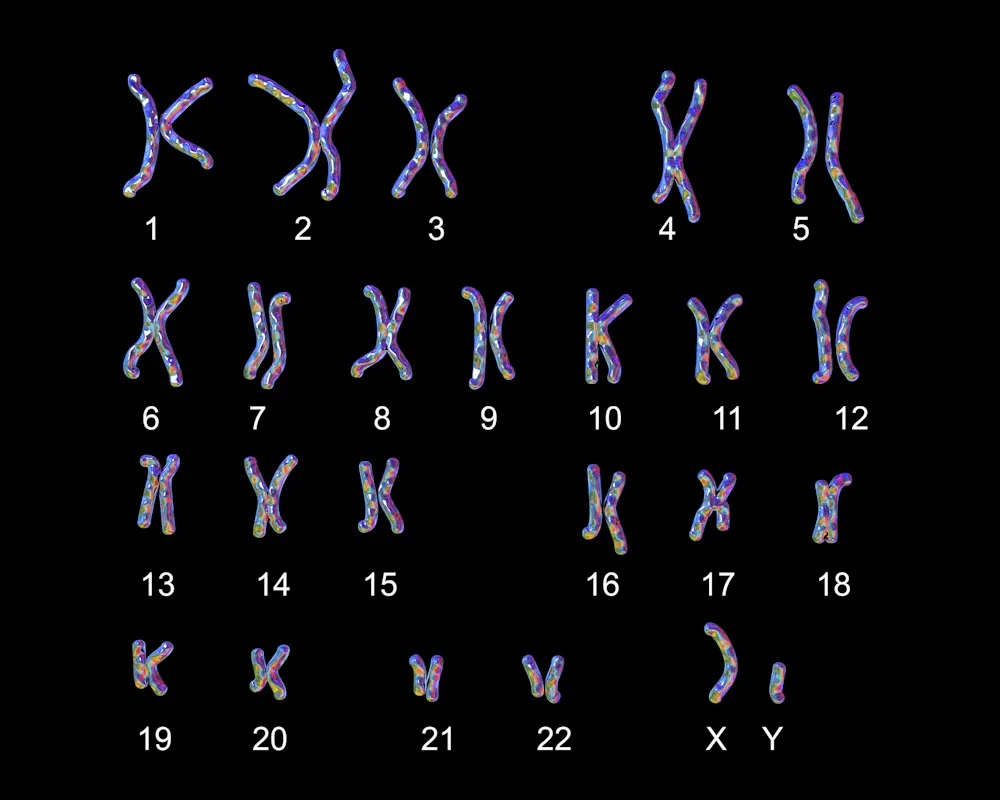
Males typically carry one X and one Y in each cell; they inherit the X from their mother and the Y from their father. Females, on the other hand, usually carry two X chromosomes — one from mom and one from dad. But each cell needs only one X to be active, so in females, the second X is "silenced," leaving only the maternal or paternal X switched on.
Among the 22 reawakened genes, one called PLP1 carries the instructions to make a key component of myelin, the fatty insulation that helps neurons send signals efficiently. It's known that mutations in PLP1 can decrease the amount of myelin in the brain, resulting in intellectual disability. It's also known that myelin can be compromised in aging and that loss of myelin function can contribute to cognitive decline.
To see if the reawakening of PLP1 might boost cognition, scientists confirmed that older female mice had more PLP1 activity in their hippocampi than the older male mice did. They artificially increased PLP1 using gene editing in both old males and old femalesfound that both sexes performed better on tests of learning and memory after that boost.
To see if any of the findings extended to humans, the team looked at data previously collected for a large study of human brain tissue. Data weren't available for the hippocampus, but the brain tissue immediately surrounding the hippocampus showed more PLP1 activation in older women than in older men. So that hints that the same phenomenon might be unfolding in people.
Gender reveal parties are best known as celebrations involving pink and blue, cake and confetti, and the occasional wildfire. Along with being social media hits, gender reveals are a testament to how society is squeezing children into one of two predetermined gender boxes before they are even born.
These parties are often based on the 18- to 20-week ultrasound, otherwise known as the anatomy scan. This is the point during fetal development when the genitals are typically observed and the word “boy” or “girl” can be secretly written on a piece of paper and placed into an envelope for the planned reveal.
Now there is a new player in the gender reveal game: genetic screening.
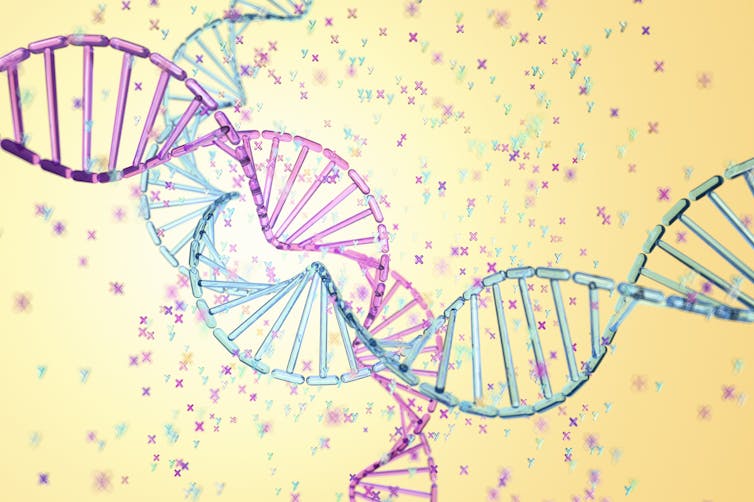
Advancements in genetic research have led to the development of a simple blood test called cell-free DNA prenatal screening that screens for whether a baby has extra or missing pieces of genetic information – chromosomes – as early as 10 weeks into pregnancy. Included in this test are the sex chromosomes, otherwise known as X and Y, that play a role in the development and function of the body.
This blood test is more informally called noninvasive prenatal testing, or NIPT. Many people refer to it as “the gender test.” But this blood test cannot determine gender.
As genetic counselors and clinical researchers working to improve genetic services for gender-diverse and intersex people, we emphasize the significance of using precise and accurate language when discussing genetic testing. This is critical for providing affirming counseling to any patient seeking pregnancy-related genetic testing and resisting the erasure of transgender and intersex people in health care.
Distinguishing sex and sex chromosomes
Sex and gender are often used interchangeably, but they represent entirely different concepts.
Typically when people think of sex, they think of the categories female or male. Most commonly, sex is assigned by health care providers at birth based on the genitals they observe on the newborn. Sex may also be assigned based on the X and Y chromosomes found on a genetic test. Commonly, people with XX chromosomes are assigned female at birth, and people with XY chromosomes are assigned male. Since cell-free DNA, or cfDNA, prenatal screening can report on sex chromosomes months before birth, babies are receiving sex assignments much sooner than previously possible.
While cfDNA prenatal screening can offer insights into what sex chromosomes an infant may have, sex determination is much more complicated than just X’s and Y’s.
For one, sex chromosomes don’t exactly determine someone’s sex. Other chromosomes, hormone receptors, neural pathways, reproductive organs and environmental factors contribute to sex determination as well, not unlike an orchestra with its ensemble of instruments. Each cello, flute, tympani and violin plays a crucial role in the performance of the final musical score. There is no single instrument that defines the entirety of the symphony.
Expanding social and medical concepts of sex and gender beyond the binary can help patients and doctors.
Intersex people, or those with variations in sex characteristics that deviate from societal norms of binary sex, exemplify the complexities of sex. These variations can manifest in various ways beyond X and Y chromosomes, such as differences in hormone levels, genitalia or secondary sexual characteristics.
The oversimplification of sex based on societal norms has led many to believe that there are only two discrete sexes. The binary framework of sex excludes intersex people and perpetuates their erasure and mistreatment within both health care and society at large.
While sex typically describes someone’s anatomical characteristics, gender is an umbrella term that encompasses the way someone views and presents themselves to the world. Countless aspects influence how someone defines their own gender and how the world views their gender, including clothing, haircuts and voice tone. Similar to how Western cultures have historically confined sex to two buckets, it has also created two gender categories: man and woman.
Gender is not dependent on anatomical parts or chromosomes. People are not math equations, and having certain combinations of biological parts does not equal someone’s gender. For example, some people may be transgender, meaning their assigned sex is not congruent with their socially or self-defined gender. Nonbinary people do not identify exclusively with either of the two genders in the binary, regardless of their assigned sex.
Just like sex diversity, gender diversity is not rare. A 2022 Pew Research Center analysis found that approximately 5% of adults in the U.S. under the age of 30 are transgender or nonbinary.
Intersex and gender-diverse people show that sex and gender are both multidimensional. Gender is not solely determined by biology, and it is erroneous to define someone’s gender by their sex, much less by their sex chromosomes.
For instance, societal norms dictate that women should be nurturing and gentle, while men are expected to be protective and assertive. Such rigid gender roles, often enforced through the lens of biology, serve to uphold notions of evolutionary destiny and a purported natural order.
Marketing strategies for children’s toys often adhere strictly to gender roles, steering girls toward dolls and domestic play sets while steering boys toward action figures and construction sets.
Educational systems often reinforce gender norms by directing girls toward subjects such as literature and arts while steering boys toward science and mathematics. This perpetuates the notion that certain traits and interests are inherently linked to one’s sex and gender, thereby reinforcing societal norms and sustaining inequality.
Upholding binary constructs of sex and gender does not allow for individuality and gender fluidity. Categorizing people from the time their chromosomes are analyzed or the moment their genitals are observed at birth restricts their autonomy and authenticity. These simple assumptions set expectations that can be harmful.
Letting children define themselves
If you’re a parent offered cfDNA prenatal screening during pregnancy, remember that it is commenting only on one instrument in the orchestra of sex. It cannot examine all of the other factors that determine sex as a whole. And it most certainly cannot determine gender, which is an entirely different concert.
In recent years, Jenna Karvunidis, the mother considered the inventor of gender reveal parties, shared her regrets for starting the trend and noted that her views on sex and gender have shifted. In a 2019 Facebook post, Karvunidis wrote, “PLOT TWIST. The world’s first gender reveal party baby is a girl who wears suits!” She had also gone on to say, “Celebrate the baby … Let’s just have a cake.”
When the envelope is opened, the balloons are popped and the crafty cake is cut, consider how these practices perpetuate social confinements and a gendered destiny for your little bundle of joy. Perhaps opt simply for a celebration that leaves space for your child to one day define who they are.
The majority of these zombie genes were not random in terms of function. Each of them play an important role when an animal experiences some kind of trauma or illness. For example, some genes that were ramped up are responsible for stimulating inflammation and the immune system as well as for countering stress. Some genetic activity, like a gene that’s responsible for embryonic development, baffled the scientists. Noble suspects that this gene becomes active because the cellular environment in dead bodies must somehow resemble those found in embryos.
Importantly, several genes that promote cancer also became active. This may explain why many organ donor recipients develop cancer. This tidbit of information could help scientists develop better methods of organ preservation prior to transplantation.
“Most ancient combs are double-sided and have more teeth on one side than the other,” wrote Mumcuoglu and Zias. “The user would straighten his or her hair with the side that had the fewer teeth and then whisk away lice and louse eggs with the finer and more numerous teeth on the other side of the comb.”
Eating inconsistently may affect our internal body clock or 'circadian rhythms' which typically follow a 24-hour cycle. Many nutritionally related metabolic processes in the body follow a circadian pattern such as appetite, digestion and the metabolism of fat, cholesterol and glucose. Food intake can influence our internal clocks, particularly in organs such as the liver and intestine, whilst our central clock is also regulated by the dark/light cycle which in turn can affect food intake. Chrono-nutrition involves studying the impact of nutrition on metabolic processes and how these may be influenced by and also alter circadian patterns through nutrient intake (ir)regularity, frequency and clock time.
Scientists believe the chameleon-like creature was an infant when it was trapped in a gush of sticky resin while darting through a tropical forest in what is now Myanmar. The creature’s entire body, including its eyes and colorful scales, was unusually well-preserved, Stanley said. The other reptiles trapped in the amber, including a gecko and an arctic lizard, were also largely intact.
And finally, splendor from the heavens: three bright nebulae in the constellation Sagittarius.
In the last post, we looked at a SNP (“single nucleotide polymorphism” — a very, very tiny mutation at just one “letter” of novel of DNA) as a potential cause. This week’s paper looked at a different type of change: trinucleotide repeats.
There are some sections of human DNA that have funny little repeats of three “letters”. If you remember, DNA has four letters: A, T, G, and C. Some parts of our DNA have long strings that looks like this: CAGCAGCAGCAGACAG. It’s called a trinucleotide repeat. Everybody has sections like this, and it’s not clear why they exist. The sections vary a lot from person to person, and change from generation to generation. Within the same person the repeat doesn’t change. Sometimes these repeats, when a person has a lot of them, can cause disease. Trinucleotide repeat expansions are the cause of both Huntington’s disease and Fragile X syndrome. Most of the time, though, trinucleotide repeats aren’t a problem.
Repeats of other lengths are also found in humans — it can be as small as two letters (e.g., “AGCACACACACACACACACACATG”)
So — what about this study?
This study looked at nucleotide repeat sequences in three specific areas in trans women and cis men: CYP17, AR, and ERBeta. Yes, CYP17 is back! You may recall that’s involved in the creation of sex hormones. AR stands for androgen receptor — it codes for the receptors that testosterone binds to to cause its effects. And ER Beta is one of the estrogen receptor subtypes. Like AR, it is a receptor that estrogen binds to to cause its effect. In essence, this paper asked: “Do the number of nucleotide repeats in genes associated with sex hormones differ between transgender women and cisgender men?”
The results?
Some of them. There were no differences in ERBeta (the estrogen receptor) or CYP17. But the AR (androgen receptor) gene in trans women had longer nucleotide repeats than the cis men did. Since AR codes the androgen receptor, it is an even more important controller of masculinization of a fetus than testosterone itself is. As the researchers state, the difference in nucleotide repeats “might result in incomplete masculinization of the brain in male-to-female transsexuals, resulting in a more feminized brain and a female gender identity.”
It’s an interesting thought and definitely in line with the brain research that’s been published. As always, we need more studies and more data to say that the cause is definitely the androgen receptor gene.
From Open Minded Health, early research on the genetic differences between cis and trans men and women. We don't know what these findings mean...yet.
The science of transgender is still in its infancy, but evidence so far points to it being biological. Differences in brain have been seen, and I’ve covered them before here on OMH. However, genetic evidence is also being published!
This week, let’s take a look at CYP17. CYP17 is a gene that makes enzymes that are part of sex hormone synthesis. Mutations in CYP17 have been noted in some intersex conditions, such as adrenal hyperplasia.
Now, there’s a SNP that’s been noticed in CYP17. SNPs are “single nucleotide polymorphisms”, which takes some explaining. SNPs are very, very tiny mutations in genes — just one letter in the DNA alphabet changes! SNPs don’t usually change the protein that the gene makes very much.
So we have this gene — CYP17, that is involved in making sex hormones. And we have this tiny mutation, this SNP. Now let’s look at the science!
Specifically, let’s look at this one study that was published back in 2008. They looked at the CYP17 gene in 102 trans women, 49 trans men, 756 cis men, and 915 cis women. They compared the CYP17 of trans women to cis men, and trans men to cis women. Unlike many studies, this comparison makes sense. We’re talking about the DNA in the genes here, not something that’s changed by hormonal status.
They found multiple things:
There was no difference between trans women and cis men
Trans men were more likely to have a SNP in their CYP17 than cis women were.
Cis men, trans women, and trans men all had the SNP more frequently than cis women
What does that mean?
We don’t know yet. But it does appear that CYP17 is a gene that it might be worth looking deeper into to find potential causes for transgender.