
Then another mass shooting happened here. Another one. Children and teachers.
The Russians have slaughtered hundreds of Ukrainian children.
We slaughter our own.
Then another mass shooting happened here. Another one. Children and teachers.
The Russians have slaughtered hundreds of Ukrainian children.
We slaughter our own.

It’s difficult to
find words to describe a Daniel Pinkwater book because they are a unique breed
that defies the usual literary terminology: they’re enchanting (often
literally), playful, spontaneous (as in combustion, upon occasion), and
hilarious-yet-insightful. In other words, a Daniel Pinkwater book provides the
occasion for parents wrestling the copy from their kids, and vice versa, so why
not avoid bloodshed, or paper-shred, and read them aloud together?
Mick’s ordinary life
comes to a screeching 180 degree turn when his older brother returns home from Tibet
with Guru Lumpo Smythe-Finkel and his dog, Lhasa, and Mick finds himself—how,
he’s never entirely clear—the guru’s new disciple. Guru, disciple, and magical
dog set off on a quest that’s as notable for its vagueness as its
unpredictability. They acquire fellow travelers, graffiti-fanatic Verne and Molly,
a Dwergish girl (sort of like leprechaun trolls with hidden goals, magical
powers, a gift for making friends, and a charmingly madcap sense of humor).
Soon they’re cavorting with a ghost whale who is the essence of love, as well
as other wacky and memorable characters.
Pinkwater’s in on a
great secret: if you want to communicate wisdom to young readers, first make them
smile. Or giggle. Or run wild in Poughkeepsie, as the case may be.
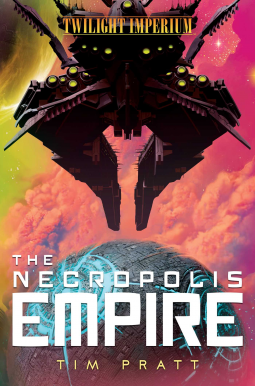
Tim Pratt writes a lot of very cool science fiction. From
his “Axiom” series (my gateway into his work) to The Doors of Sleep
(which I really, really hope will become an entire series, now that there’s a
sequel) to his “Twilight Imperium” novels. When I reviewed the first of these, The
Fractured Void, I had no idea that Twilight Imperium is a war-without-end
strategic game. I wrote, “Game tie-in novels are common these days, but not
those that are so well crafted as to stand on their own merits. I picked it up
because I loved Tim Pratt’s other science fiction novels (and after reading it
I still have no idea what Twilight Imperium is, nor do I particularly care as
long as Pratt turns out books as good as this one).” That’s even more true for The
Necropolis Empire. If you, like me, are so much Not a Gamer that you’re
into negative gamer-ness, just ignore that part and enjoy the book as a great
science fiction tale.
Standing on its own, The Necropolis Empire falls into
one of my favorite science fiction subgenres: spooky alien ruins. In this case,
very, very old alien ruins from a race we’re really glad has gone extinct. Now
if folks would just stop trying to resurrect their tech…
Our young heroine, Bianca, lives on one such world, a
pastoral culture built on top of the aforementioned, deeply buried alien tech.
Scavenged bits are useful, but mostly the farmers go about their lives…until a
ship from the imperialist Barony of Letnev arrives, annexes the planet, and
carries Bianca away with a rather incredulous story about her being a space
princess. Bianca falls for it, though. Not only is she adopted, but rather than
settle down with a nice neighbor boy, she has always yearned for something
beyond her own world. That something becomes clearer when she begins changing,
developing superhuman speed, strength, senses, healing, and more. The ruthless
Letnev believe she is the key to finding and controlling the ancient military
relics, which they mean to use to dominate all known space. Bianca has other
ideas.
I absolutely love how vulnerable and how competent Bianca
is. Her confidence in herself and her abilities stems from more than her new,
superhuman powers. As a child, she was wanted and cherished, never coddled but given
responsibilities. She grew up with permission to tackle all manner of
challenges, and she’s a genuinely nice person. The Letnev, not so much. They’ve
perfected arrogance to an art form.
I would be perfectly happy to see an entire series of “The Adventures of Bianca,” although I sadly fear the good folks who’ve created Twilight Imperium are more interested in promoting their game and not so much in a fascinating character who stands on her own.

How To Become a Planet features a youngster, creatively named Pluto, who struggles with depression. I reviewed it here.
How to Become a Planet focuses on Pluto as a sympathetic character, a person who is both resourceful and overwhelmed, insightful and confused by changes in herself. Her use of astronomy metaphors is particularly vivid and powerful. Above all, Pluto is a person whose brain chemistry isn’t working quite right, not a diagnosis, and this excellent novel showcases her journey toward a new balance in her life.
Here's what the author said about this character in a recent interview:
Q: How did you balance depicting the reality of living with mental illness with the important message of hope?A: Getting a diagnosis isn’t the end for Pluto—it’s a new beginning. I wanted to show that despite it feeling so hard, there is always hope. In the end, Pluto still has depression, she still has her struggles, but she has her support system and the understanding of her needs, and she’ll be okay.
I think this is spot on for adults as well as kids. Turning your life around takes not only appropriate treatment (including, in Pluto's case, medication as well as psychotherapy) but time and patience. Backsliding and reversals are par for the course, no matter how skillful the professional help and supportive the loving families are. There's no magic wand to make psychiatric problems disappear, although popular media often portray it so. One insightful conversation and poof! you're cured. This is one of many reasons why books like Melleby's are so important. There is hope, she says, so hang in there.
In Melleby's new novel, The Science of Being Angry, young Joey can't understand why she explodes into destructive fury. Like Pluto, she has a family that loves her and struggles to understand her, yet it isn't enough.
In my review of this book, I wrote:
What I most loved about this book was the respect with which Joey and her problems were portrayed. Joey is in many ways still a child, and for all her competence in many areas, she has a child’s limited resources for dealing with psychological issues that confound many adults. Her sense of responsibility often leads her to shoulder disproportionate blame, to withdraw rather than harm someone she loves, and to keep her pain to herself. She confronts an issue all of us face, regardless of how old we are: when do we ask for help, and when do we rely upon our own resources? In the end, Joey realizes that she cannot master her temper by herself, and—more importantly—that there is kindness, understanding, and help available to her.
Melleby doesn't condescend or simply. Her characters grapple with complex, often ambivalent emotions. Yet her faith in the resourcefulness of troubled young people, when given appropriate care, shines through. She reminds us,
There’s no one answer, there’s no one story for someone struggling with mental illness.
If this means there are many more Melleby MG novels to come, that's an excellent thing!
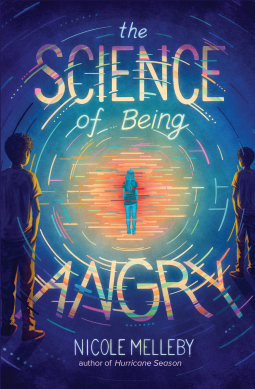
Eleven-year-old Joey lives in an unusual blended family. For
one thing, she and her two twin brothers have two moms, one of whom was married
before and has a son from that marriage. She and her brothers were the result
of IVF, and the boys are identical, having split from the same egg. For all the
nontraditional nature of this family, there’s a lot of love and acceptance. But
all is not well with Joey. She’s been having increasingly volatile episodes of
anger and acting-out. Her temper has become legendary at school, where she’s been
given the nickname, “Bruiser,” after she threw a soccer ball at a boy in gym
class so hard she bruised his collarbone. She’s roughly pushed away her best
friend, on whom she also has a crush. Now she’s left with the fallout wreckage
of what she’s done.
Despite the efforts of her moms to help her, Joey’s
outbursts are only getting worse. Finally, she melts down into a tantrum so
destructive, her family is evicted from their apartment and must move into a
motel, where close quarters fuel everyone’s irritation. Her moms start
bickering, and Joey thinks that’s her fault. Her older brother, who is trying
to focus on his academics, goes to live with his father, and of course, Joey
blames herself for that, too.
Joey can’t understand why she flies into a rage or how to
control it. All her best intentions are in vain. Then she gets the idea that
perhaps her temper is a genetic trait inherited from her biological father. If
she can just track him down, she thinks, she might better understand her own
volatility—and he might have found successful strategies for managing his
anger. With the help of her alienated best friend/crush, she embarks on a
genetics project for science class. And, of course, nothing goes the way Joey
expects.
In many ways, Joey is a typical adolescent, struggling with
the tensions between immaturity and independence. In others, though, she is
very much her own person with a unique family. I loved the way the unusual
marriage and relationships are presented in a matter-of-fact way. Joey’s anger is
clearly not caused by her having two lesbian mothers. Indeed, the clear love
and understanding between her mothers, the way each of them has found her way
to an authentic life, are one of Joey’s principal strengths. I also noted very
little along the lines of, “girls don’t have anger management issues,” when in
fact psychological research shows that girls experience anger as frequently as
boys do (but are socialized to suppress it).
What I most loved about this book was the respect with which
Joey and her problems were portrayed. Joey is in many ways still a child, and
for all her competence in many areas, she has a child’s limited resources for
dealing with psychological issues that confound many adults. Her sense of
responsibility often leads her to shoulder disproportionate blame, to withdraw
rather than harm someone she loves, and to keep her pain to herself. She
confronts an issue all of us face, regardless of how old we are: when do we ask
for help, and when do we rely upon our own resources? In the end, Joey realizes
that she cannot master her temper by herself, and—more importantly—that there
is kindness, understanding, and help available to her.
Highly recommended for adults as well as their adolescent
children.
