Showing posts with label LGBTQ fiction. Show all posts

Friday, September 23, 2022

Short Book Reviews: Tending a Sleeping Star


The Unbalancing
, by R.B. Lemberg (Tachyon)

R. B. Lemberg’s The Unbalancing is an exquisite marriage of imaginative world-building, insightful relationships, and compelling story. Here stars are sentient, ghosts speak to their descendants, both sexuality and gender are accepted as fluid, and people work magic through their “deepnames.” It’s also a sweet love story between a reclusive poet and the brash new starkeeper who’s tasked with the care of a restless, unhappy, submerged star.

The story is rich in unexpected yet consistent details. Through the dual viewpoints, Lemberg guides the reader through the complexities of a world that is just like enough to our own to feel familiar and yet challenging at every turn. Its differences invite us to re-examine our assumptions about people, their nature, and their relationships. What would it be like if every person figured out for themselves if they belonged to a single gender, and if so which one, a combination, or an entirely new one? How does this affect political power? How is physical intimacy negotiated? Lemberg’s characters exemplify  consent (“Is this good?” “Do you want me to go on?” “What would you like?”) as a normal, natural part of courtship, one the modern human world could emulate.

As with Lemberg’s previous novella, The Four Profound Weaves, The Unbalancing is a tale of emotional power and superbly handled prose that often approaches poetry in its nuance and poise. Highly recommended, with the suggestion that it be read slowly and savored.


Friday, May 13, 2022

Superb Middle Grade Fiction Featuring Queer Kids


Nicole Melleby writes Middle Grade fiction featuring exclusively queer kids who also happen to struggle with mental illness. They're really, really good books, too. Books I wish every family of a troubled adolescent, queer or not, would sit down and read together.

How To Become a Planet features a youngster, creatively named Pluto, who struggles with depression. I reviewed it here.

How to Become a Planet focuses on Pluto as a sympathetic character, a person who is both resourceful and overwhelmed, insightful and confused by changes in herself. Her use of astronomy metaphors is particularly vivid and powerful. Above all, Pluto is a person whose brain chemistry isn’t working quite right, not a diagnosis, and this excellent novel showcases her journey toward a new balance in her life.

Here's what the author said about this character in a recent interview:

Q: How did you balance depicting the reality of living with mental illness with the important message of hope?

A: Getting a diagnosis isn’t the end for Pluto—it’s a new beginning. I wanted to show that despite it feeling so hard, there is always hope. In the end, Pluto still has depression, she still has her struggles, but she has her support system and the understanding of her needs, and she’ll be okay. 

I think this is spot on for adults as well as kids. Turning your life around takes not only appropriate treatment (including, in Pluto's case, medication as well as psychotherapy) but time and patience. Backsliding and reversals are par for the course, no matter how skillful the professional help and supportive the loving families are. There's no magic wand to make psychiatric problems disappear, although popular media often portray it so. One insightful conversation and poof! you're cured. This is one of many reasons why books like Melleby's are so important. There is hope, she says, so hang in there.

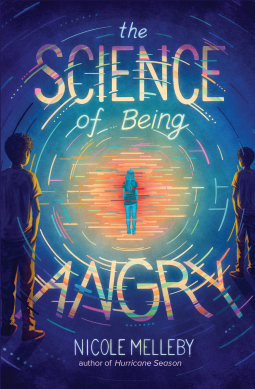
In Melleby's new novel, The Science of Being Angry, young Joey can't understand why she explodes into destructive fury. Like Pluto, she has a family that loves her and struggles to understand her, yet it isn't enough. 

In my review of this book, I wrote: 

What I most loved about this book was the respect with which Joey and her problems were portrayed. Joey is in many ways still a child, and for all her competence in many areas, she has a child’s limited resources for dealing with psychological issues that confound many adults. Her sense of responsibility often leads her to shoulder disproportionate blame, to withdraw rather than harm someone she loves, and to keep her pain to herself. She confronts an issue all of us face, regardless of how old we are: when do we ask for help, and when do we rely upon our own resources? In the end, Joey realizes that she cannot master her temper by herself, and—more importantly—that there is kindness, understanding, and help available to her.

Melleby doesn't condescend or simply. Her characters grapple with complex, often ambivalent emotions. Yet her faith in the resourcefulness of troubled young people, when given appropriate care, shines through. She reminds us,

There’s no one answer, there’s no one story for someone struggling with mental illness. 

If this means there are many more Melleby MG novels to come, that's an excellent thing! 

Tuesday, May 10, 2022

Book Reviews: A Respectful Treatment of Adolescent Anger Issues


The Science of Being Angry
, by Nicole Melleby (Algonquin Young Readers)

Eleven-year-old Joey lives in an unusual blended family. For one thing, she and her two twin brothers have two moms, one of whom was married before and has a son from that marriage. She and her brothers were the result of IVF, and the boys are identical, having split from the same egg. For all the nontraditional nature of this family, there’s a lot of love and acceptance. But all is not well with Joey. She’s been having increasingly volatile episodes of anger and acting-out. Her temper has become legendary at school, where she’s been given the nickname, “Bruiser,” after she threw a soccer ball at a boy in gym class so hard she bruised his collarbone. She’s roughly pushed away her best friend, on whom she also has a crush. Now she’s left with the fallout wreckage of what she’s done.

Despite the efforts of her moms to help her, Joey’s outbursts are only getting worse. Finally, she melts down into a tantrum so destructive, her family is evicted from their apartment and must move into a motel, where close quarters fuel everyone’s irritation. Her moms start bickering, and Joey thinks that’s her fault. Her older brother, who is trying to focus on his academics, goes to live with his father, and of course, Joey blames herself for that, too.

Joey can’t understand why she flies into a rage or how to control it. All her best intentions are in vain. Then she gets the idea that perhaps her temper is a genetic trait inherited from her biological father. If she can just track him down, she thinks, she might better understand her own volatility—and he might have found successful strategies for managing his anger. With the help of her alienated best friend/crush, she embarks on a genetics project for science class. And, of course, nothing goes the way Joey expects.

In many ways, Joey is a typical adolescent, struggling with the tensions between immaturity and independence. In others, though, she is very much her own person with a unique family. I loved the way the unusual marriage and relationships are presented in a matter-of-fact way. Joey’s anger is clearly not caused by her having two lesbian mothers. Indeed, the clear love and understanding between her mothers, the way each of them has found her way to an authentic life, are one of Joey’s principal strengths. I also noted very little along the lines of, “girls don’t have anger management issues,” when in fact psychological research shows that girls experience anger as frequently as boys do (but are socialized to suppress it).

What I most loved about this book was the respect with which Joey and her problems were portrayed. Joey is in many ways still a child, and for all her competence in many areas, she has a child’s limited resources for dealing with psychological issues that confound many adults. Her sense of responsibility often leads her to shoulder disproportionate blame, to withdraw rather than harm someone she loves, and to keep her pain to herself. She confronts an issue all of us face, regardless of how old we are: when do we ask for help, and when do we rely upon our own resources? In the end, Joey realizes that she cannot master her temper by herself, and—more importantly—that there is kindness, understanding, and help available to her.

Highly recommended for adults as well as their adolescent children.

Friday, April 22, 2022

Book Reviews: A Brilliant Fantasy with an Intersex Hero

 The Desert Prince, by Peter V. Brett (Del Rey)


The Desert Prince was my introduction to the world of Peter V. Brett’s “Demon Cycle.” I’d read The Warded Man years ago, enjoyed it, but didn’t make the connection until sitting down to write this review. It’s a tremendous challenge for multi-volume series to make each book satisfying to the new reader without overwhelming with the backstory and boring continuing readers. Brett has accomplished this so deftly that I never missed what had come before, although now I want to go back and gobble up all the previous books. So if this is your entry point (aka “gateway drug”), dive right in!

In Brett’s world, demons arise from the core of the Earth, wreaking havoc and violence on human settlements. Fifteen years before the present, a small band of women and men created magical wards to beat back the hordes of demons and keep their lands and people safe. Now the teenaged children of those heroes have come of age, burdened by the weight of their legacies. Olive, the daughter of a duchess, has lived a life of luxury and confinement in a city, while Darrin, her childhood friend, who has a variety of magical talents, including the ability to change the density of his body, but who prefers to remain in obscurity while he creates musical magic with his pipes. Their parents tend to be both bossy and overprotective, which makes sense in light of their previous saving-the-world adventures. Naturally, neither teen is excited about living a safe, boring life of parental expectations, especially Olive.

Olive has a secret. When pregnant with Olive and her twin brother, her duchess mother engaged in a ferocious magical battle, resulting in the fusion of the two into a single, intersex person. “Which do you want to be? A boy or a girl,” the Duchess asks. Olive picks being a girl, although sooner or later, she knows, the game will be up, certainly on her wedding night. When she’s captured by a rival nation, who think to use her in a marriage alliance, her secret comes out. Princess Olive must then learn to survive as Prince Olive before the demons mass for another, devastating war. Olive is a wonderfully complex character, a joy to watch as they struggle against almost insurmountable odds, gains fighting skills, experiences love and loss, and brings their own perspective to the escalating conflicts, both between humans and between humans and the monstrous demon king, capable of controlling minds. A heroic, sympathetic intersex protagonist forced by circumstance to embrace both masculine and feminine aspects arises naturally from the world-building. The Desert Prince is written and marketed for a general fantasy audience, but readers with particular interest in LGBTQI characters will find the careful examination of gender issues especially rewarding.

Although The Desert Prince is clearly only the beginning of Olive’s and Darrin’s stories, it works well as a stand-alone. As I mentioned above, the backstory is woven into the action so skillfully that I never had the sense of not knowing what was going on or why. Instead, the story swept me up with a generosity that made every plot turn or character nuance a delight. The prose is smooth, the pacing brilliant, and the fight scenes some of the best I’ve ever read.

As I was writing this review, I came across an interview with Peter V. Brett. Check it out! 


Friday, March 18, 2022

Short Book Reviews: A Queer Fantasy Role Playing Club Love Story


The Cleveland Heights LGBTQ Sci-Fi and Fantasy Role Playing Club
, by Doug Henderson (University of Iowa Press)

To begin with a disclaimer: I’m not a gamer, although I appreciate both the imagination and the community-building involved. I found the idea of a queer (in the most inclusive meaning) D & D club appealing. I wondered how would this be any different from a mainstream (cis/het) club. The answer turned out to be both not so much and a lot.

The players at the Readmore Comix and Games store’s weekly game include both out and closeted gays, a transgender dungeon master, and a confused maybe-bisexual. The group has become too small for a great adventure, so when a new guy joins, sensitive, lonely Ben is instantly smitten. That is, until his character is killed in the game, the boyfriend of the closeted banker is accosted on the street, and the connections and parallels between the game and real life become even stronger. The game characters, situations, and humor reflect the changing worlds of the players.

Since I’m not a gamer, I didn’t connect with much of the game action. I kept thinking I’d never write a plot line like that, while I tried to keep in mind that games have a different story structure. What mattered to me were the reactions and interactions of the players. I suspect that the intended audience, queerfolk who are also gamers, would love the campy atmosphere and the burgeoning sexual tension between Ben and the new guy.

In the end, though, I found the resolution too pat, the problems too easily overcome, and too many questions left unanswered. But for all that, it’s a sweet gay-gamer-geeky love story sure to bring a smile to many readers’ faces.