Showing posts with label middle grade fiction. Show all posts

Friday, May 27, 2022

Short Book Reviews: Middle Grade Walkabout with a Guru


Crazy in Poughkeepsie
, by Daniel Pinkwater; Aaron Renier illustrator (Tachyon)

It’s difficult to find words to describe a Daniel Pinkwater book because they are a unique breed that defies the usual literary terminology: they’re enchanting (often literally), playful, spontaneous (as in combustion, upon occasion), and hilarious-yet-insightful. In other words, a Daniel Pinkwater book provides the occasion for parents wrestling the copy from their kids, and vice versa, so why not avoid bloodshed, or paper-shred, and read them aloud together?

Mick’s ordinary life comes to a screeching 180 degree turn when his older brother returns home from Tibet with Guru Lumpo Smythe-Finkel and his dog, Lhasa, and Mick finds himself—how, he’s never entirely clear—the guru’s new disciple. Guru, disciple, and magical dog set off on a quest that’s as notable for its vagueness as its unpredictability. They acquire fellow travelers, graffiti-fanatic Verne and Molly, a Dwergish girl (sort of like leprechaun trolls with hidden goals, magical powers, a gift for making friends, and a charmingly madcap sense of humor). Soon they’re cavorting with a ghost whale who is the essence of love, as well as other wacky and memorable characters.

Pinkwater’s in on a great secret: if you want to communicate wisdom to young readers, first make them smile. Or giggle. Or run wild in Poughkeepsie, as the case may be.


Friday, May 13, 2022

Superb Middle Grade Fiction Featuring Queer Kids


Nicole Melleby writes Middle Grade fiction featuring exclusively queer kids who also happen to struggle with mental illness. They're really, really good books, too. Books I wish every family of a troubled adolescent, queer or not, would sit down and read together.

How To Become a Planet features a youngster, creatively named Pluto, who struggles with depression. I reviewed it here.

How to Become a Planet focuses on Pluto as a sympathetic character, a person who is both resourceful and overwhelmed, insightful and confused by changes in herself. Her use of astronomy metaphors is particularly vivid and powerful. Above all, Pluto is a person whose brain chemistry isn’t working quite right, not a diagnosis, and this excellent novel showcases her journey toward a new balance in her life.

Here's what the author said about this character in a recent interview:

Q: How did you balance depicting the reality of living with mental illness with the important message of hope?

A: Getting a diagnosis isn’t the end for Pluto—it’s a new beginning. I wanted to show that despite it feeling so hard, there is always hope. In the end, Pluto still has depression, she still has her struggles, but she has her support system and the understanding of her needs, and she’ll be okay. 

I think this is spot on for adults as well as kids. Turning your life around takes not only appropriate treatment (including, in Pluto's case, medication as well as psychotherapy) but time and patience. Backsliding and reversals are par for the course, no matter how skillful the professional help and supportive the loving families are. There's no magic wand to make psychiatric problems disappear, although popular media often portray it so. One insightful conversation and poof! you're cured. This is one of many reasons why books like Melleby's are so important. There is hope, she says, so hang in there.

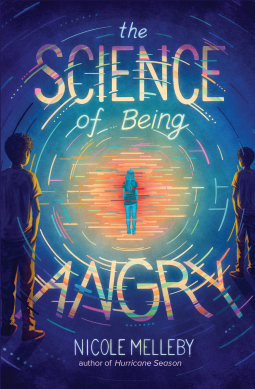
In Melleby's new novel, The Science of Being Angry, young Joey can't understand why she explodes into destructive fury. Like Pluto, she has a family that loves her and struggles to understand her, yet it isn't enough. 

In my review of this book, I wrote: 

What I most loved about this book was the respect with which Joey and her problems were portrayed. Joey is in many ways still a child, and for all her competence in many areas, she has a child’s limited resources for dealing with psychological issues that confound many adults. Her sense of responsibility often leads her to shoulder disproportionate blame, to withdraw rather than harm someone she loves, and to keep her pain to herself. She confronts an issue all of us face, regardless of how old we are: when do we ask for help, and when do we rely upon our own resources? In the end, Joey realizes that she cannot master her temper by herself, and—more importantly—that there is kindness, understanding, and help available to her.

Melleby doesn't condescend or simply. Her characters grapple with complex, often ambivalent emotions. Yet her faith in the resourcefulness of troubled young people, when given appropriate care, shines through. She reminds us,

There’s no one answer, there’s no one story for someone struggling with mental illness. 

If this means there are many more Melleby MG novels to come, that's an excellent thing! 

Tuesday, May 10, 2022

Book Reviews: A Respectful Treatment of Adolescent Anger Issues


The Science of Being Angry
, by Nicole Melleby (Algonquin Young Readers)

Eleven-year-old Joey lives in an unusual blended family. For one thing, she and her two twin brothers have two moms, one of whom was married before and has a son from that marriage. She and her brothers were the result of IVF, and the boys are identical, having split from the same egg. For all the nontraditional nature of this family, there’s a lot of love and acceptance. But all is not well with Joey. She’s been having increasingly volatile episodes of anger and acting-out. Her temper has become legendary at school, where she’s been given the nickname, “Bruiser,” after she threw a soccer ball at a boy in gym class so hard she bruised his collarbone. She’s roughly pushed away her best friend, on whom she also has a crush. Now she’s left with the fallout wreckage of what she’s done.

Despite the efforts of her moms to help her, Joey’s outbursts are only getting worse. Finally, she melts down into a tantrum so destructive, her family is evicted from their apartment and must move into a motel, where close quarters fuel everyone’s irritation. Her moms start bickering, and Joey thinks that’s her fault. Her older brother, who is trying to focus on his academics, goes to live with his father, and of course, Joey blames herself for that, too.

Joey can’t understand why she flies into a rage or how to control it. All her best intentions are in vain. Then she gets the idea that perhaps her temper is a genetic trait inherited from her biological father. If she can just track him down, she thinks, she might better understand her own volatility—and he might have found successful strategies for managing his anger. With the help of her alienated best friend/crush, she embarks on a genetics project for science class. And, of course, nothing goes the way Joey expects.

In many ways, Joey is a typical adolescent, struggling with the tensions between immaturity and independence. In others, though, she is very much her own person with a unique family. I loved the way the unusual marriage and relationships are presented in a matter-of-fact way. Joey’s anger is clearly not caused by her having two lesbian mothers. Indeed, the clear love and understanding between her mothers, the way each of them has found her way to an authentic life, are one of Joey’s principal strengths. I also noted very little along the lines of, “girls don’t have anger management issues,” when in fact psychological research shows that girls experience anger as frequently as boys do (but are socialized to suppress it).

What I most loved about this book was the respect with which Joey and her problems were portrayed. Joey is in many ways still a child, and for all her competence in many areas, she has a child’s limited resources for dealing with psychological issues that confound many adults. Her sense of responsibility often leads her to shoulder disproportionate blame, to withdraw rather than harm someone she loves, and to keep her pain to herself. She confronts an issue all of us face, regardless of how old we are: when do we ask for help, and when do we rely upon our own resources? In the end, Joey realizes that she cannot master her temper by herself, and—more importantly—that there is kindness, understanding, and help available to her.

Highly recommended for adults as well as their adolescent children.

Friday, April 24, 2020

Short Book Reviews: Imagination Takes on Faerie

The Fantastical Exploits of Gwendolyn Gray (Book 2), by B. A. Williamson (Jolly Fish Press)

I first had the pleasure of meeting Gwendolyn Gray in her Marvelous Adventures (of GG). I write and mostly read YA and adult fantasy and science fiction, but I had recently delved into reading Middle Grade. To my delight I found that literature for this age group has all the adventure and self-discovery I love, plus a simplicity and directness that adds depth and honesty. Yep, honesty. Kids this age are hard, if not impossible, to fool when it comes to emotional truth. They’re old enough to have attained a considerable degree of agency in their own lives, which connects them with characters, but young enough to not yet be smothered in hormonal angst. The best Middle Grade books trust their young readers to figure out what’s going on and how they feel about it. I love that! I should also add that no matter what the target audience, the most powerful ideas are best communicated in simple, direct language. Nowhere is that more true than in Middle Grade.

So, to Gwendolyn. When I first met her, she was a flame of color and imagination in a city of unrelenting conformity. Specifically, she lived in a City – the one and only City – where everything is gray and monotonous, literally as well as chromatically, and where children and adults alike spend the better part of their lives under the control of soporific lights called “lambents.” What distinguishes Gwendolyn, besides her delicious name, is her imagination, which is so vivid as to constitute a superpower. In that first book, she battled the Faceless Mister Men, traveled across worlds with her maybe-not-imaginary friends, Sparrow and Starling, rescues a snarky teenage pirate king, saved the City from the vile Abscess, and destroyed the lambents.

Of course, the resulting good times cannot last,

Monday, March 30, 2020

Guest Blog: Tara Gilboy on Why Adults Should Read Middle Grade Novels

Tara Gilboy is the author of the Middle Grade fantasy novels, Unwritten and  Rewritten (see my review next Friday). Stay tuned for her upcoming blog post on writing for Middle Grades.


Why Adults Should Read Middle Grade Novels
by Tara Gilboy

I don’t read adult books.

Most people give me strange looks when I say this. I’m an author, after all.  And a grown up. Why wouldn’t I want to read adult books?

I think my friends and family assume it’s a phase. They are always trying to give me books after they’ve finished them. This one will convince you to read adult books again. Nope.

Now don’t get me wrong: there are many adult books I like. I have a few favorites, and from time to time, I will reread them. I love Jane Austen, Stephen King, and Amy Tan. Elizabeth Kostova’s The Historian is a favorite, as is Anthony Doerr’s All the Light We Cannot See. It’s not that I think there is anything wrong with adult books. It’s just that I like middle grade books better.

As I sat down to write this blog post, I realized I’d never really considered closely why I prefer middle grade over adult novels. Whenever anyone asked me, I’d always given the easy answer: “well, it’s because I write them.” (Which seems like the very responsible, professional, “adult” answer.) Or even worse: “ I don’t know. I just like them better.”

But middle grade books are important. For children, yes. But for adults too.