Wednesday, February 14, 2018

BOOK RELEASE DAY! Lace and Blade 4

Just in time for Valentine's Day, Lace and Blade 4 offers a bouquet of sensual, romantic, action-filled stories. It's now available in trade paperback, Kindle, Nook, and other ebook editions.

Here's the Table of Contents:
“At the Sign of the Crow and Quill,” by Marie Brennan
“On the Peacock Path,” by Judith Tarr
“Sunset Games,” by Robin Wayne Bailey
“Sorcery of the Heart,” by Lawrence Watt-Evans
“The Butcher’s Boy and the Piri Folk,” by Pat MacEwen
“Gifts Tell Truth,” by Heather Rose Jones
“A Sword for Liberty,” by Diana L. Paxson
“Hearts of Broken Glass,” by Rosemary Edghill
“The Game of Lions,” by Marella Sands
“The Sharpest Cut,” by Doranna Durgin
“Pawn’s Queen,” by India Edghill
“The Heart’s Coda,” by Carol Berg
“The Wind’s Kiss,” by Dave Smeds


I've been posting interviews with some of the authors. Here's the list, in case you missed any of these delightful chats:


Early praise for Lace and Blade 4:

Publisher's Weekly:  Dave Smeds’s “The Wind’s Kiss,” ... captures not only the imagination but also the heart, leaving behind a sense of peace and longing. India Edghill’s “Pawn’s Queen” follows a young woman on the path to her own destiny, seamlessly marrying a feast for the senses with the darker whimsies of magic and duty. Marella Sands’s excellent “The Game of Lions” focuses on the strength of bonds between sisters and teammates. The ... stories evoke wonder and excitement.

Kevin O'Brien: This volume contains thirteen stories that range from action tales where romance is at best a subplot, to love stories with nary a hint of violence. Similarly, the romance varies from intense to casual, with both men and women as the aggressors. Also, the level of intrigue ranges from being the point of the plot to being practically non-existent. The level of quality is consistently high, I found no typos or obvious grammatical errors, and those stories set in alternate realities had good world-building; the settings felt real, not thrown together with spit and tissue paper.

And if you enjoyed this anthology, please post a review!

Monday, February 12, 2018

Lace and Blade 4 Author Interview With Carol Berg

Just in time for Valentine's Day, Lace and Blade 4 offers a bouquet of sensual, romantic, action-filled stories. Order it from iBook, Kindle, Kobo, Nook. The Table of Contents is here.


Deborah J. Ross: Tell us a little about yourself.  How did you come to be a writer?
Carol Berg: I grew up reading classics, mysteries, fantasy, science fiction, adventure stories, and spy thrillers, but never imagined I could ever write one for myself. Instead I majored in math, had a short stint as a teacher, had a family, got another degree--this time in computer science—and was halfway through a software engineering career when a fellow engineer (and good friend) convinced me to write a series of letters “in character” so she could practice her writing. It was so much fun, I couldn’t quit! After a number of years writing novels just for myself, reading an article about writing now and then and revising with the newfound knowledge, I wrote a story that was most definitely the best thing I’d written thus far. It felt as if I’d made a huge step forward. My friend agreed, and we stuck our toes in the publishing waters by attending a writers conference. A year later I’d sold three books to the publisher who’s bought them all so far.

DJR: What inspired your story in Lace and Blade 4?
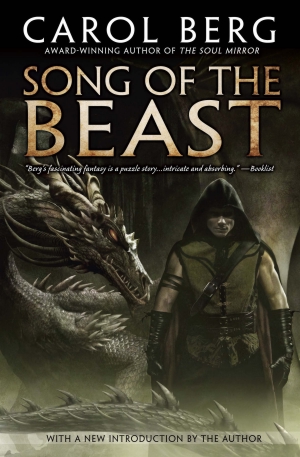
CB: One of my aims when I create new heroes or heroines is to make them real people. I want readers to believe they had a life before walking onto the canvas of my story and will (if the story permits!) have a life when they walk off again. But of course, after the traumas/losses/victories of the story, the nature of that life is often irrevocably changed. Ever since my novel Song of the Beast was published, I’ve had readers asking what became of Aidan McAllister--a scarred, broken singer of visions, who saved his world from the scourge of dragon warfare. At the end of the story, he abandons his friends and his hope of a normal life to lead the beasts into the wild. I decided that it would be fun to satisfy the readers’ curiosity and mine, and so I wrote “The Heart’s Coda. “

DJR: What authors have most influenced your writing?  What about them do you find inspiring?
CB: So many! One of the first was Mary Renault, who took the mythological hero, Theseus, and the historical myth, Alexander the Great, and wrote them as fascinating, flawed human beings in worlds that felt real and true. Another Mary--Mary Stewart--showed me the epic story of Merlin and Arthur through a very human Merlin’s personal lens.  And then there’s Ellen Kushner, who created true magic with exquisite prose and deep emotion in her novel, Thomas the Rhymer. Alongside these three are many mystery and thriller writers like Dick Francis and Len Deighton who instilled a love of complex stories and exciting adventures, and fantasy writers like Roger Zelazny and Poul Anderson who taught me the delights of building magical worlds.

Friday, February 9, 2018

Guest Post: Nancy Jane Moore on Fighting and Gender

At a recent meeting of my writers’ group, we discussed fight scenes while critiquing an early draft of my novel in progress. The discussion went something like this:

“Women fight differently from men,” one of the guys said in pointing out that the sword fight scenes didn’t vary much.

I didn’t think he was referring to the inaccurate stereotype that women can’t fight, but I also didn’t think his point applied, so I said – speaking as a long-time martial artist and instructor as well as a writer – “In my experience, that’s not always the case, especially with weapons.”

And he replied, “Yeah, but you’re big.”

I let it go at that, because he was right that the fight scenes needed work, but it bothered me. After some reflection, I realized what the problem was: If my experience isn’t key to discussions about how women fight simply because I’m a woman about the size of the average U.S. man, then the issue isn’t biological sex or gender; it’s body size and build. The average man may be bigger than the average woman, but there are plenty of small men – and big women – in the world. Also, there are some people who don’t fit into standard gendered categories, and they, too, come in a variety of body types. As writers, if we make assumptions about fighting styles based on sex or gender, we’re not going to create scenes that reflect the complexity of real fights.

There is only one situation in which writers should give some consideration to the gender of their fighters, and that’s if they are creating a world in which the culture puts distinct rules on gender behavior. Most current societies give girls and boys very different signals from an early age, with the girls getting the message – incorporating it into their bodies – that they aren’t capable of handling themselves physically in dealing with men, and the boys, regardless of size or skill, learning that they have power over women. In a world in which calling men and boys “girls” (or much less acceptable words for female) is a major insult, women who fight will have to deal with the cultural dynamics.

Wednesday, February 7, 2018

Today's Moment of Serenity


Canal in Zeeland, 1899 (Emil Claus,1849-1924)

Monday, February 5, 2018

Lace and Blade 4 Author Interview: Marie Brennan

Just in time for Valentine's Day, Lace and Blade 4 offers a bouquet of sensual, romantic, action-filled stories. Order it from iBook, Kindle, Kobo, Nook. Table of contents is here.


Deborah J. Ross: Tell us a little about yourself.  How did you come to be a writer?

Marie Brennan: I generally credit that to Diana Wynne Jones, and specifically her novel Fire and Hemlock, which I read when I was nine or ten years old. The main characters in it are writing a story together, and when I put the book down, I thought, I want to be a writer. It was the first time I recall thinking about making up stories, not just for my own entertainment, but for other people to read. I got serious about it when I was eighteen, sold my first novel when I was twenty-four, and have never looked back.


DJR: What inspired your story in Lace and Blade 4?

MB: Some years ago I bought a pair of black-and-red beaded earrings from the jeweler Elise Matthesen, who habitually gives titles to all the pieces she makes. The earrings are called "At the Sign of the Crow and Quill," and like many authors, I pledged to Elise that I would try to write something by that title someday. The mood that evoked in my mind was very much a Lace and Blade mood, so when I received an invitation to submit to the anthology, that turned out to be the spark I needed to transform the phrase into characters and plot.


DJR: What has most influenced your writing?

MB: Definitely my academic background. In college I majored in archaeology and folklore; in grad school it was cultural anthropology and folklore. I never took a single creative writing course. I know that some people find them great; if you have a good teacher you can grow enormously as a writer, and even without that, just having permission to treat writing as something important, rather than just a hobby, can be vital. But for me, the most effective thing was to take classes and read books that gave me something to write about. The real world, in all its multifarious historical and geographical and cultural glory, is an endless source of inspiration to me.