Monday, November 9, 2015

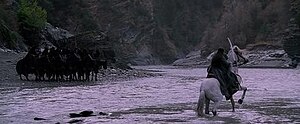
World Fantasy Awards and Jackson's Middle Earth

First and foremost, congratulations to the winners of the World Fantasy Award, and also to the finalists. Many splendid creations here.

Now this post will veer off in a highly personal direction, applying to no one but myself. I have read one of the winners and when I saw the title, I felt a little sick. Do not get me wrong -- the work absolutely deserved the award. It was highly original and superbly executed, a stellar addition to the field.

And it gave the the absolute shakes. There's no way I can see myself ever reading it again. Our local library got my copy.

I've talked with folks who write and love horror about my aversion to it, and I appreciate their point that horror gives us a way of regaining power over the things that terrify us. Once upon a time, I got a delicious thrill out of that adrenaline jolt and the weird, fascinating dark stuff. I don't anymore. I think my threshold has been permanently re-set, and the consequences of exceeding it are more tenacious.

So why am I not pushed over that edge by the violence in the Peter Jackson Middle Earth films? There's plenty of excitement and twenty ways to kill an orc, each sillier and bloodier than the one before, and characters I love in dire peril. Is it the fantastical setting? The characters, even non-humans like Elves and Dwarves, don't feel unreal. Is it the knowledge that all will be well in the end, or as well as can be, given the price various characters play? I still cry at Boromir's death -- he didn't have a happy ending.

And yet, as I wrote in an earlier, watching the films, with all their flaws -- and also reading the books, albeit less vividly -- leaves me with a feeling of peace. Emotionally wrung-out, but brought to a good place by all the adventures I've gone along on.

Truly, we each see and read a different story. They are all colored by what we as individuals bring to them.

Friday, November 6, 2015

Cataract Journey 7: Settling in

It’s been several months (August) since my cataract surgery, and I’m adjusting to my new vision. My eyes have recovered from the surgery and my vision seem to have stabilized. It hasn’t changed noticeably over the last month or so.

So far, my experience continues to be positive. It’s amazing to open my eyes in the morning and be able to see clearly. I haven’t experienced the halos or other visual distortions that some patients with accommodative lenses report. My eyes had gradually become drier and scratchier over the years, and that is slightly improved, although I’m not sure why, maybe all the eye drops I used after the surgery. I’ve talked to other folks who’ve had cataract surgery and reported increased scratchiness afterward (to be fair, once I shared with them my optometrist’s protocol for dry eyes, they said it helped tremendously).

Here’s where I landed, vision-wise. I’ve gone from being incredibly near-sighted to being only slightly near-sighted. I had expected to be able to see clearly at intermediate (computer screen) and distance (driving) ranges, and to need reading glasses for close activities, but that turned out to not be the case. My vision for working at the computer and playing piano is excellent. I can’t remember seeing the piano music so crisply before. I can also read, unless the type is really small or I have to hold the book really close, so I use low-power over-the-counter reading glasses for reading in bed. My distance vision is not so great, especially in my weak eye. I can see well enough to drive places I already know how to get to, but reading street signs requires me to be fairly close to them (the letters and symbols of traffic signs are big enough, so that’s not a problem). I’d likely not pass the driver’s license vision test with my weak eye.

Now it’s time to decide what, if anything, I want to do about the residual near-sightedness.

Wednesday, November 4, 2015

Guest Blog: More on Transgender Genetics

Welcome back! This week let’s look at a different paper that examined potential genetic causes for transgender.
In the last post, we looked at a SNP (“single nucleotide polymorphism” — a very, very tiny mutation at just one “letter” of novel of DNA) as a potential cause. This week’s paper looked at a different type of change: trinucleotide repeats.
There are some sections of human DNA that have funny little repeats of three “letters”. If you remember, DNA has four letters: A, T, G, and C. Some parts of our DNA have long strings that looks like this: CAGCAGCAGCAGACAG. It’s called a trinucleotide repeat. Everybody has sections like this, and it’s not clear why they exist. The sections vary a lot from person to person, and change from generation to generation. Within the same person the repeat doesn’t change. Sometimes these repeats, when a person has a lot of them, can cause disease. Trinucleotide repeat expansions are the cause of both Huntington’s disease and Fragile X syndrome. Most of the time, though, trinucleotide repeats aren’t a problem.
Repeats of other lengths are also found in humans — it can be as small as two letters (e.g., “AGCACACACACACACACACACATG”)
So — what about this study?
This study looked at nucleotide repeat sequences in three specific areas in trans women and cis men: CYP17, AR, and ERBeta. Yes, CYP17 is back! You may recall that’s involved in the creation of sex hormones. AR stands for androgen receptor — it codes for the receptors that testosterone binds to to cause its effects. And ER Beta is one of the estrogen receptor subtypes. Like AR, it is a receptor that estrogen binds to to cause its effect. In essence, this paper asked: “Do the number of nucleotide repeats in genes associated with sex hormones differ between transgender women and cisgender men?”
The results?
Some of them. There were no differences in ERBeta (the estrogen receptor) or CYP17. But the AR (androgen receptor) gene in trans women had longer nucleotide repeats than the cis men did. Since AR codes the androgen receptor, it is an even more important controller of masculinization of a fetus than testosterone itself is. As the researchers state, the difference in nucleotide repeats “might result in incomplete masculinization of the brain in male-to-female transsexuals, resulting in a more feminized brain and a female gender identity.”
It’s an interesting thought and definitely in line with the brain research that’s been published. As always, we need more studies and more data to say that the cause is definitely the androgen receptor gene.
Want to read the study for yourself? The abstract is publicly available!

Tuesday, November 3, 2015

Peter Jackson’s Middle Earth – Unexpected Gifts


It has often seemed to me that fans of J. R. R. Tolkien’s The Lord of the Rings (and The Hobbit) fall into two categories: those who adore Peter Jackson’s films and those who despise them. I fall into the former category and my husband into the latter. From our conversations, I have concluded that in most cases, it is impossible to change the other person’s mind (not to mention disrespectful to try). This is hardly a problem of cosmic importance, unless one person attempts to drag the other to all six extended cut versions of the movies or prevents the other person from enjoying them. Both sides put forth arguments and reasons, and they are entitled to them. I think just about everything that can be said has already been expounded upon.

I am firmly in the love-them camp. All the objections folks have are absolutely right, and have no relevance to my experience of the movies. The uncritical, immersive, “take me away” quality of my enjoyment of the films has definitely piqued my curiosity. What happens when I spend hours in Jackson’s Middle Earth?

In general, I am far less critical of visual media than of text. Because my own art form is prose, I have developed a keen internal editor and critic that may be regaled to the back seat but never entirely departs. I have no such filters for films or paintings. Only a horrifically bad film can destroy my suspension of disbelief, but horrifically bad films are enjoyable for quite different reasons than good ones.

I devoured Tolkien’s novels as a young adult, although I never wanted to run away to Middle Earth then. I found some aspects of the books frustrating: the “travelogue” passages were often tedious, I had no idea what Tom Bombadil was doing in the story, and I had trouble forming clear images of many of the places, for example Helm’s Deep. Nonetheless, I joined the ranks of fans wearing buttons that said “Frodo Lives!” and “Beware the Balrog.” I stood in line to see the films by Ralph Bakshi and Rankin-Bass (The Hobbit and The Return of the King), all of which I found unsatisfying. The hobbits and dwarves in the animated versions were silly, in bad need of haircuts, and the Bakshi film was just plain weird. The orcs looked like sabertoothed Sand People (from Star Wars), the Balrog was a costume from a bad opera, Boromir looked ridiculous in a Viking helmet, and none of the character moved in a natural way. Et cetera.

I had no idea who Peter Jackson was, but special effects had come a long way since the 1970s. Needless to say, I had excitement but not high hopes. I came prepared to see a live action version of the previous attempts. Five minutes into The Fellowship of the Ring, I was in love. The Jackson films “clicked” for me and brought the stories alive in ways that previous versions, even the original text, fell short.

This is not to say that everyone must feel the same way. Different media and different interpretations work for different people. I’m delighted that some folks prefer Tolkien’s text or even the animated versions. I am also delighted that this one form of presentation worked so well for me. When I go back and re-read the books, I can now immerse myself in the rich and varied landscapes of Middle Earth, and see and hear the characters.

After the extended editions of all three Ring movies came out on DVD (and I had watched all the commentaries and appendices), I set them aside. Every few years, however, I would watch them (3 movies over 2 days, usually, and when my husband – who is in the “doesn’t work for me” camp – was out of town). Either by happenstance or internal prompting, my schedule synchronized with the parole hearings of the man who raped and murdered my mother. That is, I’d gear up for the hearing, get re-traumatized no matter what precautions I took, come home and fall apart, and slowly put myself back together again. Some quality of the Jackson films spoke to me and offered itself as a healing tool.

Sunday, November 1, 2015

NaNoWriMo Resources!

Here's a great collection of writing books, from "hot-to" for beginners to the finer points of specific elements, all at a fantastic price. Not only that, but you'll get two of my own essays in Book View Cafe's Brewing Fine Fiction -- one on writing when there is no time, and another on surviving being reviewed!


NaNoWriMo-storybundle-covers


Book View Cave is delighted to be included in StoryBundle’s 2015 NaNoWriMo Writing Tools Bundle. Not only is ourBrewing Fine Fiction anthology part of the bundle, so are two additional guides by BVC members: Writing Horses by Judith Tarr and Writing Fight Scenes by Marie Brennan.

Never heard of StoryBundle? It’s where you can get fantastic ebooks at one low pay-what-you-want price. DRM-free means you can read them on just about all the devices you own, no matter who makes it.

– Pay the minimum $5 and get Brewing Fine Fiction plus five other great titles.
– Beat the bonus price ($13), and get seven more books including Writing Horses and Writing Fight Scenes.
– Opt into the 2nd tier bonus ($25) and get the 2014 NaNoWriMo bundle as well, for a total of twenty-five fantastic writing books!

Plus Bundle buyers have a chance to donate a portion of their proceeds to charity.

National Novel Writing Month happens every November. Thousands of writers all over the world take up the challenge to produce a novel in a month.

This toolkit offers great advice from a multitude of seasoned professionals including Kevin J. Anderson, Lawrence Block, Algis Budrys, Kristine Kathryn Rusch, Dean Wesley Smith, and Al Zuckerman. Curator Kevin J. Anderson writes:

Here, to get you ramped up for the marathon, I’ve curated a baker’s dozen of instructional books on all aspects of writing, from craft, to productivity, to business, to career advice, to specific areas of expertise. Presenting, for the second year in a row, the NaNoWriMo Writing Tools StoryBundle: a massive batch of useful books that will help you survive—and thrive—during National Novel Writing Month—the full spectrum of useful information. You name your own price, whatever you feel this batch of books is worth, and part of the money you pay goes to help the supportive non-profit NaNoWriMo organization.

I put together these books from the general to the specific, a treasure chest of books vital to your success—not only in writing your novel but in launching your long-term career as a successful writer. This is a toolkit, a drill sergeant, a mentor, and a cheerleading section, all in one.

For complete details and to pick up your bundle, visit 2015 NaNoWriMo Writing Tools Bundle.