Showing posts with label epic fantasy. Show all posts

Monday, February 5, 2024

Praise for The Seven-Petaled Shield

The Seven-Petaled Shield is the first volume of my epic fantasy trilogy. Here's what reviewer Reggie Lutz had to say about it:


It has been a while since I've read a fantasy that, at first glance, appears to be categorized in the genre as clearly as The Seven-Petaled Shield. It is almost deceptive in this way. What the author does with the form, and the narrative is engaging, unique and managed to keep me up past my bed time a couple of nights. There are swords, there is sorcery and as the cover suggests, yes. A sea god does appear. Though to many, such themes are familiar territory, what she does with them, how they serve the narrative, and how all of this is viewed through her protagonist's unusually compassionate gaze is unique and engaging. I'm still digesting a lot of this as I've finished reading this book only recently, but one of the things that I noticed as I read it was having the thought, "Oh, this is another Chosen One story," and then of course having that perception proven wrong, which is an absolutely delicious experience as a reader. There are moments like this throughout the book, accomplished with deft prose and subtlety. I agree with another reviewer about how the mutli-cultured worldbuilding is handled well. For me, as a reader, I love a strong character, and in that regard this book does not disappoint. It was a joy getting to know her main character, Tsorreh. I will definitely read the rest of this series.


"A critical, inventive spin brings an exciting uniqueness to the good and evil quest theme." —Midwest Book Review

Buy it at Amazon or your favorite vendor.

If you enjoyed the book, please post a review! 

Friday, March 17, 2023

Short Book Reviews: Bad Snake Things Waking Up

The Thousand Eyes, by A. K. Larkwood (Tor)


This sequel to A. K. Larkwood's debut fantasy, The Unspoken Name, continues the adventures of many of the original characters, including some we thought were dead. It seems that in Larkwood’s world of “The Serpent Gates,” you cannot count on anything staying dead, whether they be people (not strictly limited to humans), gods, empires, or gigantic mystical serpents. It’s now two years after our heroes/anti-heroes—ogre Csorwe, her girlfriend, mage Shuthmili, and ne’er-do-well Tal Charossa—supposedly defeated the immortal wizard, Belthandros Sethennai. Who, of course, is not actually dead, in no small part because he’s made a bargain with a snake goddess to become her mortal, unstoppable incarnation.

Making bargains with snake goddesses never turns out well, as our friends discover when they unearth an ancient artifact, the Mantle of Divinity, from the long-extinct snake empire. And wake Bad Snake Things up.

Without giving away too much of the marvelously convoluted-but-circular plot, the Bad Snake Things include the last royal soldier of the above-mentioned extinct Snake Empire, a person of truly epic obsessive loyalty. The Mantle of Divinity does its thing, turning a mortal into a divine incarnation of the original snake goddess, who then commences to remodel all the linked dimensional worlds into a recreation of the original above-mentioned extinct Snake Empire. But Belthandros Sethennai is not only not dead, he’s been systematically destroying all the subsidiary incarnations of the One True Snake Goddess so that he can become Her. And matters go pear-shaped from there.

Like its predecessor, this is a long novel, lushly detained, and for all the horrific ways Things Go Wrong, it’s a joy to spend this much time (and these many plot reversals) with our friends. It’s not the place to start, but for everyone who, like me, fell in love with the world and its characters, it offers a rich feast of the imagination.


Monday, June 8, 2020

Horses in The Seven-Petaled Shield


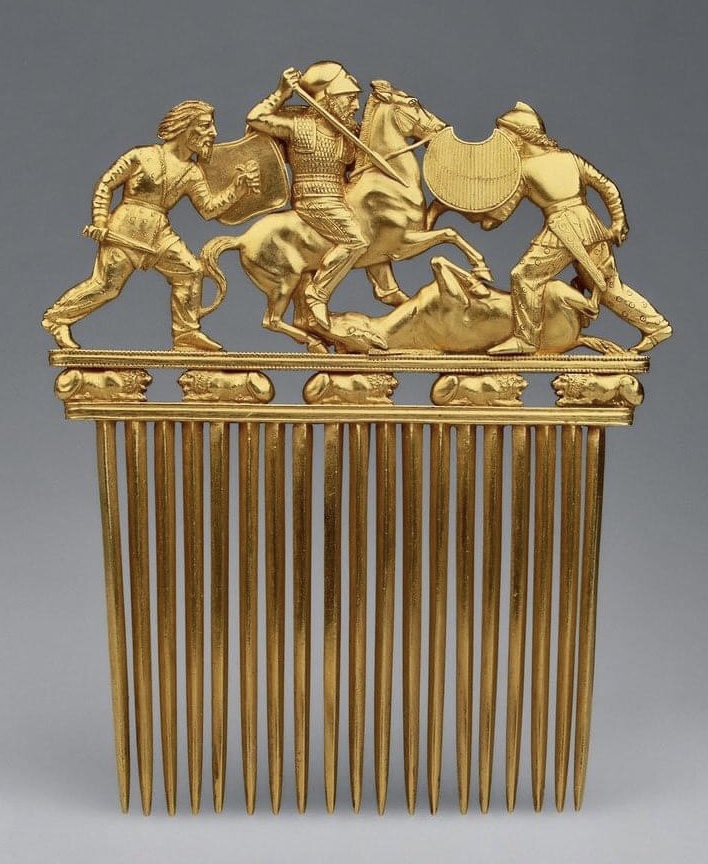
Scythian gold comb


The stories that gave rise to The Seven-Petaled Shield began with my love of horses and a special exhibit at the Natural History Museum of Los Angeles County of the art of the nomads of the Eurasian steppe. I marveled at the beautiful gold artifacts of the Scythians, depicting horses, elk, and snow leopards, and the lives and adventures of these people. The Greek historian Herodotus described the Scythians as “invincible and inaccessible,” and Thucydides asserted, “there is none which can make a stand against the Scythians if they all act in concert.” This world, its people, and its marvelous horses practically begged for stories to be written about them.

The Scythians were only one of many nomadic horse-faring peoples who roamed the Central Asian steppe from the beginning of the first millennium before the Common Era into the 20th Century. Sarmatians, Cimmerians, Massagetae, Alani, and many others were followed by such groups as the Hun, Kazars, Uzbeks, Bulgars, and Magyars. Although these peoples differed in culture, language, religion, and place of origin, they shared the characteristics of nomadic horse folk. They were highly mobile, superb archers, and their survival depended on their horses.

Friday, May 17, 2019

Short Book Reviews: Great World-Building Shows Promise


For the Killing of Kings, by Howard Andrew Jones (St. Martin’s)

The best thing about this book is the world-building, which the author has clearly put a great deal of care and thought into, at least for the central realm and its main characters. Especially in the beginning, it reminded me of Sherwood Smith’s wonderful Inda books with the sense of long-established institutions, complex relationships, and history.  The opening sequence, with the discovery that a legendary sword is missing and a well-constructed forgery substituted in its place of honor, engaged me right away.

Gradually I became less enchanted with the story. Too many characters, especially the antagonists, did and said things that were ill-thought-out or downright incompetent. Denevan, who has risen to a position of power and authority as chief of the ultra-elite Alternen, has the emotional maturity of an adolescent, still nursing old petty jealousies. I much prefer villains on a more majestic scale, capable of greatness. Neither Denevan nor Mazakan, king of the invading Naor, fits the bill.

My favorite character was the brilliant, if somewhat distracted mage, Varama, who’s always a step ahead of everyone else but gets lost as other, less intelligent characters end up bashing their way through the violent climax. For me this was a major disappointment. Varama was akin to this world’s Sherlock Holmes, putting together otherwise-overlooked details to perceive patterns. I’m sure she would have come up with an elegant solution to Denevan’s power play and the invasion of the Naor. Speaking of the Naor, their only purpose in life seems to be to invade, pillage, and so forth, in order to make the central characters look noble. I never discerned any reason for their belligerence.  In fact, it seemed at the opening that a mutually beneficial peace might lead to some interesting politics, jockeying for trade advantages and so forth. The only explanation seems to be because evil invaders (hint: “piles of skulls” = seriously nasty folks) are required for a big battle or three.

I wish the author had put as much thought into the causes of war and its creative resolution, and valuing science/intelligence over military prowess, as he did into the rest of the world-building. Such a rich world and array of characters might have served up a truly memorable story, but this one is only pretty good.


Friday, April 20, 2018

Short Book Reviews: Two Delights from Kevin Hearne


In which I review two quite different pieces by versatile author Kevin Hearne

The Squirrel on the Train, by Kevin Hearne (Subterranean Press)

My introduction to Kevin Hearne’s work was Iron Druid, so I was delighted to discover that the dogs belonging to Druid Atticus O’Sullivan, or perhaps the other way around, he belonging to them, have their own adventures. This one begins with a train trip to Portland, during which the dogs are terribly upset because there is a squirrel (die, evil squirrel!) on top of the train. Atticus explains that the wind shear will cause the squirrel to jump off and when they arrive, squirrel in place, of course the dogs conclude that all natural order, including the laws of physics, will now be overturned. Their fears are confirmed when an Atticus look-alike is murdered, and so the chase is afoot. A-four paws, that is.

This utterly charming novella showcases Hearne’s skill at whimsical humor and his versatility as an author.


A Plague of Giants, by Kevin Hearne (Del Rey, 2017).

At some time in the past of this fantasy world, the balance of trade and power has been overturned through not one but two invasions of oversized warriors; one race being known to the others, quasi-Viking fire-wielders driven from their lands by a volcanic eruption. The second, strangers from over the sea, are mysterious and even more lethal. How these upheavals came about and were responded to is related in the present time through a bardic storyteller who assumes the likeness of various participants along the time line. In the present, we know that the giants have been defeated at a terrible cost, yet wounds remain unhealed and intrigues abound, threatening chaos.

This is a long, slowly-paced book that incorporates the stories of a large cast of characters from different cultures, much of it channeled through the central storyteller, with past and present timelines looping back on themselves. The world-building is amazing in itself, rich and complex, with each culture possessing its own form of magical gift (“kenning”) acquired through near-lethal trials. The individual stories are marvelous, the characters clearly distinct. My favorite is Abhinava Khose, born into a clan of plains hunters and unable to tell his family that not only does he never want to kill animals, but he is gay. He’s sensitive, compassionate, a natural leader, and unexpectedly courageous. The inner conflicts reflect and intensify the outer drama in his tale.

Read at a leisurely pace to savor the adventures of each person, the book is a delight. It’s not a tale to skim for “what happens next.” The ending is already established. However, that slowness, when combined with the length and complexity of the timelines, means it’s easy to get lost in the story of the moment and forget the multitude of details that have come before, to keep track of the cast of thousands and the sheer number of place names, group names, and so forth. In the ebook version I read, there are no maps or helpful lists, but there are series of charming portraits of important characters. Add to this the revelation that A Plague of Giants is only the first in a series means either loving the world so much you never want to leave it, or not experiencing the satisfaction of a complete story arc.

Kevin Hearne is an immensely capable author. A Plague of Giants and its subsequent volumes represents a highly ambitious project that I have no doubt he will carry on in a brilliant fashion. Besides the difficulties presented by the length and complexity of the book, I would have liked to spend more consecutive time with my favorite characters, each of whom surely deserves an entire book of his or her own.

Monday, July 1, 2013

Women Heroes in The Seven-Petaled Shield


Novels begin in many different ways, drawing their “motive energy” or “visions of ultimate coolness” from varied sources. Which is a high-falutin’ way of saying that there is no one right way in which to begin a story. It can start with a visual image (very common with me, as I’m a visual writer), an emotional turning-point, or an idea that grabs the imagination. Or a line of dialog or a melody. Many writers experience a tango-like dance with their creative inspirations, which ranges from the times the source dictates its own story in total defiance of genre boundaries and market demands, to those instances when the writer summons a story to fit certain specifications. The world of The Seven-Petaled Shield began with the latter.

My first professional short story sale was to Marion Zimmer Bradley for the debut volume of Sword & Sorceress. (It was, of course, an occasion of much rejoicing!) When the anthology became an annual series, I kept submitting stories, and looking around for different cultures and situations. For one of the later volumes (XIII), I wanted to explore the tensions between a nomadic horse people and a city-based culture like Rome, and their different values and forms of magic. I did not call them Romans and Scythians, but these models were very much in my mind. As I delved further into my research, researching aspects of life and warfare that spoke to me, I learned that although Scythian women were definitely second-class citizens, the Sarmatian women rode to battle and were likely the origin of the “Amazons” of legend. Thus began a series of “Azkhantian” tales, in which the women of a nomadic horse people battle against the relentless incursions of Gelon (this world’s Roman Empire) What could be more perfect for a sword and sorcery story featuring a strong woman protagonist?

Thursday, May 30, 2013

Amazing Fantasy Round Table: 50 Shades of Fantasy

This month's Amazing Fantasy Round Table examines the question of whether modern fantasy comes in shades other than grim and gritty.


Warren Rochelle: Fantasy: How Many Shades of Grey?
All right.  I’ve been browsing in The Encyclopedia of Fantasy. I googled “different kinds of fantasy—and, for the most part, found similar lists and similar terms.  I doubt most of those who write for this blog would be surprised at the terms and definitions I found, such as:  

Ø  high fantasy: immersion, set wholly in the secondary world, “with its own set of rules and physical laws,” (no connections between here and there). Think Middle-earth.
Ø  low fantasy: a sub-genre of fantasy fiction involving nonrational happenings that are without causality or rationality because they occur in the rational world where such things are not supposed to occur. Low fantasy stories are set either in the real world or a fictional but rational world, and are contrasted with high fantasy stories (see above)… The word "low" refers to the level of prominence of traditional fantasy elements within the work, and is not any sort of remark on the work's quality” (Wikipedia contributors. "Low fantasy." (Wikipedia, The Free Encyclopedia. Wikipedia, The Free Encyclopedia, 27 Mar. 2013. Web. 2 May. 2013.)  Examples include The Borrowers, Tuck Everlasting, The Five Children and It, Edward Eager’s novels, and so on.


Ø  epic fantasy, which is centered on the quest, relies on a heroic main character, stresses the battle between good and evil, heroes, legendary battles—often called heroic fantasy.  A portal-quest or portal fantasy could be a variant, with a prime example that of the Chronicles of Narnia.

The lists go on to include contemporary/urban fantasy, anthropomorphic, historical, dark, science fantasy—you get the idea. Fantasy, all about good vs. evil, the light versus the dark, heroes and heroines, magic, dragons, and their ilk, comes in many shades of grey. (50? That’s another essay—see the blog on sexuality in fantasy, okay?)  Then, there is immersive vs. intrusive and liminal or estranged and … But instead of defining each and every one, and dredging up examples (which is something I like to do when I teach fantasy lit—English 379, this fall, 3:30-4:45 TTh, come on down), I want to talk about the shade of grey I write and why (and yes, grey, the British spelling, and not the American gray. Grey just looks …. well, grey, and it’s prettier… I digress).

So. What’s my shade of grey?  I have two published fantasy novels, Harvest of Changelings (Golden Gryphon, 2007) and its sequel, The Called (Golden Gryphon, 2010). A third is being edited, The Golden Boy, and a fourth in progress even as I write, The Werewolf and His Boy. They are all, I am thinking, low and intrusive fantasies. True, The Golden Boy is sort of pushing the above definition of low, as it is set in an alternate reality, that of the Columbian Empire. Magic is real, but it is illegal, and the Empire is definitely meant to be a rational country. Magic, does, however, intrude, according to the Columbian political and religious authorities. But, the others: this world (more or less), and then magic returns (thus intruding), or is disclosed in some fashion, voluntarily and otherwise. Harvest and The Called are set in North Carolina; Werewolf, in Virginia. Complications ensue—lots of complications. Bad things happen. The good guys are in serious trouble. Yes, there are forays into Faerie from time to time, but on the whole, things happen here, not there.

The question of the moment is why, to what end. Part of me has always wanted to believe in magic (oh, all right, part of me does believe in magic) and that it is real and if we just knew—the right people, the right words, where to look—we could find it. It’s always been here. There has to be a reason for all these stories. So, I create fictional worlds that satisfy this longing. In these worlds the magical and the mundane intersect, overlap, come into conflict—and I find these encounters fascinating. As do their real-world counterparts (encountering the unexplainable), such meetings pull back the veils and reveal us as who and what we really are. They are meetings in which we are forced to ask the question of what it means to be human. That some of these encounters are fraught with peril is also part of this question.  To be human is, sometimes, to be in danger, to be facing great evil, and to have to confront that evil, albeit the evil is a monster, another human, or a personal darkness. To be human is to undertake the quest. As Le Guin says in her essay, “The Child and the Shadow,” “fantasy is the natural, the appropriate language for the recounting of the spiritual journey and the struggle of good and evil in the soul”(Language of the Night 64).