Friday, August 30, 2024

Book Review: Wishing Disappoints

 The Wishing Game, by Meg Shaffer (Ballantine)

I was intrigued by the premise of an updated Roald Dahl’s Charlie and the Chocolate Factory with emphasis on the plight of kids stuck in the fosterage system. As much as I was predisposed to like this book, especially in light of it earning “Best Book of the Year,” I found in it one disappointment after another.

First, the protagonist: Lucy Hart, rejected by her family in favor of her chronically ill older sister, ought to have been a sympathetic viewpoint character. She has gone from one miserable life situation to another. As a child, though, she had the gumption to run away to the island fortress (Clock Island, site of the eponymous, wildly popular children’s book series penned by the mysterious recluse, Jack Masterson) and demand to become his apprentice. Of course, this did not go well, although she, Jack, and gifted cover artist Hugo have never forgotten one another. At the opening of the book, Lucy is working at a dead-end job as a teacher’s aide. She’s barely able to make rent, let alone provide a suitable home for Christopher, the foster kid she’s determined to adopt. Herein lies my initial and enduring inability to connect with Lucy. She seems to be no more emotionally mature than an average adolescent, even more so when she decides that the only solution to her life problems is to enter and win a fabulous prize offered by Jack, the only copy of his unpublished next Clock Island novel. Her wish appears to be coming true when she is selected as a finalist and travels to Clock Island.

Aside from one writer to another: One copy?? Give me a break! No agent, editor, publisher, publicist, beta reader, copy editor, proofreader, online writers group, professional association, or trusted friend (looking at you, Hugo) would ever allow such irresponsibility as printing out one copy and then destroying all the files of the previous versions (or the equivalent typewritten manuscripts). (At the beginning of my writing career, I typed out drafts (at least three) with carbon paper and kept them all, using them as show and tell for school presentations.)

Second aside: many aspects of this novel read as if written by someone ignorant of the publishing business, yet Jack is a many-times-over best seller, supposedly with an agent and editor with whom he’s had a long relationship. It didn’t take long for me to suspect that the naïveté was on the part of this book’s author. I confess to a prejudice against “Creative Writing” folks who all too often have no clue about how genre storytelling works. I can’t think of another explanation for the prevailing ignorance.

These issues paled beside the huge red flags. Here are but a few: Lucy decides that the key to happiness is to adopt a kid. Other than the limited, structured interactions with students her job, she has no experience with parenting. Her interactions with Christopher come across as sugar-coated wish fulfillment (except for a few small afterthought details in the last chapter). There’s no chemistry between the two of them; their stereotyped interactions could have come straight out of 1950s family sitcoms. As Lucy’s history is revealed, it’s clear that because she felt unloved as a child, her solution is to shower another child with the love she never received. Not to resolve her own issues, not to learn to love (and forgive) herself, not to let go of her resentment of her sister and parents.

Friday, August 2, 2024

Baycon 2024 Report


Baycon is my local science fiction convention and I’ve been attending it, more or less regularly, since the 1990s. It’s moved from one hotel and city to another over the years and I have followed, “as the tail follows the dog.” My attendance came to a screeching halt in 2020 with the pandemic. The last convention I attended in person was FogCon in February of that year. We knew that a nasty virus was afoot but nobody wore masks. We “elbow-bumped” instead of hugging. If anyone got sick, I never heard. Then came the lockdown, as we called it. Conventions switched to virtual attendance. Althought I’m a somewhat slow adopted or tech, I’d become used to video chatting back in 2013, when I took care of my best friend in a different state while she was dying of cancer. My husband and I stayed in touch (via Skype, if I remember correctly). Then when my younger daughter attended medical school on the other side of the country, we visited by video chat regularly. She moved back to this area for her residency. Her final year was 2020, during which her regular service rotations were replaced by caring for dying Covid patients. Needless to say, I became quite cautious about my exposure. So even when conventions began to move from virtual-only to hybrid to in-person, I reconnected slowly. Even when I was ready to attend a convention in person (2023, which shows you how long it took me), armed with masks, hand sanitizer, and rapid tests, the universe conspired to jinx my plans. It was hard. I missed my friends and all the chance encounters and spontaneous expressions of community. All this is a prelude to my first successful return to in-person conventions.

Baycon programming had asked potential panelists to suggest topics. Two of mine were accepted, including Writing Beyond Trauma. Here’s the description I wrote:

These are perilous times for many of us. As survivors or the loved ones of survivors, how has our experience affected us as writers? How do our stories transcend and heal? Escape? Educate our audience? Are there times when the pain is so great, the words simply will not come--what do we do when we have lost our voice and how do we use writing to regain it? In this panel, we will strive to listen respectfully and to leave time between each speaker to absorb more deeply what they have said.

Monday, July 29, 2024

[Guest Post] Writing Black Rose by Arlo Z Graves

 Writing Black Rose

by Arlo Z Graves


 I knew I wanted to tell stories in first grade.

I entered kindergarten late because at five, I still couldn’t talk well. Not long after, I ended up in special education classes and speech therapy. The special ed teacher, a lovely soul of infinite patience, assigned us a retelling of Cinderella.

I hated school. The sounds, smells, social rules, they overwhelmed me. But this story, this retelling of Cinderella…it made sense. I could do that. I couldn’t read or write to any extent at the time. I recall knowing the alphabet and little else, so my mom typed the thing while I dictated it.

It was terrible, naturally, the Cinderella story. It changed me. I knew it was what I wanted in life. I knew I had stories to tell. I knew I wanted to be a writer.


I didn’t learn to read until I was sixteen. It’s still a struggle. My brain sees the negative space around the words and letters before the words themselves. Sometimes there are colors involved too. It’s a processing difference that modern technology allows me to adapt around. But before I could change the display of my laptop or simply have it read to me, my mom read to me. She read so much of my college curriculum, she deserves her own degree.

My dad told me stories. Every day on the way to school, he fabricated outrageous adventures of magical creatures living on Mars.

Between my parents, I might have been behind my peers in terms of ability, but I was well-read and inspired.

In high school, I started writing fanfiction. I went through a several-year hyper-fixation on the movies Van Helsing and Tombstone. So, I wrote about them. I put Van Helsing in the American West. I pitted him against a shapeshifting menace with a magical revolver. It was asinine teenage stuff. I called it Black Rose after the magical revolver.

“That’s a good story,” Dad said. “That’s a fun story.”

I forgot about it and moved on. Fast forward through a creative writing program at UCSC and several years spinning my wheels querying.

One day, my partner and I had dinner in Scotts Valley. I remember tearing up at the table. “I don’t know what I’m supposed to do,” I said.

I’d been writing and querying, and piling up dozens, then hundreds of rejection letters.

I don’t remember exactly what my partner said. Something to the tune of: the right opportunities are coming.

Whatever he said, I got myself together and walked across the Safeway parking lot to the CVS for soap.

“Excuse me,” said a voice behind me. “That is the most amazing coat.”

I turned to thank her.

“You look like you stepped right out of a book. I write fantasy, you could be a character.”

I almost started crying again. “A real writer?” I asked. “You’re a real writer?”

She was indeed. She was Lillian Csernica (who writes about Finding Happiness in Writing here.)

We ended up meeting for tea. Then tea again. She introduced me to Duotrope and got me writing in different lengths. Flash fiction, short stories, novellas. She pushed me. She believed in me.

More important than anything else, than any stories I may write or sell, I made a friend that day. A stranger in a Safeway parking lot picked up my broken hope, dusted it off, and handed it back to me. “Let’s fix this up. You’ve got things to do kid.”


I wrote about things that scared me. I wrote about the fire, the CZU. That piece went on to win the grand prize in Stories That Need to be Told.

My parents saved half of our neighborhood during the fire, and I want to give something back to them. My dad, at seventy years old, held a firehose over our cabin while a crew backburned up the mountain. Pieces of homes fell on the roof.

“Are you ever going to write Black Rose?” my dad still asks me.


I wrote Black Rose.

It’s so stupid, it’s too stupid…I kept telling myself.

I imagined Lillian’s voice in my mind asking: why? Why is it stupid?

I outlined it, made the magic system, sat down and wrote the thing. I drew heavily from the Louis L'Amour books my mom read to me in bulk. I drew from the bonkers antics of my dad’s bite-sized space operas.

Using my winnings from the fire memoir, I booked a trip to old west ghost towns for research and took my mom with me. This was such an important experience. I’d looked at hundreds of images of Rhyolite and Goldfield Nevada to craft a wasteland setting for the book. But when we got there in our rental car, we found the landscape rich with color and diverse in plant and animal life. If I’d gone off of Google’s visions of the Nevada desert, I would never have known to incorporate so much beauty into the story. To me, those little details tied it all together into a piece I can be proud of.


Every time I give my family a writing update, Dad asks: “when are you going to write Black Rose?”

Don’t tell him I already wrote it. I hope someday soon, I can hand it to him, bound and polished. He always believed in it and I’m not sure why. And yet, here it is in spite of everything.


Postscript: Black Rose just made the long list for the Uncharted Novel Excerpt prize.


Arlo Z Graves is a nonbinary hillbilly who lives in a shack in the woods. ‘Zven’ enjoys ocarina, night hikes, and goth fashion. Their story Gerald: a Memoir won Stories That Need to be Told 2023 and their work can be found at Dragon Soul Press, the 96th of October, and others. Visit Zven on Instagram.

https://www.instagram.com/arlozgraves/


Friday, July 26, 2024

Short Book Reviews: The Keeper's Six by Kate Elliott


The Keeper's Six
, by Kate Elliott (Tordotcom)

 I’m an unabashed fan of stories featuring kick-ass older women. My favorites include The Stone War by Madeleine E. Robins and Elizabeth Moon’s Remnant Population. Now I add The Keeper's Six, by Kate Elliott. The story opens with middle-aged Esther getting a frantic, cut-off phone call from her adult son, Daniel. It turns out to be every mother’s nightmare: He’s been kidnapped. Only this is not the mundane world and Daniel’s kidnapper turns out to be a dragon lord who lives in an island of stable reality in the midst of the non-real, ever-shifting, fatally treacherous Beyond where Dark is deadly but Bright daylight is even more so. Esther is not without resources. Although they are on temporary suspension by the Powers-That-Be, she is a member of a Hex, a five-person magical team, a combination freelance fortune hunters and SWAT team. Their sixth member is Daniel, Keeper to the Keep (a bungalow on Oahu where Daniel’s partner and their quadruplet toddlers live) that provides passage and anchor between ordinary reality to the Beyond. After some persuasion, for Esther is responsible for the suspension and hence not in the Hex’s good graces, she convinces them to track down Daniel and rescue him, whatever it takes. Daniel, meanwhile, has been organizing the dragon lord’s servants to demand better working conditions through collective bargaining while whipping up heavenly pastries.

The story is by turns dramatic, thriller-tense, full of reversals and plot twists, inventive in both world-building and character development, touching, and funny. (I love the idea of magically indentured servants going on strike.) And a sweet could-be-love story. Elliott pulls off the difficult feat of weaving in backstory and innovative world-building without losing the dramatic movement of the opening scenes. It’s a stand-alone, self-contained gem. I expect fans will clamor for a sequel or five. The Keeper’s Six is so perfect, I hope she resists.


Monday, July 22, 2024

[reprint] Sex, Gender, and Genetic Testing

Genetic testing cannot reveal the gender of your baby − two genetic counselors explain the complexities of sex and gender

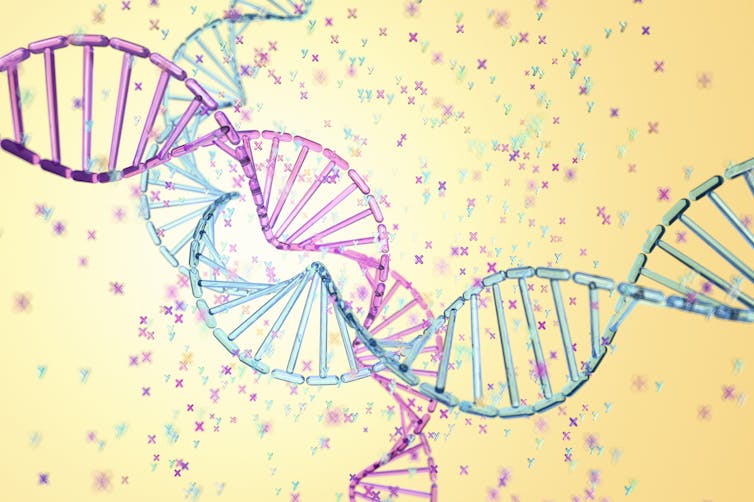
Gender and sex are more complicated than X and Y chromosomes. I Like That One/Digital Vision via Getty Images
Maggie Ruderman, Boston University and Kimberly Zayhowski, Boston University

Gender reveal parties are best known as celebrations involving pink and blue, cake and confetti, and the occasional wildfire. Along with being social media hits, gender reveals are a testament to how society is squeezing children into one of two predetermined gender boxes before they are even born.

These parties are often based on the 18- to 20-week ultrasound, otherwise known as the anatomy scan. This is the point during fetal development when the genitals are typically observed and the word “boy” or “girl” can be secretly written on a piece of paper and placed into an envelope for the planned reveal.

Now there is a new player in the gender reveal game: genetic screening.

Advancements in genetic research have led to the development of a simple blood test called cell-free DNA prenatal screening that screens for whether a baby has extra or missing pieces of genetic information – chromosomes – as early as 10 weeks into pregnancy. Included in this test are the sex chromosomes, otherwise known as X and Y, that play a role in the development and function of the body.

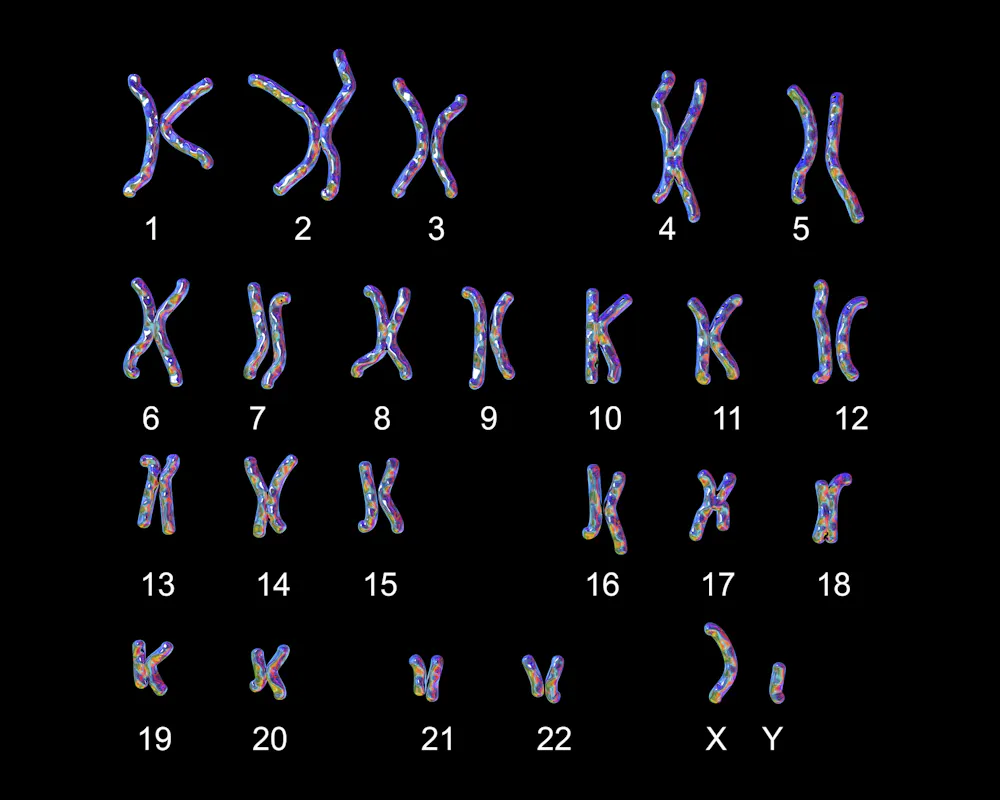
Illustration of human karyotype
Prenatal screening tests look for chromosomal abnormalities. Anastasia Usenko/iStock via Getty Images Plus

This blood test is more informally called noninvasive prenatal testing, or NIPT. Many people refer to it as “the gender test.” But this blood test cannot determine gender.

As genetic counselors and clinical researchers working to improve genetic services for gender-diverse and intersex people, we emphasize the significance of using precise and accurate language when discussing genetic testing. This is critical for providing affirming counseling to any patient seeking pregnancy-related genetic testing and resisting the erasure of transgender and intersex people in health care.

Distinguishing sex and sex chromosomes

Sex and gender are often used interchangeably, but they represent entirely different concepts.

Typically when people think of sex, they think of the categories female or male. Most commonly, sex is assigned by health care providers at birth based on the genitals they observe on the newborn. Sex may also be assigned based on the X and Y chromosomes found on a genetic test. Commonly, people with XX chromosomes are assigned female at birth, and people with XY chromosomes are assigned male. Since cell-free DNA, or cfDNA, prenatal screening can report on sex chromosomes months before birth, babies are receiving sex assignments much sooner than previously possible.

While cfDNA prenatal screening can offer insights into what sex chromosomes an infant may have, sex determination is much more complicated than just X’s and Y’s.

For one, sex chromosomes don’t exactly determine someone’s sex. Other chromosomes, hormone receptors, neural pathways, reproductive organs and environmental factors contribute to sex determination as well, not unlike an orchestra with its ensemble of instruments. Each cello, flute, tympani and violin plays a crucial role in the performance of the final musical score. There is no single instrument that defines the entirety of the symphony.

Expanding social and medical concepts of sex and gender beyond the binary can help patients and doctors.

Intersex people, or those with variations in sex characteristics that deviate from societal norms of binary sex, exemplify the complexities of sex. These variations can manifest in various ways beyond X and Y chromosomes, such as differences in hormone levels, genitalia or secondary sexual characteristics.

The oversimplification of sex based on societal norms has led many to believe that there are only two discrete sexes. The binary framework of sex excludes intersex people and perpetuates their erasure and mistreatment within both health care and society at large.

For instance, many intersex individuals face unnecessary surgeries, such as nonconsensual genital procedures, to conform to binary norms, violating their bodily autonomy.

Where gender comes in

While sex typically describes someone’s anatomical characteristics, gender is an umbrella term that encompasses the way someone views and presents themselves to the world. Countless aspects influence how someone defines their own gender and how the world views their gender, including clothing, haircuts and voice tone. Similar to how Western cultures have historically confined sex to two buckets, it has also created two gender categories: man and woman.

Gender is not dependent on anatomical parts or chromosomes. People are not math equations, and having certain combinations of biological parts does not equal someone’s gender. For example, some people may be transgender, meaning their assigned sex is not congruent with their socially or self-defined gender. Nonbinary people do not identify exclusively with either of the two genders in the binary, regardless of their assigned sex.

Just like sex diversity, gender diversity is not rare. A 2022 Pew Research Center analysis found that approximately 5% of adults in the U.S. under the age of 30 are transgender or nonbinary.

These estimates will likely increase as societal awareness and acceptance of gender-diverse individuals increases. Anti-transgender legislation often oversimplifies gender as strictly binary, conflating it solely with sex assigned at birth.

Intersex and gender-diverse people show that sex and gender are both multidimensional. Gender is not solely determined by biology, and it is erroneous to define someone’s gender by their sex, much less by their sex chromosomes.

Challenging sex and gender norms

The idea that biology plays the largest role in determining who an individual is, or bioessentialism, has governed misconceptions about sex and gender for many years. This concept is used to confine people to buckets and limit their self-determination.

For instance, societal norms dictate that women should be nurturing and gentle, while men are expected to be protective and assertive. Such rigid gender roles, often enforced through the lens of biology, serve to uphold notions of evolutionary destiny and a purported natural order.

Doctor holding stethoscope on belly of pregnant person
Categorizing your child at birth limits their ability to define who they are. Halfpoint Images/Moment via Getty Images

Marketing strategies for children’s toys often adhere strictly to gender roles, steering girls toward dolls and domestic play sets while steering boys toward action figures and construction sets.

Educational systems often reinforce gender norms by directing girls toward subjects such as literature and arts while steering boys toward science and mathematics. This perpetuates the notion that certain traits and interests are inherently linked to one’s sex and gender, thereby reinforcing societal norms and sustaining inequality.

Upholding binary constructs of sex and gender does not allow for individuality and gender fluidity. Categorizing people from the time their chromosomes are analyzed or the moment their genitals are observed at birth restricts their autonomy and authenticity. These simple assumptions set expectations that can be harmful.

Letting children define themselves

If you’re a parent offered cfDNA prenatal screening during pregnancy, remember that it is commenting only on one instrument in the orchestra of sex. It cannot examine all of the other factors that determine sex as a whole. And it most certainly cannot determine gender, which is an entirely different concert.

In recent years, Jenna Karvunidis, the mother considered the inventor of gender reveal parties, shared her regrets for starting the trend and noted that her views on sex and gender have shifted. In a 2019 Facebook post, Karvunidis wrote, “PLOT TWIST. The world’s first gender reveal party baby is a girl who wears suits!” She had also gone on to say, “Celebrate the baby … Let’s just have a cake.”

When the envelope is opened, the balloons are popped and the crafty cake is cut, consider how these practices perpetuate social confinements and a gendered destiny for your little bundle of joy. Perhaps opt simply for a celebration that leaves space for your child to one day define who they are.The Conversation

Maggie Ruderman, Assistant Professor of Medicine, Boston University and Kimberly Zayhowski, Assistant Professor, Boston University

This article is republished from The Conversation under a Creative Commons license. Read the original article.