Friday, October 29, 2021

Book Reviews: Magical London, Three Views

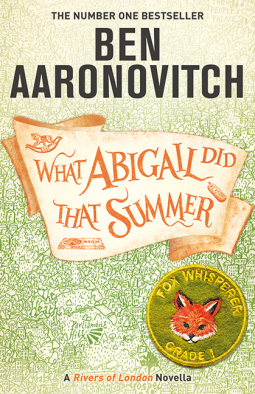
What Abigail Did That Summer, by Ben Aaronovitch (Subterranean)

Lies Sleeping, Ben Aaronovitch (DAW)

Best Thing You Can Steal, by Simon R. Green (Severn House)


I very much suspect that one night, Simon R. Green, Charles Stross, and Ben Aaronovitch met in a pub, got drunk together, and started telling tall tales about creepy things happening in London. Stross’s “Laundry Files” novels center on a secret agency tasked with keeping Lovecraftian Elder Gods in check. In Aaronovitch’s “Rivers of London,” waterways ancient and modern possess spirits, foxes have their own security forces, and a not-so-secret agency investigates supernatural crimes. Elsewhere I’ve reviewed some of the “Laundry Files” novels (they’re terrific fun, so check them out if you haven’t already).


My introduction to Aaronovitch’s enchanted London was reading Lies Sleeping and What Abigail Did That Summer simultaneously. It wasn’t intentional, but it turned out brilliantly. In the former, police constable and apprentice wizard Peter Grant investigates an ongoing mystery from the agency’s headquarters, “The Folly.” This is actually well into the series, which I didn’t realize, and there’s a massive amount of backstory, but I found that just hanging out with Peter was vastly entertaining. Really, a summer evening picnic, trying to get the spirit of Old Father Thames to remember where King Arthur left his sword? Delicious fun! Abigail of What Abigail Did That Summer is Peter’s cousin, and her own adventure took place back in 2018. Missing kids, a seriously psychotic haunted house, and a security detail provided by talking foxes were just a few of the marvels. Then Abigail appears in Lies Sleeping as an extraordinarily perceptive student, which makes sense given what she went through years ago. It’s no wonder the magical bosses insisted she receive proper training!
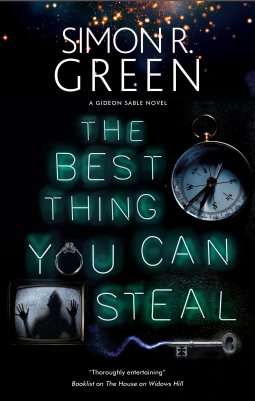

And then there’s Green’s Best Thing You Can Steal, which features a thief and con man extraordinaire, going under an assumed name. He specializes in stealing things like a ghost's clothes or a photo from a country that never existed. Now he’s after a television set that shows the future and that most delicious of prizes, revenge against “the worst man in the world.” He’s put together a team that includes a ghost who remembers being human, a man wearing the armor of the angels he’s slaughtered, the possibly human embodiment of random luck, and his ex-girlfriend, who can make technology fall in love with her. Armed with a ballpoint pen that can stop time and a skeleton key that can open any lock, not to mention their special talents and wits, he and his team go up against poltergeist attack dogs, golem guards, shaped curses, and a villain who can foresee their every move.


Each of these books is fast-paced, chock-full of inventive imagination and quirky characters. They also share a blend of off-beat bad guys, love for London and the English language, and humor that strikes me, as an American, as quintessentially British. Which is not to say they share a setting, magical systems, or histories, because each is as individual as the thoroughly skillful author who created it, only that if you enjoyed one you’ll likely find delight in the others.

Friday, October 22, 2021

Short Book Reviews: The Transformative Power of Fungi

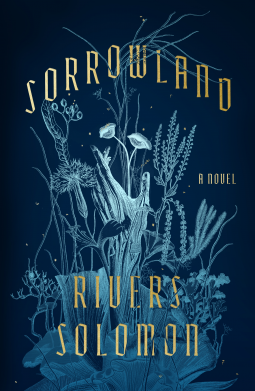
Sorrowland, by Rivers Solomon (Farrar, Straus and Giroux)


Rivers Solomon’s previous novel, An Unkindness of Ghosts, was a powerful story set on a multi-generation space ship. Now she weaves a tale of magic and racism in the American South. The story begins with a gripping sequence as pregnant Black teen Vern escapes to the woods from an oppressive cult commune. Alone she gives birth to and then raises two very different fraternal twins. From almost the beginning of her exile, she’s hunted by shadowy demons and haunted by ghosts. I confess I found it unbelievable that a girl this young could not only survive delivering twins without help but re-invent survivalism, everything from finding or growing enough food to making her own shelter and clothing. However, the story carried me along, and it turned out I was right about these feats being extraordinary and it was a piece of deliberate awesomeness on the author’s part.

This book has many layers woven together. Seemingly disparate elements, like Vern’s ability to see and later to physically interact with ghosts, are eventually tied together as Vern’s physical and emotional transformation proceeds. The skillfulness of the prose and the dynamic plot momentum gave me enough confidence that the author knew what she was doing, and with each emerging connection, that trust was amply rewarded.

Solomon is a courageous, generous writer who doesn’t shrink from facing painful and difficult material squarely. Vern’s experiences in a Black-supremacist cult and her forays into the larger world are fraught with danger, bigotry, and ugliness. Yet the story never descends into polemics and it’s not solely about racism. There’s a great deal about love and loyalty and friendship, and how these define our humanity.

Monday, October 18, 2021

Do You Outline Your Novel? Should You?


Photo by Cleo Sanda
It cannot be repeated often enough that there is no single right way to write a novel (or to compose a symphony or design a house). All these artistic endeavors require certain elements (plot, characters, tension rising to a climax, or motif and variations, harmony, contrast, or foundation, walls, plumbing, etc.) They vary in the point in the creative process at which those crucial elements must be in place, of course. Within those parameters, there’s a great deal of flexibility that allows for individual differences. What matters is not when a writer nails down the turning points, but that they are present and in balance with the rest of the book when it ends on the editor’s desk.
Many writers attempt their first novels by the “seat-of-the-pants” method, that is, writing whatever pops into their heads. Sometimes they end up with dead ends (disguised as “writer’s block”) and don’t finish the work. Other times, they do finish, only to discover (either through their own perceptions or feedback from others) that the book has significant problems. So they write another draft and go through the same process until either the story works or they become so frustrated they give up, or they refuse to accept further critiques and self-publish it.

There’s nothing inherently wrong with such a spontaneous approach to the first draft. A good deal of the pleasure of writing is in discovery, in not knowing what will come next as the adventure unfolds. This is how children play. It does require a separate editorial, self-critical phase, at least for most of us. That’s neither good nor bad, it’s just part of the process. If you want to “pants” your first draft, you accept that you’re going to have to revise. Maybe a little, maybe a lot. Some writers loathe revision. I happen to love it.

At some point, it occurs to many of us that if we maybe thought about what was going to happen in our novel and how we were going to portray it, that we might save ourselves a bit of revision time. We might even jot down a few notes, reminding ourselves that this is just a tentative sketch and that nothing is carved in granite. We may and most certainly do change our minds when we discover that the actual story has diverged significantly from our strategy. I’ve been known to rework my notes, negotiating the borderlands between spontaneous writing and ill-thought-out plan.

Friday, October 15, 2021

Short Book Reviews: Magical Lovers Reunited


The Beautiful Ones
, by Silvia Moreno-Garcia (Tor)

Spoiler alert!

As I read Siliva Moreno-Garcia’s The Beautiful Ones, I kept thinking of Jane Austen’s Persuasion, with its theme of lovers given a second chance. In Persuasion, young lovers Anne and Frederick are parted when her family persuades her to reject his proposal because of he lacks riches and aristocratic standing. Years later, when he returns as a rich naval captain, they gradually overcome misunderstandings, jealousies, and broken hearts to re-kindle their devotion. The Beautiful Ones begins when a pair of youthful, parted lovers, Valérie and Hugo, meet again. By this time, however, Valérie has given in to family pressure and married, whereas Persuasion’s Anne remained single, a spinster ignored by her family. Valérie’s husband is rich and boring, his sole virtue seems to be his affection for his niece, Nina, who visits him. Hugo, like Frederick, is now rich and Valérie the icy, elegant queen of the social scene (“The Beautiful Ones” of the title). Magic comes into play since Nina, like Hugo, can move objects with her mind. While attempting to get close to Valérie, Hugo becomes Nina’s mentor in levitation. She falls in love with him and is shattered when she walks in on him and Valérie in a passionate embrace.

Here the parallel breaks down. Our sympathies are with Nina, not Valérie, who has become an unrelentingly selfish, vain, mean-spirited, possessive woman. Who she might have been if she and Hugo had stayed together is a matter of conjecture because the unfolding story makes it plain that theirs was a tempestuous, immature, and problematic infatuation that both have outgrown but not been able to let go of.

This leaves the issue of Nina and Hector, her heartache and anger at him, his gnawing guilt at having caused so much pain to someone he actually loves. Hugo’s struggles to come to terms with how he betrayed and injured Nina force him to review his past and himself in an uncompromising light. It’s a reversal of roles from Persuasion, where his was the broken heart, but strongly parallels the journey to understanding and forgiveness, both of self and the beloved, with renewed appreciation for how each enriches the other’s life. It’s a gorgeous, emotionally generous tale worth savoring again and again.


Monday, October 11, 2021

Gossip and Community


The internet is practically an engraved invitation to indulge in gossip and rumor. It's so easy to blurt out whatever thoughts come to mind. Once posted, these thoughts take on the authority of print (particularly if they appear in some book-typeface-like font). Have you ever noticed how much easier it is to question something when it appears in Courier than when it's in Times New Roman? For the poster of the thoughts comes the thrill of instant publication. Only in the aftermath, when untold number have read our blurtings and others have linked to them, not to mention all the comments and comments-on-comments, do we draw back and realize that we may not have acted with either wisdom or kindness.

To make matters worse, we participate in conversations solely in print, without the vocal qualities and body language that give emotional context to the statements. I know a number of people who are generous and sensitive in person, but come off as abrasive and mean-spirited on the 'net. I think the very ease of posting calls for a heightened degree of consideration of our words because misunderstanding is so easy.

I've been speaking of well-meaning statements that inadvertently communicate something other than what the creator intended. I've been guilty of my share of these, even in conversations with people with whom I have no difficulty communicating in person. What has this to do with gossip?