Tuesday, March 13, 2012

A New Anthology: Beyond Grimm: Tales Newly Twisted

First of all, a Happy Editor dance... [dance, dance, dance]

This is the first anthology I've edited (actually, co-edited with Phyllis Irene Radford) for Book View Cafe. It began, lo these many many months ago, with an in-house discussion along the lines of "Hey, wouldn't it be fun to..." Book View Cafe has already published several anthologies (Rocket Boy and the Geek Girls, Dragon Lords and Warrior Women -- which has a story of mine! -- The Shadow Conspiracy I and  II), so there was some precedent. We knew to ask things like, Will this be reprint, original stories, or both? Will it be a benefit for BVC or will the authors receive shares of the proceeds? How will we define the theme? At a certain point, we'd reached a sufficient level of enthusiasm and clarity so that someone had to put on an organizational (aka editor's) hat.

Thinking this would be marvelous fun, I volunteered, and the way it worked out, Phyl co-edited it with me. I supplied time and my own editorial experience, and she had the expertise of working with the BVC anthology publication procedures. Because there were two of us, we could submit our own stories to one another, thereby avoiding the editing-your-own-work scenario.

One of the things I love about editing anthologies is watching the process, the landscape of that adventure, unfold, discovering moments of truth and hilarity and heart-wrenching sadness and sheer beauty and poetry in prose. Beyond Grimm was no exception. Although we started with "let's retell classic fairy tales," our imaginations took us in other directions as well - the sun-drenched islands of Greek mythology, legends from the frozen north, Arthurian tales, nursery rhymes, even my own riff on the plots of classical ballets. Fairy-tale lands, contemporary urban settings, magical and not-so-magical steeds, spells and epistles of the people's revolution, mysterious locked chambers and shape-shifters...moonlight and storms.

Tuesday, March 6, 2012

GUEST POST Madeleine E. Robins on Regency Romance

I wrote Althea, my first book, because I needed something to read.  I think most readers know that feeling: you look around wanting a particular something and you cannot, in that moment, find it.  What I wanted was more Georgette Heyer, new Heyer; but Miss Heyer had recently died, and there would be nothing new from her any more.

I discovered Georgette Heyer's books in high school, and read her entire oeuvre, including her medieval books and her mysteries; what I really loved were her Georgian and Regency romances.  They were witty and sparkling and filled with nifty sense of the time and place, and unlike most of the period fiction I had stumbled over up to that time, they weren't Victorian; call it aesthetic preference or just cussedness--the Victorians don't speak to me.  But the Regency, as depicted by Heyer, was bright and frothy and delightful.

Then I encountered Jane Austen, and fell into an entirely different and deeper love; Austen writes of love and money but without Heyer's fascination with the nobility of the nobility (virtually none of the titled characters in Austen are admirable).  Austen is deadly funny, observant, and firmly rooted in a real time and place (my favorite line in Sense and Sensibility comes at the end, when the heroine and her husband are so happy that "they had in fact nothing to wish for, but the marriage of Colonel Brandon and Marianne, and rather better pasturage for their cows.").  I went through a brief period where my passion for Austen kind of spoiled Heyer for me.  But I got better.

Monday, February 27, 2012

The Feathered Edge: A Woman Warrior and The Horned King

"The Woman Who Fell In Love With The Horned King" is the second story with a woman warrior-as-champion/paladin. One of the most interesting things about putting together these anthologies of romantic, swashbuckling fantasy (2 volumes of Lace and Blade, and now The Feathered Edge: Tales of Magic, Love, and Daring) is the synchronicity -- or parallelism -- or "great minds work alike" thematic resonances. The first had 2 stories about Spanish highwaymen, the second 2 stories with Chinese generals. I'm not in the least surprised, but I am delighted and a bit awestruck by the way life works. The cover for The Feathered Edge could illustrate either this story or Sean McMullen's "Culverelle." You get to pick.

Now to the story. No, wait, background! I've loved Judith Tarr's work since I picked up A Wind In Cairo when it first came out. The horse got me into the book, as I'm a sucker for well-written horse characters, but the sheer mastery of storycraft, the depth and nuance, the use of language, all kept me wanting more. None of this should come as a surprise. Judy knows more about horses than any ten fantasy writers put together, and what she doesn't know, one or another of her nine amazing Lipizzan horses will enlighten us about. She's written the best guide to horses in writing I've ever seen, Writing Horses; The Fine Art of Getting It Right, and if you are a writer and need a horse in your story, it's a must-read.

Wednesday, February 22, 2012

Now in print...

The Feathered Edge: Tales of Magic, Love, and Daring is now available as a trade paperback. It's up on Amazon - don't see it elsewhere yet. Should make it to bookstores in a week or two.

If you enjoy it, please post a brief review!

Tuesday, February 21, 2012

Winter reading - some very cool books

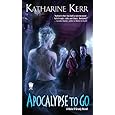
I’m an unabashed fan of Katharine Kerr’s “Nola O’Grady” series. The third, Apocalypse To Go, lives up to its predecessors in inventiveness, drama, romance, and whimsy. In this urban fantasy, the heroine works for a supernatural Agency “so secret, the CIA doesn’t know it exists”. This takes place in an alternate San Francisco, one in which magic and the clandestine agencies necessary to regulate it are real. This world is not the only one; there are alternate, weirdly dystopic worlds (and a gateway in the attic of Nola’s aunt’s house). Not only do the Agency and its people hide in plain sight, Nola’s family, Irish illegal immigrants with past ties to the IRA, live with secrets, low on the radar. In this newest novel, we not only explore the radioactive San Francisco from previous episodes, but we encounter yet another world, one in which the dominant intelligent race is feline in origin, leopard to be precise. Apocalypse To Go definitely builds on the previous two books, but Kerr offers enough toe-holds so that it can serve as an entry point. Readers should be warned, however, that the series is addictive.
Winter brings storms, and storms mean power outages. Here in the mountains, these often go on for days. Most years, our generator kicks in and we continue on as before. This year, however, through a series of mechanical failures, we suffered through a period without electricity. Fortunately, there are many wonderful things to do that do not require it. Walking the dog, playing the piano, snuggling by candle light. Reading…as long as it’s daytime. All of which is a roundabout way of saying how glad I was that I’d loaded Pati Nagle’s Immortal on my (fully-charged) netbook computer. As the forest darkened, I pretended I was on vacation and curled up in my favorite chair.