Showing posts with label sword and sorcery. Show all posts

Friday, April 11, 2025

Book Review: A Sword and Sorcery Flop

 Red Sonja: Consumed, by Gail Simone (Orbit)
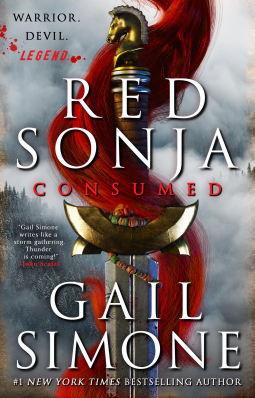

I tried hard to like this book, but I failed. I never overcame my initial, extremely unpleasant impression of Red Sonja as callous, self-centered, and incompetent. Even the queen she beds and betrays dives headlong into revenge without a second thought. Jumping from one POV character to another further disrupted any engagement with the story.

Sword and sorcery in the tradition of Robert E. Howard is a stylized subgenre. The tropes are distinctive but consistent: larger-than-life characters with larger-than-life adversaries, colorful settings with mythic overtones, exaggerated action sequences, and a tendency toward florid prose. Consistency with Howard’s literary style without becoming ridiculous amounts to a high-wire act. In the hands of a master, the elements come together like an amusement park ride: breathless, engaging escapism that is ultimately emotionally satisfying. The best of these stories work by evoking psychological resonances (see Joseph Campbell’s The Hero’s Journey) in an immersive reading experience.

Alas, not only was I unable to connect with any of the characters in the book’s opening, but too many details strained my credibility even by the standards of the subgenre. For example, Red Sonja is remarkably unaware of her surroundings, allowing enemies to sneak up on her on a regular basis. She’s just plain incompetent at basic survival skills. Many details about riding and horses are wrong in the sense of being ignorant. (Example: a skilled rider on a familiar and extremely well-trained mount does not haul on the reins to halt but uses a shift in weight and pelvic angle.) Once my confidence in the author had been impaired, other things that might not have otherwise kicked me out of the story became barriers, like “firing” arrows in an era before gunpowder. That’s a linguistic bobble that has become commonplace and can be excused in an otherwise consistent setting.

On the plus side, Simone occasionally comes up with a memorable turn of phrase, action, or characterization (but not, alas, of Red Sonja).

I checked other reviews, both critical and defensive, to see what other readers thought. I wondered if I was missing something because I hadn’t read all the modern stories. The reviewers divided mostly into two camps: those with extensive knowledge of the Red Sonja novels and graphic and those who just want a fun reading experience. Some of the former novels are either critical of the many lapses in geography, nomenclature, and history, while others insist that this book cannot be properly appreciated without in-depth knowledge of the franchise. I disagree with the latter.

Good storytelling is good storytelling, regardless of genre. Nobody expects high literary values from sword and sorcery, but perhaps that is a mistake. Consider the work of Tanith Lee, C. J. Cherryh or C. L. Moore. Unfortunately, Gail Simone is not in their class.


Saturday, July 23, 2016

Cover Reveal: Sword and Sorceress 31

Here's a first peek at the cover by Dave Smeds. This volume, edited by Elisabeth Waters, includes my story, "Sage Mountain," which I describe as Buddhist sword'n'sorcery. With trolls. And a dragon. You can read a snippet here.


The anthology will be out in November 2016.

Tuesday, February 16, 2016

A Fruitful Absence

It's been a while since I've blogged regularly. I've put up some quotes-to-think-about on Mondays, and soon will be hosting a series of guest interviews from the contributors to Realms of Fantasy.

This does not mean my writing has come to a screeching halt, however! Quite the opposite: I've been working on two and sometimes three projects. One is the next-next Darkover novel (Thunderlord is scheduled for this August, so this is The Laran Gambit, which I hope to turn in by the end of 2015.) I'm about 10K words into it; it's got some forward momentum building to the first thing-changes-everything moment. I've heard writers say they don't like to talk about a new project because their creative energy goes into the talking, not the writing. That's somewhat true in this case. And besides, why talk about a book that isn't even finished when one that is ready to go will be coming out soon? This is what happens when writers turn in one book and dive right into the next, while publishing takes its sweet time. If you're curious about Thunderlord, check the blog archives here. I posted snippets of chapters from the first half of the book. And I'll blather on about it as the day approaches.

The other big project is a combination of fiction (sword and sorcery) and non-fiction (commentary on my own sometimes very dark journey of healing from my mother's murder). I've spoken about the latter, sometimes to large audiences, but writing about it, especially as intensely as I have been doing in the last couple of months, is much more immersive. I have no idea if anyone will want to read it, but the writing has been filled with revelations for me. Here's a bit from the introduction:

Because I am a writer, much of what I experienced — not the external circumstances but the emotions and insights — made its way into my stories. In the first few years after the murder, I wrote a short story, “Rite of Vengeance” (Sword & Sorceress V, ed. Marion Zimmer Bradley, DAW, 1988) about anger and revenge; it also contained a glimmering of understanding of how these could destroy me. I followed the same wounded heroine in “Crooked Corn” (Spells of Wonder, ed. Marion Zimmer Bradley, DAW, 1989) and eventually used these two episodes as the basis for a novel-length work, The Haunted Ring. The good news was that this gave me a sense of completion; the bad news was that it simply did not work as a novel. Eventually, I set it aside as a poignant but essentially dead-end exercise. 
Years and much recovery later, this book presented itself to me again. I was speaking to a class of law students, trying to explain what it was like to live through the violent death of a loved one. I scribbled a few notes on the “stages” of healing — numbness and shock, anger and vengeance, letting go, re-engaging with life, and so forth. It occurred to me that The Haunted Ring was not a deeply flawed, episodic, meandering novel. It was a healing journey disguised as a fantasy-adventure.
Here then is that story, with my own commentary about how I now understand what all this was about for me, and some queries that have been helpful to me. Stories keep our intellects busy while the deeper parts of our psyches resonate with things that are not easily put into words. Every person's experience of tragedy is different. How we make sense of what has happened to us also changes with time. A reader brings his or her own history and temperament, beliefs and visceral reactions, to the tale.

The way I've structured this book, each chapter of story is followed by commentary about my own experiences, reflections on larger issues of clawing my way out of the darkness and then creating the life I want, and queries for reflection. I'll keep you posted about the progress of this piece. It's in revision now, but because it is so emotionally intense, it's hard to predict when it will fly along and when I have to take a breather.

Tuesday, April 2, 2013

The Feathered Edge: Moonlight and Martial Arts

I love the way each story in this anthology carries with it a history, not just of that particular tale itself but of the growth and comradeship of the author. So in order to talk about Dave Smeds's wonderful "A Swain of Kneaded Moonlight," I have to go back to how I first met him. We both had stories in the fourth volume of Sword & Sorceress (1987), edited by Marion Zimmer Bradley. (It's a marvelous volume, if I do say so, with stories by Mercedes Lackey, Jennifer Roberson, Charles de Lint, Diana L. Paxson and more, some of us just starting out our careers.) As an editor, Marion encouraged new writers and eventually a whole community of successful authors who'd made their first sales to her emerged. "Gullrider" wasn't Dave's first sale; he was already building a reputation as an up-and-coming fantasy writer with quite a few short fiction sales, a novel in print (The Sorcery Within) and another in publication when Sword & Sorcery IV came out.

"Gullrider" showed a number of characteristics I would grow to recognize as hallmarks of a Dave Smeds story - an original idea, carefully developed, meticulous attention to story craft, and a "heart" that stays with me long after I've put down the volume. At a time when the generic fantasy default was telepathic dragons, Dave took us soaring with sea birds and diving with mermen.

Various of us whose early sales were to Marion managed to hook up at conventions, this being before the internet made geographical separation irrelevant. I might have been introduced to Dave by Jennifer Roberson, another rising star I'd met through Marion, or perhaps we made our way to one another on our own. Dave and I discovered that we were not only writers of fantasy but martial artists. Dave's art was goju-ryu karate and today he is a senior black belt and instructor in that style. I'd met other writers who were also martial artists; it was like a secret underground, with the recognition of the discipline required, an appreciation of the balance of mind, body, and spirit. Not only that, most of us found our martial arts experiences sneaking into our fiction. This was certainly true for Dave!