Showing posts with label galaxies. Show all posts

Monday, March 20, 2023

Love Letters from Space Telescopes

 What an age we live in!
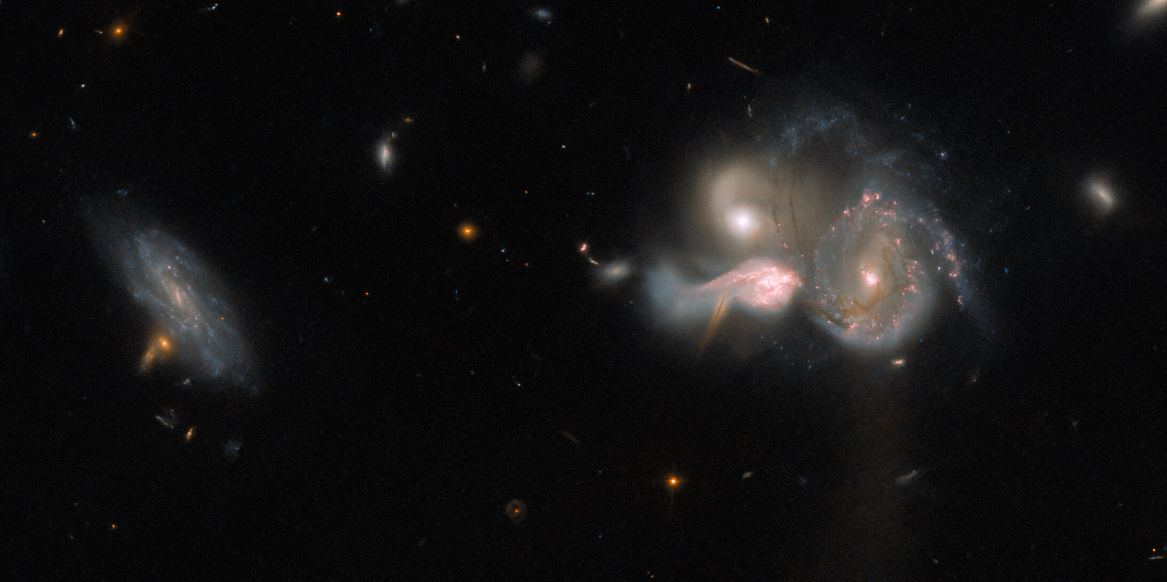

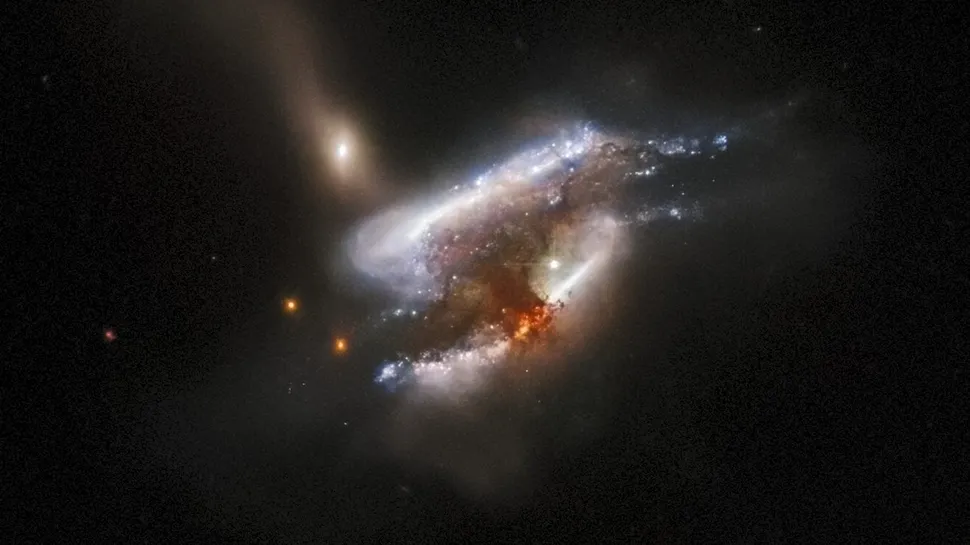
A spectacular trio of merging galaxies in the constellation Boötes takes center stage in this image from the NASA/ESA Hubble Space Telescope. These three galaxies are set on a collision course and will eventually merge into a single larger galaxy, distorting one another’s spiral structure through mutual gravitational interaction in the process. An unrelated foreground galaxy appears to float serenely near this scene, and the smudged shapes of much more distant galaxies are visible in the background. Image Credit: ESA/Hubble & NASA, M. Sun. Article here.


On March 1, 2023, NASA’s Juno spacecraft flew by Jupiter’s moon Io, coming within 51,500 km (32,030 miles) of the innermost and third-largest of the four Galilean moons. The stunning new images provide the best and closest view of the most volcanic moon in our Solar System since the New Horizons mission flew past Io and the Jupiter system in 2006 on its way to Pluto.

h
Jupiter’s moon Io, as seen by the JunoCam instrument on Juno, on March 1, 2023. Credit: NASA/JPL-Caltech/SwRI/MSSS/ processed by Kevin M. Gill.
Cleary, Io still looks like a pizza. The mottled and colorful surface comes from the volcanic activity, with hundreds of vents and calderas on the surface that create a variety of features. Volcanic plumes and lava flows across the surface show up in all sorts of colors, from red and yellow to orange and black. Some of the lava “rivers” stretch for hundreds of kilometers


Glimpsed only occasionally at the hearts of massive clusters of galaxies, ultramassive black holes are some of the largest and most elusive objects in the universe. These black hole behemoths have masses exceeding that of 10 billion suns, making them far more monstrous than even the supermassive black holes found at the centers of galaxies like the Milky Way, and their tremendous size has long perplexed astronomers. 

Now, researchers studying a rare galaxy merger with three supermassive black holes at its center may have finally discovered the origins of these cosmic monsters. 

Using a high-resolution cosmological simulation called ASTRID, the team modeled the evolution of the universe as it appeared about 11 billion years ago. In the simulation, the team witnessed the birth of an ultramassive black hole following the merger of the three galaxies. Each of these galaxies contained its own quasar, a supermassive black hole that feeds on gas and powers massive outbursts of radiation that can outshine all the stars in their host galaxies combined.

Monday, September 13, 2021

Galaxies Dance to the Death

This image  from the Hubble Space Telescope was so striking, I could not resist sharing it with you.


These two galaxies (NGC 3808A on the right and NGC 3808B on the left) are distorted ("peculiar") by the massive gravitational tides of a near encounter. The one on the right shows areas of new star formation as a result. Eventually, they will merge into a single galaxy. The bridge between them is made up of gas, dust, and stars.

I wonder what the night sky looks like from a planet in either one -- delicious fodder for a science fiction story! Or a fantasy? What will the two galaxies look like in a billion years? Computer modeling can give us a fascinating peek. Meanwhile, (thank you yet again, Hubble!) we get to enjoy this beautiful, dramatic image.

Monday, July 10, 2017

A Hidden Island of Beauty in the Heavens


This image, from Astronomy Picture of the Day, reminds me of the beauty all around us, throughout the cosmos, if only we can see it. The gorgeous spiral galaxy, IC 342, is usually not visible because it lies on the plane of the Milky Way, and all those stars and dust obscure the view. The pink areas mark regions of star formation, perhaps a fairly recent burst in activity. It's thought that IC 342, which really deserves a name fitting to its glory, may have gravitationally influenced the evolution of the local group of galaxies and the Milky Way.

Sunday, May 21, 2017

Glory in the Skies

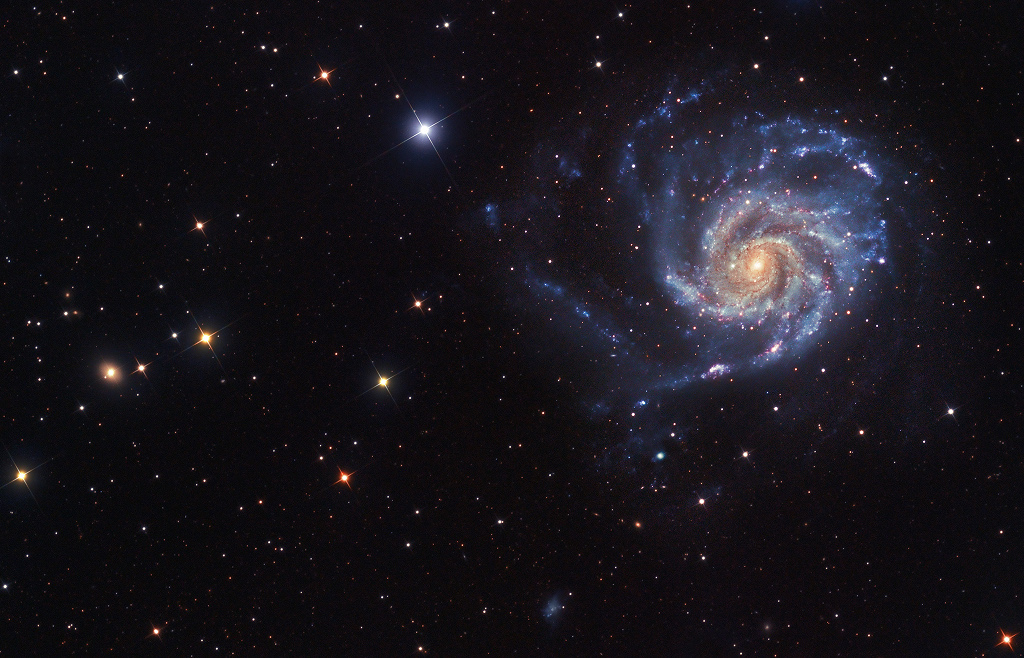
Today's "Astronomy Picture of the Day" is so beautiful, so uplifting to my spirits, I cannot resist posting it here. For all the troubles on our small globe, the universe is an awesome place. Often I need reminding of the scale of things, "this too shall pass," and that there is always beauty and wonder to be found if we but lift our eyes.


About 170,000 light-years across, this galaxy is enormous, almost twice the size of our own Milky Way galaxy. ... Its core is dominated by light from cool yellowish stars. Along its grand spiral arms are the blue colors of hotter, young stars mixed with obscuring dust lanes and pinkish star forming regions.

Wednesday, October 14, 2015

[links] Wonderful Things in the Sky and Elsewhere

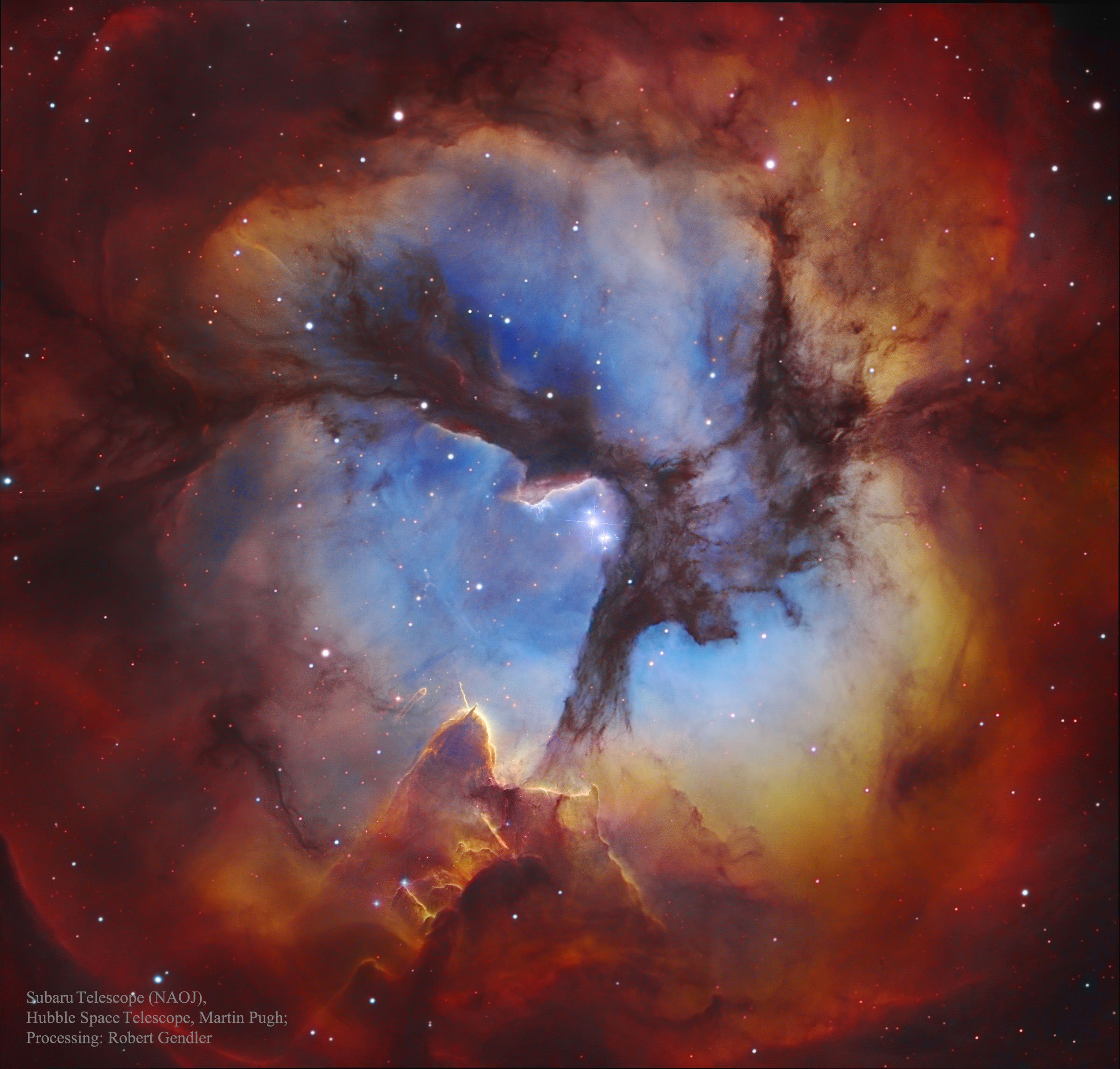
First, a beautiful image of the Trifid Nebula to brighten your day:


Mountains of opaque dust appear on the right, while other dark filaments of dust are visible threaded throughout the nebula. A single massive star visible near the center causes much of the Trifid's glow.
 Thank you, Hubble Space Telescope!


From Open Minded Health: Article Review: Sexual Orientation Identity Disparities in Awareness and Initiation of the Human Papillomavirus Vaccine Among U.S. Women and Girls
Human Papilloma Virus
Lesbian, bisexual, and straight women had heard of the HPV vaccine. There was no difference there. However, 28% of straight women, 33% of bisexual women and 8.5% of lesbian women received the HPV vaccine. That’s 8.5% of lesbians vs 28-33% of non-lesbian women. Why?? Lesbians are at risk for HPV infection too!


In case you despaired of there being no new animal species left to be discovered, here is a beautiful new species of lemur:


About the size of a small squirrel, the animal weighs 250-310 g. It is reddish-brown in color with a white underside and has brownish-black rings around the eyes.

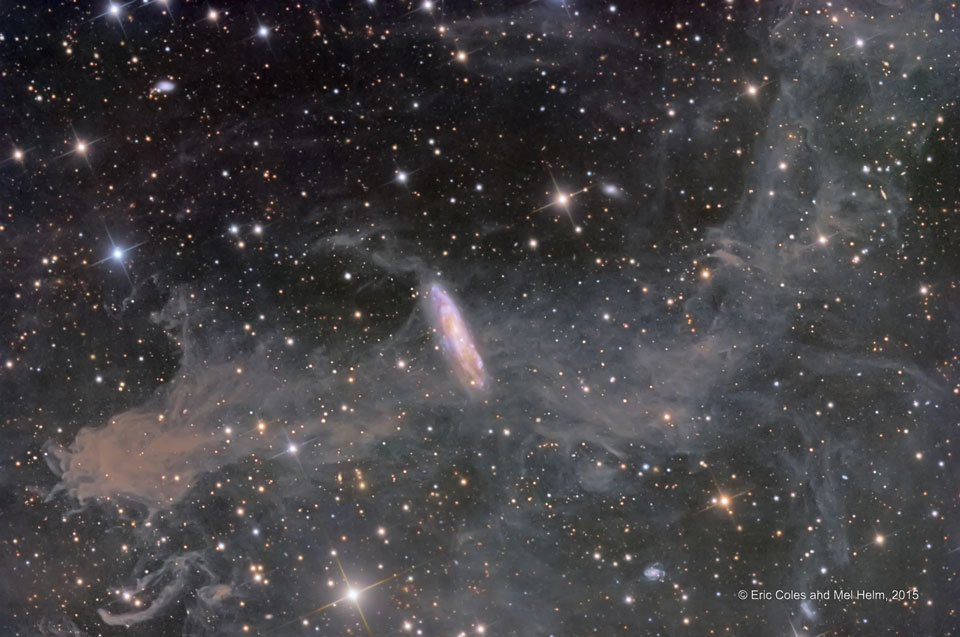
This galaxy (MBM 54) in the constellation Perseus isn't really awash in dust.  


The faint but pervasive clouds of interstellar dust ride above the galactic plane and dimly reflect the Milky Way's combined starlight. Known as high latitude cirrus or integrated flux nebulae they are associated with molecular clouds.

Thursday, July 21, 2011

More Cosmology: Looking Back in Time

UGC 12158, photo by Hubble/NASA
More strange and wonderful theoretical stuff" As we look backwards in time, the universe gets denser and hotter; we know this from the absorption lines in the background radiation, and it fits with our current theory. The densities of galaxies have also evolved as expected.

In the first seconds after the Big Bang, radiation dominated, then matter dominated with formation of galaxies.