Showing posts with label Hubble Space Telescope. Show all posts

Monday, March 20, 2023

Love Letters from Space Telescopes

 What an age we live in!
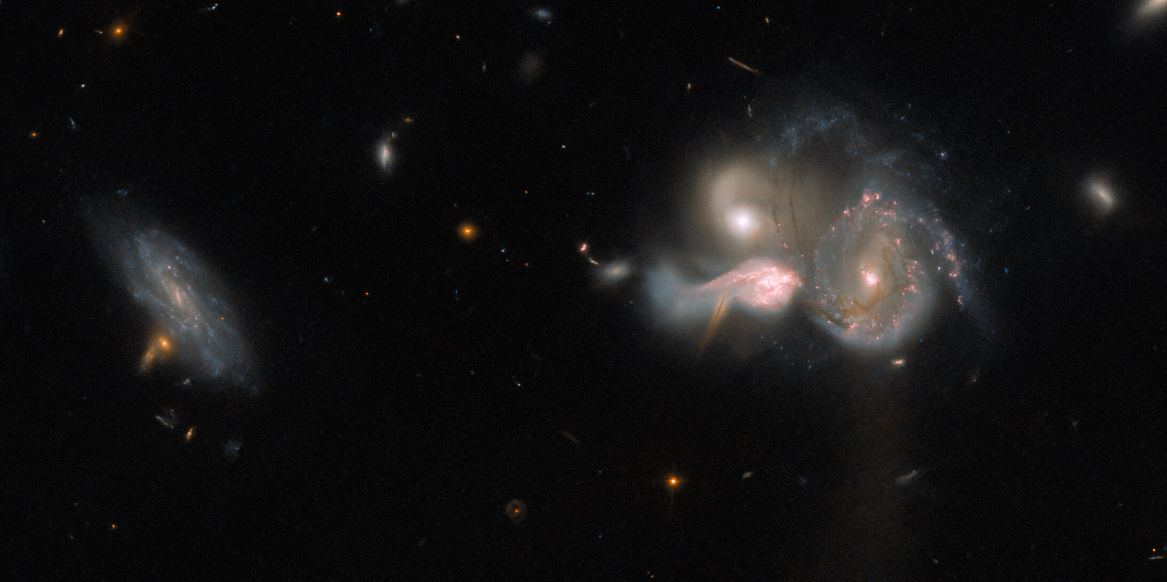

A spectacular trio of merging galaxies in the constellation Boötes takes center stage in this image from the NASA/ESA Hubble Space Telescope. These three galaxies are set on a collision course and will eventually merge into a single larger galaxy, distorting one another’s spiral structure through mutual gravitational interaction in the process. An unrelated foreground galaxy appears to float serenely near this scene, and the smudged shapes of much more distant galaxies are visible in the background. Image Credit: ESA/Hubble & NASA, M. Sun. Article here.


On March 1, 2023, NASA’s Juno spacecraft flew by Jupiter’s moon Io, coming within 51,500 km (32,030 miles) of the innermost and third-largest of the four Galilean moons. The stunning new images provide the best and closest view of the most volcanic moon in our Solar System since the New Horizons mission flew past Io and the Jupiter system in 2006 on its way to Pluto.

h
Jupiter’s moon Io, as seen by the JunoCam instrument on Juno, on March 1, 2023. Credit: NASA/JPL-Caltech/SwRI/MSSS/ processed by Kevin M. Gill.
Cleary, Io still looks like a pizza. The mottled and colorful surface comes from the volcanic activity, with hundreds of vents and calderas on the surface that create a variety of features. Volcanic plumes and lava flows across the surface show up in all sorts of colors, from red and yellow to orange and black. Some of the lava “rivers” stretch for hundreds of kilometers


Glimpsed only occasionally at the hearts of massive clusters of galaxies, ultramassive black holes are some of the largest and most elusive objects in the universe. These black hole behemoths have masses exceeding that of 10 billion suns, making them far more monstrous than even the supermassive black holes found at the centers of galaxies like the Milky Way, and their tremendous size has long perplexed astronomers. 

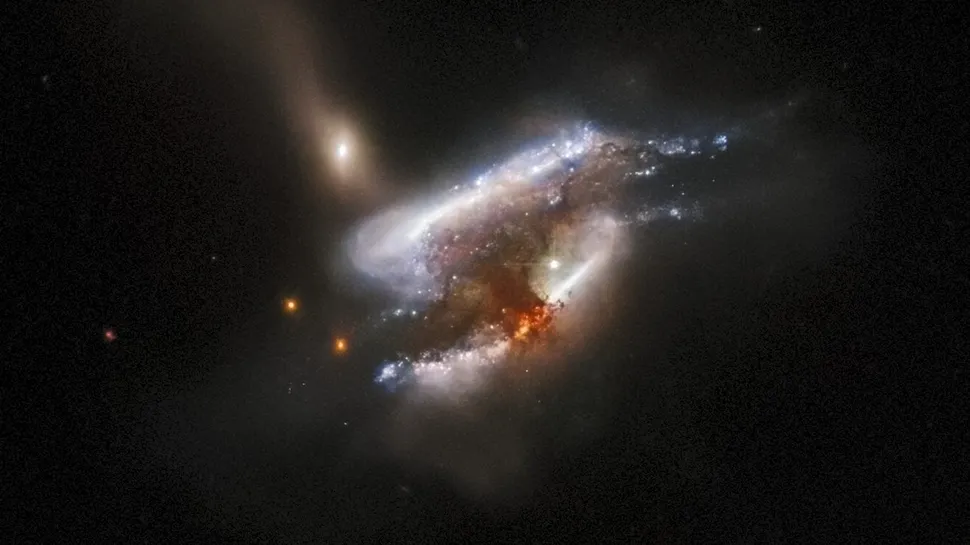
Now, researchers studying a rare galaxy merger with three supermassive black holes at its center may have finally discovered the origins of these cosmic monsters. 

Using a high-resolution cosmological simulation called ASTRID, the team modeled the evolution of the universe as it appeared about 11 billion years ago. In the simulation, the team witnessed the birth of an ultramassive black hole following the merger of the three galaxies. Each of these galaxies contained its own quasar, a supermassive black hole that feeds on gas and powers massive outbursts of radiation that can outshine all the stars in their host galaxies combined.

Monday, September 13, 2021

Galaxies Dance to the Death

This image  from the Hubble Space Telescope was so striking, I could not resist sharing it with you.


These two galaxies (NGC 3808A on the right and NGC 3808B on the left) are distorted ("peculiar") by the massive gravitational tides of a near encounter. The one on the right shows areas of new star formation as a result. Eventually, they will merge into a single galaxy. The bridge between them is made up of gas, dust, and stars.

I wonder what the night sky looks like from a planet in either one -- delicious fodder for a science fiction story! Or a fantasy? What will the two galaxies look like in a billion years? Computer modeling can give us a fascinating peek. Meanwhile, (thank you yet again, Hubble!) we get to enjoy this beautiful, dramatic image.

Thursday, November 2, 2017

A Grand Age of Astronomical Discovery

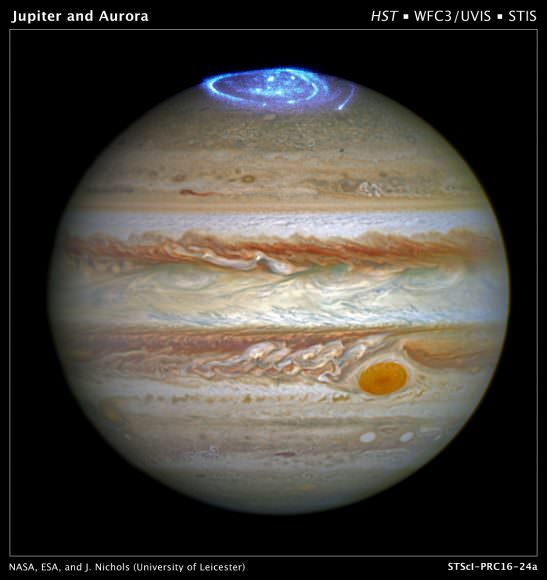
This is an amazing age of astronomical discovery. Not that long ago we could only speculate on the existence of planets around other stars, not to mention exploring those in our own system. We didn't know Jupiter had auroras or any of the many, many amazing discoveries of the last decades. Once we were limited to what our eyes and cameras could detect through the thickness of our terrestrial atmosphere. The Hubble Space Telescope launched our instruments beyond that blurring layer, and other telescopes, both on Earth and in orbit, expanded our view to include other parts of the EM spectrum. We have X-ray and infrared telescopes, and color enhancement by computers. Space probes like the Pioneers, Voyager, Spirit and Opportunity, Cassini-Huygens, Juno, and New Horizons have vastly expanded our understanding of the solar system. Who knows what wonders lie yet to be explored?

Here are a few tidbits in recent news:


In the past, auroras have been spotted around Jupiter’s poles by NASA’s Chandra X-ray Observatory and by the Hubble Space Telescope. Investigating this phenomena and the mechanisms behind it has also been one of the goals of the Juno mission, which is currently in an ideal position to study Jupiter’s poles. With every orbit the probe makes, it passes from one of Jupiter’s poles to the other – a maneuver known as a perijove. Full article here.


Using the NASA/ESA Hubble Space Telescope, astronomers have discovered that the brightest galaxies within galaxy clusters “wobble” relative to the cluster’s centre of mass. This unexpected result is inconsistent with predictions made by the current standard model of dark matter. With further analysis it may provide insights into the nature of dark matter, perhaps even indicating that new physics is at work. Full article here.


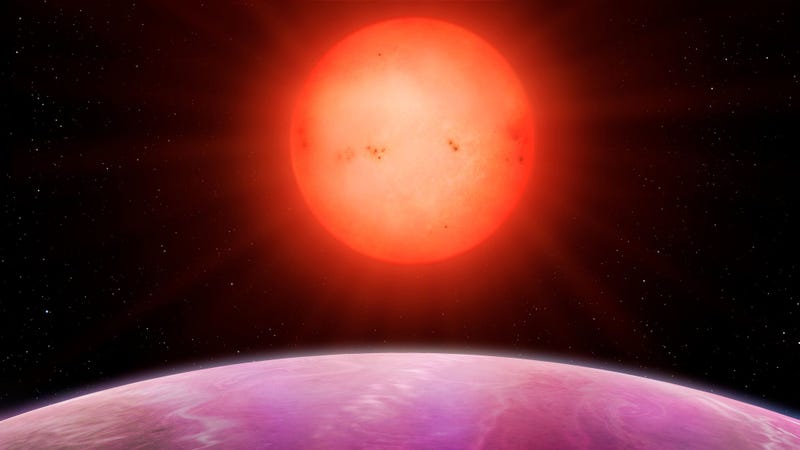
Using an innovative new telescope array, an international team of researchers has discovered a distant gas giant roughly the size of Jupiter around a star half the size of ours. It’s considered the largest planet in proportion to its companion star.
Bayliss and Wheatley spotted the hot Jupiter using the Next-Generation Transit Survey (NGTS) instrument, a wide-field observing facility composed of several telescopes at the European Southern Observatory’s Paranal Observatory in Northern Chile. This state-of-the-art facility is operated by the Universities of Warwick, Leicester, Cambridge, Queen’s University Belfast, Observatoire de Genève, DLR Berlin, and Universidad de Chile. Full article here:


Saturday, February 14, 2015

Colliding galaxies

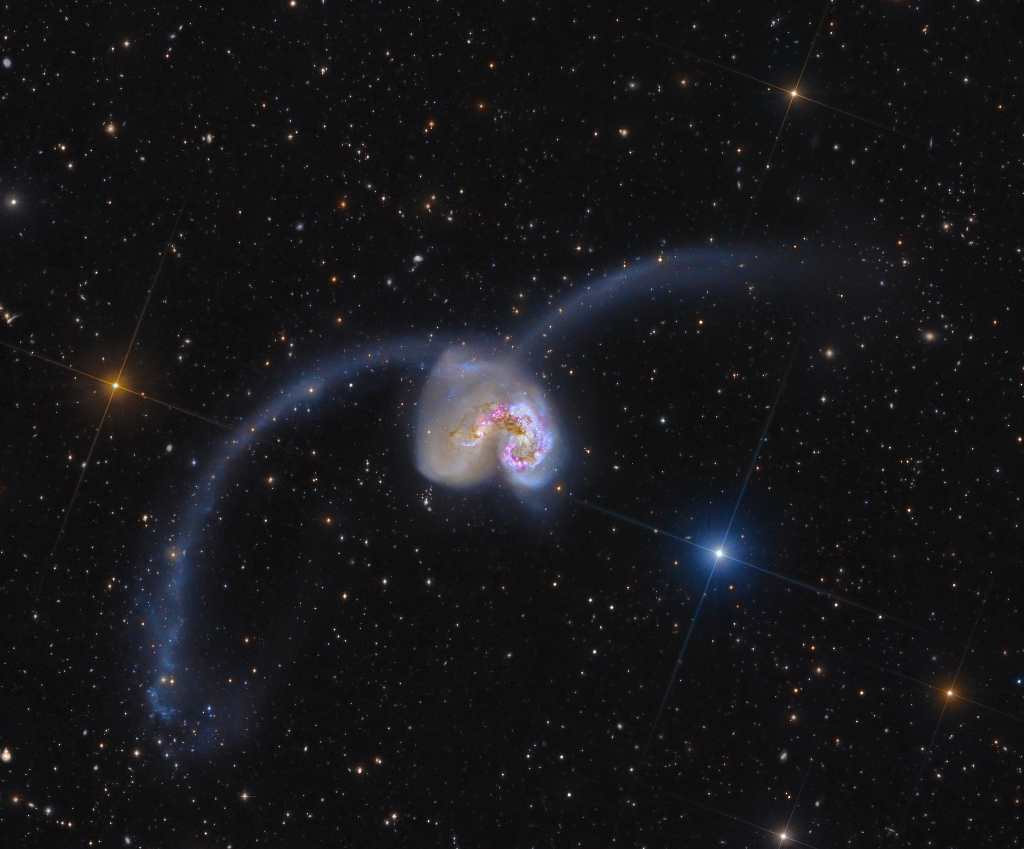
The universe is filled with glorious objects, and understanding the science adds to their fascination. In this image from the Hubble Space Telescope two galaxies collide.


"The stars in the two galaxies, cataloged as NGC 4038 and NGC 4039, very rarely collide in the course of the ponderous cataclysm, lasting hundreds of millions of years. But their large clouds of molecular gas and dust often do, triggering furious episodes of star formation near the center of the cosmic wreckage."

Read more here.

Friday, April 4, 2014

A gift from Hubble: Stars A-Bornin'

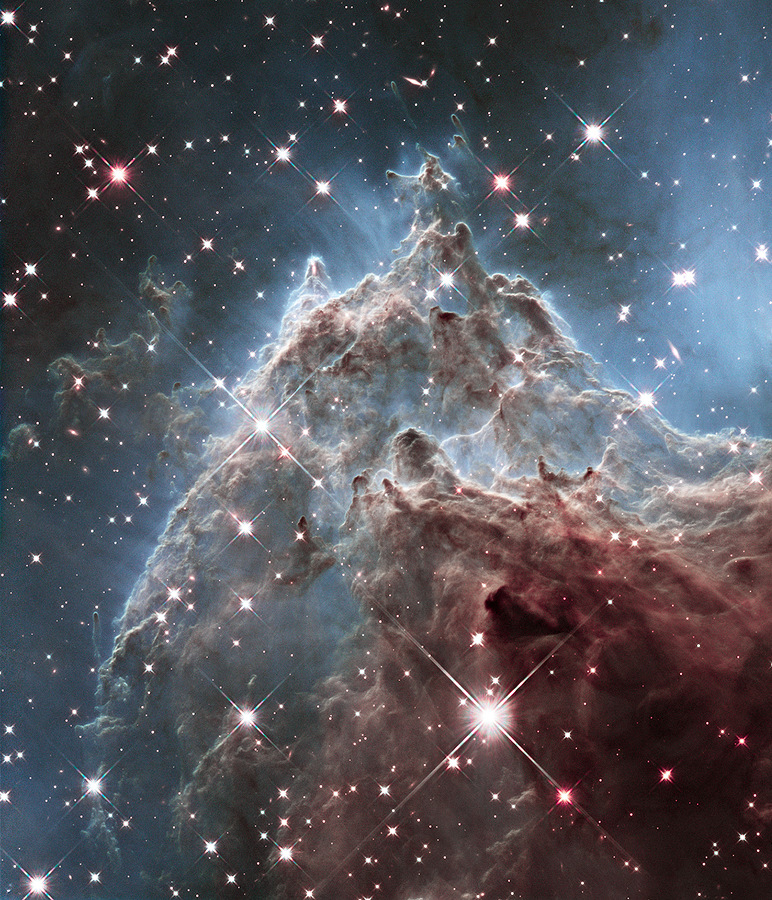
From the Hubble Space Telescope comes this glorious image of a star-forming region:
"clouds of gas and dust carved by winds and radiation from the region's newborn stars, now found scattered in open star clusters embedded around the center of NGC 2174, off the top of the frame. Though star formation continues within these dusty cosmic clouds they will likely be dispersed by the energetic newborn stars within a few million years."


This takes my breath away, it's so amazing.