Some years ago, I struck up a conversation with a young writer at a convention. (I love getting to know other writers, so this is not unusual for me.) One thing led to another, led to lunch, led to getting together on a regular basis, and led to frequently chatting online. I cheered her on as she had her first professional sale and then another, and then a cover story in a prestigious magazine. One of the gifts of such a relationship is not the support I receive from it, but the honor and joy of watching someone else come into her own as an artist, to celebrate her achievements. It's the opposite of Schadenfreude -- it's taking immense pleasure and pride in the success of someone you have come to care about.
I find such friendships invaluable, and even more so when they shift from "pro/newbie" to one of true peers. Although we may not be in the same place in terms of professional publication, we each bring a wealth of life experiences to the conversation. Often, critical skills develop faster than writing craft, so even a novice writer can provide invaluable feedback. Trust arises from recognition of each other's strengths.
This happened recently, when I was wrestling with the opening of a new novel. I typed "Chapter 1" and then stared at the blank screen. Everything I could come up with for a beginning sentence was -- to put it mildly, just awful. I wouldn't want to read a book that began that way. But because my friend and I were DMing and she often shares thoughts about her creative process and struggles with various aspects of storytelling in a very different style than mine, I felt safe with her. She agreed that my idea wasn't very entrancing (she was very nice about it, for she understands that beginnings are vulnerable times and that this is indeed a process, not the final copy on the editor's desk). Her support lightened the burden of "I'm totally useless and now everyone is going to find out; I'll never write another decent sentence in my life and I have no idea how to begin a novel!" which we both knew to be not true, but the sort of self-doubt that regularly assails writers of all skill levels.
Eventually, I calmed down enough to remember one of my tried and true techniques for coming up with titles. I write down every one I can think of, quite quickly so that I get through all the really stupid ones first. I give myself permission to be ridiculous -- and silly -- and quirky -- and by this time, I am usually generating stuff that has some potential. I did the same thing with opening lines, and before long I realized I'd become ensnared by one of my perennial challenges: wrong point of entry. By backing up (in this case) or leaping forward, I can find the place that clicks.
I went to bed, having written a page or so, and woke up with: "Yes, and this other thing happens and then she gets thrown into jail (on page 2 or 3) and by the time she gets bailed out, her father has been brainwashed..." Okay, this has possibilities!
Thanks, dear friend, for cheering me on through the discouraging part!
“Genderqueer” and “nonbinary” are contemporary terms for people who don’t fit neatly into male or female categories. But acknowledging that not everyone fits neatly into those two groups has a much longer history than you might suspect.
As a scholar of Judaism and gender, I find that people across the political spectrum often assume religion must be inherently conservative and unchanging when it comes to sex and gender. They imagine that religions have always embraced a world in which there are only men and women.
Traditional Jewish sources discuss the categories “man” and “woman,” but these aren’t the only designations rabbinic texts use for sex and gender.
Rabbinic literature, the body of texts written by Jewish leaders in antiquity, includes several other categories. In these texts, a person with both sets of external genitalia is called an “androgynos,” a term borrowed from Greek. A person with neither is called a “tumtum,” and a person who loses his male sexual organs is called a “saris.” There is also a term for someone whose sex assigned at birth is female but does not develop to female sexual maturity – in some cases, because they develop “male” traits: an “aylonit.”
For example, Genesis Rabbah, a collection of creative Biblical interpretation from late antiquity, records an interpretation of a creation story in the biblical book of Genesis in which God forms the first humans. Genesis 1 includes the phrase, “Male and female He created them,” which many readers interpret to mean that God created a man and a woman.
But some of the rabbis quoted in Genesis Rabbah believed that God had made an androgynos.
One rabbi explained: “In the hour when the Holy One Blessed Be He created the first human, He created an androgynos, as it is written, ‘male and female He created them.’”
Genesis Rabbah continues with another rabbi’s argument that God made the first human with two fronts: a female face and body facing one way, and a male face and body facing the opposite direction. Only later did God split the two, in this rabbi’s reading.
Though the specifics of their interpretations differ, both put an androgynos at the center of God’s creation.
Applying the law
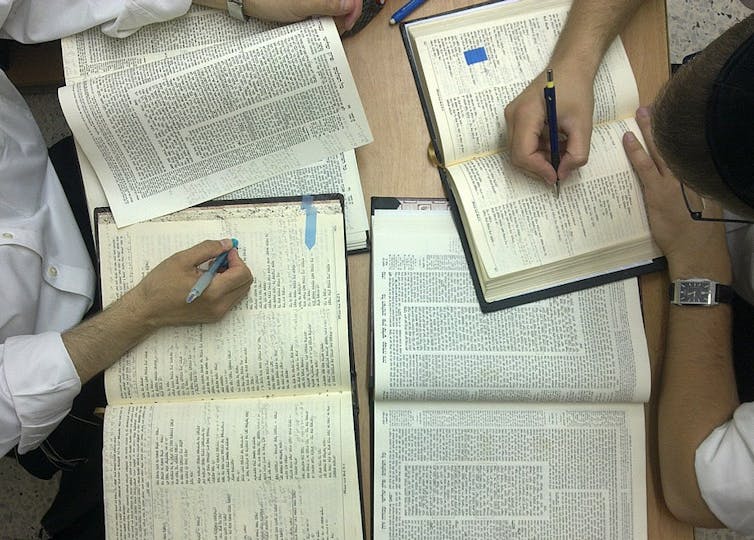
Jewish law, or halakhah, is based on a gender binary. For example, some commandments, such as studying Torah or not shaving sidelocks, apply only to men; others, such as Sabbath candle lighting, apply only to women.
However, some halakhic traditions also recognize that not every person’s body fits that binary.
Men and women ride separate escalators to their designated seating sections as Orthodox Jews gather during a 2012 event to celebrate religious study in New Jersey.Mario Tama/Getty Images
The Mishnah, a text compiled in the third century C.E. which includes halakhic material, roots its interpretations in the categories men and women, yet also affirms the idea that sex and gender go beyond those terms.
For example, a section called Mishnah Bikkurim explains: “There are some ways the androgynos is like men, and some ways he is like women, and some ways he is like men and women, and some ways he is like neither men nor women.” Another section of the Mishnah explains that, like women, neither a tumtum nor an androgynos is obligated to go to the Temple in Jerusalem as part of certain religious festivals. Meanwhile, an androgynos must dress like a man, and a priest cannot marry an aylonit unless he already has children.
As these examples suggest, gender diversity is woven throughout rabbinic traditions. Yet there is still a hierarchy, with men holding positions of the highest religious obligation.
It is also important to note how these categories differ from the ways people understand gender today. A nonbinary person in the 21st century does not have the same experience as a tumtum in late antiquity. The idea of “aylonit” does not map clearly onto any common gender identity today. Even the term “androgynos” is not quite the same as intersex. And none of the rabbinic categories match current ideas about trans identity.
Forging a future
In spite of this textual tradition, many observant Jewish communities today still tend toward a gender binary. In most Orthodox synagogues, for example, a physical partition divides the worship space into two sections: one for men and one for women. Halakhic rulings about whether and how parents should support medical interventions on intersex children suggest they should be raised as male or female, not as an androgynos or tumtum.
In other Jewish communal spaces, however, traditional texts have become a resource for contemporary LGBTQ+ Jews. Some look to these texts to affirm their beliefs that Judaism has always seen gender diversity as a spectrum. Others use these texts to see themselveswithin Jewish tradition. Still others use these examples to call for change in the present, countering anti-LGBTQ+ positions.
Participants from Jewish Queer Youth walk in the New York City Pride March on June 25, 2023.Charles Sykes/Invision/AP
Many of these Jews recognize that the diversity of sex and gender in these ancient texts is different from gender identity today, but they believe the past can still serve as an important tool in the present.
Rabbinic texts illustrate that there is no magical time in the past when every person fit easily and naturally into gender categories.
A “story midwife” is someone whose insightful feedback helps
the writer to make the story more fully what it is intended to be. A
while ago, I wrote about Trusted Readers, the unsung heroes of this
process. Sometimes they receive thanks in the Acknowledgements page of a novel,
but rarely for a short story. Now let’s talk about more visible helpers: beta
readers and critiquers.
Most of the time, there is little functional difference
between beta readers and critiquers. Both read a story in draft form and
respond with comments and analysis. Unlike a Trusted Reader, a beta reader or
critiquer is usually either a writer or someone knowledgeable about the
internal workings of fiction, like a professional editor. So the feedback may
go more along the lines of technical criticism and less a generalized “this
didn’t work for me.” A beta reader acts
like a Trusted Reader-with-expertise, whereas a critiquer focuses on
pinpointing weaknesses and often suggesting solutions, many times in a workshop
or other group setting. For this blog post, however, I’ll use the terms
interchangeably.
Critiques often take place in a structured setting, such as
a workshop. My first experiences with exchanging critiques were done through
the Science Fiction and Fantasy Workshop, a by-mail-with-newsletter forum run
by Kathleen Dalton-Woodbury (back in the 1970-90s or a little beyond, if I
remember correctly). I’ve also attended ongoing face-to-face workshops, as well
as weekend groups at conventions. All have involved both giving and receiving
critiques. Like many writers, I have cultivated a small group of “go-to” beta
readers. Although it’s often not stated explicitly, the understanding is that
over the course of time, each of us will critique a story from the other.
Alastair Reynolds is one of my favorite writers of hard
science fiction. His stories sweep me up in adventure, mystery, and very cool
ideas. With Eversion, he’s reached new heights of complex yet rewarding
storytelling. In it, he builds mystery upon mystery, with each layer adding
connections and insights. He always “plays fair,” giving the reader everything
they need to understand the characters and the dilemmas he has thrust them into
at that moment. The book is a primer of brilliantly handled plot twists!
The story begins as a sea adventure: an 1800s expedition to
discover an enigmatic structure, “the Edifice,” deep within a fissure in the ice
cliffs of Norway. The narrator is the ship’s physician, recruited at the last
minute and therefore not on the ship’s manifest. As he performs his medical
duties, he develops relationships with the rest of the crew and passengers,
including the arrogant tycoon who’s financed the expedition, a brilliant but
tortured young mathematician, and a disturbingly flirtatious woman who seems to
have no other function than to torment the doctor. Soon, however, things go
horribly wrong. Even as the ship finds the bizarre, possibly inhuman structures
of the Edifice, it also discovers the wreckage of an earlier ship, one the tycoon
lied about… and then the doctor dies and finds himself a century later on an
airship encountering the Edifice in a different, expanded form, and the
previous ship, but with strange, fragmented memories of having been in a
similar situation before. With each iteration of an exploration gone horribly
wrong, the doctor makes new connections and comes closer to what’s really going
on, the truth beneath the narratives. It’s a gorgeous spiral of self-discovery,
tense action, and ultimate sacrifice.
Larry Brooks interviewed best-selling author Philip Margolin on his latest book and a bunch of related writerly topic. This comment from Margolin struck home for me.
Don’t try to figure out what you must write to get published or make the
bestseller list; write something that excites you. If you look at most
first novels, even ones that aren’t particularly good, they all have a
certain energy that comes from a writer getting an idea that excites
them.
I think this is right on target. If you look at what's hot now, you're looking into the past. A traditionally published book often takes about a year from its acceptance to its appearance in bookstores. Many times the lead time is longer. The manuscript must be edited and revised, copy-edited, and proofread. Cover art must be commissioned, sketches reviewed and approved, and cover designed. Sales teams need catalogs about six months in advance. That's not counting advance reading copies (ARCs) to review venues like Publisher's Weekly. Finally, the book must be printed and distributed so that it is available at your corner bookstore on or slightly before the release date.
Even with e-publishing, which does not require the long lead times for preparation and distribution of the physical book, there is a gap between the finished product (which hopefully has been through a similarly-rigorous process of editing and proofreading, not to mention cover art and design!) and the initial conception of the author -- the decision to write this particular book. Writers vary in how long it takes to write a novel. This involves not only the speed of creating that first draft but on how much revision the draft needs. And how committed we are to making each book the very best we can, which means both learning our craft and not turning out hastily-written slip-shod work. For most of us, care requires time.
So the ebook or print book you see in the stories may have taken anywhere from 6 months to 6 years in creation. Who wants to be that far behind the times? More to the point, who wants to spend that much of your writing career imitating what someone else was excited about 6 years ago?
Fads will come and go, tastes will change with the seasons. Publishers merge or fold and even more arise. Wonderful books receive lousy promotional support and fizzle. Mediocre ones catch the public's fancy and make pots of money. We as writers have zilch control over any of this. I truly believe that chasing the market is not only futile, but deadly to our creative lives.
The only way to have a satisfying career is to write what you love. It is not enough to guarantee commercial success, but without it, you might as well take a job as an accountant. The paycheck's a whole lot more reliable.
If you've enjoyed this essay on nourishing yourself as a writer, please check out my collection, Ink Dance: Essays on the Writing Life. It's filled with stories, advice, commiseration, and inspiration.