Showing posts with label aliens in science fiction. Show all posts

Friday, June 19, 2026

Book Review: Aliens Warp Reality


A Hole in the Sky
, by Daniel H. Wilson (Doubleday)

A Hole in the Sky by Daniel H. Wilson combines elements of thriller, horror, and first-contact science fiction. Something’s out there…it’s made contact with Voyager 1, out in the heliopause, the boundary where the interstellar medium and solar wind pressures balance each other…and a mysterious, infallible US intelligence predictive device issues a warning: “First contact imminent.” These are not cute, friendly aliens, nor are they hostile killers (a la Predator). The incoming object is able to warp time, space, and reality itself. Meanwhile, in the heartland of America, a Cherokee single father and his teen daughter rediscover ancient legends of powers protecting their people and the planet.

This book was a quintessential page-turner, a tale that kept me up way too late. While I don’t appreciate shock and gore for their own sake, I found these elements so well integrated into the story that the book would have seemed pallid without them. I enjoyed the characters, especially Jim Hardgray, the Cherokee whose viewpoint—from his indigenous beliefs to his position outside the super-secret military intelligence apparatus—enriches the story beyond its otherwise claustrophobic paranoia. For most of the book, I loved astrophysicist Dr. Mikayla Johnson, an autistic genius whose noise-canceling communication headphones morph from enabling her to manage sensory overload to melding with her brain. My only quibble with the book is her descent into delusions and then outright insanity. I appreciate seeing a character with autism portrayed as strong and competent, but it seemed too easy to show how her different perceptions transformed her into an extension and, hence, a pawn of the weird extra-terrestrial entity.

All in all, this fast-paced book engaged me with characters I cared about and an unrelenting buildup of Things Going Wrong. The author is a citizen of the Cherokee Nation, as well as a former threat forecaster for the US Air Force.


Friday, January 17, 2025

Book Review: Another Gem from Ann Leckie


Translation State
, by Ann Leckie (Orbit)

Ann Leckie is a jewel of modern science fiction. Her worldbuilding and characters are consistently original, nuanced, deeply resonant, and well thought-out. To describe the plot and premises of Translation State is to ignore her masterful layering of themes and her ability to create truly relatable alien characters.

This story centers on three characters:  Enae, a reluctant diplomat tasked with hunting down a fugitive who has been missing for over 200 years; Reet, an adopted mechanic who is desperate to learn about his genetic roots to explain why he operates so differently from those around him. And Qven, created to be a Presger translator, an intermediary between the dangerous—as in world-destroying—Presger and human civilization. The Presger are truly alien, and it’s only through a centuries-old Treaty and the translators that they haven’t inadvertently destroyed entire systems of inhabited worlds.

Presger translators are far from benign; in their formative stages, for example. they think nothing of vivisecting or slaughtering their age-mates. They must be taught human customs, everything from wearing clothes, making small talk, drinking tea, and sitting on furniture to not casually eating one another. Qven is no exception, and Reet very well may be at least part translator, although his adopted parents have instilled human values in him.

Leckie manages to make both characters, as well as the endearing Enae, sympathetic, understandable, and even upon occasion admirable. She introduces Enae first, inviting the reader into a complex universe through a single relatable character. I had a harder time with Reet initially, but by the time it was clear the story lines would merge, the deeper themes of consent, becoming fully oneself, loving another as I-Thou, and the meaning of being human had me hooked. I loved Leckie’s subtle hand in conveying sophisticated, often bizzare cultural conventions without a trace of ramming them down the reader’s throat.

Leckie also portrays gender conventions in ways that are occasionally humorous—like the way the Imperial Radch insist on using “she” for everyone, but Reet keeps correcting them, “I’m a he!” and Qven, for the first time given a choice, insists on being an “e” (and, after seeing the unconditional love and support of Reet’s three moms, makes a conscious choice to become human).

Highly recommended.


https://images-na.ssl-images-amazon.com/images/S/compressed.photo.goodreads.com/books/1673303646i/62873999.jpg

Friday, November 15, 2024

Short Book Reviews: Stealing a Human/Alien Hybrid Ghost

 Not of This World, by Simon R. Green (Severn House)


Gideon Sable--master thief, con artist, and self-proclaimed vigilante--faces a challenge he can't resist: to break into the British Area 51 and steal a ghost. Not just any ghost, but a hybrid between a human astronaut and an alien utterly bent on destruction. Although Gideon suspects the motives and veracity of his would-be client, he gathers his crew, lured with the promise of being able to walk off with whatever ultra-secret, ultra-valuable gadgets they can lay their hands on. His crew includes The Damned, armored by the haloes of two dead angels; Switch-It Sally, who can switch out just about anything; a werewolf; and Annie Anybody, capable of fully embodying an array of personas (in this case, Melody Mead, Girl Adventurer). Of course, nothing goes as planned, and this volume is, like its predecessors, jam-packed with plot twists, treachery, and revelations.

Gideon and his crew have come a long way since he first convinced them to join up with him, progressing through suspicion and animosity to grudging respect and, now, the bonds of family. In the last episode, The Damned and Switch-It Sally not only fell in love but also informally adopted the young werewolf. Gideon himself has gone from being a nameless man who inherited a legend to the emotional glue and super-planner brains holding it all together. In this sense, the book is as much about loyalty and family as it is about the present adventure. This gives a supernatural spy/con-man romp satisfying depth. I hope there will be many more books in the series.


Friday, December 1, 2023

Short Book Reviews: Walter Jon Williams's "Praxis" Homerun

 Imperium Restored (A Novel of the Praxis), by Walter Jon Williams (Harper Voyager)


This was my first “Praxis” novel, and it’s a tribute to the author that although I could not always follow the intricacies of the backstory, I was so caught up in the action that I simply didn’t care. Imperium Restored works on so many levels, each of them fascinating. Star-crossed lovers are separated by a colossal misunderstanding that spews forth confusion, mistrust, and crushing hurt (but does nothing to erase the fundamental attraction between them). There’s also a bang-up battle in space, one of the smartest and most inventive I’ve read, enough to convince me that any spacemil science fiction Williams writes will be superb. Life in a vast star-spanning spaceforce is filled with rivalries, jealousies, boredom, ill-fated sexual encounters, interspecies friction, and what-do-we-do-with-ourselves once the war is over. A lesser writer might have focused on the war itself. While the battle scenes are pure bravura, Williams keeps enlarging the lens to look at the ramifications, not just during the conflict but also afterward. The resulting peace offers as many opportunities for tension, betrayal, alliances made and broken, assassination attempts, revenge, and general chaos as the actual fighting did.

There’s also a mystery.

What more could a science fiction fan want?


Friday, July 21, 2023

Short Book Reviews: A Time-Twisting Space Mystery

 Eversion, by Alastair Reynolds (Orbit)


Alastair Reynolds is one of my favorite writers of hard science fiction. His stories sweep me up in adventure, mystery, and very cool ideas. With Eversion, he’s reached new heights of complex yet rewarding storytelling. In it, he builds mystery upon mystery, with each layer adding connections and insights. He always “plays fair,” giving the reader everything they need to understand the characters and the dilemmas he has thrust them into at that moment. The book is a primer of brilliantly handled plot twists!

The story begins as a sea adventure: an 1800s expedition to discover an enigmatic structure, “the Edifice,” deep within a fissure in the ice cliffs of Norway. The narrator is the ship’s physician, recruited at the last minute and therefore not on the ship’s manifest. As he performs his medical duties, he develops relationships with the rest of the crew and passengers, including the arrogant tycoon who’s financed the expedition, a brilliant but tortured young mathematician, and a disturbingly flirtatious woman who seems to have no other function than to torment the doctor. Soon, however, things go horribly wrong. Even as the ship finds the bizarre, possibly inhuman structures of the Edifice, it also discovers the wreckage of an earlier ship, one the tycoon lied about… and then the doctor dies and finds himself a century later on an airship encountering the Edifice in a different, expanded form, and the previous ship, but with strange, fragmented memories of having been in a similar situation before. With each iteration of an exploration gone horribly wrong, the doctor makes new connections and comes closer to what’s really going on, the truth beneath the narratives. It’s a gorgeous spiral of self-discovery, tense action, and ultimate sacrifice.


Friday, May 19, 2023

Short Book Reviews: A Smart Alien Murder Mystery

 Drunk on All Your Strange New Words, by Eddie Robson (Tordotcom)


 I loved this fresh and wonderful take on human-alien cultural clashes! This alien race, the Logi, are approximately humanoid in appearance and possess valuable technology. They’re fascinated by human culture, especially the arts and printed books. The catch is that they communicate telepathically through specially trained “Thought Language” translators. One such is our heroine, Lydia, from a poor British background. She loves her work, the only thing she’s ever been really good at, not to mention her generous salary and her sensitive, thoughtful boss, the Logi cultural attaché. All this makes it worth feeling drunk from translating between Thought Language and English. It all goes to hell when her boss is murdered and she’s the prime suspect. Both her freedom and her ability to solve the mystery depend on her remaining at the Embassy, and the Logi is charge has never liked her.

Drunk on All Your Strange New Words combines alien contact science fiction, a sympathetic heroine, weird maybe-supernatural stuff, and a highly complex mystery filled with surprises and reversals. I found Lydia, with all her insecurities, bravura, and gullibility, deeply sympathetic. I fell for the same deceptions and cheered her on as the pieces of the puzzle fell into place. This is a smart science fictional mystery and a wonderful take on how even truly weird aliens and humans can find understanding and common ground. Best of all, a deeply flawed character prevails at the end.


Friday, December 30, 2022

Short Book Reviews: "This Fine Crew" of Weird and Wonderful Aliens

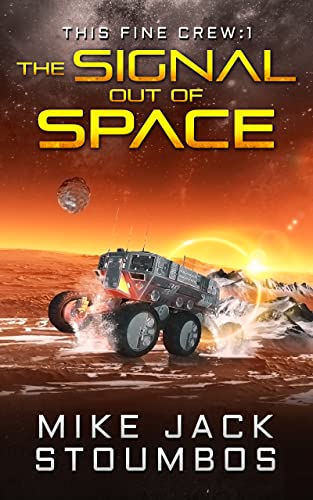
The Signal out of Space, by Mike Jack Stoumbos (Theogony Books)

This space opera hits so many tropes just right! It’s a school story (well, cadets in the Interstellar Initiative, but close enough), a patchwork of alien species learning to work together (shades of Star Trek) and a mystery. After a brutal interspecies war, the Interstellar Initiative is the galaxy’s best hope for peace, cooperation, and rewriting nasty first impressions.

    • To begin with, our motley crew includes:
    • A declawed reptilian engineer who goes “Mmmmmm!”
    • A furry medic with a secret noble heritage, like a werewolf with tusks
    • An insectoid programmed to adore humans, whose chosen name is Paul Newman and who has four arms, rather than wings
    • A barely-legal-age human pilot who reminds me of the kid in the film, The Last Starfighter with his gift with video games and puppy-like enthusiasm.

The prolog throws us into action as the crew hurtles across the Martian terrain in a test run when matters go seriously pear-shaped. It’s confusing because (a) there’s no context for any of these characters or their relationships (for example, one is referred to as “Paul,” but later turns out to be the sentient insectoid who has adopted the name, “Paul Newman”); (b) prologs at best are incredibly challenging to pull off and are usually a terrible idea. However, it’s soon over and when we return to the scene later in the book, we are better equipped to understand what’s going on.

From there, the story shifts into multiple POV, not-quite-linear time as we experience each character’s arrival and interactions. These chapters are brilliant. The depiction of the differences as well as similarities between the five characters/five species are gorgeously well done.

No book is perfect (not even mine!) but I found the few flaws trivial in comparison to the wonderful voices of the characters, the unfolding mystery, and the intricate politics of each species. It’s the first of series but stands alone very well. Fans of space-opera-with-aliens will love it!


Friday, September 9, 2022

Short Book Reviews: Alastair Reynolds A Master of Space Opera

 Inhibitor Phase, by Alastair Reynolds (Orbit)


I’m an unabashed fan of Alastair Reynolds’s science fiction. I love how he combines fascinating hard-science worldbuilding, pitch-perfect control of pacing, and characters who hold my interest even when, let’s face it, they’re downright weird. Inhibitor Phase is no exception. Not only that, but it’s readily accessible to readers who aren’t familiar with the previous books set in the Revelation Space universe.

The background is this: The Inhibitors, a ruthless, infinitely patient cybernetic entity, have all but wiped out humankind. Remnants survive by staying hidden and very, very quiet.

When a lone human ship blunders into the Michaelmas system, it’s only a matter of time before the Inhibitors take notice. For thirty years a tiny band of humans has been sheltering in the caverns of an airless, crater-pocked world. Their leader, Miguel de Ruyter, takes one of their few spacecraft to intercept the intruder ship and prevent this catastrophe. Floating in space, he encounters a refugee from the ship—an enigmatic woman who calls herself Glass—and embarks upon a near-suicidal, against-all-odds quest for a weapon against the Inhibitors.

Reynolds writes very, very good space opera, and this book is no exception. It’s longer than some of his other work, with more sprawling action and a ton of inventive details. Many of the entities de Ruyter (not his real name: hint!) encounters are weird, unpredictable, and deliciously alien.

Friday, May 6, 2022

Book Reviews: Alien Messages from Space

Shadows of Eternity, by Gregory Benford (Saga)

Gregory Benford is an accomplished, seasoned writer and as usual, he offers a treasure trove of fascinating ideas. In this novel, set two centuries from now, humans have set up a base on the Moon to house a SETI library whose mission is to decipher and comprehend the many Messages received from space. As Benford points out, the immense distances involved would almost certainly mean that these civilizations are now long since extinct. So why would they broadcast Messages for a future intelligent race to receive? As a record for posterity, a boast of their prowess, a plea for help? What about the alien AIs, who have aggressive agendas of their own? Fascinating possibilities abound!

The story begins when Ruth, a trainee Librarian, is accepted into the program, her work is to analyze Message texts and eventually converse with the AIs. She finds her feet in the byzantine hierarchy of the library, makes friends and discovers romance, and embarks on studying the Messages and interacting with the alien AIs.

After Ruth’s initial integration into the Library culture and her first few AI encounters, the book loses much of its forward momentum and takes on an episodic quality. To be sure, there are occasional references to earlier events—for example, a present-day alien race seeks her out because of her role in deflecting an existential threat to Earth, a result of her bargain with one of those AIs. I kept looking for a sense of rising tension, the inexorable progression of one crisis building to an even greater one, and not finding it.

Eventually, I gave up. The book is really long, and I kept having the experience of beginning again. Information that is usually presented near the beginning of a novel appeared a third or a half through. This circling back to “Go” reminded me of television programs of the 1950s and early 1960s, where episodes could be shown in any order because no matter what happened, all the characters and pieces ended up right where they started. (In contrast, programs of the 1970s and later tended to have story arcs that lasted several episodes, and then Babylon 5 blew them all out of the water with a five year story arc.) Upon reflection, if the book had been presented as, “These are the ongoing adventures of Ruth, Librarian to Alien Cultures,” my expectations would have been more in line with my experience.

All that said, Benford is a highly skilled writer, and many readers will relish the length and slow build of this novel, as well as the richness of the ideas.


Friday, March 4, 2022

Short Book Reviews: Creating Alien Community


The Galaxy, and the Ground Within,
by Becky Chambers (Harper Voyager)

Set on an uninhabitable planet whose only value is as a stopover for other worlds, this story explores what happens when members of very different species and histories are forced into community when they are temporarily cut off from contact with the larger Galactic Commons. Three of these strangers are guests at the overwhelmingly hospitable Five-Hop One-Stop version of a spacer’s truck stop when a freak accident halts all traffic and communications. At first glance, they have little in common: an exiled artist with an urgent, perhaps redemptive appointment to keep, a cargo runner with a military history at a personal crossroads, and a mysterious individual who cannot leave her space suit but is doing her best to help those on the fringes. Add to this odd grouping, their host and her teenager, furred quadrupeds that reminded me repeatedly of space otters. Most of all, though, this book is about how people who are initially not only diverse but at odds with one another can bridge those differences through understanding and shared experiences to form friendships and, ultimately, community.


Friday, July 9, 2021

Short Book Reviews: Another Slightly Wacky Space Opera from Tim Pratt


The Fractured Void, A Twilight Imperium Novel
, by Tim Pratt (Aconyte)

Imagine my surprise when I learned the space opera. The Fractured Void, was based on a strategic board game, Twilight Imperium. Game tie-in novels are common these days, but not those that are so well crafted as to stand on their own merits. I picked it up because I loved Tim Pratt’s other science fiction novels (and after reading it I still have no idea what Twilight Imperium is, nor do I particularly care as long as Pratt turns out books as good as this one).

Starship crews as family are a familiar, eternally attractive trope. Pratt brings his own slightly offbeat cast to the Temerarious: a human captain, his best friend, a ninja chameleon toad, and his leonine security officer. From the universe’s most boring patrol, they’re off to rescue the universe’s most obnoxious scientist, who just may have discovered a way to create worm holes and to control them. It turns out that the mysterious race known as the Ghosts has very strong opinions about why opening new worm holes is as Extremely Bad Idea, and are prepared to enforce or sabotage or otherwise nix the project. Throw in a ruthless but very sexy bounty hunter, a sentient squid who is the universe’s best engineer, a remarkably hidebound rival culture, and a host of plot twists, double-crosses, and one-step-ahead schemes, and the resulting adventure is nonstop entertainment.

My introduction to Pratt’s star-spanning bibliography was The Wrong Stars, and The Fractured Void features the same flowing prose, superb control over disparate story elements, wacky characters, plot tension, and supremely resourceful and competent characters. I look forward to gobbling up his next.

Saturday, January 9, 2021

Jaydium Chapter 7 FREE on Curious Fictions

 Chapter 7 of Jaydium is up on Curious Fictions. How many of you are reading along?


https://curiousfictions.com/stories/3674-deborah-j-ross-jaydium-chapter-8

Monday, November 9, 2020

Jaydium: Chapter 5 Free on Curious Fictions

Between the wildfires and evacuation, I've fallen behind in posting free chapters of Jaydium on Curious Fictions. With apologies, here's the next one!


Jaydium, Chapter 5

By Deborah J. Ross
Nov 6, 2020 · 1,761 words · 7 minutes

Jaydium700x1050

Art by Vincent Di Fate.  Edit Art · Remove Art

From the author: Far in the future, an interplanetary civil conflict has ground to an uneasy halt. Kithri, abandoned on a desolate mining planet, meets Eril, shell-shocked pilot. A freak accident sends them back to a time when their desert world was lush and green, when an alien civilization stands on the brink of a war of total destruction. They must choose to remain outside the conflict or to stand up for what they believe


 An audio version is available for this chapter. Listen online →

JAYDIUM

Chapter 5

For a moment Eril considered telling her the truth, that he had as much chance of getting into the Corps without her as she had getting off Stayman without him. In the mood she was in, she'd probably tell him to stuff a comet up his pitouchee. The only thing to do was to keep his mouth shut and wait for another opening. He hoped he'd get one.

Kithri picked up the water bottle, took a long swallow and then dropped it, sputtering. She pointed down the tunnel.

As he followed her gesture, Eril's mouth went electrically dry. The last time he'd looked, the tunnel had been empty except for the two of them and the scrubjet. Now a man-shaped mist hovered in the middle of the 'hole, one moment diaphanous, then condensing into near solidity. In stark contrast to the rosy glow of the partly-sealed jaydium, it was a clear, untinted gray. Eril made out a bulbous head, two arms, and two splayed-out legs. He thought he saw markings on the head section, but they faded so quickly he could not be sure.

"What the hell is that?" Kithri whispered. "I've been running these tunnels for years, and I've never seen anything like it."

"Space ghost," he said, dredging his memory. "They're sighted along the old interstellar routes. There are only about six or seven documented cases known, never this close to a planet. By our best guess, they're relics of early attempts to exceed the speed of light. Residues of energy that just happen to be shaped like humans. They probably don't actually exist in three-space."

As he spoke, the figure descended until its feet seemed to touch the tunnel floor. For a moment it stood there, motionless. Then it began to move. First one leg and then the other stretched out and swung back as it drifted along in a mechanical parody of walking. 


Here's the link to the rest...

https://curiousfictions.com/stories/3051-deborah-j-ross-jaydium-chapter-5

Friday, November 6, 2020

Short Book Reviews: A Medical Rescue in White Space

 Machine (A White Space Novel), by Elizabeth Bear (Saga)


My introduction to Elizabeth Bear’s gorgeously inventive “White Space” novels was Ancestral Night (check our my review here). While I highly recommend be read first, Machine stands on its own. Both are huge books in the sense of sweeping plots and vast universe-building.

As before, Bear uses an unreliable but highly competent first-person narrator, in this case Brookllyn Jens, a rescue operations physician ex-cop with a chronic pain condition, who relies on self-administered drugs and an exosuit for support. Despite being estranged from her wife and daughter, she’s formed deep ties with her crew and shipmind, the AI of their rescue vessel. Chance places them first on the scene of a generation ship, drifting far from where it ought to be, with a much smaller ship of methane-breathing aliens attached to it. One mystery unfolds into the next: why are both crews in cryo sleep? What’s going on with the generation ship’s android/ship-computer peripheral unit? Matters take a turn for the much, much worse when one AI after another becomes infected with a meme virus, and all too quickly Llyn realizes there is no one she can trust but herself.

My reactions to this book were very much in line with how I felt about Ancestral Night, so I’ll paraphrase them here: The book is filled with action and reflection that say as much about the different ways of looking at self vs society as they do about Llyn’s journey of self-discovery. It’s all fascinating, if a bit sedate in places, until the pieces start coming together. Then the parts I had previously found slow made brilliant sense and I couldn’t put the book down until the exciting and immensely satisfying conclusion. I say this as an advisory to other readers to hang in there: every piece is there for a reason, and it is richly worth the ride. Machine is in turns dramatic, thoughtful, humorous, hopeful, and tragic. From the government ship name, I Really Don’t Have Time For Your Nonsense to the weird and wonderful aliens to everything I’ve mentioned above, the book is as much about how we balance individual choices with the greater good. Worth savoring, and re-reading, as is the previous book.

Monday, September 21, 2020

Author Interview: Marella Sands Interviews Me


In a fun turnabout, author Marella Sands interviewed me on her blog about my forthcoming release, Collaborators. Here's our chat:


Marella Sands: What prompted you to write this book?

Deborah J. Ross: I lived the better part of 1991 in Lyons, France, and I was repeatedly struck by how history permeated every aspect. Some buildings showed damage from cannon balls during the French Revolution. Plaques marked places where citizens were executed by the Nazis or Jewish families were deported. After visiting the tiny Musée de la Résistance, I became interested in how many varied ways the French responded to the German occupation. Some protested from the very beginning for religious or ethical reasons, but others went along, whether from fear or apathy or entrenched anti-Semitism, or simply because the war did not affect them personally. Yet others more sought to exploit the situation for personal power or financial gain. Some became active only when their own personal lives were affected.

I knew then that I had to tell this story. Because I’m not a writer of history or historical fiction, but of science fiction and fantasy, I would tell it in the genre I know. I would set my tale on an alien planet, in an alien city . . . but one that I love even as I had come to love Lyons.


MS: How did you develop the motivations of the main characters? 

DJR: The central inspiration for Collaborators – that individuals respond in a variety of complex and contradictory ways to a situation of occupation and resistance – immediately suggested many types of characters: the rebel, the idealist, the opportunist, the political player, the merchant willing to sell to anyone if the profit is high enough, sadist who exploits the powerlessness of others for his own gratification, the ambitious person who doesn’t care who his allies are, the negotiator, the peace-maker, the patriot.

One of the first characters to speak to me arose from an unexpected source. I never knew either of my paternal grandparents, for both had perished in the lawlessness and pogroms in the Ukraine shortly after the first World War. My father told me about  how his mother ran a bookstore that was the center of intellectual (and revolutionary!) thought in their village, how when that village was destroyed, she kept her two children alive as they wandered the countryside for two years, going from one cousin’s house to another but never staying very long. He spoke of her courage, her idealism, and her unfailing love. Some piece of her, or her-as-remembered, stayed with me, and I wondered if I could create a character with that strength and devotion to her children. I began to write about Hayke, who opens the book as he lies in a field with his two children, gazing up at the stars and wondering what these star-people might be like. Hayke had other ideas about what his life was like besides merely following in my grandmother’s footsteps, and everything changed once it became clear to me that the alien race – the Bandari – were gender-fluid. Hayke, like my grandmother, was a widow (using the term generically to include both sexes), and one of his children was born of his own body, but the other of his dead spouse’s, and he told me he felt an especial tenderness for the latter child.

Even though the ground action takes place in an area roughly the size of Western Europe and most of the characters live or come from Chacarre, I didn’t want all the national territories to be the same. I wanted differences in language, dress, attitudes toward authority, etc., between Chacarre and its rival, Erlind, and also within Chacarre itself. Every once in a while, a new character would surprise me, like Na-chee-nal with his “barbarian” vigor and his smelly woolen vest, or Lexis, the dangerously repressed academic poet.

The Terrans presented a different challenge because they were more homogeneous than the Bandari. They inhabit a single spacecraft and although there is a natural division between crew and scientific personnel, for the most part their goals are shared and their hierarchies are well-defined. Left unchecked, that’s a recipe for boring, so I added some friction, a few divergent motives, a highly stressed environment . . . and into this walked Dr. Vera Eisenstein, eccentric genius. Most of the inspiration for her character came from the women engineers and physicists I’d gotten to know (thank you, Society of Women Engineers!) with a touch of Dr. Richard Feynmann thrown in. She doesn’t play by anyone’s rules, she cares far more about science than diplomacy, she’s simply too good at what she does to disregard, and her mind never stays still. I had a ball cooping her up in the infirmary and watching what kind of trouble she’d get into, but I didn’t realize at first that she would become a pivotal character, one capable of acting for the greatest good despite the depth of her loss. I’d been thinking about her passion in terms of science, not in terms of her capacity for love nor in terms of her ruthless commitment to understanding everything she sees around her, whether it is a problem in laser spectroscopy or alien psychology or the nature of her own grief.
Friday, August 28, 2020

Short Book Reviews: A Space Opera Gem from Elizabeth Bear


Ancestral Night, by Elizabeth Bear (Saga)


This is a long, fascinating space opera in a far distant future in which humans manipulate their emotional moods and attitudes, AI shipbrains have dreams and social obligations, sentient squid-whales live in the vast interstellar spaces, and ancient alien technology holds the key to artificial gravity.

The story begins when Haimey Dz, engineer and scavenger of space wreckage, her pilot, Connla, and their shipbrain, Singer, act on a tip and come across an abandoned, repurposed space vessel (see above alien tech) that has been harvesting the corpse of a squid-whale (see above) to manufacture a costly and highly addictive drug. No sooner does Haimey realize (a) this is a moral outrage as well as a crime; (b) OMG there is artificial gravity here!; (c) she’s been infected with what looks like a glowing fungus-like parasite (see alien tech, above), but (d) aieee! The space pirates arrive to nab their prize.

One thing leads to another as the glowing fungus-like parasite grants Haimey the ability to sense, and eventually communicate with, said alien ships, and the charismatic and amoral female space pirate pushes Haimey to confront her own anguished past. Meanwhile, Haimey wrestled with her programmed adherence to mutual collective responsibility, teams up with a gigantic sentient mantis-like alien law enforcement officer from a low-gravity planet, Singer gets summoned to a term of civil duty, and the cats – did I mention the cats? There are two cats on their ship.

As I said, the book is long but filled with action and reflection that say as much about the different ways of looking at self vs society as they do about Haimey’s long-buried sense of self. It’s all fascinating, if a bit sedate in places, until the pieces start coming together. Then the parts I had previously found slow made brilliant sense and I couldn’t put the book down until the exciting and immensely satisfying conclusion. I say this as an advisory to other readers to hang in there: every piece is there for a reason, and it is richly worth the ride. Ancestral Night is in turns dramatic, thoughtful, humorous, hopeful, and tragic. From the government ship name, I’ll Explain It To You Slowly to the weird and wonderful artificial mind that has wrapped itself around a dying sun, to everything I’ve mentioned above, the book is as much about how we balance individual choices with the greater good, all tied up with a big ribbon and two cats. Worth savoring, and re-reading.


The usual disclaimer: I received a review copy of this book, but no one bribed me to say anything in particular about it. Although, come to think of it, fine imported chocolates and roses might have been nice.

Saturday, May 23, 2020

New (Free) Chapter of Jaydium on Curious Fictions

The next chapter of Jaydium is up on Curious Fictions, and it's free (all the previous chapters are, too). If you love the story, the entire ebook is only $0.99 right now from all the usual vendors. (And subscribing to my Curious Fictions page for a small amount per month would be lovely, too.)


Jaydium, Chapter 4

By Deborah J. Ross
May 22, 2020 · 3,238 words · 12 minutes
Jaydium700x1050
From the author: Far in the future, an interplanetary civil conflict has ground to an uneasy halt. Kithri, abandoned on a desolate mining planet, meets Eril, shell-shocked pilot. A freak accident sends them back to a time when their desert world was lush and green, when an alien civilization stands on the brink of a war of total destruction. They must choose to remain outside the conflict or to stand up for what they believe.

Friday, May 15, 2020

Short Book Reviews: Changing the Story Halfway

The Last Human, by Zack Jordan (Del Rey)


I know this book has received a lot of buzz but frankly I found it disappointing and gave up near the end. The beginning was awesome: Sarya, a human teen raised by a voraciously violent, gigantic spider-with-razor-legs, lives on a space station with many other species, all joined by the Network, a galaxy-wide AI that offers communications and diplomatic services to those species who join, and ruthless segregation to those who refuse. Humankind is not among them; in fact, humans are considered to be extinct, so Sarya disguises her species. Various events catapult Sarya from her disadvantaged and frustrated life, variously aided and threatened by an array of fascinating aliens, and Sarya’s history – and the fate of humankind -- begins to be revealed.

That’s the story I was led to expect. But when Sarya is killed and her consciousness restored by the AI of all godlike AIs, I felt as if I had inadvertently stumbled into a cross between a New Age pseudoreligious tract and The Hitch Hiker’s Guide to the Galaxy. I wasn’t nearly as interested in the new story, and I found the switch from coming-of-age and girl-finds-herself to tongue-in-cheek super-cosmic saving-the-universe a definite let-down. 

I also confess to a personal animus against the idea of species exceptionalism. I disagreed with the idea that humans were too dangerous a species to be allowed to exist (and that this specialness was admirable). If anything, our understanding of our place in the natural world demonstrates that our destructiveness is a bad thing, detrimental to our own survival, and that our saving grace is our capacity for compassion, not ruthlessness.