Showing posts with label school stories. Show all posts

Friday, January 23, 2026

Short Book Reviews: A Queer Lovecraftian School Mystery


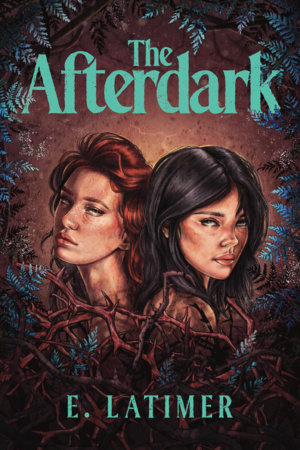
The Afterdark
, by E. Latimer (Penguin)

After her twin sister drowns under questionable circumstances, Evie questions whether the darkness she has always known lurks inside her was responsible. In the blink of an eye, she gets shipped off to an elite boarding school where her father is the principal. Northcroft, located on a remote island and surrounded by dense, old-growth forest. Spooky things happen, beginning with a nightly bell and shutters slamming down, to her father refusing to see her, to a masked cult and mysterious warnings. To make matters worse, Evie falls for glamorous film star Holland Morgan, not knowing that Holland was her dead sister’s old flame. Every day, it seems, Evie discovers another layer of creepiness. If the school and the members of the clandestine mask-wearing “honor” society weren’t bad enough, the woods themselves are a thousand times worse. Something is out there, something ancient and utterly inhuman, something that Evie is increasingly unable to resist.

The Afterdark hits so many story tropes: it’s a school story with a spooky cult, a lesbian romance, a tale of a teen struggling to break free from a highly dysfunctional family, a Lovecraftian dark horror story, and a murder mystery, all tied up with one cliffhanger plot twist after another. The story grabbed me right away and kept me turning pages, and although I’m not a typical horror reader, for me the dark fantasy elements enhanced and intensified the story in appropriate and emotionally manageable ways. So don’t pass up this marvelous book because of the genre.


Friday, August 20, 2021

Book Review: A Literary Attempt at a YA School Story Mystery


The Temple House Vanishing
, by Rachel Donohue (Algonquin Books)

I requested an ARC of this book based on the description: a mystery set in a Catholic boarding school. Twenty-five years before the opening, Louisa, a brilliant but lonely student, and Mr. Lavelle, a charismatic art teacher, have mysteriously disappeared. Victoria, who knew them both, has just committed suicide at the school itself. Why did she kill herself? What happened to Louisa and Mr. Lavelle? Did they elope together? Were they murdered or did they perish through an accident? Or were the disappearances unrelated? The atmosphere of an isolated Victorian mansion set on a cliff in Ireland added to the appeal.

Very early in the book, however, I became increasingly disappointed and frustrated. By the end, I was ready to throw the book across the room in disgust, except that I was reading it on my Kindle and I don’t treat my electronic devices so cavalierly. Based on the description, The Temple House Vanishing promised me a genre novel – YA, school story, and mystery, all in one – and yet it consistently violated the conventions of all three, and not in a skillful way.

The opening point of view, a journalist who happened to live on the same street as Louisa and who is investigating the disappearance, was hard to relate to and never made any sense to me. She isn’t involved in the events, and her own life, irrelevant to the rest of the story, seemed remote and uninteresting. Then we get into Louisa’s story, narrated by herself. Therein lies the second hurdle, because Louisa doesn’t sound or act like a teen, even one who’s stuck in her head. Almost all teens, whether intellectual “brains” or not, center their lives around the fundamental issues of those years: independence from parents, confusion about who they are and what they want to become, desperate need for approval from peers, and so forth. Hormones saturate their bloodstreams, and the parts of their brains associated with executive functions, delayed gratification, and long-term planning, won’t mature until their mid-20s. It doesn’t matter how bright or academically gifted they are, they are still at the mercy of these internal storms. Louisa’s first-person narrative reads like the overly elitist pontifications of a writer with a very poor memory of her own teenaged years, or perhaps one seen through extremely adult-colored lenses, and with no understanding of the conventions of the genre. I cannot imagine a teen reader finding Louisa believable or interesting.

Then we meet Victoria, who becomes the object of Louisa’s bloodless passion. Both girls exhibit a disconnection between their intellectual philosophizing and their relationships so extreme as to verge into psychotic dissociation. I never perceived, through their speech or behavior, or through the inner voice of the narrative, any shred of genuine emotion until very near the end, when it became clear that Louisa was just as infatuated with Victoria as Victoria was with Mr. Lavelle. But for the most part, each experiences a pale, distant imitation of obsession, not the visceral stuff of teen suicide pacts or Romeo and Juliet. Not a hint of lesbian romance, requited or not, could I discern.
Friday, July 9, 2021

Book Review: A YA School Story Mystery Falls Short

 The Temple House Vanishing, by Rachel Donohue (Algonquin Books)

I requested an ARC of this book based on the description: a mystery set in a Catholic boarding school. Twenty-five years before the opening, Louisa, a brilliant but lonely student, and Mr. Lavelle, a charismatic art teacher, have mysteriously disappeared. Victoria, who knew them both, has just committed suicide at the school itself. Why did she kill herself? What happened to Louisa and Mr. Lavelle? Did they elope together? Were they murdered or did they perish through an accident? Or were the disappearances unrelated? The atmosphere of an isolated Victorian mansion set on a cliff in Ireland added to the appeal.

Very early in the book, however, I became increasingly disappointed and frustrated. By the end, I was ready to throw the book across the room in disgust, except that I was reading it on my Kindle and I don’t treat my electronic devices so cavalierly. Based on the description, The Temple House Vanishing promised me a genre novel – YA, school story, and mystery, all in one – and yet it consistently violated the conventions of all three.

The opening point of view, a journalist who happened to live on the same street as Louisa and who is investigating the disappearance, was hard to relate to and never made any sense to me. She isn’t involved in the events, and her own life, irrelevant to the rest of the story, seemed remote and uninteresting. Then we get into Louisa’s story, narrated by herself. Therein lies the second hurdle, because Louisa doesn’t sound or act like a teen, even one who’s stuck in her head. Almost all teens, whether intellectual “brains” or not, center their lives around the fundamental issues of those years: independence from parents, confusion about who they are and what they want to become, desperate need for approval from peers, and so forth. Hormones saturate their bloodstreams, and the parts of their brains associated with executive functions, delayed gratification, and long-term planning, won’t mature until their mid-20s. It doesn’t matter how bright or academically gifted they are, they are still at the mercy of these internal storms. Louisa’s first-person narrative reads like the overly elitist pontifications of a writer with a very poor memory of her own teenaged years, or perhaps one seen through extremely adult-colored lenses, and with no understanding of the conventions of the genre. I cannot imagine a teen reader finding Louisa believable or interesting.

Then we meet Victoria, who becomes the object of Louisa’s bloodless passion. Both girls exhibit a disconnection between their intellectual philosophizing and their relationships so extreme as to verge into psychotic dissociation. I never perceived, through their speech or behavior, or through the inner voice of the narrative, any shred of genuine emotion until very near the end, when it became clear that Louisa was just as infatuated with Victoria as Victoria was with Mr. Lavelle. But for the most part, each experiences a pale, distant imitation of obsession, not the visceral stuff of teen suicide pacts or Romeo and Juliet. Not a hint of lesbian romance, requited or not, could I discern.