Monday, September 28, 2020
Wildfire Journey Part I
First came thunder and dry lightning. Such storms are rare in my area, due to the configuration of the mountains, but this one was extraordinary by any standards. The first storms hit early on August 16, with not dozens but thousands of lightning strikes (estimated 12,000 over 72-96 hours).
We had watched the lightning for a few hours, flash after blinding flash, and commented that in his last years, our old German Shepherd Dog had become fearful of loud sounds like thunder and fireworks (we dealt with this by immediately getting out his all-time favorite toy and playing with him). Even though we knew of the danger of fires, somehow it didn’t connect. It should have. Over 500 wildfires sprang up in the next few hours, fanned by hot, dry winds. Soon we saw news stories of multiple fires in our county, Santa Cruz, and neighboring San Mateo, that were to merge into the #CZUAugustLightningComplex fire.
The next day, the air was noticeably smokey, but we’d had smoky air before, from the Camp fire a couple of years ago, and others in Northern California. We kept an eye on the news but otherwise went about our business, mostly staying indoors. But as August 18 went on, the smoke thickened and the extent of the fire at Butano Park, northwest of us, expanded with terrifying rapidity, our mood went from watchful to alarmed. About dinner time, the smoke was as thick as San Francisco fog.
“We should prepare to get out of here,” I told my family. “Just in case.” For months now, I’d been gathering materials on disaster preparedness, and had checklists and evacuation route maps in a folder on the kitchen counter. Now I got out those lists.
We each went about packing up suitcases, getting cat carriers ready, piling up our binder of important documents and insurance policies, getting out boxes of family photos. CPAPs, check. Jewelry, check. Prescription meds, check. And so forth.
The smoke got worse. The fire got closer. Big Basin State Park, that jewel of old growth coastal redwoods, was in flames.
“We’re leaving,” I said, and called my dear friend and fellow writer in the East Bay.
“Of course you can stay with us,” she said.
“But first,” I told my family, “we will have a good dinner.” As I’d planned, fajitas with squash from our garden. The hot, flavorful food strengthened us for what was to come.
We finished dinner, I loaded the dishwasher and set it to run, and then we loaded up the cars, locked the house, and drove off. As it was, our grown daughter and the cats had an offer of refuge south of Santa Cruz, so after some discussion, we decided to split the family. We stepped out of the house into a sea of billowing smoke.
The road into our little town was already filling up with outbound traffic. At the one and only
stop sign in town, in front of the volunteer fire department, sheriffs were directing traffic south toward Santa Cruz. “Go, go, go!” the officer in the middle of the intersection shouted, waving cars through. I’d planned on going left, then along a twisty mountain road I knew well to the nearest highway, but followed the course of least trouble for everyone. It meant a somewhat longer drive for me to detour south, then east, then back north, but in the interest of keeping outgoing traffic flowing smoothly and not making more work for the folks who were trying to get us all out safely, I took it.
Shortly thereafter, while I was on the road, we all received reverse-911 texts of the mandatory evacuation orders.
My friends had set up a tent for us in the back yard, which was the best impromptu solution to social distancing they could come up with. Gratefully we settled down to as much sleep as we could grab. The following morning, we had a discussion about forming a quarantine pod, taking into account our risk tolerance and exposure. We all felt comfortable with this, since it was already clear my family wouldn’t be going back home in a few days. The fires were already roaring down the coast and south along Highway 236 toward our neighborhood.
The next few days passed by in a blur of being obsessively glued to social media, watching the fire’s hourly progress, connecting online with neighbors, remembering all the things we forgot to pack (the power supply to my CPAP), envisioning all the things we didn’t or couldn’t take with us (piano, artwork, 5,000+ volume library) burned to ashes, and so forth. The blaze crept closer and closer to our street. We all had difficulty sleeping and eating.
We’d see rumors that the fire crews had abandoned everything west of Highway 9 at our town, and that was where they’d draw the line. These proved to be just that — rumors — although the crews were stretched critically thin. It made horrific sense that they would throw all their meager resources into defending the town, for if that were lost the fire could go roaring south, consuming one small community after another toward the nearest small city. Neighbors rose to the occasion. Locals with fire-fighting experience set up a water station near our block, watchful for embers descending from the ridge. Neighbors formed a private Facebook DM group, exchanging snippets of real news. One was the spouse of a fire-fighter and was able to convey news. Another was a reporter who ventured behind the fire perimeter zone to check out houses.
Every night I went to sleep, expecting to find out the next morning that our house and garden and orchard were gone. And day by day, they were still there. And when I first saw the footage of our fence and carport, still intact in the swirling smoke, I burst into tears.
How our hosts put up with us, I don’t know. Despite their own problems, they were unfailingly kind, gracious, and welcoming. Between our friends and our neighbors, I got to see the best in human nature.
Then came predictions of another lightning storm, with more hot, dry winds. Fire fighters had begun to arrive from other parts of the state, from other states, and even from Australia (I learned later that this is a regular thing as our fire seasons are opposite). Inmate fire crews joined them (and since have gained the right to apply for formal fire fighter training.) The rugged terrain and heavy fuel loads combined with terrible heat to add to their burden.
We finally, finally got a break. The storm dissipated with no new lightning to spark more fires. The winds stilled. The heat wave broke. The smoke thinned enough to make air support (helicopters dumping loads of water) feasible. Our crews kept working at full pace, trying to make the most of the more favorable conditions. We even got a little rain, not enough to make any difference but enough to give us all hope. The containment went from 0% to 5 % and more.
After most of a week with our friends, we realized that we weren’t going home any time soon. I called our homeowners insurance to ask about temporary housing; because of the mandatory evacuation, this time fell under “prohibited use” and our adjuster asked where we’d like to be and what our requirements were. Unlike some others, who’d ended up in shelters or motels, we were able to say, “Three adults, four cats, separate bedrooms, one suite.” Where? the adjuster asked. I expected that all the nicer hotels near us would already be filled. My friend recommended a long-stay hotel only a few minutes drive from her place. People she’d known had stayed there and found it comfortable. Our temporary housing adjuster set us up in a suite that met our needs, plus hot “continental” breakfasts that hotels often offer now. Our daughter and the cats joined us, and we set about laying down newspaper under the litter boxes, placing scratching posts in strategic locations, and so forth. I was surprised at how quickly the cats adapted to their new surroundings, and also — although I shouldn’t have been — how much comfort they brought us.
Most of my hotel experience over the last few decades has been traveling to and from or at conventions. The glamor of staying in a new place, with those little bottles of shampoo and lotion in brands I’d never tried, not to mention eating in a restaurant, which I rarely do, had long since worn off. Now the place felt like a refuge, not just due to the relief from the smoke and having bedrooms with separate baths and a communal kitchen, dining, and living area, but because the staff soon got to know our story. True, they were doing their jobs in providing extra amenities (like detergent for the dishwasher or lending us the vacuum so we could clean around the litter boxes without having to get the cats back in their carriers) or just in passing. The wildfires touched everyone and in so many cases brought out the best in people.
Friday, September 25, 2020
Short Book Reviews: Of Badgers and Skunks and Friendship
Skunk and Badger (Skunk and Badger 1), by Amy Timberlake (Algonquin Young Readers)
As I turned the pages of this utterly charming story, I couldn’t help think what a delight it would have been to read aloud with the whole family. The animal characters – Badger the Rock Scientists and Skunk the unwelcome guest – would surely have captivated my children (who as grown women are equally susceptible), and the combination of direct language and nuanced relationships would draw in any parent wrestling with how to convey important lessons.
The story is simple on the surface: Badger’s hermit existence comes to a crashing halt when his Aunt Lula, owner of the brownstone in which he lives, also invites Skunk to move in. Skunk is not only irreverent to the Science of Rocks and friend and patron to many chickens, but quickly makes himself at home, plying Badger with home-cooked breakfasts as he gently but persistently confronts Badger with his prejudices and white lies.
In the end, Badger takes a fresh look at how he has
isolated himself, ignored the feelings of others, and done harm to a potential
best friend. One of the most profound changes was Badger’s new-found ability to
admit he was wrong and to apologize sincerely by changing his behavior. We
could all learn from his example!
Verdict: A book to read aloud with the whole family.
Monday, September 21, 2020
Author Interview: Marella Sands Interviews Me
In a fun turnabout, author Marella Sands interviewed me on her blog about my forthcoming release, Collaborators. Here's our chat:
Marella Sands: What prompted you to write this book?
Deborah J. Ross: I lived the better part of 1991 in Lyons, France, and I was repeatedly struck by how history permeated every aspect. Some buildings showed damage from cannon balls during the French Revolution. Plaques marked places where citizens were executed by the Nazis or Jewish families were deported. After visiting the tiny Musée de la Résistance, I became interested in how many varied ways the French responded to the German occupation. Some protested from the very beginning for religious or ethical reasons, but others went along, whether from fear or apathy or entrenched anti-Semitism, or simply because the war did not affect them personally. Yet others more sought to exploit the situation for personal power or financial gain. Some became active only when their own personal lives were affected.
I knew then that I had to tell this story. Because I’m not a writer of history or historical fiction, but of science fiction and fantasy, I would tell it in the genre I know. I would set my tale on an alien planet, in an alien city . . . but one that I love even as I had come to love Lyons.
MS: How did you develop the motivations of the main characters?
DJR: The central inspiration for Collaborators – that individuals respond in a variety of complex and contradictory ways to a situation of occupation and resistance – immediately suggested many types of characters: the rebel, the idealist, the opportunist, the political player, the merchant willing to sell to anyone if the profit is high enough, sadist who exploits the powerlessness of others for his own gratification, the ambitious person who doesn’t care who his allies are, the negotiator, the peace-maker, the patriot.
One of the first characters to speak to me arose from an unexpected source. I never knew either of my paternal grandparents, for both had perished in the lawlessness and pogroms in the Ukraine shortly after the first World War. My father told me about how his mother ran a bookstore that was the center of intellectual (and revolutionary!) thought in their village, how when that village was destroyed, she kept her two children alive as they wandered the countryside for two years, going from one cousin’s house to another but never staying very long. He spoke of her courage, her idealism, and her unfailing love. Some piece of her, or her-as-remembered, stayed with me, and I wondered if I could create a character with that strength and devotion to her children. I began to write about Hayke, who opens the book as he lies in a field with his two children, gazing up at the stars and wondering what these star-people might be like. Hayke had other ideas about what his life was like besides merely following in my grandmother’s footsteps, and everything changed once it became clear to me that the alien race – the Bandari – were gender-fluid. Hayke, like my grandmother, was a widow (using the term generically to include both sexes), and one of his children was born of his own body, but the other of his dead spouse’s, and he told me he felt an especial tenderness for the latter child.
Even though the ground action takes place in an area roughly the size of Western Europe and most of the characters live or come from Chacarre, I didn’t want all the national territories to be the same. I wanted differences in language, dress, attitudes toward authority, etc., between Chacarre and its rival, Erlind, and also within Chacarre itself. Every once in a while, a new character would surprise me, like Na-chee-nal with his “barbarian” vigor and his smelly woolen vest, or Lexis, the dangerously repressed academic poet.
The Terrans presented a different challenge because they were more homogeneous than the Bandari. They inhabit a single spacecraft and although there is a natural division between crew and scientific personnel, for the most part their goals are shared and their hierarchies are well-defined. Left unchecked, that’s a recipe for boring, so I added some friction, a few divergent motives, a highly stressed environment . . . and into this walked Dr. Vera Eisenstein, eccentric genius. Most of the inspiration for her character came from the women engineers and physicists I’d gotten to know (thank you, Society of Women Engineers!) with a touch of Dr. Richard Feynmann thrown in. She doesn’t play by anyone’s rules, she cares far more about science than diplomacy, she’s simply too good at what she does to disregard, and her mind never stays still. I had a ball cooping her up in the infirmary and watching what kind of trouble she’d get into, but I didn’t realize at first that she would become a pivotal character, one capable of acting for the greatest good despite the depth of her loss. I’d been thinking about her passion in terms of science, not in terms of her capacity for love nor in terms of her ruthless commitment to understanding everything she sees around her, whether it is a problem in laser spectroscopy or alien psychology or the nature of her own grief.
Friday, September 18, 2020
Surviving Ruth
I just read that Supreme Court Justice Ruth Bader Ginsberg has died. Like many others, I went from shock to dismay to despair as I tried to grapple with the news. I felt as if I’d been punched in the gut. I felt as if the world I cared about — the world of justice and compassion and equality and diversity — were coming to an end. I saw my own emotions in the social media posts of friends.
Then I remembered something that has sustained me through dark times. We aren’t all crazy on the same day. We who are not crazy (or despondent or frantic, or so depressed we can barely breathe) on any given day will carry you, and then you can carry us.
I don’t in any way mean to imply that RBG’s death is not a terrible blow. Of course it is. And the consequences may unfold in dreadful ways. But for the moment, I ask you to imagine -- with me, us together -- her saying, “Don’t lose hope. Don’t give up. We are in this together and together we will get through this.”
So many times over the years, her words, her courage, and her clarity have carried us. Now it’s time for us to do that for one another. Let’s take the time to honor her, to respect the depth of our loss.
And then let’s be RGB to one another. Let's follow her example and persist. And resist. And be shining lights of hope.
Book Reviews: Polyamory Is a Great Place to Raise Kids
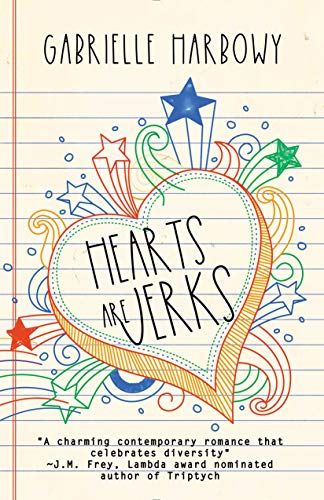
Hearts Are Jerks, by Gabrielle Harbowy (Heart Bow Books)
Back when gay marriage was being hotly debated in my state, opponents railed that the next thing, people would be able to marry more than one other person. My response, then and now, was “I don’t see why this is not a good thing.” It has always struck me that each loving relationship is unique, and the problems so often depicted in a negative way in films, television, and novels arise from poor communication and the expectation of jealousy. Characters all too often flirt with someone they’re not interested in, in order to arouse the possessive rage of their spouses. Dating more than one person is considered de facto “cheating.” Added to this pressure is the expectation that teens, who are at the beginning of their romantic lives, must find and stick with the “right” person without exploring other relationships. The truth is that all of us love more than one other person, although we typically place the different relationships in different categories: we love parents, children, siblings, kinfolk, friends, comrades...and romantic partners...at the same time. Many cultures have some form of polyamory, whether it’s marriage to more than one other person or socially acceptable lovers in addition to spouses. Human behavior and sexuality is so varied, why should we presume ours is the only right way? Or that one way is right for everyone?
I was delighted to discover Gabrielle Harbowy’s novel, which centers on a teenager who has grown up in a polyamorous family in which relationships are negotiated with kindness, skill, and clarity. Alicía Diaz considers it normal for both her parents to have other partners, and her life has been enriched by their loving support. When she begins to date both another girl and a boy, she always has someone who understands and can help her articulate the issues of consent, boundaries, privacy, and communication. Allie’s life takes a turn for the complicated when her girlfriend moves across the country and she briefly explores a relationship with the boy her girlfriend has been dating. To make matters worse, Allie inadvertently makes an enemy of a classmate, one who seeks payback through the rumor mill. Soon Allie finds herself the object of a vicious campaign of gossip, one that could have dangerous consequences.
As the author herself points out in the afterword, Allie’s family is privileged in many ways. Not only do her parents and their partners have stable, examined relationships and healthy ways of resolving conflict, but they are educated and financially secure. They are not vulnerable to blackmail or at risk of losing their jobs or homes. While these authorial choices exclude many poor families or those in occupations at risk should their polyamory be made public, the exclusion allows the story to focus on the core issues involved in creating, nourishing, and ultimately defending multiple loving relationships.
Harbowy’s prose is literate and flowing, her dialog and characterizations evocative. The voice of her teen narrator is spot on. Challenging material in the hands of a sympathetic, skilled story-teller make for a page-turning, satisfying read that captured my attention and held it to the very last words.
Allie herself reflects that “hearts are jerks,” meaning we cannot turn love on and off like a faucet. We often go to great, sometimes ridiculous lengths for those we love. Sometimes loving another person comes with unexpected, almost insurmountable challenges. Allie meets hers with courage and forthright honesty. We definitely need more stories like hers!
I should add that I read most of this book while my family and I were evacuated from the 2020 California wildfires, and I found the sanity and compassion of Allie and her partners and family incredibly reassuring. Hearts may be jerks, but the people we love most certainly are not.