Tuesday, April 30, 2013

The Feathered Edge: Ghosts in a Garden, and a Farewell

I've been wondering how I can write about K. D. Wentworth's marvelous, touching story, "The Garden of Swords." I put off this essay until the last, and you'll see why. In the story, a young scullery maid finds solace in the castle garden, in which the slain opponents of the power-mad baron are buried. This is a magical garden, and the ghosts of those swordsmen (and swordswoman!) become the girl's friends, confidantes, teachers, and on occasion her protectors. When I read it over, I feel as if Kathy's ghost is there, too, welcoming us all into her special realm of enchantment and friendship.

I met K. D. Wentworth back in the days when GEnie was a vibrant and interconnected community. I don't know how well the site worked for others, but we sf/f writers took to the bulletin board topics like ducks to supernovae. The various round tables were like rooms in an ongoing convention, with some silly chat and some serious conversations. Professional relationships formed and deepened, and many beginning writers found support and encouragement there. Alas, GEnie with its text-only format went the way of the dinosaur as the clocks ticked over into 2000, but many of the friendships are still going strong.

We met in person a few times, although I did not frequently travel outside the West Coast and she hailed from Oklahoma. I found her as charming and thoughtful in person as online. A number of her short fiction pieces were Nebula Award finalists (the novelette, "Kaleidoscope" 2008, and "Burning Bright" 1997, "Tall One" 1998, and "Born Again" 2005) have been Nebula award finalists. I knew she was one of the writers I wanted for The Feathered Edge.

True to her high professional standards, she sent me a story that is extraordinary. In clear prose and straightforward narrative, she managed to reach into my heart. "In the Garden of Swords" fits loosely within the theme of elegant romantic fantasy, a ghost-story-with-a-twist, sword and sorcery, but it is also a story of how love and kindness, strength and truth, transcend death. Whenever I re-read it, I hear Kathy's literary voice still spinning out tales of wonder and hope.

Kathy died in April 2012. I had no idea she was so ill. We weren't close, except in the sense that all writers who love fantasy and whose professional paths cross are close.

Wherever you are, Kathy, thank you for your marvelous stories. The world is richer for having had you in it.

Tuesday, April 23, 2013

The Feathered Edge: An Outlander Takes on Masks and Feathers

Writers form communities in various ways, and I think there is no finer, more supportive or interwoven community than people who read and write fantasy and science fiction. Sometimes it feels as if there really are only about 300 of us, and we mill around, meeting one another through yet another different connection. Just as I wouldn't have met Rosemary Hawley Jarman except through Tanith Lee, who I had met through Norilana's publisher, I wouldn't have had the joy of editing Samantha Henderson's "Outlander" if I had not been friends and colleagues with Sheila Finch (whose "Fortune's Stepchild" also appears in The Feathered Edge).

Samantha was such a discovery that I searched out her other work. It came as no surprise that's she's also a poet and winner of the Rhysling Award, or that her fiction spans a spectrum from hilarious to very strange-and-dark, with a little steampunk thrown in, too. As one whose own poetry efforts are best forgotten, I'm a bit in awe of writers who can do this well, and even more so when they, like Samantha, are adept at prose stories as well.

"Outlander" has many of the superficial trappings we've seen before, in the adventures of a man from the "sticks" who is seen by members of a caste-bound aristocracy as uncouth and dull-witted, although physically strong. We expect to find him in the dueling arena instead of the drawing room, and so we do, but not for the reasons we -- and the narrator -- assume. The story is told from the point of view of a member of the nobility who, while unable to see beyond his own prejudices, provides a transparent window for the reader's experience. Throughout the story, from the very first sentence, runs a vein of wit, not to mention keen social commentary. The result is a delightful mixture of humor and romance, with a twist at the end.

And I'm not saying any more about it, lest I spoil the surprise.

You can listen to this marvelous story on Podcastle.


Monday, April 22, 2013

Music and grief

Our elderly and Highly Opinionated tortoiseshell cat, Cleopatra, died Saturday morning. She's made it to her 20th birthday last month, which astonished us all. Privately, I think she wasn't about to let the dog outlast her. (Oka, our wonderful German Shepherd Dog, died on Wednesday.)

It's a bit much to take in, the loss of two pets within a week. We're keeping an eye on the black cat who was Oka's buddy. He wanders around the house, clearly looking for Oka. (He still has a cat friend, one-eyed lady pirate Gayatri.)

I've been studying piano as an adult for about 7 or 8 years now. I play mostly classical, but add in fun stuff, too, like music from The Lord of the Rings. Earlier this spring, I began working on "Into the West." It's an easy setting, and it's flowing nicely, although in a key I can't sing. That's okay. Since Oka died, I've played it with tears streaming down my face. "All dogs pass...into the west." The music brings up grief in a way words can't. A healing way, a gentle way that lets me go as deep as is right for me at the moment. It's not the same as listening to music because I'm inside of it, I'm creating it right now in this moment and no two performances are ever the same. It reminds me poignantly of how pets live in the "now."

Today's practice was a little different. One of my serious pieces is the 3rd Gymnopedie by Satie. The tempo is Lento e grave. I slowed it a bit, focusing on the full tone of each chord, and realized I was playing it for both animals. The right hand melody soars above the funeral bass rhythm in that aeolian mode. Sweet and sad and profoundly honoring the memory of these friends-in-fur.

Thursday, April 18, 2013

Good night, sweet boy

Most of my blogs are about writing and writers, my projects and those of others. But I want to step aside from that and share a very special life and passing. For those of us who are dog people, the short years we share with a canine companion enrich our lives immeasurably. Our sweet, brave German Shepherd Dog, Oka, died peacefully yesterday. He was 12 1/2, quite old for that breed, had had been battling lymphoma and degenerative myelopathy. We'd hoped to have him for a little while longer, but he developed leukemia, lost the ability to walk, and most likely had an embolism and a stroke. The vet came out to our house and he slipped away with "his people" holding him and talking to him. Also, "his cats" - all 3 gathered around, especially Oka's "best buddy," who cuddled up next to him when it was all over.

Here are a few images to share with you:

Oka at 8 weeks. The green coloring in his right ear is the Schaferhundverein breed tattoo, certifying that he really is a German Shepherd Dog (i.e. both his parents were Schutzhund titled; in fact, his father was the Weltsieger: the world champion).


Tuesday, April 16, 2013

The Feathered Edge Ventures into an Algerian Brothel

As I've discussed in earlier posts, one of the joys of editing is getting an inside view of another writer's creative process. Sometimes this comes in the reading process, but more likely it happens during the editorial discussions with their give-and-take. Often a good editor can pinpoint places where what is on the page does not fully or accurately convey the writer's intention. We then become conspirators whose goal is to make the story the best incarnation of that authorial vision. When I began editing, I had no idea that I'd also get to witness yet another joy of short fiction -- the inception and development of a series of related stories that trace not only the adventures but the emotional development of a character.

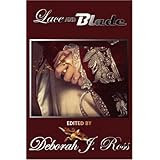
The first anthology I edited was Lace and Blade (Norilana Books, 2008), and I asked Diana L. Paxson, who I'd known about as long as I'd known Marion, to send me a story. The premise of the anthology was elegant, sensual sword and sorcery of the "Scarlet Pimpernel With Magic" or Alfred Noyse's poem, "The Highwayman," variety. Diana gave me a dashing young hero, Baron Claude DeLorme, newly come into his title, and promptly took a right angle turn from the expected European-centered fantasy by sending him off to Brazil to claim an emerald mine as his inheritance. The magic that imbues "The Crossroads" is anything but conventional, but this adventure was only the beginning. If "The Crossroads" taught Claude about Brazilian/African magic, then his next story (in Lace and Blade 2) brought him back to Paris to face a very different sort of supernatural evil in "The Crow." One of the things that most appealed to me in this second story is how, although it stands perfectly well on its own, it's a true, developmental continuation of the previous story. The Claude DeLorme who arrived in Brazil is not the same man battling an occult cabal in Paris...and not the same man who arrives in Algiers.