Thursday, January 31, 2013

Hero on a Quest


This month, the Great Fantasy Traveling Round Table looks at "The Hero and the Quest." There are some thoughtful posts from host Warren Rochelle, Chris Howard, Carole McDonnnell, and Sylvia Kelso. Here' what occurred to me: 

Once upon a time, a hero represented a very particular character, an archetype if you will. He was invariably male, either a youth or in the prime of life, neither a child nor infirm with age; he was physically powerful and if not morally irreproachable, clearly a “good guy.” It was fine for him to have a flaw or two, so long as it did not interfere with his ability to accomplish great deeds and conquer mighty foes. Occasionally, the flaw would prove his downfall, as in the case of Achilles. The tradition that stretches from Odysseus, Beowulf, and Gilgamesh continued through King Arthur and his knights, to Tarzan, the superheroes of comic books, Doc Savage, and James Bond. True, there were occasional female-heroes in this mold, but mostly they imitated the men, only with brass bikinis, improbably high heels, and better fashion sense. What made them heroic, men and women alike, were physical prowess, lofty ideals, and larger-than-life goals. In other words, they were Worthy of The Noble Quest.

The Quest was always something beyond the reach of the ordinary person. No average plowman or shop-keeper could aspire to find the Grail or slay the dragon. The Quest usually involved what Joseph Campbell called “the hero’s journey,” meaning that the central character must leave behind the familiar, venture into unknown terrain fraught with danger, and then return home. Sometimes he is changed by his experience, sometimes he merely puts himself back on the shelf until the next plea for help.

The function of this kind of Hero is not only as a Campbellian agent – that is, to guide the reader through a transformative journey – but as an instrument of Order and of The Triumph of Good. (Notice how the topic lends itself to unnecessary capitalization?) The world has veered toward Chaos, if not actually toppled headlong into the abyss, and the task of the Hero is to set things right. (I suspect that one modern incarnation of the classical Hero is the detective, who restores right social order by solving puzzles that lead to the apprehension of wrong-doers.) One of the implications here is that only those of noble birth, etc., and who are favored by the gods have the capacity to do great deeds. Aforementioned nobles undoubtedly relished stories that demonstrated them how superior they were and didn’t mind the peasantry being reminded of it. This propagated a hierarchical power structure in the same way as did the notion of the divine right of kings. It reinforced the notion that those with political power were inherently better (stronger, luckier, sexier, purer of thought, beloved by the gods) than those who had none.

Wednesday, January 30, 2013

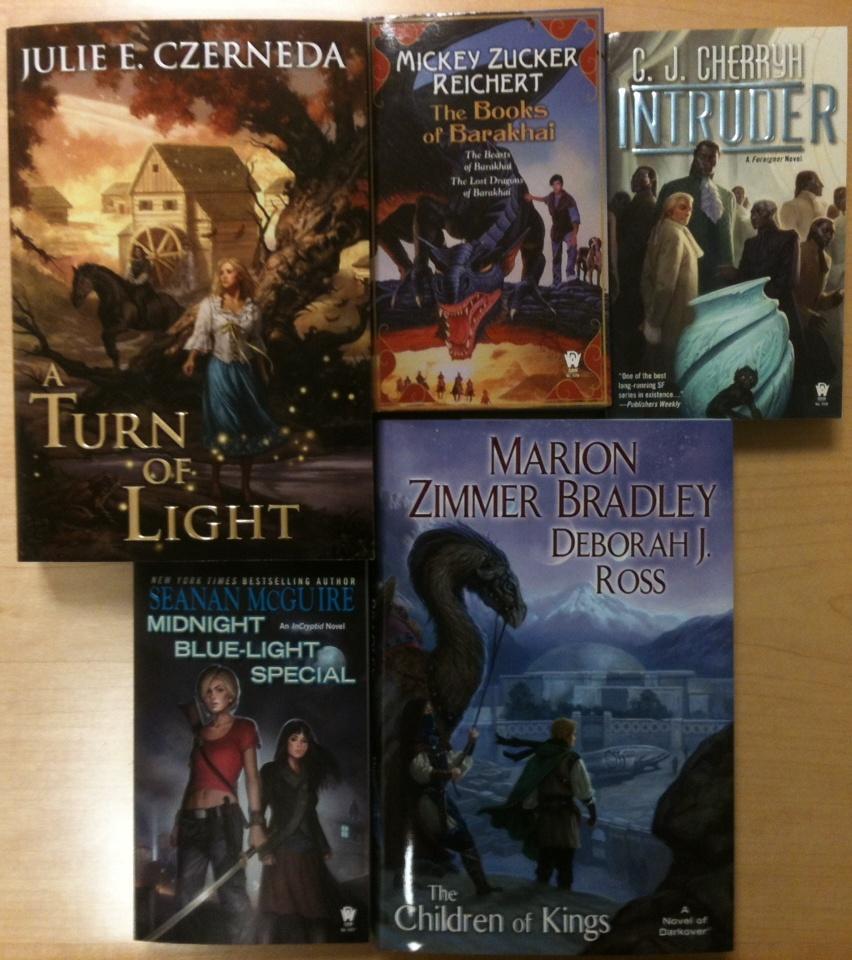
The Children of Kings sighting!

Total author squee: the first glimpse of the actual book (at the DAW office, even if I don't have it in my hands):


GUEST BLOG: Lois Gresh on Paranormal Romance

Lois Gresh's new novel, Nightfall, is a New Adult Paranormal Romance. Here she talk about her writing career and what she's learned about crafting good stories (oh, and a few words about Nightfall, too!)
When I first learned how to read, I instantly loved books.  I actually remember the moment.  I spent a lot of time at the library and reading an ancient (1930s!) set of encyclopedias that my mother kept in the hallway outside my bedroom. At 9, I wrote a 55-page science fiction story; at 12, a 220-page “report” about ancient Egypt; at 16, a 250-page book about poverty; at 22, a 500-page novel; at 23, a 400-page novel; and during college classes, I wrote horror stories featuring my professors. In my early twenties, I wrote two full-length mystery novels that twisted themselves into dark comedies. I switched to dark fiction, what's called weird fiction -- a blend of fantasy, paranormals, science fiction, and psychological horror -- and sold a bunch of stories. I ended up writing a thriller novel for Ballantine/Del Rey, then went on to write a fleet of pop culture books while continuing to work on my novels and short stories.

I usually have a pre-planned idea of how the story will end, but does it end that way? Very rarely. Typically, the characters take on lives of their own and twist my endings for me. I don’t get writer’s block (knock on wood, etc.) I always have too many stories floating in my mind that I want to tell for the amount of time I’m able to write. As for where I write, anything will distract me. So I write in a secluded environment, and I even blast a white noise machine to drown out household noises. 
The most important elements of good writing are the triad of character, plot, and theme. You need characters with real emotions and needs. Your characters require conflicts to overcome.  One or more themes -- such as “be good to other people” or “it’s not cool to lie to somebody who loves you” or “love can overcome anything” or “love is more important than where you live or what you have” -- provides your story with emotional impact.

Monday, January 28, 2013

GUEST BLOG: Juliette Wade on The Internet Trap and What To Do About It

If you're a writer, I imagine you are familiar with the problem of the internet trap. You turn on the computer to start writing, and an hour later you're still on the internet. You think of the pages you have still to write and you want to scream, Why is this happening? How can I stop it?

So I thought I'd begin this week by talking about why the internet is such a trap, at least for me. And also, thinking about how to manage the whole thing. I hope that my thoughts may help those of you out there who experience something of the same thing.

Internet Trap #1. Small flashes of wonderful in a torrent of irrelevant

I've heard partaking of the internet compared to drinking from a fire hose. I don't quite agree with this, because it suggests that if you could manage to take a sip, it would be good water that you were getting. To me it's more like a baseball game: you'd better have good friends with you and be doing something in the stands, because most of what's going on is stuff you don't care about anyway (in this I reveal my bias against baseball - sorry baseball fans!). Each critical play is buried in a ton of waiting around. On the internet, sometimes I'll have a day where I find tons of links I want to pass on to my blog readers. Then I'll go for weeks without encountering anything to care about at all.

Internet Trap #2. News

Yes, this is where I get the vast majority of my news about the world. And though I spend a lot of time in worlds of my own, I do care about what's going on. So I find myself clicking through to read about current events when I should probably be writing, or at least not reading my sixth article in a row about a particular issue. Even one I really care deeply about.

Sunday, January 27, 2013

Treasures from the Back Yard

    We live in a rural area, or rural-ish. This means wildlife of various sorts, including the usual coyotes, raccoons, squirrels, skunks, smaller critters like mice and moles and shrews. (And bobcats and an occasional mountain lion up in the hills.)

And mule deer. Oh gosh yes, deer.

Our garden is well-fenced and we don't have much problem with deer eating things. Our German Shepherd Dog does his best to convince them the property is guarded by Ravenous Deer-Eating Monsters.

Last week, when my husband was clearing storm debris  (outside The Fence), the dog got very interested in something hidden in the undergrowth. Finally, the dog emerged with a picked-clean deer femur, looking very pleased with himself. Most of the skeleton had been scattered, but we found the skull tangled in the plants. This is the condition we found it in.

We think it might be one of two stags we saw wandering by not too long ago. We have no idea why this one died, as both looked quite healthy. There's a little gnawing on the left antler and part of one maxilla is gone, but otherwise the skull is as you see it, in amazing condition.
Posted by Picasa