Monday, October 17, 2022

Proofreading The Children of Kings

Here's an image from late 2012. Cleopatra left us the next year at the ripe old age of 20.

Here I am, complete with Cat Muse, working my way through page proofs of The Children of Kings.

Cleopatra is almost 20 years old, and I've had her since she was 8 weeks. She's moving very slowly these days but still loves to curl up with me while I work. She's so thin, I've covered her with the edge of the afghan for extra warmth.


Friday, October 14, 2022

Short Book Reviews: Domestic Revenge Thriller

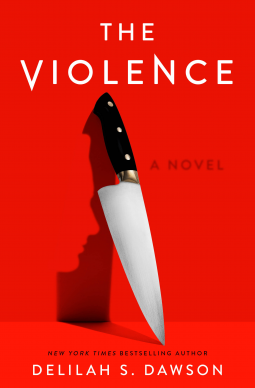
 The Violence, by Delilah S. Dawson (Del Rey)

 What a powerful, disturbing, exhilarating novel! In the beginning, three generations of women are struggling with domestic violence and oppression in different ways, with Chelsea in the middle generation. Her husband terrorizes her, sometimes choking her into unconsciousness and keeping her isolated and financially dependent on him. Her mother, once a destitute teen mother, has sought security in a loveless but wealthy marriage and become obsessed with conformity and her own survival. Now her teenage daughter is about to fall into the same trap when her once adoring boyfriend shows a dark, possessive side. Chelsea knows her chances of making a successful break for freedom are slim to none with her husband’s law enforcement and lawyer buddies to corroborate his side of the story. Her life seems hopeless until The Violence strikes, a viral epidemic that causes bursts of unprovoked, deadly rage that leave no memory of their deeds. In a scenario eerily reminiscent of the early days of the Covid-19 pandemic, the rich wall themselves into enclaves while lawlessness takes hold. Soon Chelsea finds herself separated from her family, on the run in a landscape of senseless carnage. Then she stumbles on the Violence Fight circuit, successor to pro wrestling with its vivid persona, costumes, and choreographed moves, and she begins reclaiming her life.

Part revenge-wish-fulfillment, part allegory of what happens when the downtrodden revolt, part examination of society-wide misogyny, The Violence delivers a breath-taking page-turner.

Monday, October 10, 2022

Cat Rambo on Writing Euphoria and Multitasking


Cat Rambo is a wonderful writer and teacher. I reviewed her space opera, You Sexy Thing, here. She runs the Rambo Academy for Wayward Writers, which offers live and on-demand classes. And she's a nifty person. Best of all, I love the way she talks about the writing process. Here, in an article on multitasking from the SFWA blog, she nails the description of the mental state when everything comes together and the world flow like silken fire. Whenever I see a depiction of a blocked writer (last night I watched the "Calliope" episode of the Netflix "The Sandman" series), I cringe. Yes, we go through fallow periods, frustration, and emptiness. But most working writers find strategies to get around, over, or through those blocks because there's nothing like a writer's high.

Here's Cat's description:
You start putting words on the page, and if you’re lucky, you hit the flow, that happy stream of words where you are writing and simultaneously entertaining yourself, discovering what happens next, where the world falls away and all you are doing and thinking about is writing. A state of intense, focused concentration that feels wonderful, because you are simultaneously challenged and exercising competency, constantly rising to that challenge and succeeding. [bold mine]

That’s one of the happiest states for a writer, and one that we chase. And if we want to hit it, we need to get rid of distractions. Multitasking is such a distraction, taking up a little bit of bandwidth in order to keep tabs on that task or other tasks and tracking time. Multitasking is not compatible with things that require concentration and time.

Friday, October 7, 2022

Short Book Reviews: A Sweet M/M Historical Romance

 Resurrection Men, by Steven Harper (Darwin Press)

Life in the late 1800s wasn’t easy for medical students from poor backgrounds like Arthur, and one of the few ways to pay tuition was through the illegal “resurrection” of buried corpses for use in anatomy laboratories. Life wasn’t much easier for Jesse, who fled his ultra-controlling, wealthy socialite family and ended up as a grave-digger. Now a vengeful judge is looking for a reason to throw Arthur in jail, and Arthur’s budding romance with Jesse might provide just the excuse.

The pacing of this historical novel is perfectly balanced, from desperate action to the sweet, slowing unfolding of a deep connection between the two men. Historical details create a vivid setting that heightens the stakes, drawing the reader ever deeper into this compelling story.

Monday, October 3, 2022

Let's Build a World: New Astronomical Finds for Your SF Stories

I've got a file (actually a dozen files) of cool science stories that I might use in science fictional world-building. What sf author doesn't? Even fantasy stories need good science. For instance, an urban fantasy involving werewolves really should depict the phases of the moon accurately. This week, images and data from the Hubble and James Webb Space Telescopes have furnished a treasure trove of research ideas. Rather than post them separately, I've gathered a few that I find particularly exciting.


There Could be Many Water Worlds in the Milky Way

Astronomers are curious about how many terrestrial planets in our galaxy are actually “water worlds.” 
These are rocky planets that are larger than Earth but have a lower density, which suggests that volatiles like water make up a significant amount (up to half) of their mass-fraction. According to a recent study by researchers from the University of Chicago and the Instituto de AstrofĂ­sica de Canarias (IAC), water worlds may be just as common as “Earth-like” rocky planets. These findings bolster the case for exoplanets that are similar to icy moons in the Solar System (like Europa) and could have significant implications for future exoplanet studies and the search for life in our Universe.

“We have discovered the first experimental proof that there is a population of water worlds, and that they are in fact almost as abundant as Earth-like planets. We found that it is the density of a planet and not its radius, as was previously thought, which separates dry planets from wet ones. The Earth is a dry planet, even though its surface is mostly covered in water, which gives it a very wet appearance. The water on Earth is only 0.02% of its total mass, while in these water worlds it is 50% of the mass of the planet.”

However, planets around M-type stars typically orbit so closely that they are tidally locked, where one side is constantly facing toward its sun. At this distance, any water on the planet’s surface would likely exist in a supercritical gas phase, increasing their sizes. As a result, Luque and PallĂ© theorized that in this population, water is bound to the rock or in closed volumes below the surface, not in the form of oceans, lakes, and rivers on the surface. These conditions are similar to what scientists have observed with icy moons in the outer Solar System, such as Jupiter’s moon Europa and Saturn’s moon Titan.

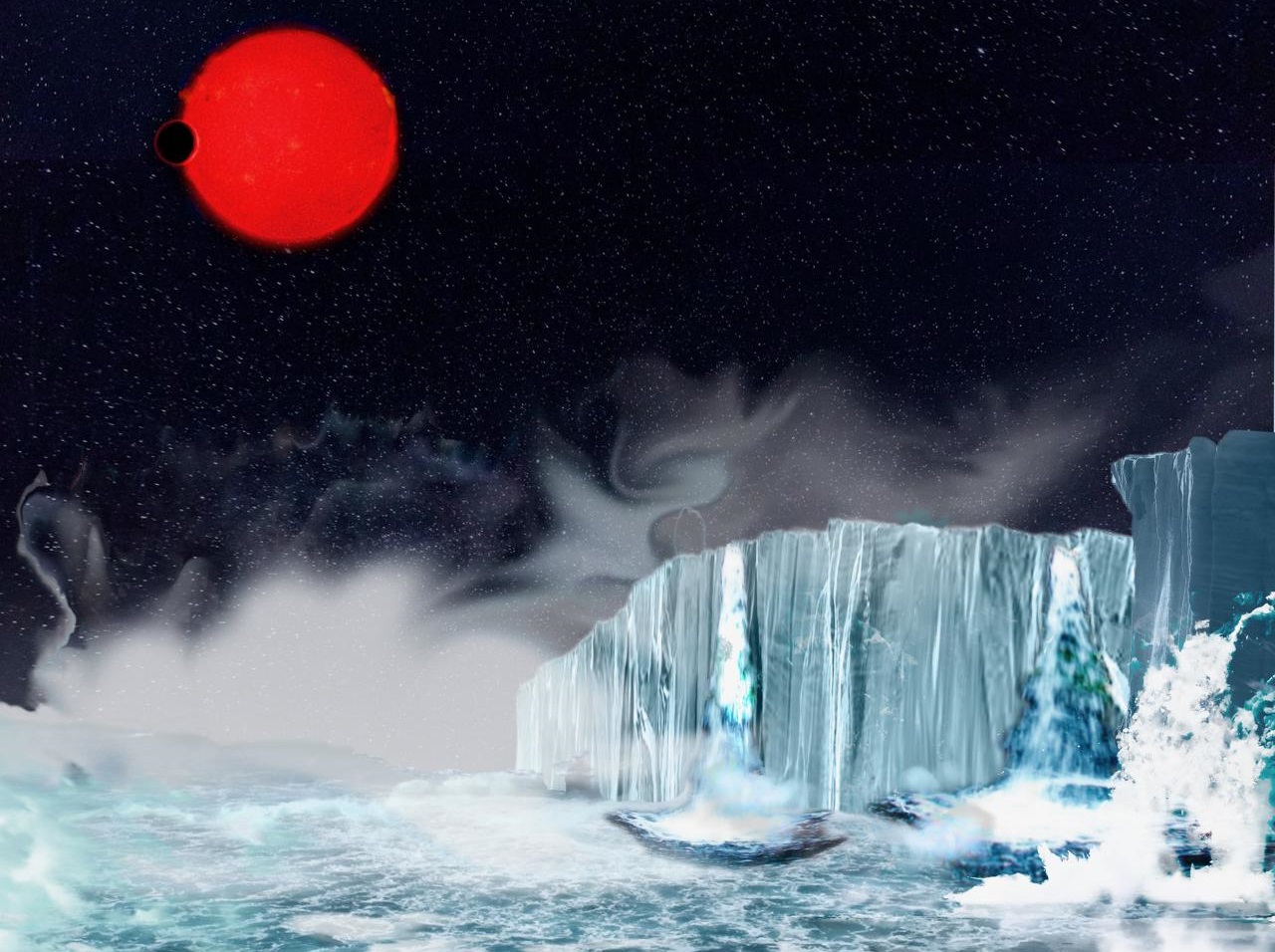
Given that they are tidally locked to their suns, these planets may also have liquid oceans on their sun-facing side but frozen surfaces everywhere else – colloquially known as “eyeball planets.” While astronomers have speculated about the existence of this class of exoplanet, these findings constitute the first confirmation for this new type of exoplanet. They also bolster the growing case for water worlds that form beyond the so-called “snow line” in star systems (the boundary beyond which volatile elements freeze solid), then migrate closer to their star.
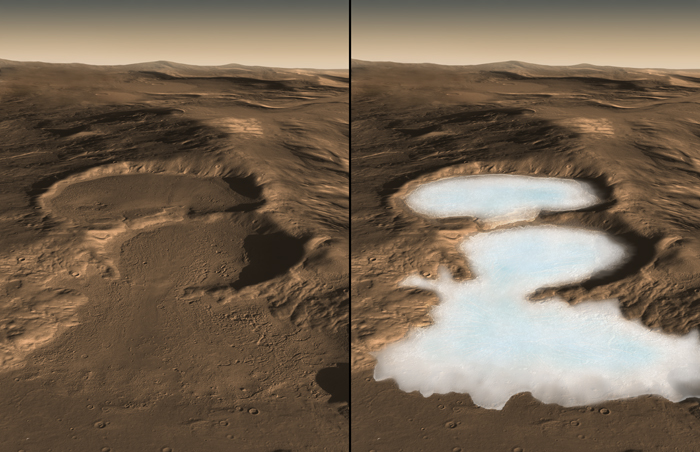


In the past, glaciers may have existed on the surface of Mars, providing meltwater during the summer to create the features we see today. Credit: NASA/JPL-Caltech/ESA

Mars Had Moving Glaciers, but They Behaved Differently in the Planet's Lower Gravity

On Earth, shifts in our climate have caused glaciers to advance and recede throughout our geological history (known as glacial and inter-glacial periods). The movement of these glaciers has carved features on the surface, including U-shaped valleys, hanging valleys, and fjords. These features are missing on Mars, leading scientists to conclude that any glaciers on its surface in the distant past were stationary. However, new research by a team of U.S. and French planetary scientists suggests that Martian glaciers did move more slowly than those on Earth.
These findings demonstrate how glacial ice on Mars would drain meltwater much more efficiently than glaciers on Earth. This would largely prevent lubrication at the base of the ice sheets, which would lead to faster sliding rates and enhanced glacial-driven erosion. In short, their study demonstrated that lineated landforms on Earth associated with glacial activity would not have had time to develop on Mars.

In addition to explaining why Mars lacks certain glacial features, the work also has implications for the possibility of life on Mars and whether that life could survive the transition to a global cryosphere we see today. According to the authors, an ice sheet could provide a steady water supply, protection, and stability to any subglacial bodies of water where life could have emerged. They would also protect against solar and cosmic radiation (in the absence of a magnetic field) and insulation against extreme variations in temperature.