Showing posts with label fake science stories. Show all posts

Monday, June 2, 2025

Reprint: Why we fall for fake health information – and how it spreads faster than facts
 

Why we fall for fake health information – and how it spreads faster than facts

Should you share that health-related Instagram post? Catherine McQueen/Moment via Getty Images
Angshuman K. Kashyap, University of Maryland

In today’s digital world, people routinely turn to the internet for health or medical information. In addition to actively searching online, they often come across health-related information on social media or receive it through emails or messages from family or friends.

It can be tempting to share such messages with loved ones – often with the best of intentions.

As a global health communication scholar studying the effects of media on health and development, I explore artistic and creative ways to make health information more engaging and accessible, empowering people to make informed decisions.

Although there is a fire hose of health-related content online, not all of it is factual. In fact, much of it is inaccurate or misleading, raising a serious health communication problem: Fake health information – whether shared unknowingly and innocently, or deliberately to mislead or cause harm – can be far more captivating than accurate information.

This makes it difficult for people to know which sources to trust and which content is worthy of sharing.

The allure of fake health information

Fake health information can take many forms. For example, it may be misleading content that distorts facts to frame an issue or individual in a certain context. Or it may be based on false connections, where headlines, visuals or captions don’t align with the content. Despite this variation, such content often shares a few common characteristics that make it seem believable and more shareable than facts.

For one thing, fake health information often appears to be true because it mixes a grain of truth with misleading claims.

For example, early in the COVID-19 pandemic, false rumors suggested that drinking ethanol or bleach could protect people from the virus. While ethanol or bleach can indeed kill viruses on surfaces such as countertops, it is extremely dangerous when it comes into contact with skin or gets inside the body.
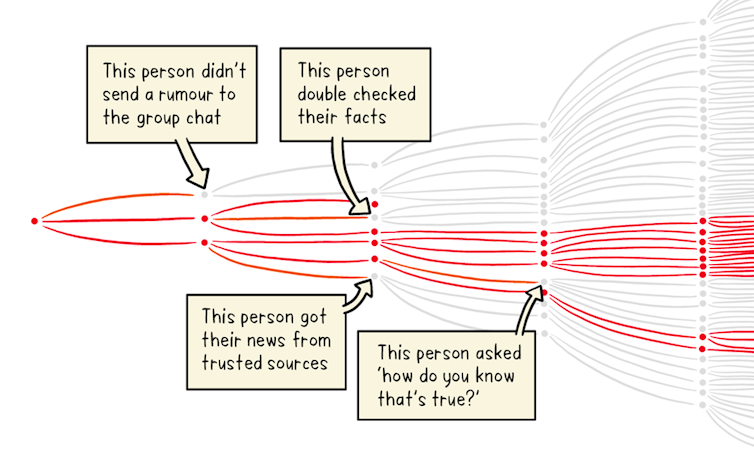
Stopping to check the facts helps stem the spread of misinformation. World Health Organization adaptation from Siouxsie Wiles and Toby Morris in The Spinoff, CC BY-SA

Monday, March 29, 2021

Beware Fake Science News!

Barbara McClintock, geneticist
Science news articles abound, everything from the results of carefully designed peer-reviewed research studies to fear-based rumors and anti-science biased conspiracy theories. How are we to discern which are reliable, which are hype based on misinterpretation, flawed studies, and the like, and which are clickbait nonsense?

The first thing I do is look at the source. Mediabiasfactcheck and other sites provide information as to the right-left biases and factual accuracy of a given source, although not of a particular story. Science Based Medicine is also helpful. I've been known to search under "Is Dr. So-and-So a quack?" and get useful answers. 

I also check my own reactions: Is this too good to be true? Is it at odds with what I understand about science (my academic background is biology and health sciences)? Have I seen an article in a trusted source (such as the newsletter from Center for Science in the Public Interest) debunking this or similar claims? I've been also known to check with friends with special expertise in the field.

The Conversation offers some guidelines on assessing the quackery scale of science new stories. Their suggestions:

1. Has the story undergone peer review?

Scientists rely on journal papers to share their scientific results. They let the world see what research has been done, and how.

Once researchers are confident of their results, they write up a manuscript and send it to a journal. Editors forward the submitted manuscripts to at least two external referees who have expertise in the topic. These reviewers can suggest the manuscript be rejected, published as is, or sent back to the scientists for more experiments. That process is called “peer review.”

Research published in peer-reviewed journals has undergone rigorous quality control by experts. Each year, about 2,800 peer-reviewed journals publish roughly 1.8 million scientific papers. The body of scientific knowledge is constantly evolving and updating, but you can trust that the science these journals describe is sound. Retraction policies help correct the record if mistakes are discovered post-publication.

Peer review takes months. To get the word out faster, scientists sometimes post research papers on what’s called a preprint server. These often have “RXiv” – pronounced “archive” – in their name: MedRXiv, BioRXiv and so on. These articles have not been peer-reviewed and so are not validated by other scientists. Preprints provide an opportunity for other scientists to evaluate and use the research as building blocks in their own work sooner.

How long has this work been on the preprint server? If it’s been months and it hasn’t yet been published in the peer-reviewed literature, be very skeptical. Are the scientists who submitted the preprint from a reputable institution? During the COVID-19 crisis, with researchers scrambling to understand a dangerous new virus and rushing to develop lifesaving treatments, preprint servers have been littered with immature and unproven science. Fastidious research standards have been sacrificed for speed.

A last warning: Be on the alert for research published in what are called predatory journals. They don’t peer-review manuscripts, and they charge authors a fee to publish. Papers from any of the thousands of known predatory journals should be treated with strong skepticism.

2. Be aware of your own biases.

Beware of biases in your own thinking that might predispose you to fall for a particular piece of fake science news.