Showing posts with label dictators. Show all posts

Monday, October 20, 2025

Reprint: Abortion Rights vs Authoritarianism


Banning abortion is a hallmark of authoritarian regimes
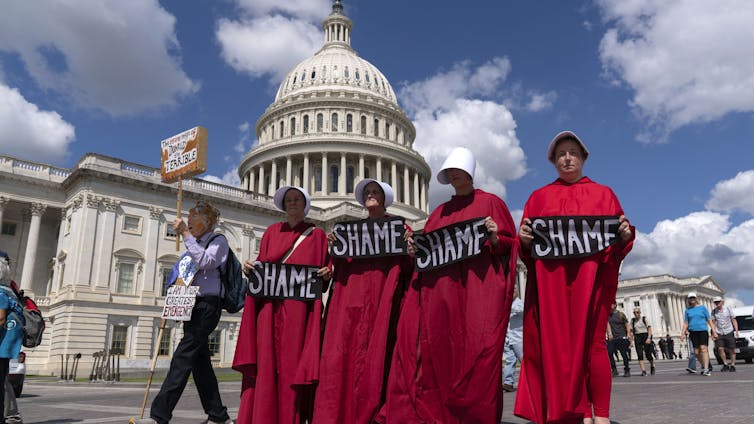
Abortion rights protesters march against Trump’s deployment of federal troops to Washington, D.C., on Sept. 2, 2025. Jose Luis Magana/AP
Seda Saluk, University of Michigan

Pregnant women crossing borders to get an abortion. People who miscarry facing jail time or dying from infection. Doctors who won’t perform lifesaving procedures on a pregnant patient for fear of prosecution.

For years, this was the kind of thing that happened in Poland, Nicaragua or El Salvador. Now, it’s headline news in the United States.

As a scholar who studies the relationship between reproductive rights and political regimes, I see the U.S. mirroring a pattern that has happened in authoritarian regimes around the world. When a government erects barriers to comprehensive reproductive care, it doesn’t just cause more death and suffering for women and their families. Such policies are often a first step in the gradual decline of democracies.

Yet, the U.S. is different in a meaningful way. Here, abortion has historically been framed as a personal right to privacy. In many other countries I’ve studied, abortion is viewed more as a collective right that is inextricably tied to broader social and economic issues.

The American individualist perspective on abortion can make it harder for people in the U.S. to understand why banning abortion can serve as a back door for the erosion of civil liberties – and of democracy itself.

Autocrats target abortion first

Restricting reproductive rights is a hallmark of authoritarian regimes.

From Benito Mussolini’s Italy in 1926 and Josef Stalin’s Soviet Union in 1936 to Francisco Franco’s Spain in 1941 and Nicolae CeauČ™escu’s Romania in 1966, the first move most 20th-century dictators made after seizing power was to criminalize abortion and contraception.

Initially, for some of those autocratic leaders, limiting access to abortion and contraception was a strategy to gain the approval of the nation’s religious leaders. The Catholic Church held great power in Italy and Spain, as did the Orthodox Church in Romania. At the time, these faiths opposed artificial birth control and still believe life begins at conception.

Restrictions on reproductive rights also aimed to increase birth rates following two world wars that had stamped out some of the population, particularly in the Soviet Union and Italy. Many political leaders saw procreation as a national duty. They designated women – white, heterosexual women, that is – specific roles, primarily as mothers, to produce babies as well as future soldiers and workers for their regimes.


Friday, January 26, 2018

In Troubled Times: George Washington on Political Parties and the Abuse of Power

In light of the political events of recent times, I offer these words from George Washington's highly prescient Farewell Address.

United States 19th September 1796
Friends, & Fellow--Citizens.

I have already intimated to you the danger of Parties in the State, with particular reference to the founding of them on Geographical discriminations. Let me now take a more comprehensive view, & warn you in the most solemn manner against the baneful effects of the Spirit of Party, generally.

This Spirit, unfortunately, is inseperable from our nature, having its root in the strongest passions of the human Mind. It exists under different shapes in all Governments, more or less stifled, controuled, or repressed; but in those of the popular form it is seen in its greatest rankness and is truly their worst enemy.

The alternate domination of one faction over another, sharpened by the spirit of revenge natural to party dissention, which in different ages & countries has perpetrated the most horrid enormities, is itself a frightful despotism. But this leads at length to a more formal and permanent despotism. The disorders & miseries, which result, gradually incline the minds of men to seek security & repose in the absolute power of an Individual: and sooner or later the chief of some prevailing faction more able or more fortunate than his competitors, turns this disposition to the purposes of his own elevation, on the ruins of Public Liberty.

Without looking forward to an extremity of this kind (which nevertheless ought not to be entirely out of sight) the common & continual mischiefs of the spirit of Party are sufficient to make it the interest and the duty of a wise People to discourage and restrain it.

It serves always to distract the Public Councils and enfeeble the Public Administration. It agitates the Community with ill founded Jealousies and false alarms, kindles the animosity of one part against another, foments occasionally riot & insurrection. It opens the door to foreign influence & corruption, which find a facilitated access to the government itself through the channels of party passions. Thus the policy and the will of one country, are subjected to the policy and will of another.

There is an opinion that parties in free countries are useful checks upon the Administration of the Government and serve to keep alive the spirit of Liberty. This within certain limits is probably true--and in Governments of a Monarchical cast Patriotism may look with endulgence, if not with favour, upon the spirit of party. But in those of the popular character, in Governments purely elective, it is a spirit not to be encouraged. From their natural tendency, it is certain there will always be enough of that spirit for every salutary purpose. And there being constant danger of excess, the effort ought to be, by force of public opinion, to mitigate & assuage it. A fire not to be quenched; it demands a uniform vigilance to prevent its bursting into a flame, lest instead of warming it should consume.