Last
year I began this series on "the stories behind the stories" in this
anthology of marvelous fantasy stories I was privileged to edit. I got
about halfway through when life in the form of writing deadlines
intervened. So I'm going to repost them and hopefully finish the series,
then put them together in a companion volume. to
The Feathered Edge.
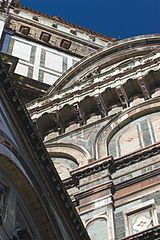
Italy has some of the most
romantic and mysterious cities in the world, and I was delighted when
Jay Lake and Shannon Page sent me a story set in the Renaissance
Florence.
 |
| Florence, by Thermos |
 |
| Venice, by Paolo da Reggio |
My own adventure began in 1991, when I was living in
France. We used our children’s spring break to visit Italy, and that
meant Florence and Venice. These places overwhelmed me with a sense of
being not quite in the same reality as other places I’d been. I was
accustomed to living near water (having come from Venice, California --
all right, just across the street from the Venice city line), but not
the pervasive sense of dark, fluid depths underlying every building and
every walkway, nor the atmosphere of age and history, or the constant
reminders of private lives – of secrets – behind those shuttered windows
and doors. Whether strolling through the piazzas or over one of the
many bridges, or riding in a gondola, or sitting in a café, I felt
myself surrounded by stories. I remember the moment of awe when I
stepped out into the plaza of the
ghetto (the original ghetto,
after which all others are named). There isn’t much to see, just a
well-swept space surrounded by tourist shops; it’s not what I saw but
what I felt, century upon century of hope and despair, of huddled safety
and wellsprings of determination.
A tourist brochure,
perhaps from the city of Venice itself, I can’t remember now, featured
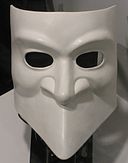
images from carnevale. One of these was the famous character, Bauta.
This costume consists of a unadorned white mask, flared at the bottom
where the mouth should be, a black tricorned hat, and a black cloak. It
is impossible to tell if the person wearing it is old or young, man or
woman, rich or poor – a true disguise for that brief time of
merry-making when such distinctions no longer hold sway. In the
publicity image, indirect, diffuse lighting cast the figure in
mysterious shadows. You can see something of what it looked like
here.
 Or here.
Oh my,
Or here.
Oh my, I thought.
Story material.


 Or here.
