Showing posts with label Richard III. Show all posts

Monday, January 20, 2025

Shakespeare on Tyrants: Richard II and Drumpf


What Shakespeare revealed about the chaotic reign of Richard III – and why the play still resonates in the age of Donald Trump
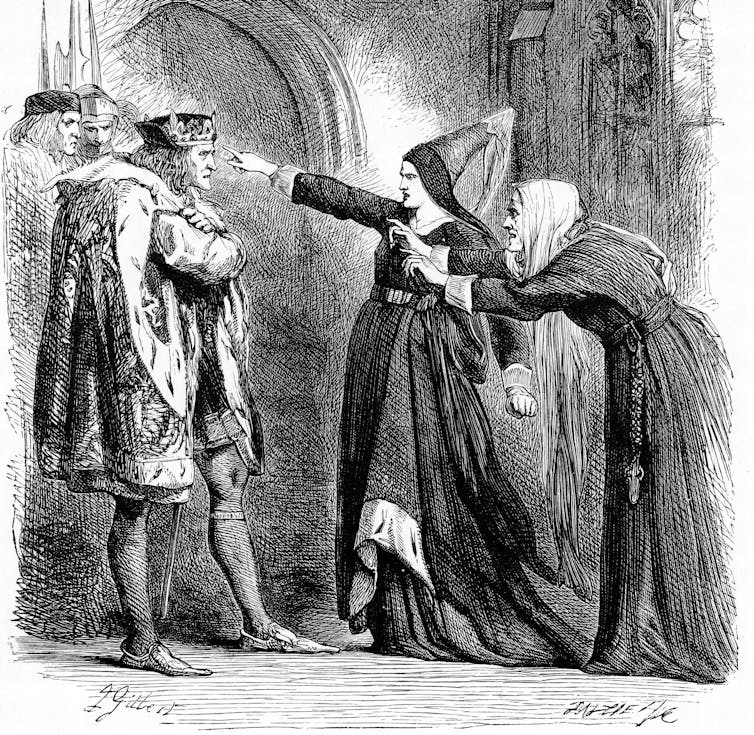
In this circa 1754 illustration, two women scold Richard III in Shakespeare’s play. Universal History Archive/Getty Images)
by David Sterling Brown, Trinity College

Written around 1592, William Shakespeare’s play “Richard III” follows the reign of England’s infamous monarch and charts the path of a charismatic, cunning figure.

As Shakespeare depicts the king’s reign from June 1483 to August 1485, Richard III’s kingdom was wrought with chaos, confusion and corruption that fueled civil conflict in England.

As a scholar of Shakespeare, I first thought about Richard III and his similarities with Donald Trump after the latter’s debate with President Joe Biden in June 2024. Those similarities – and Shakespeare’s depictions – became even clearer after Trump’s election in November 2024.

Shakespeare’s play highlights the flawed character of a man who wanted to be, in modern terms, a dictator, someone who could do whatever he pleased without any consequences.

In his 1964 essay, “Why I Stopped Hating Shakespeare,” writer James Baldwin concluded that Shakespeare found poetry “in the lives of people” by knowing “that whatever was happening to anyone was happening to him.”

“It is said that Shakespeare’s time was easier than ours, but I doubt it,” Baldwin wrote. “No time can be easy if one is living through it.”

A black and white drawing of Richard III.
An undated portrait of Richard III. Universal History Archive/Getty Images

A villain?

In Act 2, Scene 3 of Shakespeare’s play, a common citizen says Richard is “full of danger.”

“Woe to the land that’s govern’d by a child,” the citizen further warned.

Beyond hiring murderers to kill his own brother, Shakespeare’s Richard was keen on belittling and distancing himself from people whom he viewed as being not loyal or being in his way – including his wife, Anne.

To clear the way for him to marry his brother’s daughter – his niece Elizabeth – Richard spread what now would be called fake news. In the play, he tells his loyalists “to rumor it abroad that Anne, my wife, is very grievously sick” and “likely to die.”

Richard then poetically reveals her death: “Anne my wife hath bid this world goodnight.”

Yet, before her death, Anne has a sad realization: “Never yet one hour in Richard’s bed / Did I enjoy the golden dew of sleep.”

That sentiment is echoed by Richard’s mother, the Duchess of York, who regrets not strangling “damned” Richard while he was in her “accursed womb.”

As Shakespeare depicts him, Richard III was a self-centered political figure who first appears alone on stage, determined to prove himself a villain.

In Richard’s opening speech, he even says that in order to become king, he will manipulate his own brothers George, the Duke of Clarence, and King Edward IV, “in deadly hate, the one against the other.”

But as his villainous crimes mount up, Richard shares a rare moment of self-awareness: “But I am in / So far in blood that sin will pluck on sin.”

Shakespeare’s Richard III and Trump

Friday, September 13, 2019

Book Review: Saving Shakespeare's Endings

The Mercutio Problem, by Carol Anne Douglas (Hermione Books)


I picked up The Mercutio Problem unaware that it was a sequel to Merlin’s Shakespeare. One of the challenges of writing a stand-alone book within a series, or linked to other series, is the balance between giving the new reader all the necessary background, developing the characters well enough, and yet not boring readers who are already familiar with the cast and setting. Sometimes I can’t tell if a book is a sequel or a stand-alone with a rich and brilliantly handled back story. In this case, it became obvious almost immediately, although to her credit, the author gave me all the information I needed to understand and enjoy the present story.

So the back story from the first book is that Merlin (from the legends of King Arthur) enlists the help of Beth Owens, high school theater student, to convince William Shakespeare to write a play about King Arthur. In the course of this adventure, she meets many characters from Shakespeare’s plays, including flirtatious, charismatic Mercutio (from Romeo and Juliet) and the ultimate villain, Richard III.

At the beginning of the present book, Mercutio is dead, slain not by Tybalt but by Richard. Here comes Merlin again, only this time the problem is that Richard wants to change the ending of Shakespeare’s plays (especially his own) and is going about enlisting various other characters and the ghost of Christopher Marlowe in order to pressure Shakespeare. Not only that, but Merlin offers an added inducement to Beth, that she will take the form of Mercutio within Shakespeare’s plays and if she dies in that form, he will live again. Got all that?

Then comes the fun part, visiting the plays and interacting with the characters, many of whom wander into other plays, too. The dialog is often brilliant, reflecting not only Shakespearean language but the particularities of the specific character (for example, Julius Caesar always talks about himself in the third person and rambles on about honor and fate). Bottom has gone missing, so Midsummerland is perpetually rainy (and Bottomless). Lady MacBeth, who knows a thing or two about tyranny and regret, plays a pivotal role in organizing the resistance against Richard, and King Lear, consumed with guilt, goes rampaging through the other plays to slay anyone who wants to keep the plays as they were originally written.